
What if the only thing standing between your living room and a family of raccoons was a single piece of rusted metal? In Spring Hill, a chimney cap isn’t just a decorative accessory; it’s a critical engineered component designed to withstand intense Kansas wind speeds and prevent expensive masonry rot. You likely prioritize home maintenance, yet it’s easy to ignore the very top of your house until you spot rust stains on the brick or realize you need a Spring Hill chimney cap replacement to stop water from leaking into your fireplace. We understand that protecting your family’s safety and your property’s value is your top priority.
Investing in a professional replacement is your home’s first line of defense against the unpredictable local climate and invasive wildlife. This guide explains how modern, durable materials like stainless steel and copper provide long-term protection for your chimney crown and liner. You’ll discover the best options for our specific regional needs and how a proper installation prevents animal entry while keeping your masonry bone-dry through every season.
Key Takeaways
- Protect your home from intense Kansas storms by understanding how a properly fitted cap prevents water infiltration and masonry rot.
- Identify the best materials for a Spring Hill chimney cap replacement, including why stainless steel is the preferred choice for local durability.
- Learn the critical warning signs of a failing cap, such as rust streaks on your masonry or unusual scratching sounds from your flue.
- Discover the professional measurement and evaluation steps required to ensure your new cap provides a weather-tight, custom fit.
- Find out how specialized chimney caps act as a permanent barrier against nesting birds, raccoons, and squirrels common in Johnson County.
Why Spring Hill Chimney Cap Replacement is Essential for Your Home
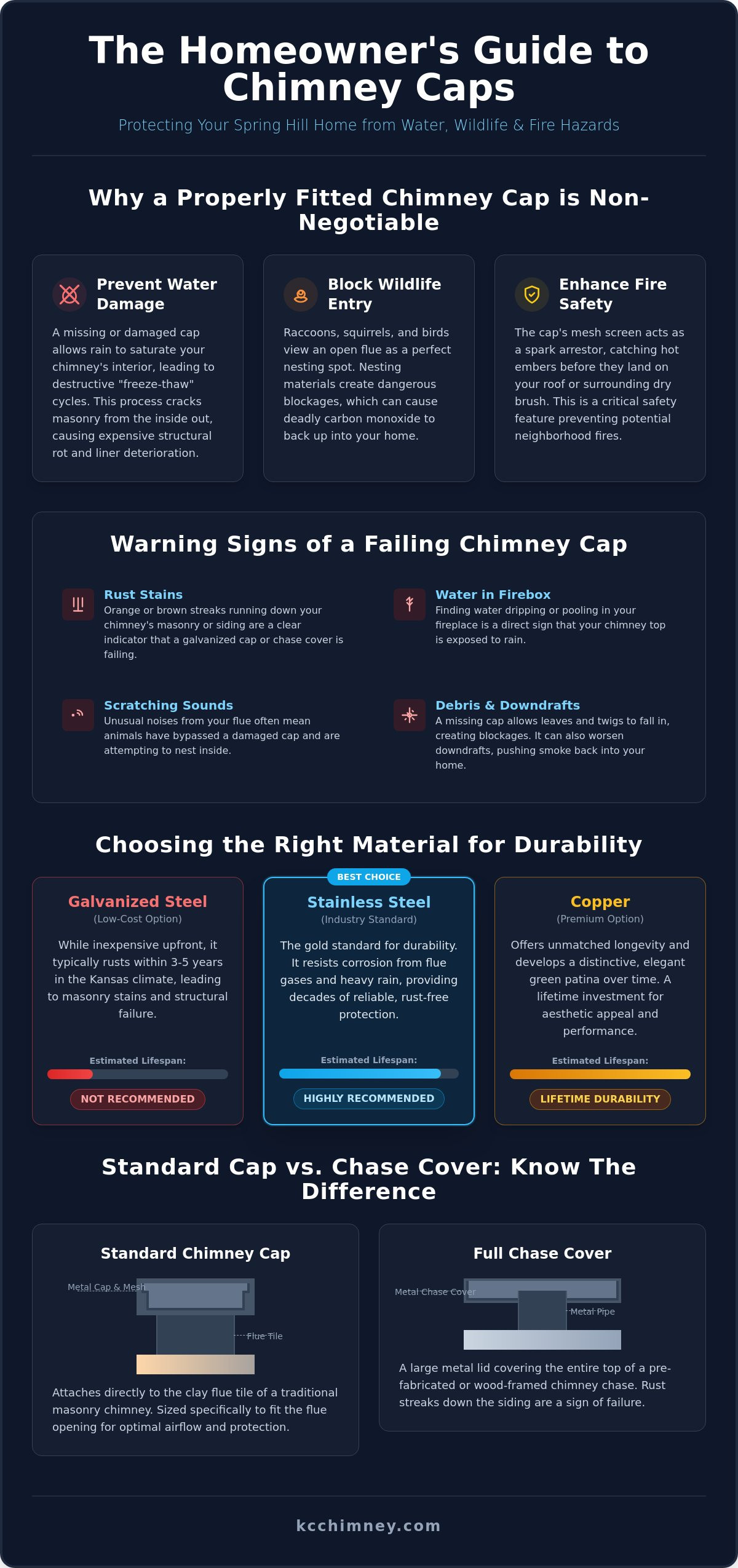
A chimney cap is essentially a protective roof for your fireplace system. It sits securely atop your flue to keep out rain, falling debris, and curious animals. In Spring Hill, KS, our open landscapes and frequent storms mean high winds can easily dislodge aged or poorly installed caps. When this happens, your flue is left vulnerable to the elements, leading to expensive structural issues that are often hidden from view until they become emergencies.
Many homeowners don’t realize their cap also functions as a critical spark arrestor. This specialized mesh screen is designed to catch hot embers before they can land on your roof or the dry Kansas brush surrounding your property. Without this barrier, a cozy evening fire could turn into a serious safety hazard for your entire neighborhood. Understanding different Types of Chimney Cowls helps you choose a model that balances proper airflow with maximum fire protection. A professional Spring Hill chimney cap replacement ensures your home remains a safe haven rather than a fire risk.
Defending Against Spring Hill Wildlife
Raccoons, squirrels, and birds frequently seek shelter in open flues throughout Johnson County. These animals view your chimney as a perfect, warm hollow tree for nesting. Unfortunately, their nesting materials create dangerous blockages that can cause carbon monoxide to back up into your living room instead of venting safely outside. You should be especially aware of the chimney swift; this is a federally protected bird that cannot be legally removed once they have established a nest in your flue. A timely Spring Hill chimney cap replacement acts as a permanent barrier, ensuring these guests never have the chance to move in and create a legal or safety headache for your family.
Preventing Water Damage and Masonry Rot
Water is the single greatest threat to your chimney’s structural integrity. A missing or damaged cap allows rain to saturate the interior mortar and the chimney liner directly. In 2026, as we face the unpredictable Kansas weather cycles, this moisture leads to destructive ‘freeze-thaw’ cycles. When water trapped inside the masonry freezes, it expands and cracks the brick and mortar from the inside out. Over time, this constant moisture leads to the total deterioration of the chimney liner and firebox. Choosing a replacement cap now is a proactive step that costs a small fraction of a full chimney repair in Kansas City. It’s a simple investment that preserves your home’s foundation and your peace of mind.
Choosing the Right Chimney Cap for Your Johnson County Home
Selecting the right material for your Spring Hill chimney cap replacement is the difference between a 20-year solution and a two-year mistake. In Johnson County, we recommend stainless steel as the gold standard. It effectively resists the corrosive effects of flue gases and won’t rust when exposed to our heavy spring rains. Copper is another excellent choice, often seen on larger estates throughout Spring Hill. It develops a distinctive green patina over time and offers unmatched longevity. While galvanized steel is available at a lower price point, it typically begins to rust within three to five years in the Kansas climate. This rust eventually stains your chimney masonry and weakens the cap’s structure.
Proper sizing is just as important as the material. A cap that is too small or sits too low can “choke” the flue, causing smoke to spill back into your living room. The EPA emphasizes the importance of professional installation and maintenance to ensure your fireplace operates safely and efficiently. If you aren’t sure which size fits your specific flue tile, a Level 2 inspection can clarify your home’s needs before you make a purchase.
Standard Caps vs. Chase Covers
It’s vital to distinguish between a standard cap and a chase cover. Standard caps attach directly to the flue tile of a traditional masonry chimney. In contrast, a chase cover is a large metal lid that covers the entire top of a pre-fabricated or siding-wrapped chimney. If you see orange rust streaks bleeding down the side of your chimney siding, your chase cover has likely failed. We specialize in replacing chase covers in Overland Park and Spring Hill to stop this damage before it rots the wooden structure beneath the siding.
Specialty Caps for High-Wind Areas
Spring Hill’s open geography creates a unique challenge for homeowners. High wind gusts across the plains can easily catch a standard slip-on cap and blow it right off the roof. For these exposed areas, we recommend bolt-on or custom-fabricated caps that anchor firmly to the masonry. These provide the security needed for Kansas storm seasons. If your fireplace struggles to draw or smokes on windy days, a draft-inducing cap can help. These specialized designs use the wind’s energy to pull smoke up and out of the flue, solving draft issues caused by nearby tall trees or hills.
Signs Your Spring Hill Chimney Cap Needs Immediate Replacement
Identifying a failing chimney cap doesn’t always require a ladder. Many warning signs are visible or audible from your living room or your lawn. If you notice rust streaks “bleeding” down your chimney’s exterior masonry or siding, the metal has already begun to oxidize and fail. This orange staining is a clear indicator that a Spring Hill chimney cap replacement is overdue. Similarly, if you hear scratching or chirping sounds coming from the flue, your cap’s side mesh has likely been breached by local wildlife seeking shelter.
Physical debris in your firebox is another major red flag. If you find twigs, leaves, or nesting material when you open your damper, your cap is no longer acting as a barrier. Beyond wildlife, a compromised cap is a potential fire hazard because it can’t safely contain sparks or prevent downdrafts. After a severe Kansas thunderstorm, always check if your cap appears tilted, loose, or is missing entirely. High wind gusts across the plains often target weakened fasteners on older, low-quality installations.
Inspecting from the Ground
You can safely assess the state of your chimney from the safety of your yard using a pair of binoculars. Look closely for missing lids or large gaps in the wire mesh. You should also check for white, powdery staining on the brick, known as efflorescence. This staining suggests that excess moisture is entering the system because the cap is no longer shedding water effectively. Make sure the drip edge of the cap has a proper overhang to direct rain away from the chimney crown and masonry.
The Hidden Danger of Rusted Mesh
Even if the top lid looks intact from a distance, the side mesh is often the first part to fail. Galvanized steel mesh can rust through, creating small holes that allow birds or hot embers to pass through easily. These holes represent a total structural failure of the component and cannot be simply patched. A compromised mesh will often cause a home to fail a professional chimney inspection in Kansas City. Replacing the entire unit with a high-quality stainless steel model is the only way to restore the safety and integrity of your flue for the long term.
The Professional Replacement Process: What to Expect
A professional Spring Hill chimney cap replacement is far more than a simple hardware swap. It’s a methodical process designed to ensure your home remains weather-tight and safe from local environmental threats. Our technicians begin with a comprehensive roof-level evaluation of your entire chimney system. This includes inspecting the flue tile and the chimney crown for structural integrity. By measuring your specific flue or chase dimensions precisely, we guarantee a custom, airtight fit that prevents the common rattling or whistling sounds associated with poorly installed units.
Before the new installation begins, we carefully remove the old, damaged unit. We then prep the masonry or metal surface to ensure a secure seal. In Kansas, where wind gusts can exceed 70 mph, a loose cap is a liability. That’s why we use heavy-duty bolts or masonry anchors to secure the new cap firmly to the structure. This level of precision is what separates a professional installation from a DIY attempt. Our process focuses on long-term durability so you don’t have to worry about the next storm season.
Step 1: The Multi-Level Safety Evaluation
We don’t just replace the cap; we investigate why the previous one failed. During this initial phase, we check the chimney crown for hairline cracks or water penetration. If we find evidence of storm damage or extensive animal entry, we may recommend a Level 2 inspection to ensure no hidden blockages or internal damage exists. Our goal is to ensure your new cap meets all 2026 fire codes for Spring Hill, providing you with a system that vents safely and efficiently. This thorough approach identifies small issues before they become expensive repairs.
Step 2: Custom Fitting and Installation
Many “one-size-fits-all” caps found at big-box stores fail because they don’t account for the unique dimensions of older Spring Hill flues. These generic models often create poor drafts or allow wind-driven rain to bypass the lid. We use high-quality, weather-resistant silicone sealants at all contact points to create a secondary moisture barrier. This prevents water from seeping under the cap and saturating the crown. Once the cap is secured, we perform a final stability test and verify that the spark arrestor mesh has the correct clearance for optimal airflow. If you’re ready to secure your flue against the next storm, our team provides expert Chimney Cap Installation services tailored to your home’s needs.
Why Spring Hill Homeowners Trust Best Chimney Services
Since 2012, we’ve served the Spring Hill community and the greater Kansas City metro area with a commitment to high-integrity service and technical mastery. We understand that your home is your most significant investment, and its safety shouldn’t be left to chance. Our certified technicians prioritize a neighborly approach, treating your property with the same care we’d give our own. We focus on homeowner education, ensuring you understand exactly why a Spring Hill chimney cap replacement is necessary before any work begins. This transparency builds the long-term trust that has made us a fixture in the local community.
Our team brings specialized expertise to every project, whether you own a historic masonry chimney in an established neighborhood or a modern pre-fabricated system in a newer development. We’ve seen how Kansas weather can take a toll on even the sturdiest structures. That’s why we use only high-standard materials and rigorous installation methods. We don’t believe in high-pressure sales tactics. Instead, we offer direct, no-nonsense solutions that solve your household concerns efficiently. Our goal is to be your home’s guardian, providing the reliability you need to enjoy your fireplace with total peace of mind.
Local Expertise in Johnson County
We’re intimately familiar with the specific architectural styles and housing stock found throughout Spring Hill neighborhoods. This local knowledge allows us to recommend solutions that aren’t just functional but also aesthetically appropriate for your property. Our installations are engineered to last through the biting cold of Kansas winters and the intense humidity of our summers. When you work with us, you’re dealing with locally owned and operated professionals who are easily accessible and deeply invested in the safety of our regional residents. We don’t just provide a mechanical service; we provide stability for your home’s future.
Comprehensive Care Beyond the Cap
Our commitment to your chimney’s health extends well beyond a simple cap installation. We offer a full suite of services to keep your hearth in peak condition, from routine chimney sweeping in Kansas City to complex masonry repair and crown restoration. To ensure complete clarity, we provide detailed video inspections that show you exactly what’s happening at the top of your flue. This visual evidence allows you to see the condition of your liner and masonry for yourself. Schedule your Spring Hill service today to secure your home against the elements and ensure your family’s safety for the 2026 season and beyond.
Securing Your Home Against the Kansas Elements
Your chimney is a complex system that requires specialized care to remain functional and safe. As we’ve discussed, a properly installed cap is your first line of defense against invasive wildlife and the destructive freeze-thaw cycles common in Johnson County. By choosing high-quality materials and ensuring a custom fit, you protect your masonry from the inside out. Don’t wait for rust streaks or nesting animals to signal a problem. A proactive Spring Hill chimney cap replacement is a small investment that preserves your property’s value and your family’s peace of mind.
Our team has been locally owned and operated since 2012, bringing technical mastery to every roof we step on. We employ certified technicians capable of performing rigorous Level 2 and Level 3 inspections to ensure your entire system is sound. We specialize in weather-resistant installations designed specifically for the unique Kansas climate. Secure your home with a professional Spring Hill chimney cap replacement today! We look forward to helping you maintain a safe, efficient, and worry-free hearth for many seasons to come.
Frequently Asked Questions
How much does it cost to replace a chimney cap in Spring Hill, KS?
The total cost for a Spring Hill chimney cap replacement depends on the material you choose and the complexity of your chimney’s design. Stainless steel and copper are premium options that offer superior longevity compared to galvanized steel. Factors like the height of your roof and the number of flues also influence the final investment. We focus on providing durable, high-quality installations that prevent expensive masonry repairs in the future.
Can I install a chimney cap myself or do I need a professional?
Professional installation is highly recommended to ensure both your safety and a proper, weather-tight fit. Climbing onto steep Kansas rooflines carries significant risks that require specialized safety equipment. A professional technician has the expertise to measure your flue tile precisely and use heavy-duty masonry anchors. This ensures the cap remains secure during intense 70 mph wind gusts and prevents water from seeping into your chimney structure.
How long does a stainless steel chimney cap typically last?
A high-quality stainless steel chimney cap typically lasts for 20 years or more. These units are specifically engineered to resist the corrosive byproducts of wood and gas fires while standing up to the Kansas climate. Unlike galvanized steel, which often rusts within a few seasons, stainless steel maintains its structural integrity and appearance. This makes it a reliable, long-term investment for protecting your home’s chimney system from the elements.
What happens if I don’t have a chimney cap?
Operating without a cap allows rain and snow to enter your flue directly, which is the leading cause of masonry rot and liner deterioration. This moisture triggers destructive freeze-thaw cycles that can crack your chimney’s internal structure. Additionally, an open flue serves as an invitation for raccoons, squirrels, and birds to nest. These nests create dangerous blockages that can lead to carbon monoxide backups and potential fire hazards in your home.
Will a new chimney cap stop my fireplace from smoking?
A specialized draft-inducing chimney cap can often solve smoking issues caused by wind-related downdrafts. If your fireplace only smokes when the wind blows from a specific direction, these caps are designed to use the wind’s energy to pull smoke up and out of the flue. However, if the smoking is caused by heavy creosote buildup or a structural blockage, you will likely need a professional cleaning or a Level 2 inspection to restore proper airflow.
Are there specific building codes for chimney caps in Johnson County?
The City of Spring Hill has adopted the 2006 International Residential Code (IRC) for building standards. While the 2006 edition does not contain a prescriptive mandate for chimney caps, they are considered a critical best practice for moisture control and fire safety. Newer versions of the IRC, which many local professionals use as a safety baseline, explicitly require caps with a drip edge to protect the chimney crown and prevent structural water damage.
What is the difference between a chimney cap and a chimney shroud?
A chimney cap is a functional safety component designed to block rain, debris, and animals while catching sparks. In contrast, a chimney shroud is a decorative metal housing that sits over the cap to enhance the home’s architectural style. While a cap is essential for protection, a shroud is an aesthetic choice common in premium Johnson County estates. It is vital that any shroud is professionally engineered to ensure it doesn’t restrict the fireplace’s ability to vent safely.
Can birds get through the mesh of a standard chimney cap?
Birds cannot get through a chimney cap as long as the wire mesh remains intact and is correctly sized. Most professional caps use a sturdy mesh that is small enough to block chimney swifts and other local birds while still allowing smoke to vent freely. However, if your current cap is rusted or has large gaps, birds can easily enter and build nests. Regular inspections are the best way to ensure your mesh barrier remains a solid defense against wildlife.