
What can a relining quote tell you beyond the price? If you’re weighing the cost to reline a masonry chimney Mission Hills, it’s reasonable to ask whether the liner needs replacing or whether another repair could address the problem. The answer should start with what a qualified professional finds inside your chimney, not a one-size-fits-all estimate.
Mission Hills homes can have chimneys with different ages, layouts, and conditions. Flue dimensions, access, existing damage, and related work can all affect the proposed scope. A Level 2 inspection with video camera equipment can help document the flue’s condition and support a clearer recommendation. With those findings in hand, you can ask why relining is advised and whether another repair may be appropriate.
This article explains which inspection findings can lead to a relining recommendation, how liner approaches and project scopes may differ, and what to compare when reviewing quotes. It also covers practical questions about materials, access, removal of existing components, and possible added work. A thorough, documented proposal makes it easier to understand the recommendation and decide what to do next.
Key Takeaways
- The cost to reline a masonry chimney Mission Hills depends on inspection findings and the work included, so compare written scopes rather than relying on a bare estimate.
- Ask how the inspection supports the relining recommendation and whether another repair could address the documented concern.
- Compare liner approaches based on suitability for your chimney and appliance, and check that each proposal identifies the liner and installation scope.
- Before approving work, clarify access needs, exclusions, possible added work, and workmanship details with the contractor.
- Start with an inspection, then review the recommendation and compare proposals for your home.
What Determines the Cost to Reline a Masonry Chimney in Mission Hills?
Relining means installing a suitable liner inside an existing chimney flue. The liner helps contain and direct smoke and other combustion byproducts through the chimney and outdoors. For a plain-language overview of what a chimney liner is, see the reference from Wikipedia.
The cost to reline a masonry chimney Mission Hills homeowners are quoted depends on the inspection findings and exactly what the proposed work includes. The location or the label “masonry chimney” alone can’t establish the flue’s condition, the work required, or a reliable estimate. This guide focuses on the factors that shape a proposal rather than offering unsupported local price ranges.
What does masonry chimney relining include?
Relining addresses the inside passage used by a fireplace or connected appliance. It is different from tuckpointing, which repairs mortar joints; crown repair, which addresses the chimney’s top masonry surface; and chimney rebuilding. These repairs may be separate from a liner project, although an inspection could identify more than one concern. The appropriate liner and scope depend in part on the appliance or fireplace it will serve, as well as the flue’s condition and configuration.
Why can two Mission Hills relining quotes differ?
One proposal may account for a different flue size, condition, or access challenge than another. Preparation, removal of existing material, insulation, and related repairs may be included in one scope but excluded or treated as conditional in another. These items aren’t automatically required for every project, so ask what finding supports each one. A camera evaluation can help document the flue’s interior and connect observed concerns to the recommendation.
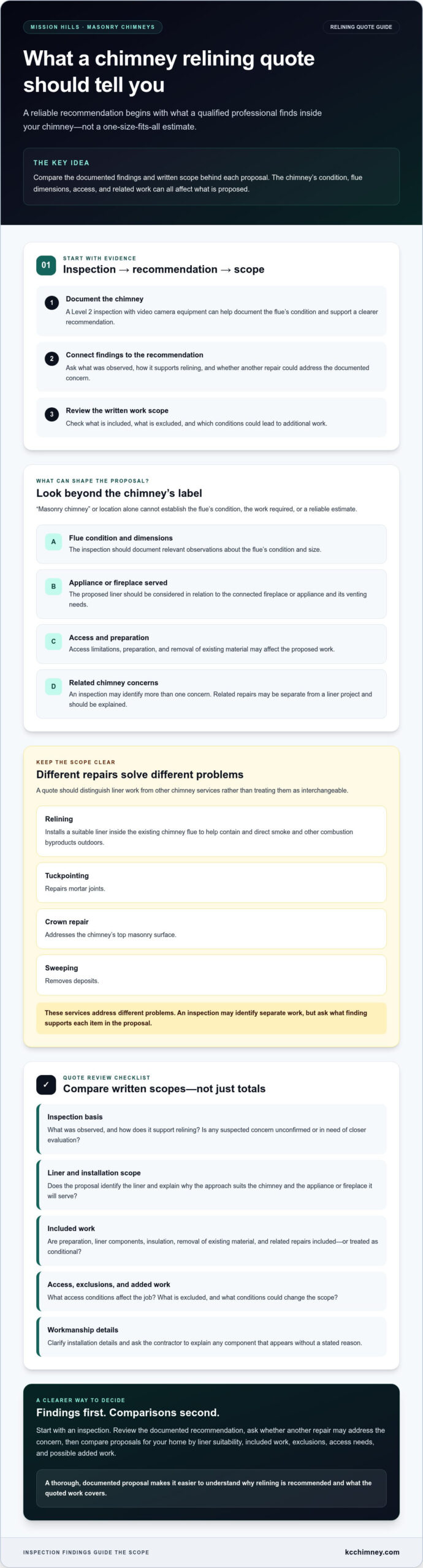
Before comparing totals, check whether each quote explains:
- Inspection basis: What was observed, and how does it support relining?
- Flue and access: What dimensions or access conditions affect the proposed work?
- Work included: Which preparation steps, liner components, insulation, or related repairs are part of the scope?
- Exclusions: What is not included, and what conditions could lead to added work?
A clear written explanation makes differences easier to understand. If a component appears in the proposal without a reason, ask the contractor to connect it to an inspection finding or explain why it is needed for the stated scope.
How Inspection Findings Shape a Masonry Chimney Relining Proposal
A relining recommendation should connect a specific chimney condition to a defined scope of work. An inspection may include a visual review and, where appropriate, a camera evaluation of the flue. Documentation helps distinguish what the professional observed from what remains uncertain or needs closer evaluation. A photo or video can make the conversation clearer, but the findings still need to be explained in plain language.
Inspection findings shape the relining scope by showing what the flue needs, what the proposed liner must serve, and whether other chimney concerns need separate attention. The NFPA 211 standard is a reference for chimney safety and maintenance. Homeowners can ask how the contractor’s evaluation and recommendation relate to applicable professional standards.
What should a chimney inspection establish before relining?
The inspection should identify the fireplace or appliance connected to the flue and consider its venting needs. It should document relevant observations about the flue’s condition and dimensions, as well as access limitations that could affect the work. Ask for the basis of the recommendation in writing. If a concern is suspected but not confirmed, the proposal should say so and explain whether further inspection is needed before the scope can be finalized.
When might relining be considered alongside other repairs?
Cracked or deteriorated flue surfaces may prompt a relining assessment, but an on-site inspection is needed to determine what the condition means for a particular chimney. Damage to the crown or masonry may also call for a separate evaluation. Sweeping removes deposits, tuckpointing addresses mortar joints, and relining installs a liner inside the flue. These services address different problems and shouldn’t be treated as interchangeable.
For a broader overview of the inspection process, read this Kansas City chimney inspection guide. It can help you prepare questions, but it can’t establish the condition of your chimney. When reviewing a relining proposal, ask the contractor to separate confirmed findings from possibilities, identify work outside the relining scope, and explain what would prompt a revised recommendation. That makes it easier to compare the work being offered, not just the bottom line.
If you’re weighing the cost to reline a masonry chimney Mission Hills, Best Chimney Services offers chimney inspections and relining in the area. You can discuss your chimney inspection findings with the company and ask what the documented conditions support, without assuming relining is the only solution.
Compare Chimney Liner Options and Quote Details Before You Decide
A liner label alone doesn’t tell you whether a proposal suits your chimney. The contractor should explain how the recommended approach fits the inspected flue and the fireplace or appliance it serves. A liner choice should follow the flue assessment and appliance requirements. When comparing the cost to reline a masonry chimney Mission Hills homeowners are quoted, look beyond the headline figure to the specified system and work scope.
Flexible and rigid liners: what should homeowners compare?
Flexible liners bend to follow a flue’s path, while rigid liners are formed from straight sections. Those descriptions explain their basic shape, not which option is right for a particular chimney. Ask the contractor to connect the specified approach to the flue’s configuration and condition, and confirm the materials and components in writing. Installation options can vary, so verify what the provider currently offers rather than assuming every contractor installs the same systems.
| Scope or approach | What to ask | What the quote should identify |
|---|---|---|
| Flexible liner | How does its form suit the inspected flue? | Material, components, and installation scope |
| Rigid liner | How does the proposed layout fit the flue? | Sections or components included and work assumptions |
| Another specified approach | Why is it suitable for this flue and appliance? | System details and the inspection basis for recommending it |
What should a complete relining quote spell out?
A useful written proposal makes clear what the contractor observed and what work follows from those findings. Check that it describes the liner, installation scope, preparation, and cleanup. It should also explain whether related masonry repairs are included, excluded, or recommended separately. If the proposal mentions insulation or another component, ask why it is included and whether it is part of the stated scope or a separate item.
Compare assumptions as carefully as listed work. One quote might include preparation that another leaves out, or treat a possible repair as conditional. Ask what access the work requires, what conditions could change the scope, and how any added work would be discussed before proceeding. Clear answers help you understand what each proposal covers without assuming that a lower or higher total reflects the same job.
If a contractor cites certification, ask what credential applies and who holds it. The CSIA Certified Chimney Sweep resource can help homeowners learn about CSIA certification. Use it as one point of reference alongside the contractor’s written inspection findings and explanation of the proposed work.
Questions to Ask Before Hiring a Mission Hills Chimney Relining Contractor
A clear proposal should explain why relining is recommended, what the work involves, and how the contractor will keep you informed. Use these questions to compare contractors based on the evidence and written scope, not just the estimate total. They can also help you check whether the proposal accounts for your home’s access and chimney layout.
How can you assess a relining contractor’s proposal?
- What inspection evidence supports the recommendation? Ask what was observed and whether any concern is confirmed or needs further evaluation.
- What liner and installation approach are you proposing? Request the material and components in writing, along with an explanation of compatibility with your fireplace or appliance.
- What work is included or excluded? Clarify preparation, installation, cleanup, related repairs, and any conditions that could change the scope.
- How will you communicate questions or changes? Agree on how proposed scope changes will be explained and approved, and what details you’ll receive when the work is complete.
- Which qualifications apply to the people doing the work? Ask about relevant training, credentials, and insurance, then verify claims with the appropriate issuer or provider.
These questions make the cost to reline a masonry chimney Mission Hills easier to evaluate because they connect the proposed work to its inspection basis. For broader context on related chimney work, see this Kansas City chimney repair guide.
Which Mission Hills and Johnson County details need verification?
Confirm that the contractor serves Mission Hills, Kansas, rather than another community with the same name. Before scheduling work, check applicable permit or inspection requirements directly with the relevant local authority. Don’t rely on assumptions or an informal verbal answer. Ask how your home’s chimney configuration and access affect the planned work, since those details can influence the approach and what the written scope needs to address.
Best Chimney Services is locally owned and serves Mission Hills and other Kansas City metro communities, with chimney relining and Level 2 and Level 3 inspections among its offerings. If you’d like to discuss your findings and proposed scope, contact Best Chimney Services about chimney relining.
Get a Masonry Chimney Relining Assessment in Mission Hills
A sound decision follows a clear sequence: inspect the chimney, understand the recommendation, compare written scopes, and then decide how to proceed. That process helps you judge whether the proposed work addresses documented conditions and whether you have enough information to approve it. The cost to reline a masonry chimney Mission Hills homeowners are quoted should make sense in light of the findings and work described, not just the chimney’s location or general type.
What happens after you request a relining assessment?
Before speaking with a chimney professional, note which fireplace or appliance connects to the chimney and any concerns you’ve noticed, such as visible damage, smoke issues, or past repairs. Share what you know, but leave diagnosis to an on-site evaluation. Ask what inspection is appropriate for your chimney and what information the professional can provide before recommending work.
Best Chimney Services offers Level 2 and Level 3 inspections. The appropriate service depends on the circumstances, so discuss it with the company rather than assuming in advance. Ask how findings will be explained, whether any observations need further evaluation, and what the proposed next steps involve. Request a clear written summary so you can review the recommendation at your own pace.
How can an inspection help you make a confident decision?
An inspection can give you a better basis for understanding why relining is being proposed and what the work is intended to address. Best Chimney Services says it uses video camera equipment during chimney evaluations. Ask whether camera observations are relevant to your assessment and how they relate to the recommendation. Documentation won’t replace a clear conversation, but it can help connect the observed condition to the work in the proposal.
Once you have the findings, compare the written scope with any other proposal you receive. Check that each describes the recommended liner approach, work included, exclusions, and any separate repairs. If something is unclear, ask for an explanation before deciding. A responsible assessment helps you understand the chimney and your options without pressuring you into a particular outcome.
Best Chimney Services is locally owned and serves Mission Hills and other communities across the Kansas City metro, with chimney inspection and relining among its offerings. For a discussion about your chimney and the assessment it may need, contact Best Chimney Services. Share the fireplace or appliance type and what you’ve observed, then ask what information would help clarify the next step.
Make Your Next Chimney Decision With Clarity
A relining recommendation should begin with an inspection, not an assumption based on your home’s location or chimney type. To understand the cost to reline a masonry chimney Mission Hills, focus on the documented findings, why a liner is recommended, and exactly what each written proposal includes. Confirm that the liner suits your fireplace or appliance, and ask which work is included, excluded, or conditional.
Best Chimney Services is a locally owned Kansas City metro business founded in 2012. Its offerings include chimney relining and Level 2 and Level 3 inspections, and the business reports using video camera equipment during chimney evaluations. An assessment can help clarify what was observed and what questions to ask before deciding. It doesn’t guarantee that relining is necessary or establish a price before your chimney is evaluated.
If you’re ready to discuss your chimney and possible next steps, contact Best Chimney Services to discuss a masonry chimney assessment. The company serves Mission Hills, Overland Park, Stilwell, Bucyrus, and Spring Hill. Ask about an inspection and a written explanation of the findings and proposed scope.
Frequently Asked Questions
How much does it cost to reline a masonry chimney in Mission Hills?
There isn’t a reliable flat figure without assessing the chimney and defining the work. The cost to reline a masonry chimney Mission Hills homeowners are quoted can depend on flue condition and dimensions, access, liner approach, preparation, and any additional work included. Best Chimney Services serves Mission Hills, Overland Park, Stilwell, Bucyrus, and Spring Hill. Ask for inspection findings and an itemized written scope to understand what a proposal covers.
What factors affect the cost of relining a masonry chimney?
The scope is shaped by the flue’s condition, dimensions, layout, and accessibility, as well as the liner approach selected for the connected fireplace or appliance. Preparation, removal of existing material, insulation, and related repairs may also affect what a proposal includes. These items aren’t necessary for every project. Ask the contractor to explain each component and identify exclusions or conditions that could lead to additional work.
How do I know if my masonry chimney needs a new liner?
An inspection is the way to determine whether relining is appropriate. A professional may identify deterioration, damage, or a flue that isn’t suitable for the connected fireplace or appliance, but those conditions can’t be diagnosed remotely. Ask for the inspection basis, documented findings, and an explanation of how they support the recommendation. Best Chimney Services offers Level 2 and Level 3 inspections and reports using video camera equipment during chimney evaluations.
Is a stainless steel liner always the right choice for a masonry chimney?
No. A liner’s suitability depends on the chimney’s condition and configuration, along with the fireplace or appliance it will serve. Stainless steel may be proposed in some situations, but the material name alone doesn’t establish that it’s right for your flue. Ask the contractor to specify the proposed liner and explain its compatibility with your system. Confirm which materials and installation approaches the provider currently offers.
Can a chimney be relined without repairing damaged masonry?
It depends on what’s damaged and whether that condition affects the proposed relining work. Relining addresses the flue, while tuckpointing and crown repair address different masonry concerns. A liner doesn’t automatically resolve damage to mortar joints or the crown. Ask the inspector to identify confirmed findings, whether separate repairs are recommended, and whether they’re included in the relining proposal or listed as separate work.
How long does masonry chimney relining take?
The time needed depends on the chimney’s condition, access, configuration, and the work included in the approved scope. Preparation or additional repairs may affect the project schedule, so a general estimate may not reflect your home. Ask the contractor what steps are planned, what could change the timeline, and how updates will be communicated. Request a project schedule based on the inspection and written scope before work begins.
Do I need a permit to reline a chimney in Mission Hills, Kansas?
Mission Hills’ official information identifies a building permit requirement for chimney relining projects. Because local requirements and procedures can change, confirm the current permit and inspection process directly with the City before work begins. Ask your contractor what coordination is included, but verify requirements with the relevant local authority. Don’t assume a permit is unnecessary based only on the liner type or apparent size of the project.