
If your Overland Park home was built during the housing boom of the 1980s, your chimney liner might be a ticking clock you haven’t noticed yet. A single crack in a clay flue tile can allow heat to transfer to your home’s wooden framing in minutes. Effective chimney fire prevention Overland Park depends on more than just a quick sweep; it requires a deep understanding of how aging masonry and creosote buildup interact. You deserve to enjoy a warm fire on a chilly Kansas night without the nagging fear of a hidden hazard sparking a disaster.
We understand that the difference between inspection levels can be confusing, and you shouldn’t have to guess if your system is safe. This guide provides the professional-grade prevention strategies you need to protect your family and your property. You’ll learn how to identify structural red flags, understand the NFPA maintenance schedules, and ensure your fireplace remains a source of comfort rather than a liability. Let’s look at how to secure your home for the 2026 burning season and beyond.
Key Takeaways
- Uncover the specific structural risks associated with Overland Park’s 1980s housing boom and the hidden dangers of recycled masonry.
- Identify the three stages of creosote buildup to recognize when flammable deposits require an immediate professional sweep.
- Learn the technical differences between Level 1, 2, and 3 inspections to choose the right level of chimney fire prevention Overland Park professionals recommend for your flue.
- Use the “Seasoned Wood Test” and active damper management to prevent excess smoke from coating your chimney liner.
- See how CSIA-certified standards and local architectural knowledge provide the thorough care your home needs for lasting peace of mind.
Understanding Chimney Fire Risks in Overland Park Homes
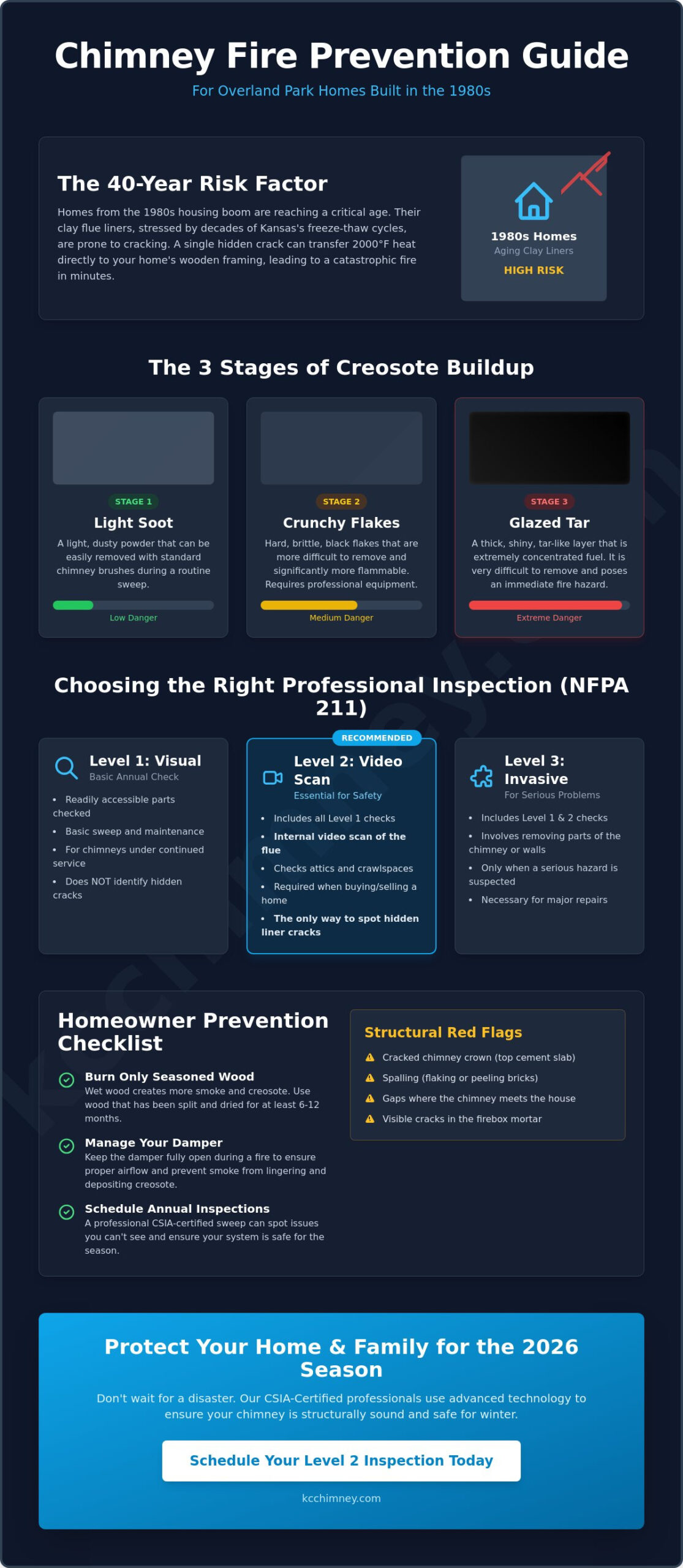
Overland Park experienced a massive residential expansion during the mid-1980s. While these homes define our local landscape, their chimneys are now crossing a critical 40-year threshold. Clay flue liners installed during this era were designed for longevity, but they weren’t meant to last forever. After four decades of heat stress and cooling cycles, many of these liners have developed hairline fractures or “spalling,” where the surface of the tile begins to flake away. These defects create gaps where heat can escape the flue and ignite the wooden framing of your house.
The Kansas City climate adds another layer of stress. Our intense freeze-thaw cycles cause moisture to settle into porous masonry. When that water freezes, it expands, causing the chimney crown to crack and allowing more water to seep into the structure. Many builders in the 1980s also utilized “recycled” or “antique” bricks to achieve a specific aesthetic. While these bricks look charming, they are often softer and more prone to moisture absorption than modern, high-fired alternatives. This degradation is a primary reason why chimney fire prevention Overland Park strategies must focus on structural integrity just as much as cleanliness. Understanding Chimney Fires requires recognizing that a “dirty” chimney is a maintenance issue, but a “dangerous” chimney is a structural one.
The Impact of Local Architecture on Fire Risk
Johnson County soil is notorious for shifting, which often leads to foundation settling. Even a slight tilt in your home’s foundation can cause a heavy masonry chimney to pull away from the main structure. This movement creates “bypass” gaps where sparks can enter the attic or wall cavities. Additionally, the rustic masonry popular in local vintage-style homes can hide deep cracks within the firebox. What looks like a small mortar pop on the surface might actually be a through-wall breach that compromises your safety every time you light a fire.
Why Modern Prevention Standards Matter in 2026
In 2026, homeowners insurance providers are increasingly requiring proof of annual inspections that meet NFPA 211 standards. These national guidelines aren’t just suggestions; they are the baseline for chimney fire prevention Overland Park residents need to follow to ensure coverage and safety. Moving from reactive repairs to proactive prevention means catching a small crown crack before it becomes a full chimney rebuild. By adhering to these rigorous industry standards, you protect your property value and, more importantly, your family’s peace of mind during the winter months.
The Anatomy of a Chimney Fire: Creosote and Structural Hazards
A chimney fire is rarely a random accident. It’s usually the result of a specific chemical process combined with structural neglect. When you burn wood, the smoke contains unburned gases that cool as they rise through the flue. These gases condense into a thick, flammable substance on the inner walls. Following EPA professional chimney inspection guidelines helps homeowners understand how these deposits grow over time. If your airflow is restricted by a partially closed damper or heavy soot, the risk of ignition increases significantly.
Creosote: The Primary Fuel for Chimney Fires
Creosote is a carbonaceous chemical compound that ignites at high temperatures. This fuel builds up in three distinct stages. Stage 1 is a light, sooty powder that brushes away easily during routine maintenance. Stage 2 turns into crunchy, black flakes that are much harder to remove. The most dangerous form is Stage 3 “glaze.” It appears as a thick, shiny layer of tar that is nearly impossible to remove with standard tools. Glaze is essentially solid fuel waiting for a spark. Because it’s so difficult to clear, it remains a primary focus of chimney fire prevention Overland Park during every professional service call.
Hidden Masonry Damage: Cracked Crowns and Liners
Your chimney crown is the first line of defense against the Kansas weather. When it cracks, water enters the system and causes the internal masonry to deteriorate from the inside out. This often results in a cracked flue liner. The liner’s job is to contain the 2000-degree heat of a fire and keep it safely away from your home’s wooden structure. Even a small breach in this barrier can lead to a house fire. A professional Level 2 Chimney Inspection is the only way to see these internal cracks using specialized high-resolution cameras.
Some fires are “silent” and happen without the homeowner noticing at the time. These fires burn intensely within the flue and can cause permanent structural damage that compromises future safety. If you see warped metal dampers, discolored chimney caps, or creosote that looks like puffed-up honeycomb, you likely had a fire. It’s critical to address these signs immediately to prevent a second, more destructive event. You can request a professional inspection to confirm your home is safe for the upcoming season.
Professional Inspections: Your First Line of Defense
Looking up at your chimney from the driveway won’t tell you if it’s safe. While the exterior brick might look sturdy, the internal flue is where the real risks hide. Effective chimney fire prevention Overland Park services rely on specific industry standards to ensure every component functions correctly. A ground-level visual check is never enough because it can’t identify the internal cracks or blockages that lead to disaster. Professional inspections provide a clear roadmap for maintenance, ensuring your fireplace remains a safe asset rather than a hidden liability.
Level 1 vs. Level 2 Inspections: Which Do You Need?
| Inspection Level | Common Trigger | Scope of Work |
|---|---|---|
| Level 1 | Annual routine maintenance | Visual check of all readily accessible areas. |
| Level 2 | Home sale or fuel change | Internal video scan plus attic and crawlspace access. |
| Level 3 | Suspected structural hazard | Removal of chimney components to see hidden areas. |
You specifically need a Level 2 evaluation if you are buying a new home or switching from wood-burning to a gas fireplace insert. Any change in fuel type alters how heat and gases move through the flue, which can stress old masonry in new ways. If our technicians find structural damage during these checks, we recommend expert chimney repair in Kansas City to address the issues before they become fire hazards. This proactive approach saves you from the stress of emergency repairs during the peak of winter.
Video Camera Inspections: Seeing the Unseen
Modern internal flue scanning is the gold standard for safety in 2026. We use specialized high-resolution cameras that travel the full height of your chimney to find “invisible” gaps in mortar joints. These tiny openings are often the starting point for house fires. A video scan also helps us identify pyrolysis. This occurs when wood studs near the chimney are exposed to high heat for years, causing them to chemically change and ignite at much lower temperatures. Having professional documentation of a clean scan is invaluable when you’re filing insurance claims or proving the safety of your home to a potential buyer.
By investing in these technical evaluations, you’re doing more than just checking a box. You’re building a history of care for your home that prioritizes your family’s protection. Chimney fire prevention Overland Park is most effective when it’s data-driven and thorough.
Essential Prevention Steps Every OP Homeowner Should Take
While professional inspections are the foundation of safety, your daily habits determine how quickly creosote builds up between visits. Taking ownership of your burning practices is a vital part of chimney fire prevention Overland Park. By managing your fuel and your equipment properly, you can enjoy a cozy hearth without increasing the risk of a structural fire. Prevention is a year-round commitment that starts with the very first log you place in the grate.
Safe Burning Practices: From Seasoned Wood to Proper Loading
The most important rule for any wood-burning fireplace is to only use seasoned wood. Freshly cut “green” wood contains up to 50 percent water. When you burn it, the fire spends all its energy boiling away that moisture rather than creating heat. This results in heavy, cool smoke that sticks to your flue walls as creosote. You can perform a simple “Seasoned Wood Test” by looking for cracks on the ends of the logs and striking two pieces together. If they make a sharp “clink” like a baseball bat rather than a dull thud, the wood is dry enough to burn. For the best results, use a top-down lighting method. Place your largest logs on the bottom, followed by smaller pieces, and put the kindling and fire starter on the very top. This allows the fire to burn more efficiently from the start, producing less smoke and more heat.
Never use your fireplace as a trash can. Burning cardboard, wrapping paper, or treated lumber can be extremely dangerous. These materials often burn at temperatures that are too high for your chimney liner to handle. They also release toxic chemicals and can create large, floating embers that escape your chimney. To prevent these embers from landing on your roof, ensure you have a high-quality chimney cap with a spark arrestor installed. These caps also serve as a barrier against rain and local wildlife, such as squirrels or birds, that might try to nest in your flue during the off-season. Keeping your damper fully open during a fire is another non-negotiable step to ensure smoke exits the home quickly.
Beyond the Fireplace: Dryer Vent Safety
Many homeowners don’t realize that dryer vent maintenance is the “forgotten” half of fire prevention. National fire safety data indicates that clogged dryer vents cause over 15,000 home fires annually. Lint is highly flammable. When it builds up in the vent, it restricts airflow and causes the dryer to overheat. If you notice that your clothes are taking longer than one cycle to dry or that the top of the dryer feels unusually hot to the touch, your vent is likely obstructed. We recommend pairing your annual chimney sweep with a professional dryer vent cleaning to ensure your entire home is protected. You can contact a local expert today to schedule a comprehensive safety visit that addresses your chimney and venting systems at the same time.
How Best Chimney Services Protects Overland Park Families
Our team at Best Chimney Services understands that your home is your most significant investment. We don’t just clean flues; we act as dedicated guardians for your household. By focusing on chimney fire prevention Overland Park residents can trust, we combine technical mastery with a neighborly approach that prioritizes your safety above all else. Every technician on our team adheres to the rigorous standards set by the Chimney Safety Institute of America (CSIA). This ensures that our work meets the highest national benchmarks for fire safety and professional integrity.
The “Full-Circle” safety evaluation we perform doesn’t stop at the firebox. We examine the entire system, from the integrity of the chase cover to the condition of the exterior masonry crown. Because we understand the specific architectural quirks of Overland Park’s 1980s-era developments, we know exactly where to look for the structural vulnerabilities that others might miss. This local expertise is what distinguishes our service and provides the peace of mind you deserve during the burning season.
Our Certified Approach to Sweeping and Safety
This foundational chimney sweep Kansas City service is designed to be thorough and completely mess-free. We use high-definition video cameras during every Level 2 inspection to provide you with a clear, documented view of your chimney’s internal health. This transparency is backed by our flat-rate sweeping fees, so you’ll never have to worry about hidden costs or high-pressure sales tactics. We believe in providing honest, expert evaluations that empower you to make informed decisions about your home’s maintenance and long-term safety.
Scheduling Your Annual Safety Visit
Scheduling your annual safety visit in the spring or summer is a strategic move for any homeowner. During these months, our schedule is more flexible, allowing us to perform detailed evaluations and any necessary repairs well before the first freeze of the season arrives. To prepare for our visit, we simply ask that you stop using your fireplace 24 hours in advance and clear a small workspace around the hearth. This allows our technicians to work efficiently while maintaining our high standards for cleanliness and precision within your living space.
Don’t wait for the cold Kansas winds to arrive before thinking about your fireplace safety. Taking a proactive step now ensures you can enjoy your hearth with total confidence all winter long. Schedule your Overland Park chimney inspection today and let us help you protect what matters most. Our commitment to excellence and local expertise makes us the high-integrity choice for families across the community.
Protecting your family requires a partner who values safety as much as technical skill. We take pride in our specialized niche and treat every home as if it were our own. By choosing a certified professional, you’re investing in the longevity and durability of your property for the 2026 season and many years to come.
Secure Your Hearth for the 2026 Season
Your home’s safety shouldn’t be left to chance. We’ve explored how aging masonry and hidden creosote buildup can compromise your chimney’s integrity. By prioritizing professional Level 2 inspections and adopting safe burning habits, you take a vital step in protecting your family. Comprehensive chimney fire prevention Overland Park starts with understanding the structural health of your flue and addressing hazards before they escalate.
Our CSIA Certified Technicians have been serving Overland Park since 2012, providing the technical expertise and neighborly care your home deserves. As A+ rated local masonry experts, we’re here to ensure your fireplace remains a safe source of comfort rather than a liability. Don’t wait for the first winter storm to discover a hidden structural hazard. Schedule Your Overland Park Chimney Safety Inspection today and enjoy the peace of mind that comes with a professionally verified hearth. We look forward to helping you keep your home warm and safe for many seasons to come.
Frequently Asked Questions
How can I tell if I have a chimney fire happening right now?
You can identify an active chimney fire by a loud roaring sound that resembles a freight train or a low-flying airplane. Other immediate signs include intense cracking or popping noises, thick plumes of dark smoke from the exterior stack, and a severe, hot smell. If you suspect a fire is occurring, evacuate your home immediately and call 911. Never attempt to extinguish a flue fire yourself, as temperatures can quickly exceed 2000 degrees.
Does a gas fireplace really need fire prevention maintenance?
Yes, gas fireplaces require annual maintenance to ensure the venting system remains clear and the gas connections are secure. While they don’t produce creosote, they can still face blockages from bird nests, debris, or crumbling internal masonry. A professional check ensures the pilot assembly and burners function correctly. This prevents carbon monoxide issues and ensures the unit operates safely throughout the winter months.
How often should I have my chimney swept in Overland Park?
You should have your chimney swept and inspected at least once a year according to the National Fire Protection Association (NFPA) standards. For chimney fire prevention Overland Park homes often need this service before the first cold snap in late autumn. If you use your fireplace as a primary heat source and burn more than a cord of wood, you might require a second cleaning mid-season to manage buildup.
What are the most common signs of creosote buildup?
Common signs of buildup include a strong, asphalt-like odor when the fireplace is not in use and visible black, crusty flakes on the smoke shelf. If you notice a shiny, glass-like coating on the flue walls, you have “glaze” creosote. This is the most flammable form of fuel and requires specialized mechanical or chemical removal to prevent a high-heat fire from starting inside your chimney structure.
Can I clean my own chimney to prevent fires?
While DIY cleaning kits are available, they cannot replace a professional inspection that identifies hidden structural cracks or thinning liners. Most homeowners don’t have the high-resolution cameras needed to see internal breaches where heat can escape. Professional chimney fire prevention Overland Park services provide a level of thoroughness that protects your home’s framing from “invisible” heat damage like pyrolysis, which a brush alone cannot detect.
Will a chimney cap really help prevent fires?
A chimney cap is a critical safety component that prevents fires by acting as a spark arrestor and keeping flammable debris out of the flue. It stops hot embers from landing on your roof or nearby dry leaves. Additionally, it prevents rain from entering and causing the internal masonry to rot. Keeping local wildlife out of the chimney also removes a common source of flammable nesting material.
What should I do if my fireplace starts smoking into the room?
If smoke enters your living room, you should first ensure the damper is fully open and then safely extinguish the fire if possible. This issue often points to a cold flue, a blockage, or a lack of combustion air in the house. Open a nearby window slightly to see if the draft improves. If the smoking continues, stop using the fireplace and schedule a professional evaluation to check for structural obstructions.
How much does a professional chimney fire prevention inspection cost?
The cost of a professional inspection depends on the level of service required and the complexity of your chimney’s design. A Level 1 inspection is a standard annual check, while a Level 2 inspection involves a detailed video scan of the internal flue. While prices vary across the industry, investing in a professional evaluation is always more cost-effective than repairing the structural damage caused by a preventable house fire.