
Did you know that the glass front of your gas fireplace can reach temperatures up to 1,000 degrees Fahrenheit? That is hot enough to cause a severe third-degree burn in less than a second, and the glass stays dangerous for nearly an hour after you turn the flames off. If you are currently focused on child proofing gas fireplace Spring Hill setups, you have likely felt that spike of adrenaline every time your toddler crawls toward the hearth. It is a common fear for local families who want to enjoy the warmth of their home without the constant worry of a trip to the emergency room.
You deserve to feel confident that your living room is safe for your kids and pets alike. This 2026 guide provides a comprehensive safety checklist tailored for our community, offering clear solutions to the most common hazards. We will walk you through a proven hierarchy of protection, from choosing the right safety screens to securing your gas remotes. By the end, you will have a clear plan to transform your fireplace into a secure feature of your home, backed by professional standards and reliable hardware.
Key Takeaways
- Understand the extreme thermal risks of glass fronts and why surfaces remain hot enough to cause burns for 30 minutes after shutdown.
- Evaluate the differences between attached safety screens and free-standing gates to determine which barrier best fits your living room layout.
- Implement a multi-layer approach to child proofing gas fireplace Spring Hill systems by securing remotes and installing child-proof wall switch covers.
- Establish a clear “no-go zone” by removing climbable furniture and using visual markers to keep curious toddlers away from the hearth.
- Learn why a professional Level 2 inspection is the essential foundation for verifying the technical safety and integrity of your gas fireplace.
Understanding Gas Fireplace Hazards for Spring Hill Families
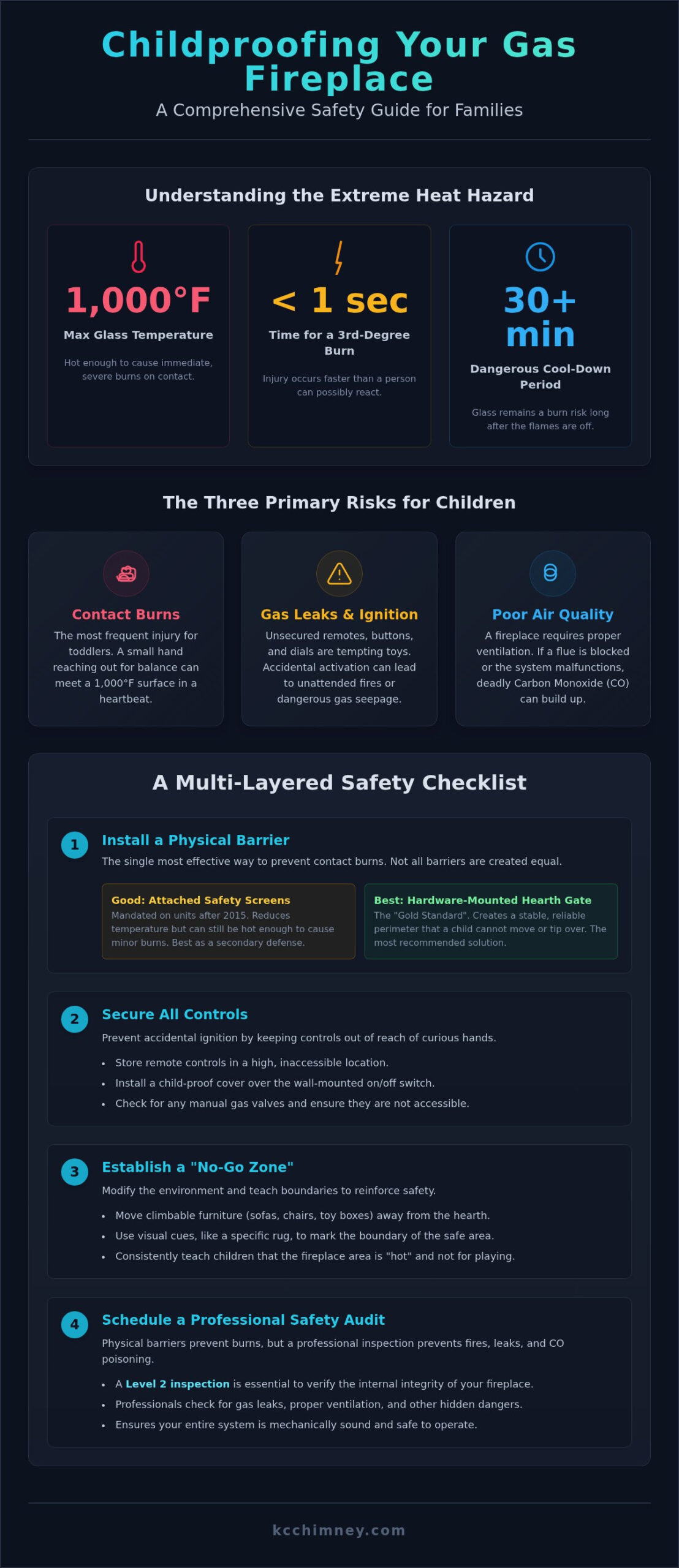
Living in Spring Hill means preparing for those brisk Kansas winters. When the temperature drops, your gas fireplace often transitions from a decorative feature to a primary heat source. This increased usage changes the safety profile of your home. If you are starting the process of child proofing gas fireplace Spring Hill setups, you must first respect the sheer power of these units. Unlike traditional wood fires that die down, a gas fireplace maintains a consistent, intense heat. The glass front can reach temperatures between 400°F and 1,000°F depending on your specific model. This isn’t just “hot”; it’s a surface capable of causing severe injury instantly.
A critical factor many parents overlook is “thermal storage.” Even after you click the remote to turn the unit off, the glass remains dangerously hot. It often stays at temperatures capable of causing third-degree burns for 30 minutes or more after the flames vanish. In a busy household, it’s easy to lower your guard once the fire is out. For a curious toddler, the danger remains invisible and active long after the room has cooled down. Beyond the heat, mechanical risks are a major concern. Kids view remotes as toys and wall switches as fun toggles. An accidental ignition when you aren’t in the room can lead to a fire running unattended, significantly increasing the risk of accidents.
The Three Primary Risks: Heat, Gas, and Air Quality
- Contact burns: These are the most frequent injuries for toddlers in the “cruising” stage. A small hand reaching out for balance can meet a thousand-degree surface in a heartbeat.
- Gas leaks: Children are naturally drawn to buttons and dials. An unsecured remote or a partially turned manual valve can lead to gas seepage, creating a fire hazard or a health risk.
- Indoor air quality: A fireplace is a complex ventilation system. If a child manages to obstruct the flue or if the unit isn’t venting properly, carbon monoxide can build up quickly. This is why professional verification of your system’s integrity is so vital.
Why Standard Precautions Aren’t Enough
Many parents believe that constant supervision is the ultimate safety net. While watching your children is essential, accidents happen in the blink of an eye. A child might trip while playing or reach out before you can react. Standard baby gates often fail here because they aren’t designed to withstand the radiant heat of a gas unit. They can warp, melt, or even become burn hazards themselves if they are made of materials that conduct heat too efficiently.
Effective protection requires specialized fireplace safety screens that are specifically engineered to handle high temperatures while providing a physical barrier. In a Spring Hill home, a gas fireplace is a heating appliance first and a decor piece second; treat its safety accordingly. Relying on generic retail solutions often provides a false sense of security that doesn’t hold up under the technical demands of a high-output gas insert.
Physical Barrier Checklist: From Safety Screens to Hearth Gates
The most effective way to prevent a contact burn is to ensure a physical barrier exists between your child and the glass. Since January 1, 2015, a federal safety mandate (ANSI Z21.50) has required all new gas fireplaces to be sold with a protective safety screen. This screen creates a small air gap that reduces the surface temperature of the outermost layer. If your home was built or your fireplace was installed after 2015, you likely already have this feature. However, these screens can still reach temperatures that cause discomfort or minor burns, so they should be viewed as a secondary layer of defense rather than a complete solution.
When you are planning your child proofing gas fireplace Spring Hill strategy, you must choose between attached screens and free-standing barriers. Attached screens are fixed directly to the unit, meaning they won’t tip over if a toddler leans on them. Free-standing screens are often more decorative, but they lack the stability needed for a home with active children. Because medical experts at Nationwide Children’s Hospital have highlighted the dangers of gas fireplaces regarding rapid-onset contact burns, we always recommend a fixed gate or a hardware-mounted barrier for maximum reliability.
Selecting the Right Safety Gate
A hearth gate is the gold standard for protection because it keeps the child entirely away from the fireplace area. When shopping for a gate, prioritize these three features:
- Hardware-Mounted: Never rely on pressure-mounted gates near a fireplace. A determined toddler can eventually push these over. Hardware-mounted gates are bolted into the wall studs for permanent stability.
- The 24-Inch Rule: Ensure the gate is installed at least 24 inches away from the glass. This distance prevents the metal of the gate itself from heating up due to radiant energy.
- Auto-Close Latches: Look for gates that swing shut and lock automatically. It only takes one person forgetting to close the gate to create a hazard.
Retrofitting Older Gas Fireplaces
If your Spring Hill home features a fireplace manufactured before 2015, it likely lacks a built-in safety screen. You can find aftermarket mesh screens designed to clip onto older frames, which provide that essential thermal break. If your current unit has loose glass or a damaged frame that makes mounting a screen difficult, it is a good idea to schedule a professional gas fireplace repair to ensure the entire assembly is structurally sound before adding child-proofing hardware.
Ensuring your barrier is made of heat-resistant metal is non-negotiable. Plastic gates or nylon mesh barriers should never be used near a gas fireplace, as they can melt or release toxic fumes when exposed to high heat. For a professional assessment of your current barrier’s effectiveness, you can always reach out to the experts at Best Chimney Services to verify your setup meets modern safety standards.
Securing the Controls: Ignition and Remote Child Proofing
To a toddler, a fireplace remote is a magic wand. One click brings light and movement, making it an irresistible target for little hands. While physical barriers prevent contact burns, securing the ignition source is the next vital step in child proofing gas fireplace Spring Hill homes. If a child manages to turn the fireplace on while you are in another room, the risk of a house fire or a severe burn increases exponentially before you even realize the unit is active. It only takes a second for a curious child to find a remote left on a coffee table.
Wall switches are equally tempting. Most standard home builds in our area place light and fireplace toggles at a height that is easily accessible to children who are just learning to stand. These switches are often located right next to standard light toggles, leading to accidental activation during play. Installing a clear, flip-top guard over these switches prevents accidental activation while allowing adults to operate the unit without needing specialized tools. This simple mechanical fix is often more effective than verbal warnings.
Step-by-Step Remote Security
Managing your remote requires a methodical approach. Don’t assume that placing it “up high” is enough, as toddlers are surprisingly good at climbing. Follow these three steps to secure your ignition source:
- Step 1: Activate the Child Lock. Many modern remotes manufactured for 2026 models include a button sequence that locks the transmission. Consult your manual to see if this feature is available on your specific device.
- Step 2: Seasonal Battery Removal. During the warmer months in Spring Hill, remove the batteries from both the remote and the receiver box. This ensures the unit cannot be turned on even if a button is pressed repeatedly.
- Step 3: Install Switch Guards. For wall-mounted controls, a simple plastic guard is a low-cost, high-impact safety upgrade that prevents “magic button” accidents.
Managing the Pilot Light and Gas Supply
Parents often ask if they should extinguish the pilot light during the summer. Keeping it on helps prevent moisture buildup and keeps spiders from clogging the burner tubes, but turning it off provides absolute certainty that the unit cannot be ignited. If you choose to keep it lit, ensure your children cannot access the manual control knob often found behind the bottom decorative louvers of the fireplace.
Every parent should locate their emergency gas shut-off valve. This is usually a red or yellow lever located in the basement or behind an access panel near the hearth. A “Gas Lockout” is the process of closing this main valve and removing the fireplace key to ensure the system is completely inert during long periods of non-use. This simple habit provides a final, redundant layer of peace of mind for your family.
Creating a Safe Zone: Environment and Habit Checklist
Physical barriers are your first line of defense, but the environment surrounding your hearth plays a supporting role in child proofing gas fireplace Spring Hill homes. A “No-Go Zone” is a designated area where children are taught not to enter, regardless of whether the fire is lit. You can define this boundary visually by using a high-contrast rug or even a strip of painter’s tape on the floor. This visual cue helps a toddler understand exactly where the “safe” floor ends and the “hot” zone begins. Over time, this boundary becomes a habit that keeps them at a distance even when you aren’t in the immediate vicinity.
Furniture placement is another critical factor. Ottomans, toy chests, and low coffee tables are essentially ladders for a curious child. Keep these “climbables” at least three feet away from the hearth to prevent a toddler from reaching over a gate or gaining access to the mantle. Speaking of the mantle, ensure all heavy decor is secured. A child pulling on a fireplace screen or gate could cause a heavy clock or vase to vibrate off the ledge. Using museum wax or discreet earthquake straps can prevent these heavy objects from becoming falling hazards during play.
Consistency is the key to successful safety habits. Implement the “One-Hour Rule” in your household. This rule teaches children that the fireplace remains “hot” for a full hour after the flames go out. Because gas fireplace glass retains heat so effectively, this habit prevents the common mistake of a child touching the glass as soon as they see the fire is gone. By treating the fireplace as a permanent heat hazard, you reduce the risk of accidents caused by the deceptive cooling period.
Visual and Verbal Training for Toddlers
Training a child requires simple, consistent language. Use words like “Hot” or “Ouchie” every time you are near the fireplace to reinforce the danger. You can also role-play common scenarios with your child. For example, practice what to do if a ball or favorite toy rolls into the “No-Go Zone.” Teach them to stop and ask an adult for help rather than reaching for the item themselves. This repetitive practice builds the muscle memory needed to stay safe during active play.
Hearth Padding and Corner Guards
While we focus on burns, the sharp stone or brick edges of a hearth are also significant fall hazards. Use flame-retardant foam padding to cover these corners. A thorough chimney inspection kansas city professionals provide will often include an assessment of the hearth’s structural stability, ensuring it can safely support the weight of mounted safety gates or heavy padding. Always avoid placing flammable decorative rugs directly against the burner area, as stray heat can cause scorching.
If you are ready to ensure your home environment meets the highest safety standards, schedule a comprehensive review with the experts at Best Chimney Services today.
Professional Safety Audit: Why Spring Hill Homeowners Trust Best Chimney Services
While the checklists and habits discussed earlier provide a strong defense, a professional audit is the essential foundation for child proofing gas fireplace Spring Hill systems. You can install the best gates and remotes, but if the internal mechanics of the unit are failing, your home isn’t truly secure. Our Level 2 inspections are designed to find the hidden hazards that a visual check simply cannot detect. For new parents in Spring Hill, this technical verification ensures that the appliance is as safe as it is functional before the first cold snap of the season.
We look for more than just a working pilot light. Our technicians check for microscopic gas leaks, verify proper venting to prevent carbon monoxide buildup, and ensure that the fireplace’s integrity hasn’t been compromised by age or wear. A professional screen installation by a certified technician also offers a level of durability that DIY retail options often lack. We ensure that every safety barrier is fitted precisely to your specific fireplace model. This precision prevents the screen from rattling or coming loose, even if a toddler pulls on it, meeting the rigorous 2026 safety standards that protect your family.
What Happens During a Safety Inspection?
During a visit, we perform a high-resolution video inspection of the flue. This allows us to see if any obstructions, like bird nests or debris, are causing dangerous back-drafting into your living space. We also test the Oxygen Depletion Sensor (ODS). This critical safety feature is designed to shut off the gas automatically if oxygen levels in the room drop too low. Finally, we clean the glass and logs. Removing dust and carbon buildup prevents “sooting,” which can negatively impact the air quality in a home where small children are breathing and playing on the floor.
Schedule Your Spring Hill Safety Check
Booking our “New Parent Fireplace Audit” is a straightforward way to gain total peace of mind. Our certified technicians serve Johnson and Miami counties, providing expert guidance on gas fireplace inserts and safety accessories. We offer flat-rate inspection fees for our neighbors in Johnson County, ensuring you get transparent, professional service without hidden costs. Taking this step transforms your hearth from a source of anxiety into a safe, reliable part of your home. It is an investment in your property’s future and your family’s protection.
Protect your little ones—book a professional safety inspection today!
Securing Your Home for the Years Ahead
Your fireplace should be a source of comfort, not a cause for concern. By implementing high-quality physical barriers and securing your ignition controls, you have already taken significant steps toward a safer home. Effective child proofing gas fireplace Spring Hill systems require a combination of reliable hardware and consistent household habits. Teaching your children the “One-Hour Rule” and marking a clear “No-Go Zone” provides a behavioral safety net that protects your family long after the flames are extinguished.
As a neighborly fixture in the community, Best Chimney Services has been serving Spring Hill and Johnson County since 2012. Our A+ rated local service is backed by Certified CSIA Technicians who take pride in maintaining the highest professional standards. We understand that your home is your sanctuary, and we are dedicated to ensuring your gas fireplace operates with the precision and integrity you expect. Don’t leave your family’s safety to chance or generic retail solutions when expert help is right around the corner.
Schedule Your Spring Hill Fireplace Safety Audit today to enjoy the warmth of your hearth with total peace of mind. We are here to help you protect what matters most.
Frequently Asked Questions
Is the glass on a gas fireplace really that dangerous for kids?
Yes, the glass front of a gas fireplace is extremely hazardous for children. Temperatures typically range from 400 to 1,000 degrees Fahrenheit depending on the model. This is hot enough to cause severe third-degree burns in less than a second. Because toddlers often use surfaces for balance while cruising, their hands are at high risk. It’s one of the most critical factors to address when planning child proofing gas fireplace Spring Hill setups.
Can I install a regular baby gate in front of my gas fireplace?
You shouldn’t use a standard plastic or wood baby gate near a gas fireplace. These materials aren’t rated for high-heat environments and can melt, warp, or even catch fire. For effective protection, you need a hardware-mounted metal hearth gate. Ensure the gate is installed at least 24 inches away from the glass. This prevents the metal itself from becoming a burn hazard for your little ones during active play in your living room.
How long does gas fireplace glass stay hot after turning it off?
Gas fireplace glass remains dangerously hot for 30 to 60 minutes after you turn the unit off. This phenomenon, known as thermal storage, means the surface can still cause significant burns even when no flames are visible. This deceptive cooling period is why we recommend the “One-Hour Rule” for families. Always assume the glass is hot until you’ve personally verified it’s safe, keeping curious toddlers at a distance during this time.
What is the “Child Lock” feature on my fireplace remote?
The “Child Lock” is a safety setting found on many modern fireplace remotes that prevents the unit from being turned on accidentally. It usually requires a specific sequence of button presses to unlock the transmission. This feature is vital because kids often view remotes as toys. If your current remote lacks this function, it’s best to store it in a lockbox or remove the batteries during the summer months to ensure the fireplace stays off.
Do I need a safety screen if I already have a hearth gate?
We recommend using both a safety screen and a hearth gate for a multi-layered approach to safety. While a gate keeps children at a distance, it only works if it’s closed and latched. A safety screen is attached directly to the unit and provides a permanent barrier against contact burns if the gate is accidentally left open. This redundancy is a hallmark of professional child proofing gas fireplace Spring Hill strategies for local families.
Are ventless gas fireplaces safe for homes with infants?
Ventless units are designed with Oxygen Depletion Sensors for safety, but they can still impact indoor air quality by releasing combustion byproducts into the room. Infants have developing respiratory systems and are more sensitive to these changes. If you have a ventless model in your Spring Hill home, a professional Level 2 inspection is non-negotiable. This ensures the sensor is functioning correctly and that your home’s air remains safe for your youngest family members.
How often should I have my gas fireplace inspected for safety in Spring Hill?
You should schedule a professional safety inspection at least once a year. Annual maintenance is the foundation of home safety, especially before the cold Kansas winters begin. Our technicians check for gas leaks, obstructed vents, and mechanical failures that could lead to carbon monoxide buildup. For homeowners in Spring Hill and Overland Park, these regular checkups ensure your system’s safety and help it operate reliably throughout the heating season.
What should I do if my child touches the hot glass?
If a child touches hot glass, immediately run the affected area under cool, not cold, water for at least ten to twenty minutes. Don’t apply ice, butter, or ointments, as these can trap heat and damage the skin further. Because gas fireplace burns are often deep and occur at extreme temperatures, you should seek medical attention immediately. Contacting a professional for a safety audit afterward can help identify how to prevent a recurrence.