
Imagine you are finally settling into bed on a blustery Kansas night, only to hear a haunting, flute-like whistle echoing through your living room. It is not a ghost; it’s the sound of wind noise coming down chimney Stilwell homes often face due to our open, rolling terrain. It’s incredibly frustrating when a peaceful evening is ruined by a howling flue. It’s even worse when you start worrying if that noise means your chimney is structurally unstable or if your heated air is simply blowing out the top. You aren’t alone in experiencing that “flute effect” during a heavy prairie gust.
We’ll help you understand exactly why your chimney is making these disruptive sounds and, more importantly, how to stop them for good. This guide covers the common causes of chimney noise in southern Johnson County, from pressure differentials to mechanical damper chatter. We will explore professional solutions like aerodynamic caps and top-sealing dampers that silence the howling. You’ll learn how a certified inspection can identify the source of the draft, lower your energy bills, and ensure your fireplace remains a safe, quiet sanctuary for your family.
Key Takeaways
- Learn why the open topography of southern Johnson County creates a “flute effect” in your flue, leading to persistent wind noise coming down chimney Stilwell homes.
- Discover how professional top-sealing dampers create a silicone-gasketed seal that blocks howling drafts and helps lower your winter heating costs.
- Compare the effectiveness of standard chimney caps versus aerodynamic, anti-downdraft models specifically designed to handle high-velocity prairie gusts.
- Understand why a Level 2 video inspection is the most reliable way to find hidden masonry gaps and internal flue leaks that cause whistling and vibration.
- See how custom-fitted shrouds can protect your chimney’s structural integrity while maintaining the architectural beauty of your Stilwell property.
Why Does the Wind Howl Down My Chimney?
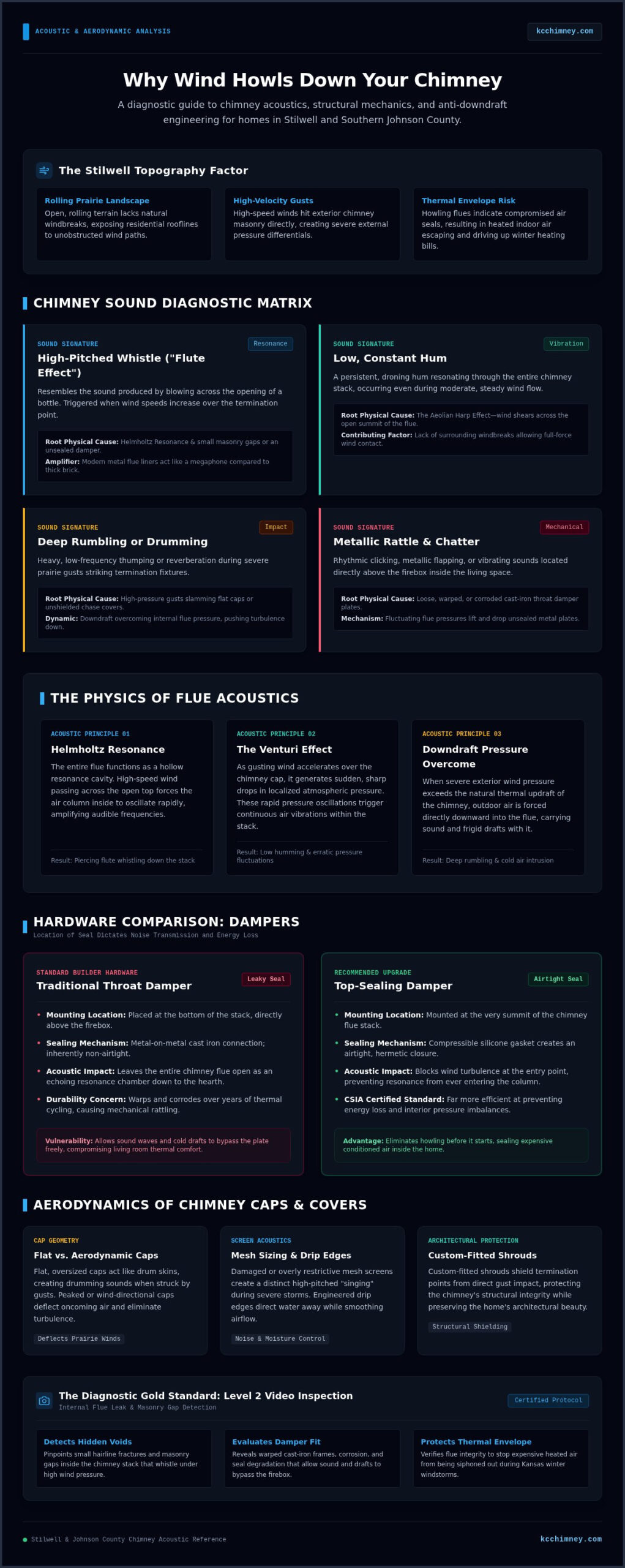
Stilwell’s rolling landscape offers beautiful views, but it also leaves your home vulnerable to high-velocity winds. When these gusts hit your roofline, they don’t just pass by; they interact with your chimney in ways that create disruptive sounds. If you’re hearing a low, constant hum, you’re likely experiencing the Aeolian Harp effect. This happens when wind shears across the open top of your flue, creating a vibration that resonates through the entire stack. It’s a common issue in our area because the lack of windbreaks allows air to hit your masonry at full force.
A high-pitched whistle is different. This usually indicates small gaps in your masonry or a damper that doesn’t close tightly. Conversely, a deep rumbling noise often occurs when high-pressure wind slams against a flat chimney top or an unshielded chase cover. We want you to know that these sounds are valid concerns. They are almost always a symptom of air leakage or an inadequate capping system that’s costing you money in heating bills. If you hear wind noise coming down chimney Stilwell living rooms, it’s a sign that your home’s energy envelope is compromised.
The Physics of Chimney Acoustics
Your chimney flue is essentially a large resonance chamber. When wind flows across the termination point, it can trigger the Helmholtz resonance effect. This is the same acoustic principle that creates a sound when you blow across the top of a glass bottle. In Stilwell, where wind speeds can be significant, this resonance becomes much louder. The Venturi Effect also complicates things. As wind speeds increase over the chimney, it creates pressure drops that can fluctuate rapidly, causing the air inside the flue to vibrate. While masonry chimneys have thick walls that absorb some sound, modern metal liners can act like a megaphone, making the wind noise coming down chimney Stilwell homes feel much more intense.
Drafts vs. Noise: Are They the Same?
While they often happen together, drafts and noise are separate issues. A draft is the physical sensation of cold air entering your living space. Noise is the sound of air turbulence or vibration within the structure. A poorly seated throat damper is a common culprit for both. When the metal plate doesn’t form a tight seal, it allows sound waves to pass through while letting expensive heated air escape. This creates a cycle where the “sound” of the wind is actually the sound of your money leaving the house.
Downdraft is the primary culprit for Stilwell chimney noise, occurring when external air pressure overcomes the internal pressure of the flue and forces air downward.
The Mechanics of Chimney Wind Noise: Dampers and Caps
Your chimney’s hardware acts as the gatekeeper for your home’s comfort. Most Stilwell homes utilize a traditional throat damper, which is a heavy cast-iron plate located just above the firebox. While it serves as a basic barrier, it’s rarely airtight. Over years of use, these metal components warp and corrode, leaving gaps that allow wind noise coming down chimney Stilwell flues to reach your ears. When wind pressure fluctuates, these loose plates can rattle or vibrate, turning your fireplace into a source of constant irritation.
Throat Dampers vs. Top-Sealing Dampers
Traditional throat dampers are notoriously leaky. They allow sound waves and cold air to bypass the seal easily because they rely on a metal-on-metal connection. We often recommend upgrading to a top-sealing damper to solve this. These units mount to the very top of the flue and use a silicone gasket to create a true airtight seal. By stopping the wind at the summit, you eliminate the resonance that occurs inside the chimney column before it ever enters your home. According to the Chimney Safety Institute of America, these dampers are far more efficient at preventing energy loss and pressure imbalances. If your current system is failing, professional chimney repair Kansas City services can retrofit your flue with a high-quality top-mounted model.
The Impact of Chimney Cap Geometry
The shape of your chimney cap dictates how it interacts with the Kansas wind. A flat, oversized cap can create a drumming effect as high-pressure gusts strike the metal surface. In contrast, peaked or wind-directional caps are designed to deflect air and reduce turbulence. The mesh screen surrounding the cap also plays a role. If the mesh is too restrictive or damaged, it can create a high-pitched singing sound during severe weather. A properly engineered cap includes a prominent drip edge. This feature doesn’t just shed water; it helps break up laminar wind flow before it can create pressure drops at the flue opening.
For homeowners with prefabricated systems, the metal chase cover is another common culprit for noise. These large metal surfaces can flex and boom in the wind if they aren’t properly braced or if the metal is too thin. Masonry crowns can also contribute to the problem. If the crown is cracked or poorly finished, it can reflect wind energy back into the flue rather than absorbing it. Ensuring your chimney is fitted with the right hardware is a key part of our comprehensive inspection process.
Comparing Solutions: Caps, Shrouds, and Dampers
When you are ready to stop the howling, you have several hardware options to consider. Standard stainless steel caps are the most common choice for many homeowners. They provide essential protection against rain and nesting animals, but they often struggle to mitigate wind noise coming down chimney Stilwell flues during heavy prairie storms. For homes situated in more exposed areas, specialized hardware is usually necessary to achieve a quiet, draft-free living space.
Wind-Directional Caps: The Ultimate Fix?
Wind-directional caps, often called vacu-stack caps, are engineered specifically for high-wind environments. These units use the wind’s own energy to create a stronger upward draft while simultaneously blocking downward gusts from entering the flue. If your home sits near Stilwell’s open fields or on an elevated ridge, a wind-directional cap can be a game-changer. They effectively “steer” the wind away from the flue opening, preventing the pressure imbalances that cause noise. While they are a premium solution, the primary downside is their distinct, industrial appearance which may not suit every architectural style.
Custom Chimney Shrouds
A shroud is a secondary wind break for masonry chimneys that sits over the termination point. These are often the preferred choice in newer Stilwell developments where homeowners associations (HOAs) have strict aesthetic requirements. Shrouds diffuse the wind before it ever reaches the flue opening, significantly reducing the “flute effect” we discussed earlier. They offer a perfect balance of functional noise reduction and architectural elegance, protecting your chimney without compromising your home’s curb appeal.
Evaluating the ROI of Professional Hardware
While DIY solutions like chimney balloons or “sheep” (thick wool plugs) are popular online, we view them as temporary fixes at best. They require you to manually install and remove them every time you use your fireplace. This creates a significant safety risk if you forget to remove them before lighting a fire. In contrast, a top-sealing damper offers a high return on investment by providing a permanent, easy-to-use solution.
A professional-grade top-sealing damper offers several long-term benefits:
- Noise Reduction: It stops wind vibration at the flue’s summit before it can resonate.
- Energy Efficiency: It prevents conditioned air from escaping, which is critical for lowering heating bills.
- Pest Control: The airtight seal keeps insects and small animals out of your home.
According to the Chimney Safety Institute of America, professional hardware is the only way to ensure your venting system remains safe and efficient. Investing in a permanent solution like a top-sealing damper or a wind-directional cap pays for itself in peace of mind and reduced heating costs. It eliminates wind noise coming down chimney Stilwell homes while making your fireplace much easier to maintain.
Stilwell’s Geography: Why Your Neighborhood Is Noisier
Stilwell isn’t just another suburb; it’s a unique transition between the metro area and the open prairie. This rolling topography is beautiful, but it creates a specific set of challenges for your home’s venting system. Unlike the dense tree canopies found in older parts of Johnson County, many developments in the 66085 zip code lack mature windbreaks. This absence of tall timber allows wind to pick up speed across pastures and fields before striking your home with unobstructed force. This is a primary reason why wind noise coming down chimney Stilwell flues is such a frequent complaint among neighbors.
If your home is built on one of Stilwell’s many ridges or hillsides, you might be experiencing the “Hillside Effect.” While you’d think the windward side of the hill would be the loudest, the leeward (downwind) side often suffers more. As wind crests a hill, it doesn’t just stop; it tumbles and creates erratic pressure zones known as turbulence. This swirling air causes the column of air inside your flue to vibrate inconsistently, resulting in that deep, rhythmic drumming sound that can be so disruptive at night.
Wind Patterns in Southern Johnson County
The direction of your chimney’s opening relative to seasonal wind patterns matters immensely. Northwest winds in the winter and Southwest gusts in the spring are the most common drivers of noise here. In some cases, the way your house is positioned relative to a neighbor’s home can create a “wind tunnel” effect. This accelerates the air speed between the structures and concentrates the force directly against your chimney masonry or metal chase cover. If you’re concerned about how your home’s orientation is affecting your comfort, a professional chimney inspection Kansas City can help diagnose these site-specific environmental issues.
Local Architecture and Chimney Height
Height is a major factor in how much noise your chimney captures. Two-story homes in Stilwell are significantly more susceptible to wind noise than ranch-style houses because their chimney terminations sit higher in the atmosphere. At these heights, wind speeds are more consistent and powerful. We often evaluate the “3-2-10 rule” during our local visits. This safety standard requires the chimney to be at least three feet tall where it exits the roof and two feet higher than any part of the building within ten feet. However, in Stilwell’s open climate, a chimney that barely meets this code may still be too short to clear the turbulence created by a steep roof pitch, leading to persistent whistling.
If you’re tired of the howling and want a solution tailored to our local geography, you can schedule a consultation with our local experts to evaluate your chimney’s height and exposure.
How Best Chimney Services Silences Stilwell Chimneys
At Best Chimney Services, we understand that a noisy chimney is more than just a nuisance. It’s a sign that your home’s primary defense against the elements is compromised. Since 2012, our CSIA-certified technicians have served as the local guardians for homeowners in southern Johnson County. We don’t just “plug holes”; we use a methodical, diagnostic approach to solve the physics problem of wind noise coming down chimney Stilwell flues. We also stand by our “No Mess” guarantee. We use specialized drop cloths and HEPA-filtered vacuums to ensure your living room remains pristine while we perform our work.
Our team combines technical authority with a neighborly touch. We recognize that every home in Stilwell has unique architectural needs based on its exposure to the prairie wind. By focusing on high-integrity repairs and long-term solutions, we ensure your chimney is not only quiet but also structurally sound and energy-efficient for years to come.
Our Professional Inspection Process
The foundation of a quiet home is a thorough Level 2 Video Inspection. While a standard sweep is important for maintenance, a video scan allows us to see what is happening deep inside the masonry or metal liner. We use high-definition cameras to identify “noise gaps” like missing mortar joints, warped damper plates, or loose prefabricated pipe seams. These small defects are often the primary source of the whistling sounds you hear during a storm. If we find that your system is clogged or poorly maintained, our comprehensive chimney sweep Kansas City services will clear any debris that might be causing air turbulence. We also perform pressure testing to pinpoint exactly where wind is bypassing your chimney’s defenses, allowing us to recommend the most cost-effective hardware upgrade.
Ready for a Quieter Home?
Addressing wind noise coming down chimney Stilwell homes is about more than just peace and quiet. It is a critical step in lowering your winter heating bills. An unsealed chimney acts like an open window, letting your expensive heated air escape while pulling cold gusts inside. By installing custom-fitted capping solutions or top-sealing dampers, we create an airtight seal that pays for itself through energy savings. Don’t wait for the next severe cold front to realize your chimney is leaking air and noise. Our team is ready to provide a measured, professional evaluation tailored to the Stilwell climate.
Schedule your Stilwell chimney inspection today and regain the peace of mind that comes with a safe, silent, and draft-free home.
Secure a Quieter, More Efficient Home
You don’t have to tolerate the haunting sounds or the high energy bills that come with a drafty flue. Living in Stilwell’s open landscape means your home is uniquely exposed to powerful prairie gusts, but modern hardware like top-sealing dampers and wind-directional caps can silence the noise for good. These professional solutions don’t just stop the sound; they protect your chimney’s internal integrity and keep your heated air inside where it belongs.
Addressing wind noise coming down chimney Stilwell systems requires a blend of local expertise and rigorous industry standards. With over 14 years of experience in the KC metro, our CSIA-certified technicians specialize in the specific architectural needs of southern Johnson County. We provide the certified Level 2 video inspections necessary to find the hidden gaps that standard visual checks miss. Book Your Stilwell Chimney Noise Evaluation today to ensure your fireplace remains a safe, silent sanctuary for your family. Your peace of mind is our priority, and we are ready to help you regain control of your home’s comfort.
Frequently Asked Questions
Is wind noise in my chimney a sign of structural damage?
Not necessarily, but it’s often a symptom of failing components. While the sound itself is usually an acoustic issue, persistent rattling or whistling can indicate gaps in your masonry or a cracked crown. We recommend a Level 2 inspection to determine if the noise is a simple pressure imbalance or if you need tuckpointing or other structural repairs to keep your home safe and draft-free.
Can a chimney cap really stop the howling sound?
Yes, the right cap is a primary solution for wind noise coming down chimney Stilwell homes. Standard caps protect against rain and pests, but specialized wind-directional caps are designed to deflect high-velocity prairie gusts. By changing how wind shears across the flue opening, these caps eliminate the pressure imbalances that create the haunting “flute effect” in your living room during a storm.
What is the best type of damper for noise reduction?
A top-sealing damper is the most effective choice for silencing a noisy flue. Unlike traditional throat dampers that sit just above the firebox, top-sealing models create a tight, silicone-gasketed seal at the very top of the chimney. This stops wind from entering the vertical column entirely. It prevents resonance and vibration while significantly improving your home’s energy efficiency by keeping heated air inside.
Why is the wind noise louder in my basement fireplace than the main floor?
This usually happens because of the length of the flue and the “stack effect.” A basement fireplace has a much longer vertical column of air, which acts as a more powerful resonance chamber for wind noise coming down chimney Stilwell residences. Additionally, basements are often located in negative pressure zones of the home. This pressure differential can pull external air and noise downward more forcefully than on upper floors.
How much does it cost to fix a noisy chimney in Stilwell?
Costs vary based on the specific hardware or masonry solution your home requires. A standard cap installation is a different investment than a full top-sealing damper retrofit or structural crown repair. We focus on providing long-term value by identifying the root cause through a professional inspection first. This ensures you invest in a permanent remedy rather than spending money on temporary fixes that don’t solve the problem.
Will cleaning my chimney reduce the wind noise?
Professional sweeping is essential for safety, but it rarely stops wind noise on its own. In fact, removing soot might occasionally make the acoustic resonance clearer. However, a thorough cleaning is always the first step in our diagnostic process. It allows our technicians to perform a clear Level 2 video inspection to find the specific masonry gaps or hardware failures that are actually causing the sound.
Can I use a chimney balloon to stop the noise temporarily?
You can use a chimney balloon as a short-term fix, but it’s not a recommended permanent solution. These devices require manual installation and removal before every fireplace use, which creates a significant safety hazard if you forget them. They also tend to leak or deflate over time. A permanent, professional top-sealing damper provides the same noise-blocking benefits with much greater safety, durability, and daily convenience.
What should I do if I hear a whistling sound even when the damper is closed?
A high-pitched whistle usually means air is forcing its way through a tiny gap in your defenses. This often happens when a traditional cast-iron throat damper is warped or corroded and no longer seats correctly. You should schedule a professional evaluation to check the seal’s integrity. We often find that replacing old hardware with a gasketed top-mounted damper is the only way to completely eliminate that persistent whistling.