
What if the hairline crack in your exterior masonry isn’t just a cosmetic flaw, but a warning that your home’s structural integrity is at risk? In the Kansas City metro area, our intense freeze-thaw cycles often hide the most dangerous signs of chimney damage behind a facade of normal wear and tear. It’s completely natural to feel a sense of dread when you spot crumbling mortar or white staining, especially when you’re worried about the high costs of masonry reconstruction or the terrifying possibility of a flue fire.
We believe every homeowner deserves the peace of mind that comes with a safe, functional fireplace. This 2026 guide will teach you exactly how to spot early warning signs of chimney failure before they become costly structural repairs or fire hazards in your Kansas City home. We’ll provide a clear checklist of what to look for and explain which symptoms require an immediate professional evaluation to keep your family protected and warm all winter long.
Key Takeaways
- Identify visible cues like spalling bricks and mortar decay that indicate your masonry is losing its structural integrity.
- Discover how to check your firebox for “shaling” or rust, which often signal hidden flue damage or a faulty chimney cap.
- Understand how Kansas City’s specific 2026 freeze-thaw cycles accelerate the most common signs of chimney damage.
- Learn why “campfire smells” and white exterior stains are red flags for moisture intrusion and hazardous creosote buildup.
- Gain clarity on when to schedule a Level 2 video inspection to ensure your fireplace is safe for the upcoming winter.
External Warning Signs: What Your Chimney’s Exterior is Telling You
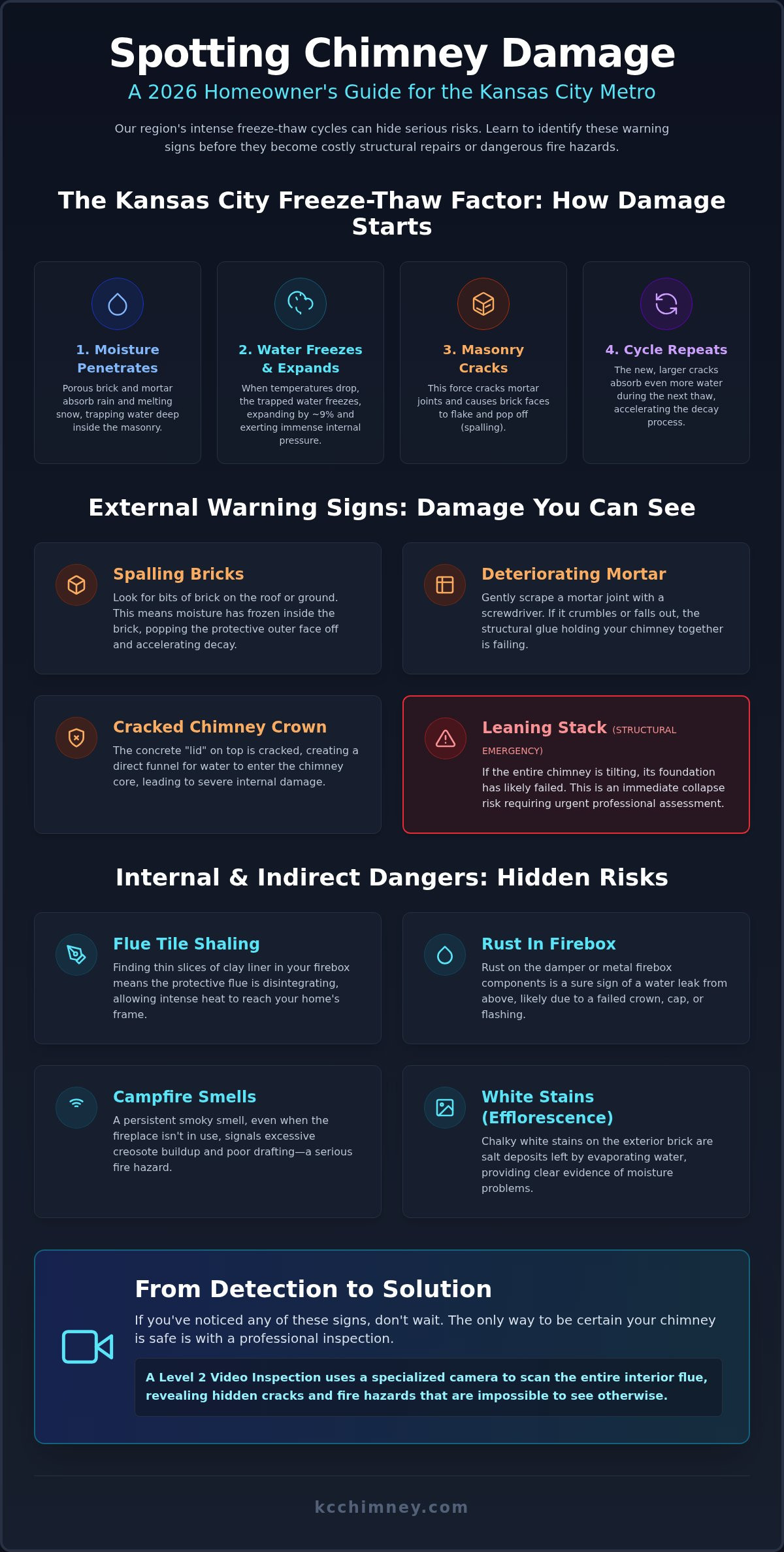
Your chimney is more than just a stack of bricks; it’s a complex ventilation system designed to keep your family safe. When you’re looking for signs of chimney damage, the best place to start is from the ground looking up. Understanding Chimney function and construction helps homeowners realize that the exterior masonry is the first line of defense against our local weather. Kansas City’s unique climate, with its rapid shifts between freezing nights and sunny afternoons, puts immense stress on exterior masonry. These temperature swings cause brick and mortar to expand and contract, eventually creating small openings where water can enter.
Spalling Bricks and Flaking Masonry
Have you noticed bits of brick lying on your roof or in your yard? This is called spalling. It happens when moisture penetrates the porous surface of a brick. When that water freezes, it expands and exerts internal pressure until the brick’s outer face literally pops off. Spalling is a progressive moisture-trapping cycle. Once the hard outer skin of the brick is gone, the soft interior absorbs even more water, accelerating the decay. Be especially cautious if your chimney is painted. While paint might look nice, it often seals moisture inside the masonry, hiding severe damage until the entire structure becomes unstable.
Deteriorating Mortar Joints
Mortar is designed to be sacrificial, meaning it’s softer than the bricks it holds together. Over time, wind and rain wash away this binding material. You can perform a simple “screwdriver test” to check its health. Gently scrape a flat-head screwdriver across a mortar joint. If it crumbles easily or falls away in large chunks, the joint has failed. This is a common issue for historic Overland Park homes where original lime-based mortars have reached the end of their lifespan. Addressing this early through Expert Chimney Repair in Kansas City prevents the need for a full chimney rebuild. This process, known as tuckpointing, involves removing the old mortar and replacing it with fresh, weather-resistant material.
Crown Damage and Structural Stability
The chimney crown is the concrete slab at the very top of the stack. It acts as a lid, shedding water away from the masonry. If you see cracks in the crown from the ground, or if your technician identifies them during an inspection, you have a major entry point for water. Left unaddressed, water seeps down into the very core of the chimney, leading to expensive internal repairs. In extreme cases, you may notice the entire chimney stack leaning away from the house. A tilting chimney is a structural emergency. It indicates that the foundation or the internal support system has failed, posing an immediate safety risk to your property. Identifying these signs of chimney damage early is the best way to avoid a total structural collapse.
Internal and Functional Signs: Detecting Hidden Flue Damage
While crumbling bricks are easy to spot from the driveway, the most hazardous signs of chimney damage often hide deep within the flue where they remain invisible to the naked eye. The interior lining serves as the only barrier separating 1,000 degree gases and sparks from your home’s wooden framing. If this lining fails, your property is at immediate risk. Understanding these internal red flags is essential for any homeowner who values both safety and the longevity of their fireplace.
Flue Tile Shaling and Liner Cracks
When you clean out your firebox, look closely for small, flat pieces of clay or ceramic mixed with the ash. This material is “shaling,” a process where the protective chimney liner begins to shed its outer layers. Shaling is a clear indicator that moisture has compromised the flue tiles. Cracked liners are dangerous because they allow heat to transfer directly to combustible house framing. We utilize advanced video camera equipment during our Level 2 inspections to act as an “X-ray” for your chimney. This technology allows us to find hidden gaps and vertical cracks that a standard visual check simply cannot reach.
Rust and Corrosion in the Fireplace
Rust is a persistent enemy of chimney safety. If your damper is difficult to operate or shows visible orange flakes, it’s a signal that water is entering the system, likely through a failed chase cover or a missing chimney cap. For homeowners with modern heating units, corrosion can be even more subtle but equally dangerous. If you notice discoloration or “white rust” on the metal components of your system, it’s time to consult a professional for Expert Gas Fireplace Repair in Overland Park to ensure your venting remains airtight and efficient.
Functional issues also provide critical clues about your chimney’s health. Creosote is a natural byproduct of wood burning, but when it reaches a thick, glazed stage, it becomes a literal fuse for a chimney fire. If you see tar-like buildup on the walls of your firebox, do not light another fire until it is professionally cleared. Another major red flag is “back-puffing,” where smoke enters your living room instead of rising through the stack. This often indicates a blockage or a serious draft failure. The U.S. Consumer Product Safety Commission has released an official safety alert on chimney hazards that details how these blockages and liner failures can lead to deadly carbon monoxide leaks. If you suspect your system isn’t venting correctly, a Level 2 inspection is the most reliable way to verify your home is protected.
The Kansas City Freeze-Thaw Factor: Why Our Climate is Brutal on Chimneys
Living in the Kansas City metro means dealing with a climate that is uniquely hostile to masonry. While homeowners in milder regions might go decades without a repair, our local weather patterns accelerate the most common signs of chimney damage. The primary culprit is the freeze-thaw cycle. Throughout the early months of 2026, we’ve observed rapid temperature swings where a 40-degree afternoon is immediately followed by a 10-degree night. This volatility doesn’t just make it hard to dress for the day; it creates a relentless mechanical pressure on your chimney stack.
KC’s Volatile Temperature Swings
The science behind this decay is simple but destructive. Brick is naturally porous, acting much like a very hard sponge. When it rains or snow melts during a mild Kansas City afternoon, the masonry absorbs moisture. As the sun sets and temperatures plummet, that trapped water turns to ice and expands by approximately 9% in volume. This expansion happens inside the microscopic pores of the brick and mortar. These “micro-explosions” eventually lead to the flaking and cracking we discussed in previous sections. Older homes in areas like Stilwell are particularly susceptible, as their aged masonry has had more time to absorb moisture and undergo thousands of these destructive cycles.
Moisture Intrusion and Soil Shifting
If you notice gaps appearing between the chimney and your siding, it is a sign that the foundation may be struggling with these soil movements. We recommend scheduling an Expert Chimney Inspection to verify the health of your foundation and the integrity of your water-shedding components. Spring is actually the best time to check for these signs of chimney damage. Once the winter snow has cleared, the fresh cracks and mortar decay caused by the recent freeze-thaw cycles are most visible, allowing you to address them before the humid summer months arrive.
Indirect Red Flags: Smells, Stains, and Efficiency Drops
Sometimes the most urgent signs of chimney damage aren’t found by looking at the roof, but by paying attention to the sensory changes inside your home. These indirect red flags often signal that moisture or hazardous chemical deposits have already compromised your system’s integrity. Identifying these subtle shifts early can prevent a minor maintenance issue from escalating into a full-scale structural emergency or a health hazard for your family. Ignoring these sensory cues can lead to degraded air quality and increased fire risks during the heavy burning season.
Efflorescence: The White Salt Warning
Have you noticed a white, powdery substance appearing on your exterior brickwork? This is called efflorescence. It occurs when water travels through the masonry, picks up natural salts, and leaves them behind as it evaporates on the surface. While it might look like a simple cleaning issue, it actually indicates that your chimney is “breathing” far too much moisture. “Efflorescence isn’t just a stain; it’s a footprint of water movement through your masonry.” If you see these white streaks, it’s a clear signal that your brick’s protective seal has failed, allowing the freeze-thaw cycles we discussed earlier to begin their destructive work from the inside out.
Interior Water Damage and Odors
Water stains on the ceiling or walls surrounding your fireplace are often misdiagnosed as simple roof leaks. However, if the dampness is concentrated near the chimney breast, the culprit is likely a failed crown or deteriorated flashing. These leaks don’t just damage your drywall; they often lead to mold growth within your home’s insulation or the flue itself. If your fireplace emits a musty, earthy scent, it’s a strong indicator that moisture is trapped somewhere it shouldn’t be. This environment is perfect for mold spores to thrive, potentially impacting your indoor air quality.
You might also notice a sharp “campfire smell” during the humid Kansas City summers. This happens because creosote, the byproduct of burning wood, absorbs moisture from the air. High humidity activates these odors, driving them down into your living space. This is more than a nuisance; it’s a sign that your chimney needs a professional cleaning to remove flammable deposits. To ensure your entire home remains safe, we also recommend including dryer vent cleaning as part of your total fire safety plan. Poorly maintained dryer vents can cause back-pressure issues that interfere with your chimney’s natural draft. If you’ve noticed these lingering smells or mysterious stains, it’s time to schedule a Level 2 Inspection to identify the root cause before winter arrives.
From Detection to Solution: Professional Inspection in Overland Park
Once you’ve identified potential signs of chimney damage, the next step is moving from observation to a professional solution. While a visual check from the ground is a great start, it cannot replace the precision of a certified evaluation. We approach every home with a focus on safety and long term durability, ensuring your fireplace remains a source of comfort rather than a liability. Whether you’re in the heart of Overland Park or further out in Bucyrus or Spring Hill, getting an expert opinion is the only way to verify that your home is truly protected against the risks of fire or structural failure.
There’s a significant difference between a standard sweep and a comprehensive safety inspection. Most homeowners need a Level 2 inspection, which we often describe as the “X-ray” for your chimney. A Level 3 inspection is only necessary when a serious, hidden hazard is suspected and requires accessing concealed areas of the chimney or home structure. Our team prioritizes a mess-free process and flat-rate transparency, so you know exactly what the health of your system is without any high-pressure sales tactics.
The Value of a Level 2 Video Inspection
We use advanced video camera equipment to scan the entire length of your flue. These cameras find hairline cracks and mortar gaps that are completely invisible to the naked eye. If you’re buying or selling a home in the Kansas City metro, these inspections are often a non-negotiable requirement of the real estate transaction. Even if you aren’t moving, an annual evaluation is the best way to catch small issues before they require major masonry work. For a deeper look at what to expect during a visit, see our Chimney Sweep Kansas City Guide.
Long-Term Protection Strategies
After we identify the signs of chimney damage, we focus on prevention. One of the most effective tools in our arsenal is professional-grade, vapor-permeable waterproofing. Unlike hardware store caulk or silicone, which can actually trap moisture inside the brick and make damage worse, these specialized sealants allow the masonry to “breathe” while shedding rain. We also specialize in installing custom chase covers and chimney caps. These components act as the primary umbrella for your system, keeping out the rain, snow, and debris that lead to the decay we’ve discussed throughout this guide.
Don’t wait for a small crack to become a major reconstruction project. Taking action now ensures your fireplace is ready for the first cold snap of the season. Schedule your 2026 safety inspection today and gain the peace of mind that comes with a professionally verified, safe home.
Protecting Your Home and Family This Winter
Your chimney works hard to protect your home from extreme heat and toxic gases. As we’ve explored, recognizing the early signs of chimney damage like spalling bricks or interior rust can save you from catastrophic repairs later. Whether it’s the brutal freeze-thaw cycles of the Kansas City winter or hidden flue cracks that only a video camera can find, staying proactive is the best way to ensure your fireplace remains a safe centerpiece for your living room.
We’ve been serving homeowners in Overland Park, Mission Hills, and the entire KC Metro since 2012. Our CSIA Certified Technicians specialize in high-precision Level 2 safety inspections and are A+ rated for our mess-free service. We believe in providing technical mastery with a neighborly touch, giving you the clarity you need to make informed decisions about your home’s integrity. Don’t leave your family’s safety to chance as the temperatures begin to drop.
Schedule Your Professional KC Chimney Inspection Today and enjoy the warmth of your hearth with complete peace of mind. We’re here to help you protect what matters most.
Frequently Asked Questions
What are the first signs that my chimney is leaking?
The first signs of a leak include water stains on the ceiling or walls near your fireplace, a musty odor, or visible rust on the damper. Moisture often enters through failed flashing at the roofline or a cracked crown at the top. Catching these early prevents mold growth and deep structural decay within your home’s walls.
Is a cracked chimney crown a serious problem?
Yes, a cracked chimney crown is a serious issue because it acts as the primary roof for your entire chimney structure. When the concrete slab fails, water seeps directly into the internal masonry and flue system. This moisture leads to expensive repairs like tuckpointing or full reconstruction if you don’t address it quickly.
Why is my chimney’s brickwork flaking or peeling off?
This flaking is called spalling, and it occurs when moisture trapped inside the brick freezes and expands. Kansas City’s intense freeze-thaw cycles make this a very common problem for local homeowners. Once the hard outer face of the brick pops off, the soft interior absorbs even more water, which rapidly accelerates the decay.
What does a white powdery substance on my chimney mean?
That white substance is called efflorescence, and it consists of salt deposits left behind as moisture evaporates from your bricks. It’s a clear signal that your masonry is absorbing an excessive amount of water. While the powder itself is harmless, it indicates that your chimney’s protective seal has failed and needs professional attention.
How do I know if my chimney liner is damaged without a camera?
You can look for “shaling,” which appears as thin slices or shards of clay tile on the floor of your firebox. These fragments mean the liner is deteriorating and losing its ability to contain heat and gases. However, many dangerous cracks remain hidden, which is why a Level 2 video inspection is the only way to be certain.
Can a damaged chimney cause a carbon monoxide leak in my home?
Yes, a cracked liner or a structural blockage can force carbon monoxide back into your living space instead of out the flue. This odorless, deadly gas is a major risk if your ventilation system is compromised. Maintaining a gas-tight flue is your family’s only defense against these hazardous leaks during the winter months.
Is it safe to use my fireplace if I see small cracks in the mortar?
We recommend that you stop using your fireplace if you notice visible gaps or crumbling joints. Even minor openings can allow extreme heat or stray sparks to reach the wooden framing of your house. These gaps are common signs of chimney damage that require professional tuckpointing to restore the structural integrity of your hearth.
How often should I check for signs of chimney damage in Kansas City?
You should perform a personal visual check every spring and schedule a professional safety inspection once a year. Our local weather is particularly brutal on masonry, so catching signs of chimney damage after the winter freeze is vital. This proactive approach ensures your fireplace is safe and ready before the next burning season begins.