
Did you know that “failure to clean” is the leading cause of the 2,900 home dryer fires reported across the country every year? In Spring Hill, Kansas, keeping your family safe starts with understanding that your lint trap is only the first line of defense. Professional clogged dryer vent cleaning Spring Hill residents rely on is about more than just appliance efficiency; it’s a critical safety intervention for your home.
It is exhausting to wait through multiple cycles for a single load of laundry to dry, and it’s even more stressful to watch your energy bills rise because of an overworked machine. You shouldn’t have to worry about a hidden fire hazard every time you start a load of towels. This 2026 safety guide will help you identify the warning signs of a dangerous blockage and explain the latest International Mechanical Code requirements for vent terminations. We’ll walk through the essential steps to resolve airflow issues, prevent energy waste, and ensure your home meets the highest professional safety standards.
Key Takeaways
- Recognize red flags like the “Double Cycle Rule” to identify hidden blockages before they become a serious fire hazard.
- Understand why Spring Hill’s seasonal humidity causes lint to “cake” inside vents, making professional mechanical agitation necessary for a thorough clean.
- Follow our professional guide to clogged dryer vent cleaning Spring Hill to restore proper airflow and lower your monthly energy bills.
- Learn about the 2021 International Mechanical Code updates that prohibit certain vent screens to keep your home compliant and safe.
- Discover the benefits of a “Safety Day” by integrating your dryer vent maintenance with professional chimney sweeping and safety inspections.
Understanding the Risks of a Clogged Dryer Vent in Spring Hill Homes
A dryer vent clog is more than a minor nuisance; it is a dangerous accumulation of lint and debris within the exhaust duct that restricts airflow. While most homeowners are diligent about cleaning the lint trap after every load, the real danger lies in the bypass. Small fibers escape the trap and settle deep within the ductwork. Over time, these layers thicken and create a significant blockage. In our local Spring Hill climate, this process is often accelerated by seasonal humidity. When the air is damp, lint becomes heavy and sticky. This causes it to “cake” against the walls of the vent rather than blowing freely to the exterior.
Many residential vent runs in Spring Hill are routed through walls, floor joists, or crawlspaces. This makes the hazard “invisible” to the naked eye. You might not realize there is a problem until your dryer starts running for two or three cycles just to finish one load of laundry. Understanding how clothes dryers work is essential to recognizing why this airflow is so vital. If the hot, moist air cannot escape, the machine becomes a pressurized box of heat and combustible material. This forced inefficiency isn’t just a waste of time; it’s a financial drain on your household.
The Fire Hazard Reality for Johnson County Residents
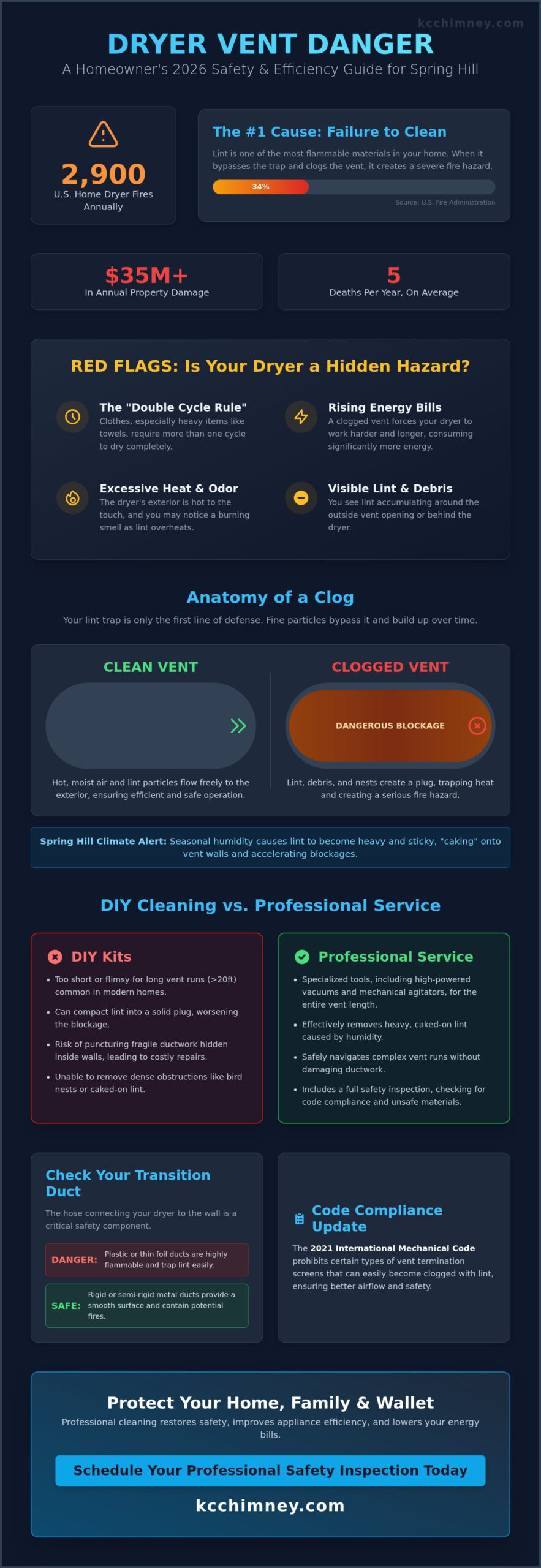
Lint is one of the most flammable substances found in a home. When a vent is restricted, the dryer’s internal temperature rises significantly. While appliances have thermal limit switches designed to shut the unit down if it overheats, these components can fail under the constant stress of a total blockage. According to the U.S. Fire Administration, an estimated 2,900 home clothes dryer fires are reported each year, with “failure to clean” cited as the leading cause in 34% of these incidents. These fires result in approximately 5 deaths and $35 million in property damage annually. Professional clogged dryer vent cleaning Spring Hill homeowners schedule is the most effective way to mitigate this risk.
Impact on Appliance Lifespan and Energy Efficiency
A clogged vent creates backpressure that forces the dryer motor and heating element to work significantly harder. This strain often leads to premature mechanical failure, requiring expensive repairs or a total appliance replacement years earlier than expected. Additionally, a restricted vent directly impacts your monthly utility bills. When a dryer runs twice as long as necessary to dry a single load, your energy consumption spikes. Investing in professional cleaning typically pays for itself through these energy savings and by extending the life of your appliance.
Anatomy of a Clog: Why DIY Cleaning Often Falls Short
Clearing your lint trap is a great habit, but it’s only a partial solution. While the trap catches large debris, fine fibers bypass the screen and enter the exhaust line. Over months and years, these fibers bond together to form a thick, felt-like lining. In our semi-rural Spring Hill neighborhoods, we also frequently see blockages caused by bird nests or small rodents seeking warmth. These biological obstructions create dense, immovable plugs that a standard vacuum cannot reach. A comprehensive clogged dryer vent cleaning Spring Hill service addresses the entire length of the duct, not just the accessible ends.
Many modern Spring Hill homes feature laundry rooms located on the second floor or in the center of the house. This design requires vent runs that often exceed 20 feet in length. DIY cleaning kits sold at big-box stores are usually too short or too flimsy to navigate these distances effectively. Using improper tools can actually worsen the problem by compacting the lint into a solid mass or puncturing the fragile ducting hidden behind your drywall. Following official Dryer Fire Prevention Tips means recognizing when a job requires specialized equipment and technical expertise.
The Danger of Foil and Plastic ‘Transition’ Ducts
The “transition” duct is the flexible hose connecting your dryer to the wall. If yours is made of plastic or thin foil, it’s a significant safety risk. These materials are highly flammable and their ribbed interior surfaces are perfect magnets for lint. Rigid metal ducting is the professional standard for safety because it provides a smooth surface for maximum airflow and contains flames if an internal fire starts. If you’re unsure about your current setup, a professional safety inspection can ensure your venting meets modern residential codes.
Hidden Blockages in Long or Vertical Vent Runs
Vertical vents are common in two-story homes and act like “lint chimneys.” Gravity causes heavy, moist lint to fall back down the pipe, where it settles in 90-degree elbows. These corners are the most frequent sites for clogged dryer vent cleaning Spring Hill service calls. Standard brushes often get stuck in these tight turns or fail to reach them entirely. Professionals use high-pressure air tools and specialized mechanical agitation to dislodge “caked” debris without damaging the integrity of the exhaust line.
Recognizing Red Flags: When Your Spring Hill Home Needs Immediate Service
Efficiency often drops so gradually that homeowners don’t notice the change until it becomes a major safety concern. The most reliable indicator of an issue is the “Double Cycle” Rule. A standard load of towels or jeans should dry in 45 minutes or less. If your machine consistently requires 60 or 90 minutes to finish the job, your exhaust system is likely struggling against a significant blockage. This delay is the primary reason residents seek professional clogged dryer vent cleaning Spring Hill services before a minor inconvenience turns into a fire hazard.
Pay close attention to the physical temperature of your laundry room. If the space feels like a sauna while the dryer is running, or if the exterior cabinet of the machine is too hot to touch comfortably, heat is being trapped inside the unit. This trapped heat often carries moisture that cannot escape, leading to a distinct musty scent on your clothes. This moldy smell occurs because damp, stagnant air is recirculating through the drum instead of being expelled to the outdoors. If your laundry doesn’t smell fresh after a full cycle, the vent is the first place you should look.
Step outside and locate your vent termination point on the side of your house or roof. You should see the flap moving freely or the louvers opening when the dryer is in use. If the flap is stuck closed or surrounded by a “beard” of lint, the system is failing. In the middle of a cold Kansas winter, a healthy vent will produce a steady stream of visible steam. If you don’t see that exhaust on a freezing day, your vent is likely fully obstructed and requires immediate attention.
Visual and Physical Red Flags
Beyond the lack of steam, check the condition of your laundry at the end of a cycle. Clothes should be dry, not scorching. If metal zippers, buttons, or snaps are painfully hot to handle, the internal thermostat is being pushed to its limit. This excessive heat accelerates the wear on your fabrics and indicates a critical lack of airflow. You may also notice fine lint accumulating on the floor or walls behind the dryer, which suggests the backpressure is so great that debris is being forced out of the connection points.
The NFPA 211 Maintenance Standard
The NFPA 211 maintenance standard recommends an annual inspection of all home venting and exhaust systems to ensure they are free of obstructions and structural defects. Following this guideline helps ensure your home remains compliant with modern safety codes throughout 2026. Many proactive Spring Hill families find it easiest to coordinate their vent maintenance with a seasonal chimney sweep. Combining these services into a single “Safety Day” ensures that every exhaust path in your home is clear, efficient, and ready for the heavy usage months of winter.
Professional Dryer Vent Cleaning: The Best Chimney Services Process
Professional service goes far beyond simply vacuuming out the visible lint behind your machine. We treat your exhaust system with the same technical rigor we apply to a complex chimney inspection. Our protocol for clogged dryer vent cleaning Spring Hill homes follows a methodical four-step process to ensure every inch of the duct is clear and compliant with safety standards. This systematic approach allows us to identify hidden structural issues that a standard DIY kit would miss.
- Step 1: Initial Airflow Velocity Testing. We establish a baseline performance metric before any cleaning begins. This data tells us exactly how restricted the line is.
- Step 2: Mechanical Agitation. We use specialized, flexible brushes designed to navigate the tight 90-degree elbows common in Spring Hill architecture. These tools dislodge “caked” lint that has bonded to the duct walls.
- Step 3: HEPA Vacuum Extraction. A high-powered HEPA vacuum captures all dislodged debris. This ensures that lint doesn’t escape into your laundry room or living spaces.
- Step 4: Final Verification. We repeat our airflow tests to confirm the system has been restored to its peak efficiency and provide a system optimization report.
Airflow Velocity and Static Pressure Testing
We don’t rely on guesswork or a simple visual peek inside the vent. Our technicians use digital anemometers to measure the exact cubic feet per minute (CFM) of air escaping the exterior termination point. If the readings are lower than the manufacturer’s specifications, it indicates a blockage or a structural problem. These pressure readings are also vital for identifying “crushed” transition ducts. Sometimes the dryer is pushed too close to the wall, crimping the hose and cutting off airflow. Data-driven testing reveals these invisible bottlenecks immediately.
Debris Removal and Line Sanitizing
In the semi-rural areas surrounding Spring Hill, we often find more than just lint. Bird nests, sticks, and pest debris can create dense plugs that are impossible to remove without professional mechanical agitation. Once the physical debris is gone, we offer line sanitizing to address the bacteria and odors that thrive in trapped moisture. Our “No-Mess” Guarantee ensures that we protect your floors and walls throughout the entire interior process. If you haven’t had your system tested recently, schedule a professional dryer vent inspection to ensure your home is operating safely.
Total Home Safety: Integrating Dryer and Chimney Maintenance in Spring Hill
Home safety is most effective when viewed as a complete system rather than a series of disconnected chores. In many Spring Hill residences, the dryer vent and the chimney represent the two most critical exhaust paths for heat and combustible byproducts. Because both systems rely on clear, unobstructed lines to prevent residential fires, a holistic “Guardian of the Home” approach is the most reliable way to protect your family. Our technicians don’t just look at a single appliance; they evaluate the entire exhaust footprint of your property to ensure every ventilation route is operating at peak safety standards.
Managing a household in Johnson County is busy enough without tracking multiple service appointments for different vents. Coordinating a professional clogged dryer vent cleaning Spring Hill visit with your annual fireplace maintenance creates a single “Safety Day” for your home. This integrated strategy ensures that no hidden hazard is overlooked. Whether it is lint buildup in a second-story laundry run or creosote accumulation in a flue, our team applies the same level of technical precision and neighborly care to every project.
Why One Call for Both Services Makes Sense
Efficiency is a primary benefit of bundling your home safety needs. By scheduling a professional chimney inspection alongside your dryer vent service, you reduce the logistical headache of multiple appointments and often lower overall service call fees. More importantly, this ensures consistent safety standards across all your home’s exhaust systems. A single, trusted local expert who understands the specific architectural styles and climate challenges of Spring Hill can provide a more thorough assessment than a technician who only sees one piece of the puzzle. This continuity of care builds long-term reliability and peace of mind.
Scheduling Your 2026 Inspection in Spring Hill
The best times for these inspections are during the transitional months of Spring and Fall. A Spring cleaning removes the lint “caked” by winter humidity, while a Fall check ensures your systems are ready for the heavy usage of the colder months. To prepare for our arrival, please ensure the area around your dryer and fireplace is clear of laundry or furniture. This allows our team to perform airflow velocity tests and mechanical agitation without delay. Protecting your home shouldn’t be a source of anxiety. Schedule your Spring Hill dryer vent cleaning today to ensure your exhaust systems are efficient, compliant, and safe for the year ahead.
Secure Your Home’s Safety for 2026
Maintaining a clear exhaust path is one of the most effective ways to protect your property and your family. By recognizing the early warning signs of airflow restriction and understanding the limitations of DIY tools, you can prevent the leading cause of dryer fires. Regular maintenance doesn’t just reduce your monthly utility bills; it ensures your home remains compliant with modern safety codes and industry standards. Investing in professional clogged dryer vent cleaning Spring Hill homeowners rely on provides a level of precision that preserves your appliances and your peace of mind.
Our team has served the Spring Hill community since 2012. We take pride in our A+ Better Business Bureau rating and our commitment to high-integrity service. With CSIA Certified Technicians handling your inspection, you can be certain that every exhaust line in your home meets rigorous safety benchmarks. Don’t wait for a “Double Cycle” warning to become a hazardous emergency. Book Your Spring Hill Dryer Vent Safety Inspection today to keep your household running efficiently and safely. We look forward to being your partner in home protection.
Frequently Asked Questions
How often should I have my dryer vent cleaned in Spring Hill, KS?
Most homes in Spring Hill should have their dryer vent cleaned at least once every year. If you have a large family or do laundry daily, you might need it more frequently. Regular inspections prevent lint from “caking” due to local humidity. Scheduling this alongside your annual chimney maintenance is a great way to ensure your home’s exhaust systems are safe and efficient for the upcoming season.
Can a clogged dryer vent really cause a house fire?
Yes, a blockage is a significant fire hazard because lint is highly combustible. When a vent is restricted, the dryer cannot exhaust hot air properly, which causes the internal temperature to spike. If the heat reaches the ignition point of the accumulated lint, a fire can start inside the ductwork. This is why professional clogged dryer vent cleaning Spring Hill is considered an essential safety service rather than just a maintenance chore.
What is the average time a professional dryer vent cleaning takes?
A standard professional cleaning typically takes between 45 and 90 minutes. The exact duration depends on the length of the vent run and the complexity of the routing. Vents that terminate on a roof or require access through a crawlspace may take slightly longer. Our technicians work methodically to ensure the line is completely clear and that all airflow velocity tests meet manufacturer specifications before the job is finished.
Will professional cleaning help my dryer dry clothes faster?
Restoring proper airflow will significantly reduce your drying times. When air moves freely through the vent, moisture is removed from the drum much more efficiently. You will likely notice that heavy loads like towels or jeans dry in a single cycle again. This improvement doesn’t just save you time; it also reduces the wear on your appliance’s heating element and lowers your monthly energy consumption.
Do you service both residential and commercial dryer vents in Spring Hill?
Our focus is on providing high-quality residential services to homeowners throughout the Spring Hill community. We understand the specific architectural needs of local houses, from ranch-style homes to multi-story builds with complex vent routing. While commercial systems have different requirements, our team is dedicated to ensuring that every neighborhood family has access to professional safety inspections and thorough maintenance for their home exhaust systems.
What is the difference between air duct cleaning and dryer vent cleaning?
Air duct cleaning involves the large metal channels that distribute heated or cooled air from your HVAC system. Dryer vent cleaning focuses exclusively on the smaller exhaust pipe that carries hot, moist air from your dryer to the outdoors. It’s important to distinguish between the two because they require different tools and expertise. We specialize in the specialized mechanical agitation needed to clear appliance exhaust lines safely and effectively.
Can I clean my own dryer vent with a kit from a hardware store?
While DIY kits are available, they often lack the reach and power needed for complex vent runs. Homeowners with long or vertical vents risk compacting the lint further or puncturing fragile ductwork with stiff brushes. Professional tools use high-pressure air and specialized agitation to remove debris without damaging the line. If your vent exceeds a few feet or has multiple turns, professional intervention is the safest choice for your home.
How do I know if my dryer vent is made of code-compliant materials?
You can check the “transition” duct behind your dryer to see if it is made of rigid metal or flexible material. Code-compliant vents should be constructed of smooth-walled rigid metal to minimize lint traps and contain potential fires. If you see thin foil or white plastic tubing, your system likely violates modern safety standards. A professional inspection can help you identify these risks and recommend the proper materials for a safer laundry room.