
What if the biggest threat to your family’s safety is the one part of your chimney that even a high-tech camera can’t reach? While most maintenance is routine, a level 3 chimney inspection is a forensic deep-dive required when serious structural concerns or “trigger” events, like a chimney fire, put your home at risk. It’s natural to feel a sense of dread at the thought of a technician removing portions of your masonry or drywall. You want a safe home, but you don’t want your living room turned into a dusty construction site.
We understand that your home is your sanctuary, and the idea of “invasive” work is stressful. This guide will demystify the 2027 NFPA 211 safety standards that dictate this specialized service. You’ll learn exactly why this forensic evaluation is an investment in your property’s longevity, what specific signs indicate you need one, and how modern HEPA filtration ensures your home stays clean. We’ll walk you through the entire process so you know exactly what to expect from the first brick to the final safety clearance.
Key Takeaways
- Learn when a level 3 chimney inspection becomes necessary to uncover hidden structural hazards that standard cameras can’t reach.
- Identify the specific trigger events, such as chimney fires or severe Kansas City weather, that require forensic-level safety evaluations.
- Understand the NFPA 211 standards that guide technicians during the removal of masonry or drywall to ensure your home’s integrity.
- Discover how specialized HEPA filtration and protective measures keep your living space clean even during invasive procedures.
- Prepare for the timeline and scope of a forensic inspection to ensure a smooth, stress-free experience for your family.
What is a Level 3 Chimney Inspection? The NFPA 211 Standard
A level 3 chimney inspection represents the highest level of scrutiny possible for a residential venting system. It isn’t a routine maintenance visit or a quick visual check performed during a standard sweep. Instead, it’s a targeted, deep-dive evaluation that occurs when a technician suspects a serious hidden defect that could lead to a house fire or structural collapse. This process moves beyond what can be seen with the naked eye or a camera, often requiring the temporary removal of building components to reach the heart of the chimney’s structure.
The framework for this work is governed by the National Fire Protection Association (NFPA), specifically the NFPA 211 standard. These guidelines provide a consistent safety baseline for homeowners in Overland Park and across the country. They dictate that a level 3 inspection is necessary when “the safety of the chimney is in question” and simpler methods can’t provide a definitive answer. We view these standards as a non-negotiable commitment to your family’s protection.
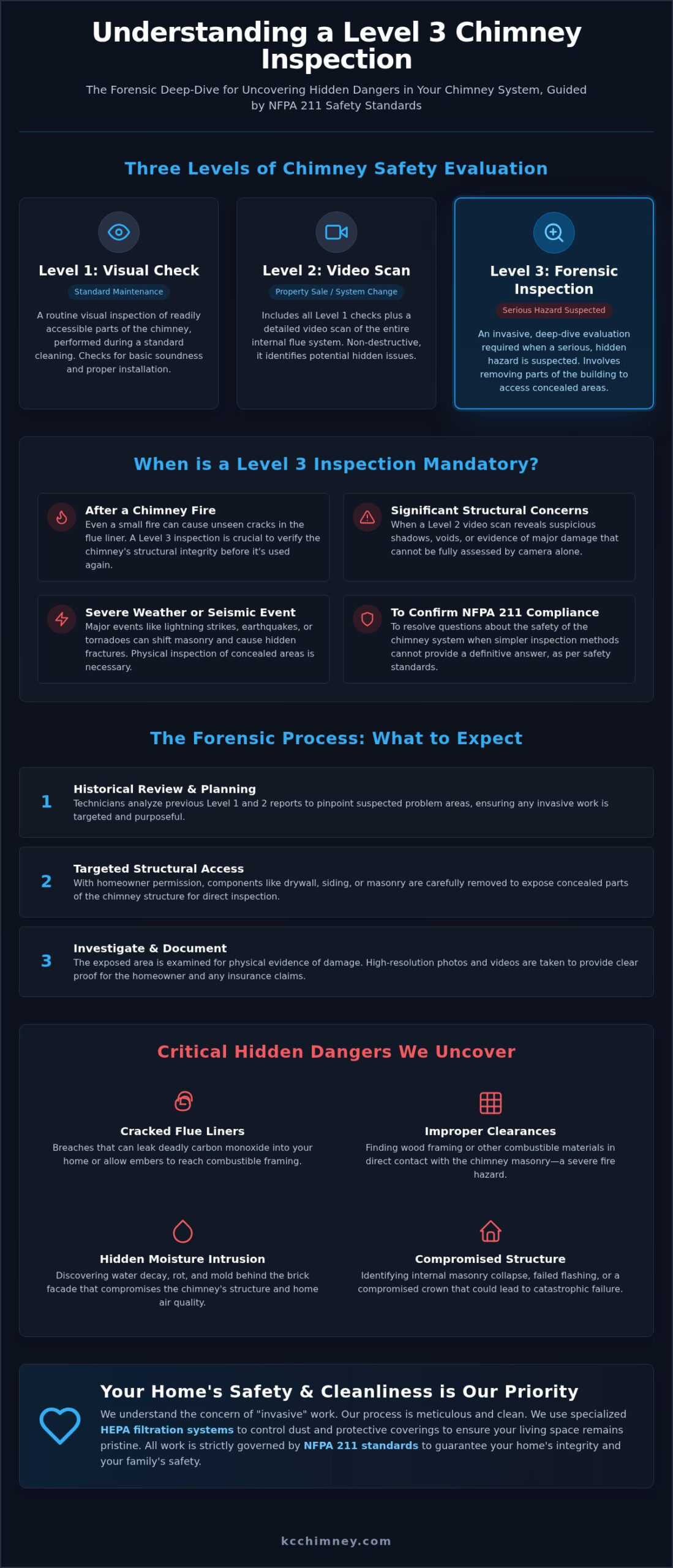
We describe this service as “forensic” because it mirrors an investigation. Just as a forensic team examines a site for evidence, our certified technicians look for physical proof of internal damage, such as cracked flue liners, improper clearances to combustibles, or moisture-driven masonry decay. It is the final step in a safety progression that begins with a basic Level 1 visual check and moves into the high-definition video analysis of a Level 2 evaluation.
The Difference Between Level 2 and Level 3
While a Level 2 chimney inspection is incredibly thorough, it relies on “non-destructive” methods. A technician uses specialized internal cameras to scan every inch of the flue, but they don’t move or remove any part of the home. A level 3 chimney inspection crosses that line. If the camera reveals a suspicious shadow or a gap behind a wall, we must physically access that area to confirm the danger. Level 2 identifies the potential problem; Level 3 confirms and measures the extent of the damage by getting hands-on with the concealed components.
The ‘Invasive’ Requirement Explained
In the chimney industry, “readily accessible” refers to areas we can reach without tools, like the firebox or the exterior crown. “Concealed” areas are those hidden behind your home’s siding, drywall, or the brick veneer itself. When a threat is hidden in these pockets, the inspection becomes invasive. This might involve carefully removing a piece of siding or cutting a small access hole in a closet wall to inspect the clearance between the chimney and the wooden framing of your house. A level 3 chimney inspection serves as the final tier of safety verification for your home’s venting system.
The Forensic Process: What Happens During a Level 3 Inspection?
A level 3 chimney inspection functions much like a surgical consultation. Before any physical changes occur, our team conducts an exhaustive review of your home’s service history. We examine previous Level 1 or Level 2 reports to identify patterns of damage or recurring issues that haven’t been resolved through standard cleaning. This baseline data helps us pinpoint “suspect” areas within the chimney structure, ensuring that any invasive work is purposeful and targeted rather than exploratory.
The scope of this work is strictly defined by the NFPA 211 Standard. This document outlines exactly when a technician must transition from visual observation to structural disassembly. During the process, we look for physical evidence of failures that could threaten your home’s safety. We look for evidence of specific failures, such as:
- Cracked or shifting flue liners that could leak carbon monoxide
- Combustible materials, like wood framing, in direct contact with the chimney
- Water intrusion and moisture decay hidden behind the masonry facade
- Compromised chimney crowns and internal flashing failures
We document every finding with high-resolution photos and video evidence. This transparency ensures you see exactly what we see, providing a clear path forward for repairs. This meticulous documentation is also vital for insurance claims, as it provides forensic proof of damage following a specific event.
Tools of the Forensic Chimney Trade
We use more than just brushes and ladders. Our forensic toolkit includes high-resolution internal flue cameras and thermal imaging sensors that detect heat signatures through walls. For structural testing, we employ specialized masonry tools to check for “soft” spots in the mortar or brickwork. These tools allow us to perform both non-destructive and destructive testing with surgical precision, minimizing the impact on your home while maximizing the accuracy of the safety report.
Accessing Concealed Areas
Gaining access to hidden anatomy is the defining feature of a level 3 chimney inspection. This might mean removing a small section of drywall in an upstairs bedroom to verify that the chimney has the required two-inch clearance from wooden framing. In other cases, we may need to open masonry joints to check for internal liner cracks or inspect the chimney’s path through attic spaces and crawlspaces. Our goal is to verify the integrity of components that are normally invisible. If you’re concerned about hidden hazards after a storm or fire, our certified specialists can provide the forensic clarity you need.
Trigger Events: When is a Level 3 Inspection Mandatory in KC?
A level 3 chimney inspection isn’t a service you schedule on a whim. Because it involves accessing concealed areas of your home, it’s reserved for specific “trigger events” where the structural integrity of the venting system is in serious doubt. The most common catalyst is a chimney fire. Even if the fire department extinguished the flames quickly, the intense heat can cause internal flue liners to shatter or wood framing behind the masonry to char. A standard camera might miss these hairline fractures or hidden hotspots, making a forensic evaluation the only way to ensure your home is truly safe to occupy.
Beyond fires, unexplained performance issues often lead to this deep-dive approach. If you notice persistent smoke leaks in an upstairs bedroom or a chemical odor that lingers despite multiple cleanings, a Level 2 camera may not be enough to find the breach. We also recommend this service after a lightning strike or a severe wind event in Overland Park. These high-impact events can shift the chimney’s internal skeleton, creating gaps that allow heat and toxic gases to bypass the flue and enter your living space.
Kansas City Weather and Structural Stress
Our regional climate presents a unique challenge for masonry. Kansas City is famous for its rapid temperature swings, especially in Johnson County where a 50 degree drop in 24 hours isn’t uncommon. These freeze-thaw cycles cause moisture trapped inside the brickwork to expand and contract violently. Over time, this leads to “spalling,” where the faces of the bricks pop off. While exterior spalling is visible, the same process often happens deep inside the chimney stack where you can’t see it. For older homes in Mission Hills with original masonry, these weather patterns can eventually necessitate a level 3 chimney inspection to verify that the internal structure hasn’t turned into a crumbling safety hazard.
Structural Failure and Seismic Triggers
If you notice your chimney is physically leaning or has developed large, horizontal cracks on the exterior, the time for visual checks has passed. These are signs of significant structural failure that could lead to a collapse. A forensic inspection acts as the “last resort” for chimneys that have failed multiple safety tests or show signs of foundation settling. By identifying these hazards early, we can determine the exact scope of work needed before the situation escalates into a total chimney repair in Kansas City. It’s about finding the root cause of the instability so the remedy is permanent, not just a cosmetic patch.
Homeowner Preparation: Costs, Time, and What to Expect
Preparing for a level 3 chimney inspection requires a shift in mindset compared to a routine maintenance visit. While a standard sweep might take an hour, this forensic evaluation is a meticulous project that can span several hours or even multiple visits. Because we are accessing the “hidden” anatomy of your home, we recommend clearing a wide perimeter around the fireplace and any attic access points. This ensures our technicians have the physical space needed to operate specialized equipment and perform structural disassembly with precision.
It’s vital to hire a certified specialist for these evaluations. A level 3 chimney inspection is the most technical service in the industry, requiring a deep understanding of both masonry and modern building codes. Our team doesn’t just look for soot; we look for structural integrity. Once the inspection is complete, you’ll receive a comprehensive written report. This document includes photographic evidence of our findings, a detailed analysis of any safety breaches, and clear recommendations for the next steps. We provide a roadmap that moves you from uncertainty to a verified safe home.
Managing the ‘Mess-Free’ Inspection
The biggest concern for many homeowners is the potential for dust and debris during masonry or drywall removal. We take this responsibility seriously. Best Chimney Services utilizes industrial-grade HEPA filtration systems to capture airborne particles before they can settle on your furniture. We use heavy-duty drop cloths and floor runners to create a “clean zone” from your front door to the work area. Our process is collaborative. We’ll walk through your home with you before we start, identifying sensitive items that need extra protection and explaining exactly where we’ll be working to minimize disruption to your daily routine.
Understanding the Cost Factors
Because every chimney is built differently, a level 3 chimney inspection is billed as a specialized labor service rather than a flat fee. Several factors influence the final cost, including the height of the chimney, the ease of access to attic spaces, and the extent of the disassembly required to reach the suspect areas. A multi-story chimney with complex masonry will naturally require more time and specialized tools than a simple single-story flue. It’s helpful to remember that the cost of an inspection is a fraction of post-fire reconstruction. If you suspect your home has hidden hazards after a fire or storm, you can schedule a professional evaluation with our certified team to get the answers you need.
Why Best Chimney Services for Forensic Inspections in Overland Park?
Choosing a provider for a level 3 chimney inspection is about more than just finding a technician with a ladder. It’s about inviting a guardian into your home who understands the gravity of hidden structural threats. At Best Chimney Services, our deep roots in the Kansas City metro mean we aren’t just contractors; we’re your neighbors. We’ve spent decades studying the unique architectural evolution of this region, from the heavy masonry of mid-century estates to the complex framing of modern suburban developments.
Our commitment to safety is backed by rigorous certification. Every member of our team is trained in the precise NFPA 211 Level 3 protocols. This specialized education ensures that when we perform invasive checks, we do so with a surgical focus on your home’s integrity. We don’t believe in high-pressure sales. Instead, we provide transparent, evidence-based reporting that demystifies complex safety issues. You’ll receive a clear, honest assessment that prioritizes your family’s peace of mind above all else.
Our Specialized KC Metro Service Area
We take immense pride in serving the diverse communities of Johnson and Miami counties. Our expertise spans the historic masonry found in Mission Hills to the modern wood and gas fireplace inserts common in Overland Park and Stilwell. Because we know the local housing stock so well, we can often predict potential “hot spots” or common construction errors before we even open a wall. This local knowledge allows us to work more efficiently, reducing the time your home is under inspection while maintaining the highest safety standards.
From Inspection to Safety Solutions
The most critical part of our process happens after the forensic work is finished. Many companies provide a report and leave the homeowner to figure out the next steps. We close that gap. We interpret our level 3 chimney inspection findings to create a comprehensive restoration plan. Whether your chimney requires relining, tuckpointing, or structural masonry work, we ensure a seamless transition from diagnosis to repair. Our goal is to ensure your hearth is ready for another safe Kansas City winter, providing you with a durable investment in your property’s future. Schedule your professional chimney evaluation with Best Chimney Services today to secure your home’s safety.
Securing Your Home with Forensic Precision
A level 3 chimney inspection is the ultimate safety net for your family. It moves beyond standard visual checks to verify the structural integrity of your chimney’s hidden anatomy. Whether you’ve experienced a chimney fire or are dealing with the cumulative damage of Kansas City’s harsh freeze-thaw cycles, this forensic approach provides the definitive answer to your safety concerns. You don’t have to wonder if your home is at risk when you have a detailed, professional report in your hands.
Since 2012, we’ve served the Overland Park and Kansas City metro area with a commitment to professional, neighborly service. Our CSIA Certified Technicians specialize in an A+ rated, mess-free process that ensures your furniture and flooring remain pristine during even the most invasive procedures. Don’t leave your family’s protection to guesswork when technical mastery and local expertise are just a click away.
Book Your Level 3 Forensic Chimney Inspection today to ensure your hearth remains a safe, reliable center for your home. We’re proud to be your local partner in long-term property protection, helping you enjoy your fireplace with total peace of mind.
Common Questions About Forensic Chimney Inspections
Is a Level 3 chimney inspection always necessary after a fire?
A level 3 chimney inspection isn’t always the first step, but it’s the gold standard for verifying safety after a fire event. We typically begin with a Level 2 video scan to assess the flue. If that scan reveals suspicious charring on the exterior of the liner or signs of intense heat transfer to the surrounding wood framing, we must move to Level 3. This ensures that hidden hazards behind your walls are fully identified before you light another fire.
Will a Level 3 inspection ruin my living room walls or ceiling?
We treat your home with surgical care rather than performing a full demolition. While we do have to access concealed areas, we only remove small, targeted sections of drywall or masonry. Our team uses industrial HEPA filtration and heavy-duty floor protection to ensure the process is mess-free. Any structural access is planned carefully to minimize the footprint of the work while still getting the safety data we need.
How long does a typical Level 3 chimney inspection take to complete?
You should expect this process to take several hours or even a full working day. Unlike a standard sweep that is finished in under an hour, a forensic evaluation is a deep investigation. We have to carefully disassemble specific components, document every finding with photos, and analyze the structural integrity of the entire system. The complexity of your chimney’s height and the number of flues will determine the final timeline.
Can any chimney sweep perform a Level 3 inspection in Kansas City?
No, this level of work requires specialized certification and advanced technical knowledge. You should only trust technicians who are specifically trained in NFPA 211 Level 3 protocols. Our team brings years of experience with Kansas City’s unique architectural styles. This specialized training allows us to interpret complex structural data that a general sweep might miss, ensuring your safety report is accurate and reliable.
What happens if the Level 3 inspection finds serious structural damage?
We provide you with a comprehensive restoration plan and a detailed safety report. If we find cracked liners or compromised masonry, we’ll explain the exact risks and the necessary steps to fix them. This might include services like chimney relining or tuckpointing. Our goal is to act as your home’s guardian, moving you from a state of uncertainty to a clear, professional solution that protects your property.
Do I need a Level 3 inspection if I am just buying a new home?
A Level 2 inspection is the standard requirement for real estate transfers in the KC metro. You only need a level 3 chimney inspection during a home purchase if the initial camera scan uncovers a major defect that is hidden from view. If the inspector sees something that suggests a deep structural failure or an immediate fire hazard behind the walls, they will recommend a Level 3 check to protect your investment.
How much does a Level 3 chimney inspection typically cost in Overland Park?
The cost of a forensic inspection depends entirely on the scope of the investigation and the accessibility of your chimney. Factors like the height of the stack, the number of access points needed, and the complexity of the masonry all play a role. Since this is a specialized labor service rather than a flat-fee cleaning, we provide a clear breakdown of the work involved. It’s a vital investment in your home’s long-term safety and structural integrity.
Is a Level 3 inspection required for gas fireplace inserts as well?
Yes, gas systems can still require forensic checks if there are signs of venting failure. While gas doesn’t produce creosote, it does produce carbon monoxide and moisture that can decay masonry from the inside out. If we suspect that the venting for your insert is leaking into the home’s structure or lacks proper clearance to combustibles, we must use a Level 3 approach to confirm the hazard and ensure your family’s safety.