
What if the most dangerous threat to your home is hidden in a section of the flue that a standard camera simply cannot reach? If you live in Mission Hills, hearing that you need a level 3 chimney inspection Mission Hills service can feel overwhelming. You likely worry about the potential for property damage or wonder why a previous Level 2 scan wasn’t enough to clear your fireplace for use. It’s natural to feel protective of your home’s structure, especially when surgical diagnostics are mentioned.
This article will help you understand exactly when this invasive approach is necessary to keep your family safe and your property protected. We’ll explain the specific triggers defined by the National Fire Protection Association, such as suspected structural failure after a seismic event or a serious chimney fire. You will learn how a professional team respects your living space while accessing concealed areas, ensuring you get the documented proof needed for insurance claims or safety clearance. We’ll walk you through the process so you can move forward with confidence and the peace of mind that your home’s integrity is intact.
Key Takeaways
- Identify the specific “surgical” diagnostics used to access concealed chimney components that standard video scans cannot reach.
- Learn the critical triggers that make a level 3 chimney inspection Mission Hills mandatory, such as post-fire analysis or damage from severe Kansas City ice storms.
- Understand how the unique masonry of historic Mission Hills estates from the 1920s to the 1950s presents specific safety challenges.
- Discover what to expect during the controlled removal of small sections of drywall or siding to ensure your home’s structural integrity.
- See how CSIA-certified technicians utilize rigorous industry standards to provide documented proof for insurance claims and safety clearances.
What is a Level 3 Chimney Inspection in Mission Hills?
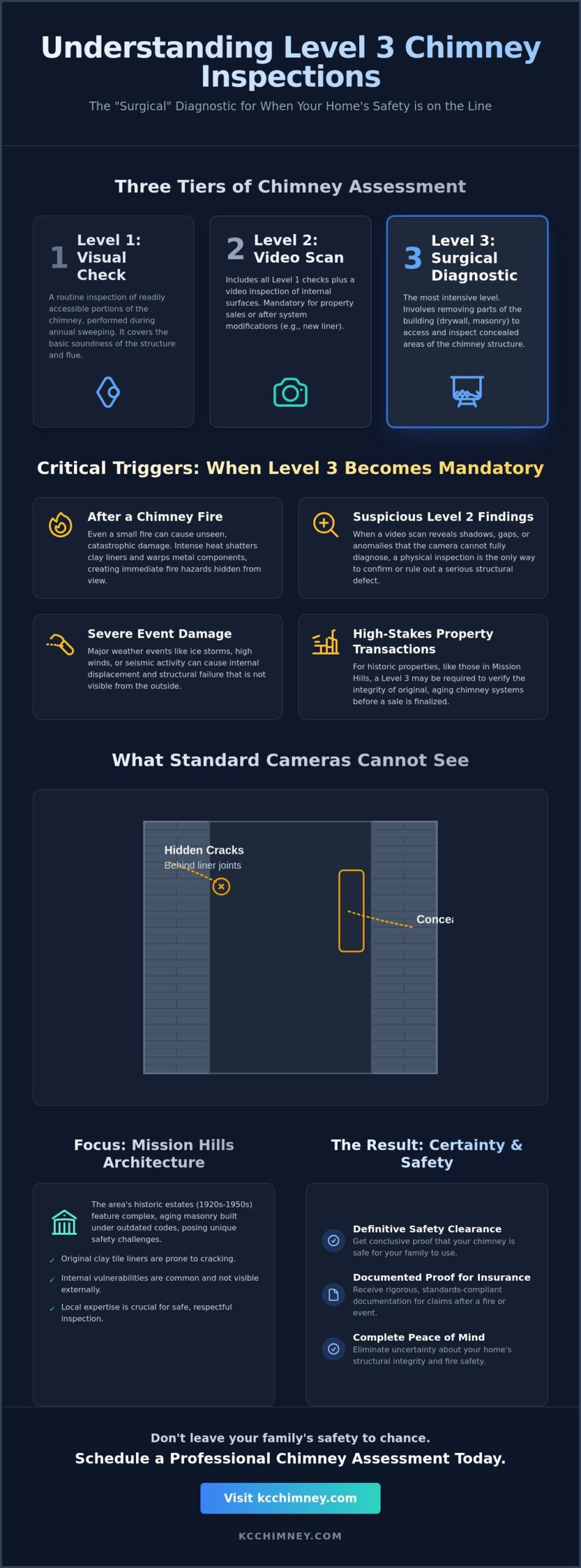
A level 3 chimney inspection Mission Hills is the most intensive diagnostic service available for your fireplace. It goes far beyond the routine sweeping or the standard video scans used in Level 1 and Level 2 assessments. Instead, this is a surgical approach. We use it when a serious, hidden hazard is suspected but cannot be confirmed without accessing the internal components of the system. This level of inspection is governed by the NFPA 211 standards, which provide the framework for diagnosing complex structural issues in residential venting systems.
In many of the grand, historic estates found throughout Mission Hills, chimney structures are often complex and decades old. These older masonry systems were built under different codes; they may have developed internal vulnerabilities that a visual scan won’t reveal. When your safety is at stake, a level 3 chimney inspection Mission Hills provides the definitive answers you need. This process involves the controlled removal of certain building components, such as a piece of drywall, siding, or masonry, to gain an unobstructed view of the chimney’s inner workings. Our priority is to find immediate fire or collapse risks that could threaten your family’s safety, providing a level of thoroughness that protects your investment.
The NFPA 211 Standard and Your Safety
The National Fire Protection Association (NFPA) sets the benchmark for chimney safety across the country. Their 211 standard dictates that a Level 3 inspection is mandatory when a Level 1 or 2 suggests a hidden hazard. This isn’t just about technical compliance; it’s about your peace of mind. Following these rigorous rules ensures your home insurance remains valid and provides documented proof of your home’s safety. We take our role as the guardian of your home seriously, using these standards to provide a definitive clearance for your fireplace. It’s a methodical process that prioritizes your family’s protection over speed.
Concealed Areas: What the Camera Misses
Even the best high-definition cameras have limitations. They can’t see behind the flue liner or into the “dead spaces” where the chimney meets your home’s wooden framing. These areas are often where the most dangerous clearance issues exist, as heat can transfer through the masonry and ignite nearby wood. A Level 3 diagnostic allows us to physically inspect the chimney’s inner skeleton. We check the integrity of the smoke chamber and the hidden flue joints that are tucked away from view. By getting hands-on access to these concealed zones, we ensure that no hidden cracks or structural failures are left to chance, giving you a full picture of your system’s health.
Critical Triggers: When Level 3 Becomes Mandatory
A Level 3 inspection is not a standard service for your typical autumn preparation. It is a specialized response to specific, high-risk events that compromise the safety of your home. While a Level 1 or 2 inspection covers the visible and accessible portions of the system, a level 3 chimney inspection Mission Hills becomes mandatory when those preliminary checks reveal evidence of a serious, hidden hazard. According to the NFPA 211 standard, this level of investigation is required whenever the structural integrity of the chimney is in question.
Common triggers include:
- Suspicious Level 2 Findings: If a video scan reveals a shadow or a gap that a camera cannot fully interpret, physical access is the only way to confirm if a crack exists.
- Severe Weather Damage: Kansas City’s notorious wind and ice storms can exert immense pressure on older masonry. If a storm causes visible exterior damage, internal displacement is often likely.
- Real Estate Transactions: In historic Mission Hills properties, a buyer may request a Level 3 if major defects are suspected in the original clay tile liners.
The Aftermath of a Chimney Fire
A chimney fire is perhaps the most urgent trigger for surgical diagnostics. Many homeowners assume that if the fire department extinguished the flames and the exterior looks fine, the danger has passed. This is a dangerous misconception. The intense heat of a chimney fire can cause clay liners to shatter and metal liners to warp. These internal failures are often invisible to standard sweeps. We use Level 3 diagnostics to document this damage for insurance adjusters, ensuring you have the evidence needed for a successful claim. If you’ve experienced a fire event, scheduling a Level 3 Inspection is the only way to ensure your home remains protected.
Structural Integrity and Seismic Shifts
Mission Hills homes often face unique challenges from foundation settling and extreme freeze-thaw cycles. These shifts can pull the chimney away from the house’s framing or cause internal masonry to slide. When we see signs of vertical misalignment, we must open small access points to check the “inner skeleton” of the flue. This is also essential after significant home renovations. If you’ve added a new hearth or changed the structural layout near the chimney, a Level 3 clearance ensures that the new construction hasn’t compromised the original venting path. It’s a methodical way to ensure your fireplace remains a safe centerpiece of your home.
The Invasive Reality: What Happens During the Inspection?
The term “invasive” often causes concern for homeowners, but in the context of a level 3 chimney inspection Mission Hills, it simply means we are moving beyond visual limitations. While previous stages rely on what can be seen from the hearth or the roof, Level 3 requires us to look behind the scenes. This involves the controlled and careful removal of small sections of drywall, siding, or masonry. We don’t do this blindly. We target specific areas where internal damage is most likely to hide, such as the transition points between the chimney and the house’s framing.
Our focus during this process is often the smoke chamber and the hidden flue joints. These components are the “inner skeleton” of your venting system. Over time, or after a traumatic event like a chimney fire, these joints can separate or crack. By gaining physical access, we can perform direct testing that a camera might miss. Our technicians, trained under the rigorous standards of the Chimney Safety Institute of America, use this access to measure clearances to combustible materials with absolute precision. We view the invasive component of this process as a temporary necessity for permanent safety.
Access Points and Property Protection
We understand that your home is your sanctuary. Before we begin any physical removal, we identify the least intrusive path to the problem area. Our team uses heavy-duty drop cloths and professional-grade HEPA filtration to maintain a “Zero-Mess” environment. If we must temporarily displace brickwork, we coordinate closely with masonry experts to ensure the structural and aesthetic integrity of your chimney is preserved. You won’t be left with a construction site; you’ll be left with answers. We treat every Mission Hills estate with the respect it deserves, ensuring our footprint is as small as possible.
The Diagnostic Toolkit for Level 3
Once we have access, we deploy a specialized toolkit designed for deep diagnostics. We use thermal imaging to detect heat transfer issues that could ignite wooden wall studs. Physical probes allow us to check the stability of mortar joints and the thickness of the flue liner. We also verify that the internal clearances meet modern safety codes, which is especially important in older homes where original construction may have shifted. This data-driven approach removes the guesswork from chimney safety. We provide you with a detailed report of these findings, giving you the documented proof required for insurance claims or future property sales.
Mission Hills Architecture: Why Local Expertise Matters
Mission Hills is defined by its architectural heritage. The historic estates built between the 1920s and 1950s feature intricate masonry that requires a specialized eye to inspect. When you schedule a level 3 chimney inspection Mission Hills service, you’re hiring someone who understands the specific construction methods of that era. These homes often utilize original clay tile liners and stone veneers that have faced decades of environmental stress. A technician from outside the area might miss the subtle signs of internal failure that a local expert identifies immediately. We prioritize the preservation of your home’s character while ensuring it meets modern safety requirements.
Our local expertise allows us to identify where historic craftsmanship might clash with current fire codes. If a diagnostic reveals significant gaps or structural decay, performing a professional chimney repair in Kansas City becomes the necessary next step. We focus on restoring the “inner skeleton” of your fireplace so it functions as safely as it did the day it was built. This methodical approach protects your family and preserves the longevity of your property’s most iconic features.
Historic Masonry and Modern Standards
Many older chimneys in Mission Hills were built without the clearances we require today. In the mid-20th century, it was common to find wooden framing members resting directly against masonry walls. Over time, heat transfer can pyrolyze this wood, making it highly combustible. A Level 3 inspection is the only way to verify these hidden clearances without guessing. We balance the need for historic preservation with 2026 safety standards, ensuring your classic unlined flue or aging tile system doesn’t become a liability. It’s about making your hearth a safe place for modern living.
Johnson County Climate Factors
The climate in Johnson County is particularly hard on masonry. High humidity followed by rapid freezing causes water trapped in the brickwork to expand, leading to internal cracks. While exterior tuckpointing can fix surface-level mortar loss, it doesn’t address the deterioration of the internal flue tiles. Our freeze-thaw cycles often stress the joints in ways that only a surgical diagnostic can uncover. Preparing your chimney for the specific demands of a Missouri or Kansas winter requires more than a visual check; it requires a deep dive into the system’s structural health. If you suspect your chimney has suffered from recent storm damage, contact us at kcchimney.com to ensure your home is ready for the cold months ahead.
Why Best Chimney Services is the Trusted Choice for Level 3
Choosing a team for a level 3 chimney inspection Mission Hills is a decision that directly impacts the structural safety of your family’s home. You aren’t just looking for a technician; you’re looking for a partner who understands the high stakes of surgical diagnostics. Our team consists of CSIA-certified professionals who have undergone rigorous training specifically for Level 3 scenarios. This certification is a non-negotiable baseline for our work. It ensures that every invasive procedure is handled with technical mastery and a deep understanding of the national safety standards. We don’t guess when it comes to your safety.
We take a neighborly approach to every project we undertake. We understand the architectural value of Mission Hills properties and treat your home with the highest level of respect. Our process is methodical, steady, and tidy. Once the inspection is complete, we provide a comprehensive report that acts as a roadmap for your home’s safety. This isn’t just a list of technical jargon. We include clear photo evidence and plain-English explanations of every finding we uncover. If a hazard is discovered, we offer a seamless transition to expert chimney repair, ensuring your venting system is restored to peak condition with minimal stress.
The ‘Guardian of the Home’ Philosophy
Our philosophy is rooted in protection and reliability. We prioritize your family’s peace of mind over a quick service call. This means we are transparent about why an invasive procedure is necessary before we ever pick up a tool. We provide clear communication on the scope of the work and maintain a straightforward approach to our service. Whether you need documented proof for an insurance claim or a safety clearance for a home sale, we deliver the precise data you need. We believe that a chimney professional should be a guardian of the hearth, providing integrity that lasts for the life of your property.
Ready to Secure Your Hearth?
Delaying a level 3 chimney inspection Mission Hills when a hazard is suspected can lead to catastrophic results. Hidden structural failures or clearance issues don’t resolve themselves; they worsen with every fire you light. Protecting your home requires proactive care from seasoned professionals who value long-term relationships over high-pressure sales tactics. If you’ve seen the warning signs mentioned in this article, it’s time to act. Schedule your professional Level 3 inspection with Best Chimney Services today. We’ll help you navigate the diagnostic process with care, precision, and the local expertise your Mission Hills home deserves.
Protect Your Historic Mission Hills Home
Your fireplace is the heart of your home, but its safety depends on what you can’t see. A level 3 chimney inspection Mission Hills ensures that hidden structural threats, from historic masonry gaps to post-storm displacement, are identified with surgical precision. By choosing a team that has served the community since 2012, you gain the peace of mind that comes with deep local knowledge and technical mastery. We understand the unique architectural nuances of our neighborhood and prioritize your family’s protection above all else.
Our CSIA Certified Technicians provide the documented safety reports required for insurance claims and property clearances. We treat every estate with the respect it deserves, ensuring our diagnostic process is as clean as it is thorough. Don’t leave your family’s safety to chance when definitive answers are within reach. Taking action now prevents small internal issues from becoming catastrophic failures later. We are here to guide you through every step of the process with honesty and care.
Book Your Mission Hills Level 3 Safety Evaluation today to secure your hearth for the seasons ahead. We look forward to helping you keep your home a safe sanctuary for years to come.
Frequently Asked Questions
What is the difference between a Level 2 and a Level 3 chimney inspection?
A Level 2 inspection is a non-invasive process that utilizes high-definition cameras to scan the internal flue. In contrast, a level 3 chimney inspection Mission Hills service is a surgical diagnostic that requires physical access to concealed areas. While Level 2 examines what is visible, Level 3 involves removing small sections of the home’s structure to check the “inner skeleton” and clearances to combustible materials.
Will a Level 3 inspection damage my home’s interior?
The procedure involves the controlled removal of certain components, such as a piece of drywall or siding, but it isn’t reckless. We identify the least intrusive path to the suspected hazard to minimize the footprint of the work. Our team uses professional-grade HEPA filtration and drop cloths to maintain a clean environment. We view these temporary access points as a necessary step to ensure your home’s long-term safety.
How long does a Level 3 chimney inspection typically take in Mission Hills?
You should expect the process to take anywhere from four to eight hours depending on the complexity of your chimney’s construction. Historic Mission Hills estates often have unique masonry layouts that require a more methodical approach to access. We work steadily to ensure every structural joint is verified without rushing the diagnostic. We provide a clear timeline before we begin so you can plan your day accordingly.
Is a Level 3 inspection required for a standard home sale in Johnson County?
No, a Level 2 inspection is the standard requirement for most real estate transactions in Johnson County. A level 3 chimney inspection Mission Hills is only triggered if the initial Level 2 scan reveals a “suspicious” shadow or evidence of a major hidden defect. If the inspector cannot clear the chimney for use based on visual evidence alone, they will recommend moving to Level 3 to protect the buyer’s investment.
What are the most common hidden hazards found during a Level 3 inspection?
The most frequent hazards include insufficient clearances to wooden framing and cracked internal flue tiles. We often find that older chimneys have “dead spaces” where heat transfers directly to combustible wall studs. Other common issues include disconnected liner joints or voids in the smoke chamber that were previously hidden from camera view. Identifying these hazards is the only way to prevent a catastrophic house fire during the winter months.
Can I stay in my home while a Level 3 inspection is being performed?
Yes, you can absolutely stay in your home while our team is working. The process is localized to the chimney area and doesn’t create any hazards for the rest of the household. While there may be some noise during the removal of access panels, we work quietly and efficiently to minimize disruption. We prioritize your comfort and keep you informed of our progress throughout the diagnostic process.
Do insurance companies cover the cost of a Level 3 inspection after a fire?
Many insurance providers do cover the cost of a Level 3 inspection if a chimney fire has occurred. Since this diagnostic is required to document hidden damage for a claim, it is often viewed as a necessary part of the recovery process. You should check with your specific provider to confirm your coverage. We provide the detailed photo evidence and technical reports that adjusters need to process your claim accurately.
What happens if my chimney fails a Level 3 inspection?
If your system fails, we will provide a detailed report explaining why it is currently unsafe to use. We don’t leave you with just bad news; we offer a clear path forward for restoration. This may include services like chimney relining or tuckpointing to address the structural deficiencies. Our goal is to move your fireplace from a liability back to a safe, functional centerpiece for your home.