
Imagine you’ve just weathered a chimney fire in your historic Brookside home. The fire department is gone, but the heavy scent of soot and a lingering sense of unease remain. You know a standard visual check won’t be enough to guarantee your family’s safety tonight. In these high-stakes moments, a level 3 chimney inspection in Kansas City becomes more than just a service; it’s a forensic necessity to uncover hidden hazards that cameras and mirrors simply can’t reach. It’s natural to feel anxious about a process that requires removing portions of your drywall or masonry, especially when you’re already dealing with the aftermath of a traumatic event.
We understand that your home is your sanctuary, and our goal is to restore that sense of security with absolute precision. This article will help you understand the specific triggers that make this invasive evaluation necessary under the 2024 edition of NFPA 211 standards. You’ll learn what to expect during the forensic process, how we maintain a mess-free environment even during structural work, and how this deep dive provides the definitive proof you need for insurance claims and long-term repairs. We’re here to provide a clear roadmap back to a safe, functional hearth and the peace of mind you deserve.
Key Takeaways
- Discover why a level 3 chimney inspection in Kansas City is the only way to find hidden structural damage after a chimney fire or a lightning strike.
- Learn what to expect during this forensic process, including how we’ll access concealed areas behind your drywall or masonry with minimal disruption.
- Understand how local weather patterns and aging architecture in historic neighborhoods like Mission Hills make deep-dive inspections a vital safety measure.
- Find out how specialized tools like thermal imaging help provide the definitive proof you’ll need for insurance claims and structural repairs.
- Gain a clear roadmap for prioritizing fireplace restoration so you can focus on immediate fire hazards before tackling routine maintenance.
What is a Level 3 Chimney Inspection? Beyond the Surface
A Chimney is a complex structural component that does more than just vent smoke; it’s an integral part of your home’s safety system. Most homeowners are familiar with an annual sweep or a basic visual check. However, a level 3 chimney inspection in Kansas City is a different category entirely. It isn’t a routine maintenance visit or a simple cleaning. Instead, think of it as a forensic investigation. We perform this deep dive only when standard methods cannot provide a definitive answer about your chimney’s safety.
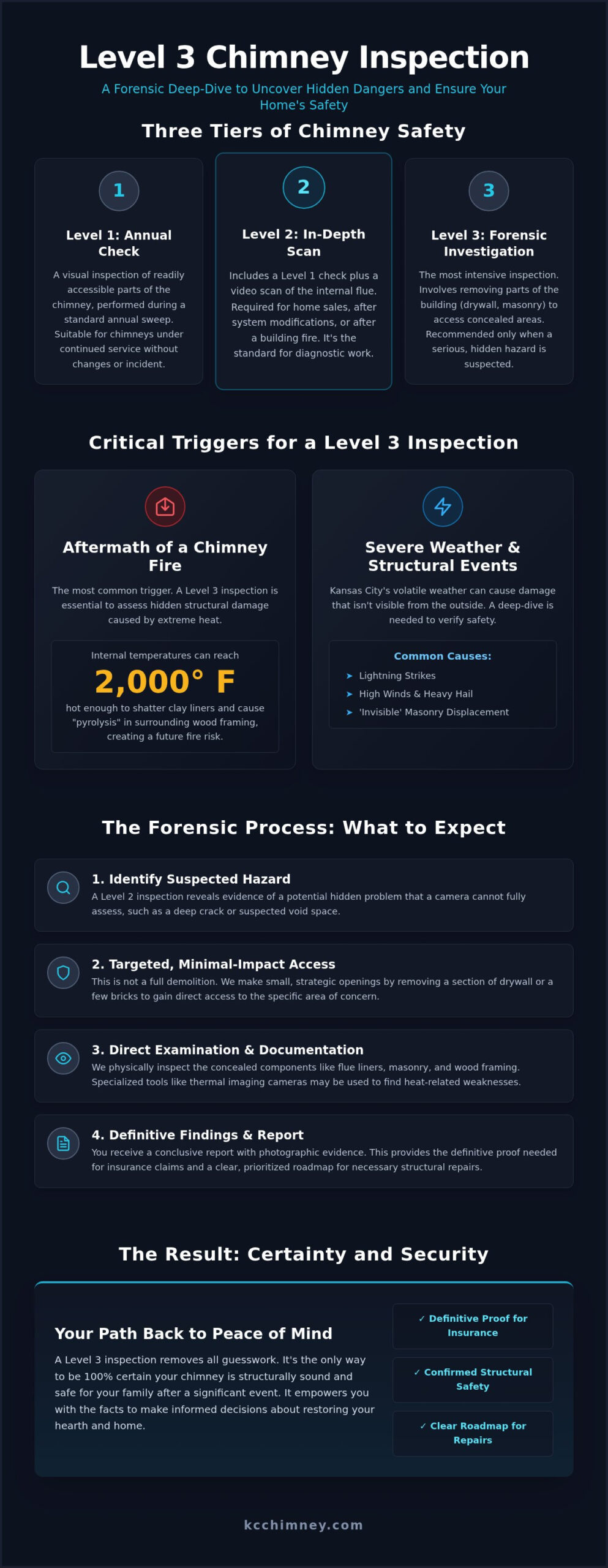
While Level 1 and Level 2 inspections focus on what we can see with our eyes or specialized cameras, Level 3 goes where those tools can’t reach. It involves the removal of permanent portions of the chimney or building structure. This might include taking out a section of drywall, removing masonry bricks, or opening up a chimney crown to see the internal flue liners. We only recommend this when we suspect a serious, hidden hazard that threatens your home’s integrity. It’s a progression from simple observation to physical investigation.
The NFPA 211 Standards for Level 3
The National Fire Protection Association (NFPA) sets the gold standard for fire safety in the United States. Their 2024 edition of NFPA 211 outlines three distinct tiers of inspection to ensure every fireplace is safe to operate. Level 3 is the most intensive tier. It’s specifically reserved for situations where a standard evaluation suggests deep-seated, suspected hidden hazards. Only certified professionals should determine if your home requires this level of scrutiny. We follow these standards to ensure every step we take is necessary, methodical, and focused on protecting your family from fire risks.
Level 2 vs. Level 3: When the Camera Isn’t Enough
A Level 2 inspection is often the first step in diagnosing a problem. It uses high-definition video scanning to look inside the flue and checks accessible areas like the attic or crawlspace. But sometimes, a camera isn’t enough. Imagine a scenario where a video scan reveals a jagged crack in a clay liner that appears to extend into the surrounding masonry. A camera can’t tell us if there’s a void behind that brick where heat could escape into your wooden framing.
This is where a level 3 chimney inspection in Kansas City becomes vital. We don’t perform a total demolition of your fireplace. Instead, we use a targeted approach to access specific blind spots. By removing a small, strategic section of the structure, we can verify the extent of the damage. This precision allows us to provide a definitive answer about whether your chimney is safe or if it needs structural restoration. It’s about getting the facts so you can make informed decisions for your home.
Critical Triggers: When Does a KC Home Need Level 3?
Homeowners often wonder why a standard sweep or a quick visual check isn’t enough. In many cases, a level 3 chimney inspection in Kansas City is triggered by a specific event that compromises the fireplace’s integrity. While a Level 2 check is standard during home sales, the Level 3 tier is reserved for high-stakes scenarios where your family’s safety is no longer a given. It’s the only way to confirm if a chimney is truly safe after it’s been pushed to its limits.
The Aftermath of a Chimney Fire
A chimney fire is the most common reason we’re called to perform this forensic level of work. During a fire, internal temperatures can reach 2,000 degrees, which is hot enough to warp metal liners and shatter clay tiles instantly. Even if the exterior masonry looks fine, that intense heat often causes “pyrolysis” in the surrounding wooden framing. This chemical change makes the wood ignite at much lower temperatures in the future. A chimney fire can reach 2000 degrees and compromise structural integrity. To ensure your home is safe, we must often access the wall cavity to inspect these hidden structural components.
Storm Damage and Insurance Claims
Kansas City’s volatile weather is another major factor. High winds, heavy hail, and lightning strikes can cause “invisible” masonry displacement. This isn’t just about a few loose bricks on the crown; it’s about the internal shifting of the entire stack. According to the NFPA 211 standard, significant weather events often necessitate a deeper look to verify safety. A professional report from a chimney repair expert is vital for insurance adjusters. They need definitive, forensic evidence to approve structural claims, and a Level 3 report provides the necessary documentation.
Older homes in neighborhoods like Mission Hills and Brookside also face risks from structural settling. Over decades, the ground shifts and heavy masonry can pull away from the house frame. If you notice a persistent smoky odor or a leak that won’t go away after multiple repairs, it’s a sign that the problem is buried deep within the structure. A level 3 chimney inspection in Kansas City uncovers these “mystery” issues by looking behind the surface. If you’re concerned about a recurring problem, reaching out to a local certified team can help you identify the root cause before it leads to a fire hazard.
The Forensic Process: What to Expect During the Inspection
When we arrive for a level 3 chimney inspection in Kansas City, our team operates more like forensic investigators than traditional sweeps. This process is highly methodical. We don’t start by tearing into walls; instead, we begin by identifying specific access points. These are strategic locations where removing a small section of the structure will provide the most critical data. By pinpointing these areas, we ensure that every action we take is purposeful and aimed at uncovering the root cause of a suspected hazard.
Our technicians use an array of specialized tools to look where eyes cannot reach. High-definition scopes allow us to navigate tight bends, while thermal imaging cameras detect heat signatures that suggest failing insulation or thinning masonry. Moisture meters help us track the path of persistent leaks that have eluded previous Level 2 evaluations. Every finding is documented with photographic evidence, which eventually forms the backbone of your final forensic report. This level of detail is exactly what insurance adjusters and structural engineers need to move forward with a claim or repair plan.
Is It Destructive? Managing the ‘Invasive’ Aspect
It’s natural to feel a bit of anxiety when you hear the word “invasive.” However, in the context of a level 3 chimney inspection in Kansas City, invasive means “necessary access,” not reckless demolition. We treat your home with the respect it deserves. As your home’s guardian, we use professional drop cloths and advanced dust containment systems to ensure your living space remains pristine. Our goal is to verify the safety of the thermal envelope surrounding the flue. If we must remove a piece of siding or a section of interior drywall, we do so with surgical precision, keeping the footprint of the inspection as small as possible.
Analyzing the Internal Components
Once we’ve gained access, we focus on the components that are usually hidden by the building’s structure. We’re looking for several critical safety factors:
- Clearance to Combustibles: We verify the actual gap between your chimney and the wooden house framing to ensure it meets modern safety codes.
- Flue Liner Joints: We check the integrity of the joints in sections of the flue that are buried deep within the masonry stack.
- Smoke Shelf and Damper: In complex masonry builds, we inspect the condition of the smoke shelf and damper assembly for signs of heat-induced warping or structural failure.
This thorough examination provides you with definitive proof that your chimney is either safe to use or requires specific structural restoration. It replaces uncertainty with a clear, evidence-based roadmap for your home’s future.
The Kansas City Factor: Local Risks and Older Architecture
Kansas City’s climate is notoriously hard on masonry. The constant shift between freezing nights and sunny afternoons in Overland Park and Leawood creates a unique stressor for your home’s exterior. This volatile environment makes a level 3 chimney inspection in Kansas City a common necessity for older properties. While newer builds often feature modern safety components, the historic housing stock in neighborhoods like Mission Hills frequently relies on aging clay tiles. These materials weren’t designed to withstand a century of our region’s weather cycles. Understanding how our local geography impacts your chimney’s health is the first step in being a proactive homeowner.
Freeze-Thaw Cycles and Structural Voids
Moisture is the primary enemy of masonry. When rain or melting snow seeps into small pores in your brickwork and then freezes, it expands with incredible force. This process leads to internal “spalling,” where the face of the brick or tile flakes off inside the structure. A chimney sweep in Kansas City might notice unusual debris during a standard cleaning that indicates a much larger hidden problem. Often, visible damage requiring crown repair is just the tip of the iceberg. A Level 3 inspection looks beneath that crown to find structural voids that a standard camera would simply pass over. It’s the only way to ensure that the internal “stack effect” isn’t pulling heat into your walls through these invisible gaps.
Older Masonry in Johnson County
In areas like Stilwell and Bucyrus, many larger estates feature massive multi-flue chimneys. These complex structures are prone to “shifting” as older foundations settle in the heavy clay soil common across the metro. If these flues become misaligned, it creates a significant risk of heat transfer to the home’s wooden framing. Our neighborly approach to these historic KC hearths focuses on both preservation and safety. We stay current with the 2018 International Building Code requirements adopted by the City of Kansas City to ensure every forensic check meets rigorous safety standards. Whether you’re on the Kansas or Missouri side, the structural integrity of your flue shouldn’t be a guessing game. If you’ve noticed new cracks in your fireplace facade, it’s time to consult with a local expert who understands the specific architectural needs of our community.
Next Steps: From Inspection to Restoration
Completing a level 3 chimney inspection in Kansas City is a significant step toward securing your home’s safety. Once the physical investigation is finished, the focus shifts to understanding the results and determining a path forward. You aren’t just left with a pile of data; we provide a comprehensive roadmap that translates technical findings into actionable repairs. This phase is about providing clarity and prioritizing the work that protects your family from immediate fire risks.
Not every finding in a forensic report requires an emergency response. Our technicians help you distinguish between “immediate fire hazards,” such as a breached thermal envelope, and “maintenance needs,” like minor tuckpointing. If the evaluation reveals deep-seated damage, we often recommend chimney relining to restore the flue’s integrity. Our commitment is to handle these structural restorations with the same precision and integrity we bring to the initial inspection, ensuring your hearth remains a safe centerpiece for your home.
Interpreting Your Level 3 Report
A professional evaluation should never be a mystery. Your forensic report will include clear pass/fail criteria for every component inspected, supported by high-resolution photographic evidence. This document is a powerful tool. You can use it to provide definitive proof to insurance adjusters or to obtain secondary opinions from structural engineers. A clear Level 3 report is an investment in your home’s resale value, offering future buyers documented proof of structural safety. It replaces anxiety with verified facts, giving you the confidence to use your fireplace again without hesitation.
Scheduling Restoration in Kansas City
Transitioning from a level 3 chimney inspection in Kansas City to a full fireplace repair is a seamless process with our team. We understand the specific safety standards required by local codes on both sides of the state line. By choosing a local, certified team, you ensure that the restoration work accounts for the regional climate challenges and architectural nuances of the KC metro. We don’t just fix the surface; we address the root cause discovered during the forensic evaluation. Our goal is to leave your home safer and more durable than we found it. For peace of mind and a definitive look at your chimney’s health, contact Best Chimney Services for a professional evaluation.
Restore Your Peace of Mind and Hearth Safety
A level 3 chimney inspection in Kansas City is the ultimate safeguard for your home’s structural integrity. Whether you’re recovering from a chimney fire or investigating a mystery leak in an older Mission Hills estate, this forensic evaluation replaces uncertainty with verified facts. We’ve explored how this invasive yet surgical process uncovers hazards hidden behind your walls, from scorched framing to internal masonry voids that standard cameras simply cannot detect. This deep dive provides the clarity needed to make informed decisions about your property’s future.
Choosing a forensic approach means you aren’t guessing about your family’s safety. Our team has served as the guardian of the home with certified technicians since 2012. As locally owned Kansas City experts, we understand the unique architectural demands of our community and provide the comprehensive forensic reporting you need for insurance claims or structural restoration. Don’t let hidden hazards linger in your chimney stack. We’re here to ensure your fireplace remains a source of warmth and comfort for years to come.
Schedule Your Certified Level 3 Inspection with Best Chimney Services Today. We’re ready to help you enjoy your hearth with absolute confidence once again.
Frequently Asked Questions
How much does a Level 3 chimney inspection cost in Kansas City?
The cost for this type of forensic evaluation is quoted on a case-by-case basis. Because it involves accessing concealed areas of your home’s structure, the scope of work depends on the complexity of your chimney and the specific access points required. We recommend starting with a Level 2 evaluation to determine if a Level 3 is truly necessary. This ensures you only pay for the specific forensic work needed for your home’s safety.
Is a Level 3 inspection always required after a chimney fire?
It isn’t always mandatory, but it is the most reliable way to guarantee safety after a high-heat event. While a video scan identifies visible damage, a fire reaching 2,000 degrees can cause hidden structural failures. If an initial scan suggests a breach in the thermal envelope, we move to a Level 3. This allows us to verify that your home’s wooden framing hasn’t been compromised by pyrolysis or heat transfer.
Will you have to tear down my fireplace for a Level 3 inspection?
No, we perform a targeted forensic evaluation rather than a total demolition of your hearth. We only remove the minimum “permanent” portions of the structure needed to reach suspected hazards. This might include a small section of interior drywall or a specific masonry brick. Our goal is to protect your property’s integrity while verifying its safety. We use dust containment systems to ensure the process remains mess-free.
How long does a Level 3 chimney inspection take to complete?
The duration varies based on your chimney’s construction and the number of access points identified. Most forensic evaluations in the KC metro take several hours to a full day to complete thoroughly. This includes the time needed to carefully remove structural components, perform the technical analysis, and document everything with high-definition photography. We prioritize precision over speed to ensure no hidden fire hazard is overlooked during the process.
Can I stay in my home while a Level 3 inspection is being performed?
Yes, you can typically remain in your home while our technicians work. We understand that invasive work can feel disruptive, so we use professional drop cloths and specialized equipment to manage dust and debris. We focus our efforts on the specific access points identified during our initial assessment. This neighborly approach allows us to act as the guardian of your home without requiring you to relocate during the investigation.
What is the difference between a Level 2 and a Level 3 inspection?
A Level 2 inspection is a non-invasive check using video scanning and access to attics or crawlspaces. In contrast, a level 3 chimney inspection in Kansas City is a forensic, invasive process. It requires us to remove portions of the building or chimney structure to reach concealed areas. While Level 2 is standard for home sales, Level 3 is reserved for suspected serious hazards that standard cameras cannot reach.
Does homeowners insurance usually cover Level 3 chimney inspections?
Coverage depends on your specific policy and the event that triggered the need for an inspection. If the evaluation is required following a sudden event like a chimney fire or a lightning strike, many insurance companies in the KC metro will cover the forensic work. We provide a detailed report with photographic evidence to help you and your adjuster document the need for structural investigation and any subsequent repairs required for safety.
How do I know if my Kansas City chimney inspector is qualified for Level 3?
You should look for technicians with specific certifications and extensive structural masonry experience. A qualified level 3 chimney inspection in Kansas City professional will be well-versed in the 2024 edition of NFPA 211 standards. Since 2012, our team has specialized in these high-level safety evaluations. We recommend verifying that your inspector uses specialized forensic tools like thermal imaging and provides a comprehensive written report with photographic proof of all findings.