
You settle in for a quiet evening as the Kansas wind howls outside, but the moment you light your hearth, a cloud of soot-heavy smoke billows into your living room instead of rising up the chimney. It’s incredibly frustrating when your fireplace feels more like a hazard than a comfort, especially when you’re just trying to keep your family warm. You aren’t alone. Dealing with smoke damage or a stubborn chill is a common hurdle for many in Miami County. This guide will show you how to improve fireplace draft Bucyrus homeowners often struggle with, helping you master the physics of your hearth to ensure a clean, efficient burn every time.
We’ll explore practical DIY troubleshooting steps, the impact of local weather on airflow, and how to identify when a professional Level 2 inspection is necessary to protect your home’s integrity. By understanding the delicate balance between indoor air pressure and outdoor elements, you can transform your fireplace back into a reliable source of heat. Whether you’re fighting back-drafts or struggling to keep a fire lit during a freezing winter, the right knowledge is your first step toward a safer and more comfortable home.
Key Takeaways
- Understand why cold air trapped in your flue causes smoke to back-draft and how to safely prime your chimney before lighting a fire.
- Discover how to improve fireplace draft Bucyrus homeowners find challenging due to negative pressure from kitchen vents or airtight home construction.
- Master the top-down lighting method to create a cleaner, hotter burn that establishes a strong upward draft from the very first spark.
- Learn the 10-3-2 rule for chimney height to determine if Kansas wind patterns or roof obstructions are causing your drafting issues.
- Identify the warning signs of Stage 3 creosote or internal flue damage that require a professional Level 2 video inspection for safety.
Understanding Fireplace Draft: Why Your Bucyrus Hearth is Smoking
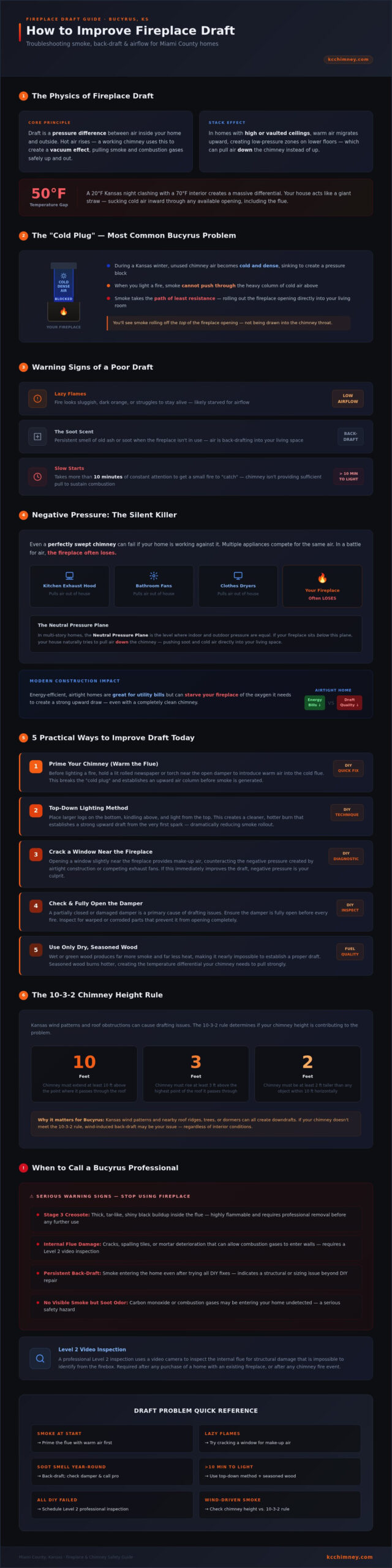
Draft is the engine that drives your fireplace. At its simplest, draft is a pressure difference between the air inside your home and the air outside. Because hot air is lighter and less dense than cold air, it naturally wants to rise. A properly functioning chimney uses this principle to create a vacuum effect, pulling combustion gases and smoke up through the flue and safely out of the house. If you are researching how to improve fireplace draft Bucyrus homes often require a specific look at how local weather and home design interfere with this delicate balance of physics.
One of the most common issues we see in Miami County is the “cold plug.” During a typical Kansas winter, the air inside an unused chimney becomes extremely cold and dense. This heavy air sinks, creating a literal block of cold pressure that sits on top of your fireplace. When you light a fire, the smoke isn’t strong enough to push this heavy column of air out of the way. Instead, the smoke takes the path of least resistance, which is usually right into your living room. You’ll recognize this immediately as smoke rolling off the top of the fireplace opening rather than being drawn into the throat of the chimney.
While older homes in our area generally rely on a natural draft, many newer constructions in the KC metro utilize forced draft systems. It’s also important to understand how chimney draft works in relation to modern building standards. Newer homes are often built to be airtight for energy efficiency, which can inadvertently starve a fireplace of the oxygen it needs to create a strong upward draw.
The Physics of Airflow in Kansas Homes
The “stack effect” plays a major role in how your hearth performs. In Bucyrus homes with high or vaulted ceilings, the warm air in your house naturally migrates to the highest point. This creates a low-pressure zone on the lower floors. If your fireplace is located in one of these low-pressure areas, your house may actually try to pull air down the chimney to equalize the pressure. This battle becomes even more difficult when there is a massive temperature differential, such as a 20°F Kansas night clashing with a 70°F interior. The house effectively acts like a giant straw, sucking air inward through any available opening, including your flue.
Common Signs of a Poor Draft
Identifying a draft issue early can prevent smoke damage to your mantels and furniture. You don’t always need a visible cloud of smoke to know there’s a problem. Keep an eye out for these subtle indicators:
- Lazy Flames: If your fire looks sluggish, dark orange, or seems to struggle to stay alive, it’s likely starved for airflow.
- The Soot Scent: A persistent smell of old ash or soot in the house, even when the fireplace isn’t in use, suggests that air is back-drafting into your living space.
- Slow Starts: If it takes more than 10 minutes of constant attention to get a small fire to “catch,” your chimney isn’t providing the necessary pull to sustain combustion.
Mastering the draft in your home is about more than just convenience; it’s about ensuring your heating system operates safely and efficiently throughout the season.
Negative Pressure: The Silent Killer of Fireplace Efficiency
Even a perfectly swept chimney can fail if your home is working against it. In many Bucyrus residences, the issue isn’t a blockage in the flue, but rather a lack of “make-up air.” Modern construction techniques focus heavily on energy efficiency, creating airtight seals that prevent drafts. While this is great for your utility bills, it can be a disaster for your fireplace. If your home is too tight, the fireplace cannot find enough air to support combustion. This is a primary reason why homeowners search for how to improve fireplace draft Bucyrus, only to find that their chimney is actually in good condition.
Multiple appliances in your home compete for the same air. High-powered kitchen exhaust hoods, bathroom fans, and clothes dryers all pull air out of the house. In a battle for air, the fireplace often loses, resulting in a back-draft. This struggle is particularly evident in multi-story homes where the “Neutral Pressure Plane”-the level where indoor and outdoor pressure are equal-shifts. If your fireplace is located below this plane, the house will naturally try to pull air down the chimney to replace what the exhaust fans are removing. This creates a situation where soot and cold air are pulled directly into your living space.
How Modern Construction Impacts Your Hearth
High-performance house wraps and double-pane windows are standard in Miami County, but they contribute to air starvation. This is especially true for basement fireplaces. Basements are naturally low-pressure zones. When your furnace kicks on, it competes with the fireplace for oxygen. Without a dedicated source of outside air, the chimney becomes the easiest path for the house to “inhale,” bringing smoke along with it. These tight homes require a more scientific approach to airflow than older, draftier houses built decades ago.
The ‘Cracked Window’ Test
The fastest way to diagnose a pressure-related draft issue is the cracked window test. Before lighting your next fire, open a window about an inch in the same room as the fireplace. This provides a temporary lung for the house. If the smoke immediately clears and the flames become more vibrant, you’ve confirmed that your home is under negative pressure. This indicates that you don’t necessarily have a chimney problem, but an air supply problem. For a permanent solution, you might consider a professional evaluation to balance your home’s airflow and ensure your hearth is safe for the family.
5 Practical Ways to Improve Fireplace Draft Today
While understanding home pressure and physics is vital, most homeowners want immediate solutions when smoke begins to fill the room. Improving your fireplace’s performance often comes down to small, behavioral changes in how you manage your hearth. If you’re looking for how to improve fireplace draft Bucyrus weather often dictates your success, especially during those unpredictable Kansas cold snaps. By following a few methodical steps, you can establish a strong draw before the first log even begins to burn.
- Step 1: Prime the Flue. Use heat to break the “cold plug” sitting in your chimney.
- Step 2: Use the Top-Down Method. Place large logs on the bottom and kindling on top to create a faster, hotter start with less smoke.
- Step 3: Burn Seasoned Wood. Only use wood with a moisture content below 20%.
- Step 4: Verify the Damper. Ensure it’s fully open and hasn’t become warped or detached from its track.
- Step 5: Check the Chimney Cap. Look for bird nests or wind-blown debris that might be restricting the exit of gases.
Priming Your Chimney Flue
As we discussed earlier, cold air is heavy and sinks. When your chimney is cold, that air acts like a lid on a jar. To fix this, you must “prime” the flue by pre-heating the air inside. Roll up a piece of newspaper, light one end, and hold it near the open damper for about 60 to 90 seconds. You’ll know it’s working when you see the smoke from the paper suddenly pull upward. On particularly bitter Bucyrus nights, you might even use a hair dryer to blow warm air up the flue for a few minutes. This simple safety step prevents that initial, frustrating puff of smoke from entering your home.
The Importance of Seasoned Wood
Wet or “green” wood is a draft killer. When you burn wood with high moisture, the fire’s energy is wasted boiling off water rather than creating heat. This results in cool, heavy smoke that struggles to rise. Because of the humidity we experience in Miami County, hardwoods like oak and hickory require at least 6 to 12 months of drying time. We recommend using a digital moisture meter to verify your wood pile is ready. If the reading is above 20%, the wood will smolder and create creosote rather than a clean, drafting fire. Investing in properly seasoned wood is the most effective way to ensure a clean burn all winter long.
External Factors: Kansas Wind and Chimney Height
Sometimes the obstacle to a perfect fire isn’t inside your home at all. In the wide-open landscape of Bucyrus, the wind plays a massive role in how your hearth performs. If you’ve tried priming the flue and using seasoned wood but still face issues, it’s time to look at the exterior of your home. Understanding how to improve fireplace draft Bucyrus homeowners often deal with requires a look at the “10-3-2 Rule.” This industry standard dictates that a chimney must be at least three feet taller than the point where it exits the roof and at least two feet taller than any part of the building within a ten-foot radius. If your chimney doesn’t meet these height requirements, the wind can create high-pressure zones that push smoke back down the flue.
The prevailing winds across the Kansas plains are another major factor. When wind hits a nearby tall tree or a higher roof peak, it creates a downward air current known as “wind-washing.” This turbulence creates a cap of high pressure over your chimney, making it nearly impossible for smoke to escape. In Miami County, where properties often have large shade trees or complex rooflines, these external air patterns are a frequent culprit behind sluggish fires and smoky living rooms.
Evaluating Your Chimney’s Exterior Anatomy
You can often spot draft problems with a simple visual inspection from the ground. Look for signs that your chimney is too short relative to your roof’s pitch. If the chimney sits in the “shadow” of a higher gable, it’s likely suffering from buffeting. Additionally, check the condition of your masonry. A damaged chimney crown can disrupt the smooth flow of air at the exit point. When the crown is cracked or deteriorating, it creates uneven surfaces that interfere with the natural draw, especially during the gusty days common in our region.
Hardware Upgrades for Better Draw
If your chimney’s height is the issue, there are hardware solutions that don’t always require major masonry work. A smoke guard can be installed at the top of the fireplace opening to reduce the area the draft needs to cover, effectively increasing the pull. For homes hit by heavy Kansas winds, a specialized chimney cap installation is often the most effective remedy. These caps are designed to use the wind to their advantage, creating a vacuum that actually pulls smoke out of the flue rather than letting the wind push it back down. In extreme cases, a mechanical draft inducer fan can be added to provide a guaranteed upward draw regardless of the weather.
If you’re tired of battling the elements every time you want a fire, contact Best Chimney Services to schedule a professional chimney cap installation and secure your home against the Kansas wind.
When to Call a Bucyrus Professional for Draft Issues
While the DIY steps mentioned earlier can resolve many minor issues, some drafting problems are rooted in structural damage or hazardous buildup. If you’ve tried priming the flue and balancing your home’s pressure but still experience smoke, it’s time to stop troubleshooting and call for professional help. A stubborn draft is often a symptom of a deeper, more dangerous problem that a simple brush or a rolled-up newspaper can’t fix. Understanding how to improve fireplace draft Bucyrus homeowners find difficult often requires specialized equipment and technical training.
One major culprit is Stage 3 creosote. Unlike the flaky or soot-like deposits you might see in a typical season, Stage 3 creosote is a thick, waxy glaze that hardens onto the flue walls. It’s highly flammable and extremely difficult to remove without professional chemical treatments or specialized industrial tools. This glaze doesn’t just increase your fire risk; it also constricts the flue, making it nearly impossible to maintain a proper draw. Other structural blockages, such as a collapsed clay liner or a persistent bird’s nest, can also choke your chimney’s airflow and force gases back into your home.
A Level 2 chimney inspection is the most effective way to diagnose these hidden issues. During this process, technicians use advanced video camera equipment to examine every inch of your flue liner. This reveals cracks, gaps, or internal deterioration that are invisible from the hearth. If your current masonry fireplace is simply too inefficient for your home’s layout, transitioning to a high-efficiency fireplace insert can provide a permanent solution for guaranteed drafting and heat output.
The Safety Risks of Ignoring Poor Draft
A smoky fireplace is more than just a nuisance; it’s a health hazard. When smoke enters your living space, it brings fine particulates and carbon monoxide (CO) with it. CO is an odorless, colorless gas that can be fatal in high concentrations. Every Bucyrus home needs a working CO detector on every floor to protect the family. Beyond immediate poisoning risks, a poor draft causes the fire to burn cooler, which rapidly accelerates creosote accumulation. This creates a dangerous cycle where the worse your draft becomes, the higher your risk of a devastating chimney fire.
Professional Diagnostic Tools
Professional sweeps use more than just brushes. We employ specialized diagnostic tools to solve the mystery of your smoky hearth. Video inspections allow us to see structural failures or obstructions that would otherwise go unnoticed. We can also perform pressure testing to identify exactly where your home is losing air or where competing fans are winning the battle for oxygen. If you’re ready for a permanent fix, schedule a professional draft evaluation with Best Chimney Services today to ensure your family’s safety and comfort all winter long.
Secure Your Hearth for the Kansas Winter
A roaring fire should bring warmth and peace of mind, not a room full of smoke. By mastering the fundamentals of home pressure and learning how to improve fireplace draft Bucyrus homeowners can reclaim their living space from the elements. Whether you’re priming the flue on a bitter night or installing a wind-resistant cap to battle the Kansas plains, these small adjustments make a significant difference in your home’s safety and comfort.
When DIY methods aren’t enough, it’s vital to rely on expert diagnostics to identify hidden blockages or structural damage. Our CSIA-certified technicians have served the KC metro since 2012, providing high-integrity care and a mess-free guarantee. Don’t let a stubborn draft compromise your indoor air quality or safety. Take the next step toward a cleaner, more efficient burn by choosing a professional partner who understands our local architectural needs and climate challenges.
Schedule Your Bucyrus Chimney Inspection & Sweeping Today and enjoy a worry-free season by the fire.
Frequently Asked Questions
Why does my fireplace smoke only when it’s very cold outside?
Cold air is much denser and heavier than the warm air inside your home. When temperatures drop in Bucyrus, a “cold plug” of this heavy air can settle deep into your chimney flue, acting like a lid. When you light a fire, the smoke isn’t hot enough to push that heavy column of air out, so it spills into your room instead. Priming the flue with a heat source before lighting your logs is the best way to fix this.
Can a dirty chimney cause a poor draft?
Yes, a dirty chimney is one of the most common causes of a restricted draft. As soot and creosote accumulate along the inner walls of the flue, they physically reduce the diameter of the exit path for smoke. This buildup also creates friction that slows down the rising gases. Regular sweeping by a certified professional ensures the flue remains clear, maintaining the necessary airflow for a clean and efficient burn in your hearth.
Will a chimney cap improve my fireplace draft?
A specialized chimney cap can significantly help by preventing downdrafts caused by the strong winds common across the Kansas plains. While a standard cap protects against debris and animals, a wind-resistant model uses the breeze to create a vacuum effect at the top of the flue. This helps pull smoke up and out, which is a key strategy for how to improve fireplace draft Bucyrus homeowners often implement to solve recurring smoke issues.
How do I know if my house has negative pressure?
You can easily test for negative pressure by performing the “cracked window test.” Open a window near your fireplace about an inch while a fire is burning. If the smoke immediately stops spilling into the room and the flames become more vibrant, your house is likely too airtight. This pressure imbalance happens when modern insulation or exhaust fans in the kitchen and bathroom starve the fireplace of the air it needs to breathe.
What is the ‘top-down’ fire-starting method?
The top-down method involves stacking your largest logs on the bottom of the grate, followed by a layer of smaller logs, and then placing your kindling and fire starter on the very top. Lighting the fire at the top allows the heat to rise directly into the flue immediately. This warms the chimney much faster than traditional methods, creating a strong upward draft early in the process and significantly reducing the amount of initial smoke.
Is it safe to use a fireplace that drafts poorly?
No, it is not safe to operate a fireplace with drafting issues. A poor draft allows combustion byproducts, including fine particulates and carbon monoxide, to enter your living space. These gases are hazardous to your health and can be fatal in high concentrations. Furthermore, a sluggish draft leads to lower fire temperatures, which causes creosote to build up much faster in your flue, greatly increasing the risk of a dangerous chimney fire.
Why does my fireplace smell like smoke when I’m not using it?
This phantom smoke smell is usually caused by air being pulled down the chimney and into your house, a process known as back-drafting. When your home is under negative pressure, it looks for any opening to pull in outside air, and an open or leaky damper is an easy target. As the air travels down the flue, it picks up the scent of old soot and creosote, bringing that campfire odor into your living room.
How much does it cost to fix a chimney draft problem in Bucyrus?
Costs vary based on the specific cause, ranging from a simple cleaning to structural repairs. We don’t provide fixed pricing without a physical assessment because every chimney in Bucyrus is unique. A Level 2 inspection using video technology is the most reliable way to identify the exact issue and provide a professional recommendation for restoring your fireplace’s safety and efficiency. This ensures the work is an investment in your home’s long-term durability.