
A smoky fireplace isn’t just a nuisance; it’s a clear sign that the physics of your home are working against you. When you try to fix smoky fireplace Stilwell issues, you’re often battling invisible pressure shifts or hidden structural blocks rather than just a stubborn log. It’s incredibly frustrating when a planned night by the fire leaves your furniture smelling like a campfire and your family worried about carbon monoxide levels. You want the comfort of a crackling hearth, not the stress of opening every window in Johnson County just to catch a breath of fresh air.
We understand that your home should be a sanctuary, and a failing draft disrupts that peace of mind and safety. This guide will help you identify exactly why your chimney is back-drafting and provide the specific steps needed to restore a safe, clean draw. We’ll explore everything from simple damper checks to the technical benefits of a Level 2 inspection. By the end, you’ll know whether your solution is a quick adjustment or requires the precision of a certified local technician to ensure your chimney is operating at peak performance.
Key Takeaways
- Learn how to balance air pressure in modern Stilwell homes to prevent the “Stack Effect” from pulling smoke back into your living room.
- Master immediate troubleshooting steps, including how to properly prime your flue with a heat source before lighting your main fire.
- Discover why even a quarter-inch of soot can severely restrict air flow and how to identify structural damage in your chimney crown.
- Identify the best hardware solutions to fix smoky fireplace Stilwell problems, ranging from draft-inducing caps to custom smoke guards.
- Understand why a professional Level 2 video inspection is the most reliable way to find hidden leaks and ensure your family’s safety.
Understanding the Science: Why Fireplaces Smoke in Stilwell
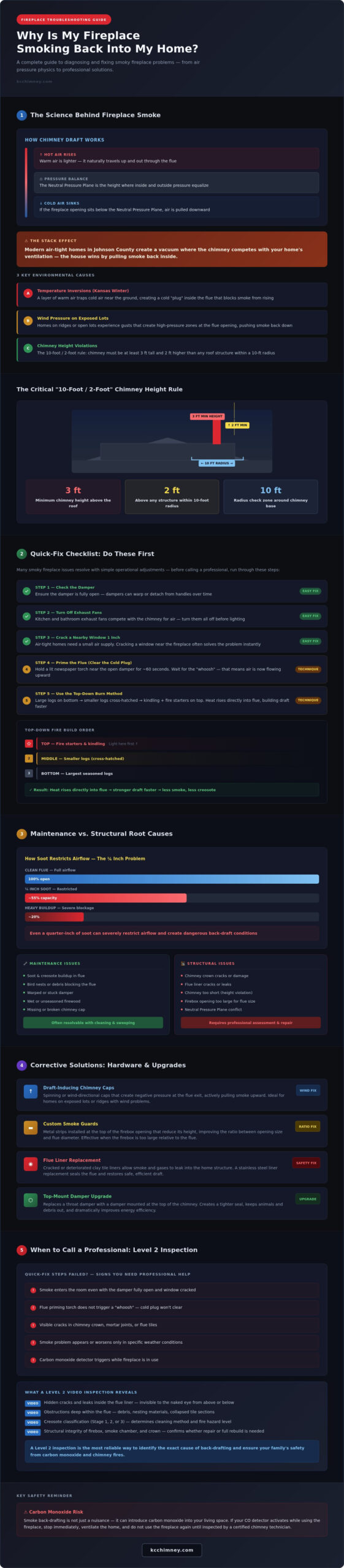
To fix smoky fireplace Stilwell issues, you first have to understand that your chimney is a machine powered by air pressure. This process is known as “draft.” It relies on the simple principle that hot air is lighter than cold air. When your fireplace is working correctly, the temperature difference creates a vacuum that pulls smoke up and out of your home. However, modern construction in Johnson County often makes homes so air-tight that the chimney cannot find enough air to breathe. This creates a competition between your fireplace and your home’s ventilation, often resulting in the Stack Effect.
In a typical two-story Stilwell home, this physics battle manifests at the Neutral Pressure Plane. This is a specific height in your house where the air pressure inside matches the pressure outside. If your fireplace opening sits below this plane, the house will naturally try to pull air down the chimney to equalize pressure. A downdraft is a reversal of air flow caused by external pressure.
The Impact of the Kansas Climate on Your Hearth
The local Kansas weather plays a significant role in how your hearth performs. During the 2026 winter season, many residents experienced temperature inversions where a layer of warm air trapped cold air near the ground. This heavy, cold air creates a “plug” inside your flue. If you do not warm the chimney first, that cold plug acts like a lid, forcing smoke into your living room. Stilwell’s unique wind patterns also create high-pressure zones. If your home is situated on a ridge or open lot, wind can gust over the top of the flue, pushing smoke back down into the house.
Architectural Factors in Johnson County Homes
We often see architectural challenges in local ranch-style and two-story builds. A common culprit is a violation of the “10-foot, 2-foot” rule. For a chimney to draft properly, it must be at least three feet tall and two feet higher than any part of the roof within a ten-foot radius. If your chimney is too short, or if large trees in your Stilwell neighborhood have grown to overlook the roofline, they create wind turbulence. This turbulence disrupts the air’s exit path, making it much harder to fix smoky fireplace Stilwell problems without structural adjustments or specialized caps. Identifying these environmental blocks is the first step toward a smoke-free home.
The Quick-Fix Checklist: Immediate Steps for a Smoke-Free Fire
Before you conclude that your chimney requires a major overhaul, start with these operational basics. Many fireplace issues in Johnson County stem from simple pressure imbalances or mechanical oversight. First, verify your damper is fully open. It sounds basic, but dampers can become warped or detached from their handles over time. Next, turn off all exhaust fans in your kitchen and bathrooms. These powerful vents compete with your chimney for air, often winning the tug-of-war and pulling smoke into your living room. If your home is particularly air-tight, crack a window near the fireplace by just one inch. This small adjustment often provides the necessary air to fix smoky fireplace Stilwell problems immediately without any expensive repairs.
How to Properly Prime Your Chimney
If you feel a draft of cold air coming down the flue, you have a “cold plug” that must be cleared before you light a full fire. To do this, roll up a piece of newspaper into a makeshift torch. Light the end and hold it carefully near the open damper for about sixty seconds. You’re waiting for the “whoosh” sound. This indicates the air flow has reversed and is now moving up the chimney. Be careful not to hold the torch too high, as you don’t want to singe your mantle or decorative trim. Once the draft is established, you can safely light your kindling. If the air continues to push down despite your efforts, it might be time for a professional chimney sweeping to clear any hidden obstructions or soot buildup that might be choking the air flow.
The Top-Down Burn Method
Traditional fire-building involves putting kindling on the bottom, but this often produces excessive smoke before the flue is warm. The top-down method is far more efficient for modern Stilwell homes. Using this technique is one of the easiest ways to fix smoky fireplace Stilwell homeowners can implement tonight. Start by placing your largest, seasoned logs on the bottom of the firebox. Layer smaller logs on top in a cross-hatch pattern, then finish with your kindling and a few fire starters at the very peak. Lighting the fire from the top allows the heat to rise directly into the flue without being blocked by heavy, cold wood. This method heats the chimney faster, creates a stronger draft earlier, and significantly reduces creosote production during the first fifteen minutes of the burn. It’s a cleaner way to enjoy your hearth while keeping your indoor air quality high.
Maintenance vs. Structural Issues: Identifying the Root Cause
If the operational adjustments mentioned earlier don’t resolve the issue, the problem likely stems from a physical obstruction or structural defect. In the wooded neighborhoods of Stilwell, animal activity is a frequent culprit. Chimney swifts and squirrels often view an open flue as a perfect nesting site. These nests create a physical block that no amount of flue priming can overcome. Additionally, seasonal debris like leaves can accumulate, especially if your chimney cap is missing or damaged. Identifying these external factors is a vital part of a professional chimney inspection kansas city homeowners rely on to maintain a safe hearth.
Creosote: The Invisible Obstruction
Creosote is a byproduct of wood combustion that sticks to the inner walls of your flue. It’s more than just a fire hazard; it’s a draft killer. Just a quarter-inch of soot buildup can restrict air flow by up to 25%. This narrowing makes it significantly harder to fix smoky fireplace Stilwell problems because the flue no longer has the volume to handle the smoke produced. In our region, homeowners often burn Kansas oak. While oak is an excellent fuel, it produces heavy creosote if it hasn’t been properly seasoned for at least a year. Creosote develops in three stages, moving from a light soot to a dangerous, glass-like glaze. Once it reaches the later stages, it becomes highly flammable and nearly impossible to remove without specialized tools.
Structural Failure: Cracked Liners and Masonry
Sometimes the smoke isn’t just failing to rise; it’s escaping through cracks in the chimney’s structure. Water intrusion is the primary enemy of masonry in Johnson County. When water enters through a cracked chimney crown, it creates turbulence that disrupts the draft. Over time, the freeze-thaw cycle expands these cracks, leading to compromised flue tiles. If your liner is cracked, smoke and heat can leak into the wall cavities of your home, creating a severe fire risk. This is why targeted chimney repair kansas city is essential. We often use tuckpointing to restore the mortar joints, ensuring the chimney remains air-tight. Maintaining the structural integrity of your masonry is the only way to guarantee a reliable, long-term draft for your Stilwell home.
Corrective Solutions: From Chimney Caps to Flue Liners
Corrective hardware is often the only way to permanently fix smoky fireplace Stilwell issues when the home’s architecture creates a natural deficit. In many local builds, the firebox opening is too large for the flue to handle, leading to smoke “spillage” into the room. A smoke guard is a low-cost, metal strip installed at the top of the fireplace opening. By slightly reducing the opening size, it increases the air velocity and helps the chimney capture smoke more effectively. For homes with persistent mechanical draft issues that simple fixes can’t touch, we may recommend a chimney fan. These specialized fans sit atop the flue and create a consistent, motorized pull that guarantees a clean draft regardless of wind or indoor air pressure.
If you’re looking for a comprehensive upgrade that solves draft issues while maximizing heating efficiency, consider a fireplace insert installation kc homeowners can rely on for 2026. These units are designed to operate as closed systems, which virtually eliminates smoke spillage and gives you total control over the burn rate.
The Power of a High-Quality Chimney Cap
A standard cap might keep out the rain, but a specialized draft-inducing cap is a game-changer for windy Stilwell lots. These caps use the wind’s own energy to create a vacuum at the top of the flue, pulling smoke upward and preventing downdrafts. They also feature integrated bird screens. This is crucial in Johnson County, where chimney swifts often build nests that create dangerous “biological” obstructions. Beyond draft control, a high-quality cap protects your chimney crown from the harsh freeze-thaw cycles that characterize our local winters. By keeping water out of the masonry joints, you prevent the structural decay that leads to air leaks and poor performance.
Chimney Relining for Improved Performance
Relining is the gold standard for restoring a chimney’s functionality. Many older homes in our community have clay tile liners that have cracked or shifted over time. These gaps allow smoke to cool down and lose velocity, or worse, leak into the home’s structure. Installing a new stainless steel liner creates a smooth, airtight path for exhaust. This is particularly important if you’ve recently upgraded your heating appliance. A flue must be properly sized to match the requirements of the stove or fireplace it serves. Stainless steel liners retain heat much better than old masonry, which keeps the draft moving quickly and prevents creosote from condensing on the walls. It’s a permanent fix for a smoky hearth. If you suspect your liner is the culprit, schedule a professional consultation to explore your relining options.
Professional Diagnosis: Why Stilwell Trusts Best Chimney Services
While troubleshooting at home can resolve minor draft issues, some problems require the precision of specialized diagnostic tools. To fix smoky fireplace Stilwell residents often turn to a professional team that understands the local architectural nuances. Best Chimney Services has been a trusted fixture in Johnson and Miami counties since 2012. We take a neighborly approach to every project in Stilwell and Bucyrus; we view ourselves as guardians of your home’s safety rather than just a mechanical service provider. Our goal is to demystify your chimney’s performance and provide a long-term solution that ensures peace of mind.
What to Expect During a Professional Sweep
We follow a methodical, multi-level safety evaluation process during every visit. The centerpiece of our diagnostic work is the Level 2 video inspection. We use advanced video camera equipment to travel the full length of your flue; this allows us to see hidden cracks, gaps in the liner, or biological obstructions that are invisible from the hearth. To address homeowner anxiety about soot, we utilize mess-free sweeping techniques. Our technicians use specialized brushes and high-powered containment vacuums to ensure your Stilwell home remains spotless. You won’t have to worry about lingering dust or debris on your furniture once the job is finished.
Get Your Smoky Fireplace Fixed Today
Some smoke issues are more than just a nuisance. If you experience heavy smoke spillage, a persistent smell of soot when the fireplace is cold, or if your carbon monoxide detector alerts you, these are signs of a critical system failure. These situations require immediate attention from a professional. Our team consists of CSIA-certified technicians who adhere to the highest industry standards for safety and precision. By scheduling your annual sweep now, you can prevent 2026 winter smoke issues and ensure your hearth is ready for the first cold snap. We value long-term relationships and provide honest, no-nonsense advice to keep your family protected. Schedule your Stilwell chimney inspection today to restore the warmth and safety of your home.
Enjoy a Safer, Smoke-Free Hearth This Season
Restoring a clean draft is ultimately about correcting the air pressure and temperature balance within your home. Whether you’ve identified a simple “cold plug” in the flue or suspect a structural obstruction from local wildlife, you now have the tools to address the root cause. You don’t have to tolerate soot-stained furniture or the stress of a smoky living room. Implementing these basic troubleshooting steps can often help you fix smoky fireplace Stilwell problems immediately.
If the smoke continues to back-draft, it’s time to rely on a professional diagnostic approach. Best Chimney Services has been locally owned and operated since 2012, serving our neighbors with integrity and technical mastery. We include advanced video inspections with every Level 2 evaluation to catch hidden safety risks. Plus, our mess-free guarantee ensures your home remains spotless throughout the process. Don’t let a drafty chimney disrupt your peace of mind. Schedule Your Smoky Fireplace Diagnosis in Stilwell Today and return to the comfort of a safe, crackling fire.
Frequently Asked Questions
Why does my fireplace smoke only when it is windy outside in Stilwell?
High pressure zones created by wind gusts over the roofline are the primary cause. In Stilwell, homes situated on ridges or open lots often face wind turbulence that forces smoke back down the flue. This is especially common if nearby trees or structures disrupt the air. Installing a specialized wind-directional chimney cap can help by using the wind’s energy to create an upward vacuum instead of a downdraft.
Can a dirty chimney cause smoke to enter my house?
Absolutely. A layer of creosote just a quarter inch thick can restrict your chimney’s air flow by as much as 25%. This narrowing makes it much harder to fix smoky fireplace Stilwell issues because the exhaust cannot escape fast enough. Regular sweeping removes this soot and any biological obstructions, like bird nests, that physically block the path of the smoke and create dangerous indoor air quality.
How do I know if my damper is fully open?
You can verify your damper’s position through a simple visual inspection. Use a flashlight to look up into the chimney; the damper is the metal flap just above the firebox. It should be vertical or tucked completely out of the way. If you see a flat metal plate blocking the view of the flue, it’s closed. Always check this before lighting a fire to ensure smoke has a clear exit path.
Is it safe to stay in a house with a smoky fireplace?
It is not safe to remain in a room filled with smoke. Fireplace exhaust contains fine particulates and harmful gases like carbon monoxide that can cause respiratory distress or long term health issues. If your fireplace is smoking, you should extinguish the fire immediately and open windows to ventilate the area. Don’t use the hearth again until a professional identifies the specific cause of the draft failure.
Will a chimney cap fix my smoky fireplace issues?
A chimney cap is a highly effective solution for specific draft problems. It prevents wind induced downdrafts and keeps out debris or animal nests that cause physical blocks. However, a cap won’t fix smoky fireplace Stilwell problems caused by internal pressure imbalances or cracked flue liners. While a cap is an essential safety accessory for every Johnson County home, it’s just one part of a properly functioning chimney system.
What is the difference between a smoky fireplace and a backup of carbon monoxide?
The main difference is visibility. Smoke is a visible mixture of soot and gases with a distinct campfire smell. Carbon monoxide is a byproduct of incomplete combustion that is completely invisible and odorless. While you can see a smoke backup, you cannot detect CO without a working alarm. Both issues are caused by poor draft and signify that dangerous combustion byproducts are entering your living space instead of exiting the flue.
How much does it cost to fix a smoky fireplace in Kansas City?
The cost to resolve a smoky fireplace depends entirely on the underlying issue. A simple chimney sweep to remove soot is a different investment than structural masonry repairs or installing a new stainless steel liner. Because every home in the Kansas City area has a unique architectural layout and different maintenance needs, a professional Level 2 inspection is the most accurate way to determine the specific repairs required for your chimney.
Why does smoke come out when I first start the fire but then stop?
This occurs because of a “cold plug” of air trapped in the chimney. When you first light a fire, the heavy, cold air in the flue acts like a lid, forcing initial smoke into the room. As the fire burns, it eventually warms the chimney walls and establishes an upward draft. You can prevent this by “priming” the flue with a heat source, like a newspaper torch, before lighting your main logs.