
Applying standard modern cement to a vintage fireplace stack is the quickest way to ruin it. When planning historic chimney preservation Stilwell homeowners often discover that dense modern mortar suffocates soft, kiln-fired antique bricks. That rigid barrier traps moisture inside the wall, triggering severe spalling and structural cracking across the 50-plus freeze-thaw cycles of an eastern Kansas winter.
You take pride in your home’s historic craftsmanship, but it’s stressful wondering whether weathered masonry or an unlined vintage flue poses an active fire hazard. You shouldn’t have to choose between period-accurate charm and modern household safety.
In this guide, you’ll discover how to protect, restore, and maintain your chimney using vapor-permeable lime mortars and code-compliant relining solutions that preserve original brickwork without risking chimney failure. We’ll walk through Johnson County permitting standards, preservation tax credit incentives, and methodical diagnostic inspections that keep your hearth performing reliably for generations.
Key Takeaways
- Learn why authentic historic chimney preservation Stilwell homes need breathable, high-lime mortar blends rather than modern Portland cement to prevent irreversible brick spalling.
- Understand the severe fire risks of unlined vintage flues and how stainless steel chimney relining upgrades performance without altering exterior heritage.
- Pinpoint subtle moisture intrusion signs early to stop harsh winter freeze-thaw erosion before it damages your home’s interior framing.
- Discover how methodical Level 2 video inspections uncover concealed structural hazards behind aging masonry without invasive tear-outs.
- Establish a practical seasonal maintenance routine to keep your antique fireplace code-compliant, structurally sound, and safe for family use.
Understanding Historic Chimney Architecture in Stilwell and Johnson County
Stilwell’s landscape tells the story of early Johnson County settlement. From turn-of-the-century Folk Victorian farmsteads along Aubry Township to early Craftsman bungalows and mid-century custom ranch estates, these properties showcase irreplaceable masonry craft. Successful historic chimney preservation Stilwell projects protect this visible rural heritage while adapting older heating structures to meet current fire safety standards.
Unlike modern modular veneer framing built around pre-fabricated steel boxes, historic chimneys are true load-bearing masonry. They rely on soft, locally fired clay bricks bonded with flexible lime-and-sand mortars. Because these structures were originally constructed without modern internal flues, they manage heat and vapor fundamentally differently than newer builds. Preserving these assemblies guards structural stability and preserves genuine architectural value.
Characteristics of Stilwell’s Early Masonry and Chimney Craft
Early residential masons in eastern Kansas relied on low-temperature, kiln-fired regional clay units. These bricks are significantly softer and more porous than modern industrial units. You will often spot distinctive regional architectural detailing across local historic properties:
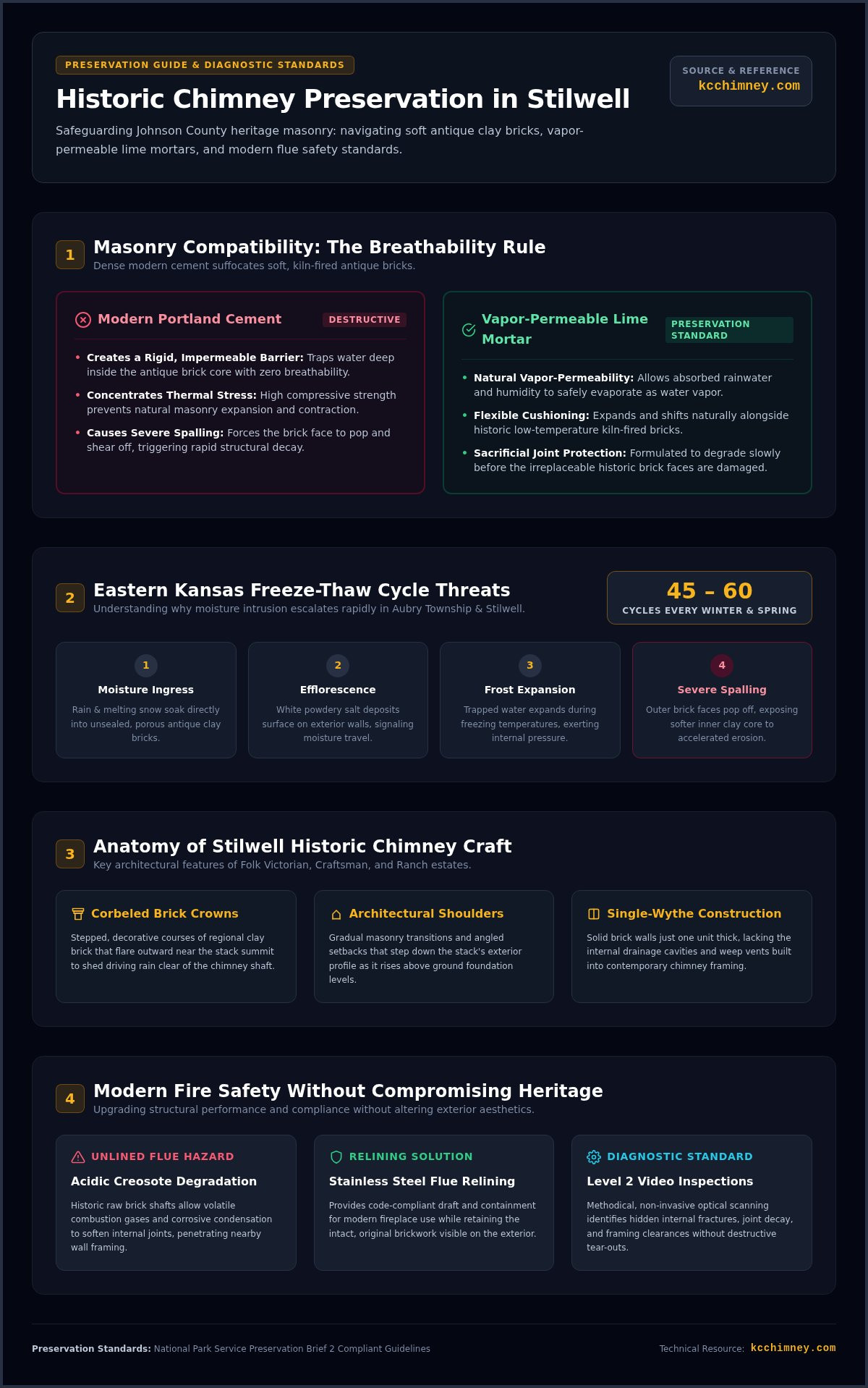
- Corbeled brick crowns: Stepped, decorative brick courses that flare outward near the stack’s top to shed driving rain.
- Architectural shoulders: Gradual masonry transitions that step down the stack’s profile as it rises above ground foundations.
- Single-wythe construction: Solid brick walls just one unit thick, lacking the secondary drainage cavities built into contemporary wall assemblies.
Why Historic Chimneys Require Specialized Maintenance Protocols
Vintage chimneys require a different care philosophy than modern builds. Older clay bricks and traditional lime-sand mortars form a vapor-permeable system. Moisture enters naturally during wet weather, then safely escapes as water vapor when the masonry dries. Applying dense modern sealants traps that liquid deep within the brick core.
Inside the flue, historic venting adds extra strain. Early chimneys were built unlined, venting heat through a raw brick shaft. Over decades of wood combustion, acidic creosote and condensation slowly degrade the interior joints. When unlined mortar softens, volatile flue gases can penetrate wall framing. Restoring these joints requires historic accuracy; utilizing traditional tuckpointing techniques with matched lime compounds ensures the stack continues to breathe while remaining structurally stable.
Choosing proper materials is not just aesthetic. For homeowners prioritizing historic chimney preservation Stilwell standards require working with the chimney’s natural movement. When rigid, high-strength cement patches are smeared over soft antique bricks, the wall loses its ability to flex. Seasonal temperature swings inevitably crack the historic brick faces, causing irreversible spalling that compromises the entire stack.
Unique Challenges Threatening Historic Stilwell Chimneys
Water is the primary enemy of vintage masonry, especially across rural Johnson County. Modern chimneys incorporate internal moisture weep systems and flashing cavities to redirect rainwater. Historic homestead structures, however, rely entirely on the exterior integrity of their brick faces and mortar joints. Achieving lasting historic chimney preservation Stilwell homes require begins with recognizing the specific regional threats that break down older chimney stacks.
The Destructive Freeze-Thaw Dynamic in Eastern Kansas
Eastern Kansas experiences between 45 and 60 freeze-thaw cycles every winter and spring. When rain or melting snow enters porous antique bricks, it expands as it freezes. This expansion pressure causes spalling, popping the protective outer face off the brick and leaving the softer interior core exposed to rapid erosion.
White, powdery stains known as efflorescence often appear first, signaling that water is traveling through the stack and depositing dissolved salts. This dynamic turns catastrophic when previous contractors apply modern, rigid mortars. As outlined in the National Park Service Preservation Brief 2, impermeable Portland cement traps moisture and concentrates thermal stress onto delicate historic brick units. In Aubry Township, expansive rural clay soils amplify the problem by shifting beneath masonry footings during seasonal wet and dry spells.
Crown Failure, Water Infiltration, and Structural Deterioration
Water damage frequently starts at the absolute top of the stack. Early masons often finished chimneys with thin mortar washes rather than overhanging, drip-edged concrete crowns. Over decades, these washes crack, funneling driving rain directly into the flue interior and masonry core.
Once moisture penetrates the upper courses, gravity pulls it downward beneath the roofline. Corroded step flashing and missing chimney caps allow rainwater to soak roof decking, rot attic framing, and stain interior ceilings. Watch for these common signs of chimney water damage:
- Rust developing on the firebox damper or cast-iron components
- Damp plaster and peeling paint on interior chimney walls
- Mortar debris collecting on the roof or inside the hearth
- Spotted wildlife nests or downdrafts caused by missing protective caps
Catching these warning signs early prevents minor masonry defects from turning into full structural collapses. Scheduling expert chimney repair in Kansas City ensures water infiltration points are sealed with period-appropriate methods before winter freezes cause irreversible destruction.
Historic Masonry Restoration: Tuckpointing and Mortar Compatibility
Restoring an aging stack doesn’t require tearing it down to the roofline. With thoughtful care, tuckpointing replaces decaying mortar while saving the original brickwork intact. When undertaking sensitive masonry work, preservation specialists such as Surfprep highlight the importance of gentle, non-destructive techniques that protect fragile vintage substrates. For authentic historic chimney preservation Stilwell homeowners must ensure the new mortar respects the physical properties of late 19th- and early 20th-century craftsmanship.
Why Modern Portland Cement Destroys Historic Brick
Traditional masonry depends on mortar acting as a sacrificial cushion. Historic lime-sand mortar flexes with structural settlement, absorbing building stresses and weathering away gradually over decades.
Modern pre-mixed Portland cement, such as Type S or Type M, behaves in the exact opposite way. It cures into an impenetrable, rigid block with high compressive strength. Vintage hand-molded clay bricks are far softer and cannot handle that rigidity. When seasonal heat and cold cause natural thermal expansion, unyielding Portland mortar crushes the adjacent brick edges. Because Portland cement is vapor-impermeable, trapped wall moisture cannot escape through the joints. It forces its way through the brick faces instead, blowing off the outer clay skin and causing irreversible spalling.
The Preservation Tuckpointing Process Step-by-Step
Preservation tuckpointing balances historical authenticity with structural integrity, aligning repairs with recognized NFPA 211 chimney safety standards. Restoring vintage joints demands a careful, methodical three-stage technique:
- Joint raking: Masons gently clear deteriorated mortar to a depth of roughly twice the joint width. Using hand chisels or specialized low-speed rakers protects the delicate, irregular edges of vintage bricks from scarring.
- Lime mortar blending: Craftsmen formulate vapor-permeable Type O or Type K mixes featuring high hydrated lime content. Sourcing compatible sand aggregates recreates the original grain texture and natural earth tones without synthetic dyes.
- Layered packing and joint striking: The joints receive damp mortar in successive thin passes, compacting each layer firmly. Masons strike the surface to replicate the original historic tooling, whether a classic flush finish, concave joint, or weathered profile.
When completed with high-lime formulas, tuckpointing safeguards structural stability while allowing your chimney stack to breathe through another half-century of Kansas seasons.
Balancing Vintage Aesthetics with Modern Flue Safety and Relining
Preserving the exterior profile of a turn-of-the-century chimney is only half the battle. Inside the stack, safety standards have evolved drastically since Stilwell’s earliest homes were built. Effective historic chimney preservation Stilwell projects demand equal attention to internal venting dynamics, ensuring the system safely exhausts dangerous combustion gases without damaging antique masonry.
The Fire Safety Hazards of Unlined Historic Flues
Most late 19th- and early 20th-century chimneys were built unlined, venting directly against raw single-wythe brickwork. Without a terra cotta tile or metallic barrier, intense heat quickly transfers through porous bricks directly into combustible ceiling joists, roof rafters, and wall framing.
Internal chemical degradation worsens this risk over time. Acidic byproducts in wood smoke eat away at soft lime mortar joints from the inside out, creating invisible gaps behind the plaster. Sparks and carbon monoxide can then slip through deteriorating interior joints long before visible damage appears on the outside. Arranging an expert chimney inspection in Kansas City allows specialists to evaluate interior flue integrity with specialized video cameras before you strike a single match.
Stainless Steel Relining and Modern Fireplace Insert Solutions
Upgrading a vintage chimney does not mean tearing down original brick or compromising curb appeal. Installing a UL 1777 listed flexible stainless steel chimney relining system creates a continuous, sealed exhaust path from the firebox to the chimney top. Wrapping these liners in high-density ceramic insulation blankets keeps volatile flue gases hot to improve draft performance while maintaining zero-clearance safety against adjacent wooden timbers.
Homeowners seeking supplemental warmth without smoky draft issues often pair a fresh flue liner with modern appliances. Professional expert fireplace insert installation in KC integrates high-efficiency wood fireplace inserts or gas fireplace inserts into the original masonry opening. These closed-combustion units produce steady, clean heat while preserving authentic brick surround details. Capping the installation with custom low-profile chimney caps locks out driving rain and animal intrusions while preserving historic rooflines.
Ready to upgrade your vintage hearth safely? Contact our team today to schedule an inspection and explore tailored relining solutions for your home.
Developing a Long-Term Preservation and Maintenance Plan
A historic chimney requires dedicated oversight rather than sporadic reactions to active leaks. Consistent preventative maintenance protects architectural character and saves property owners from major structural rebuilds down the road. For sustainable historic chimney preservation Stilwell residents should view routine upkeep as an ongoing investment in their home’s safety and structural legacy.
The Role of Level 2 Video Inspections in Older Homes
Visual evaluations from the ground or firebox cannot reveal what is happening deep inside old chimney shafts. A professional Level 2 inspection uses a high-resolution, articulating video camera passed through the full length of the flue. This diagnostic scan pinpoints hairline fissures, missing interior mortar joints between brick courses, and dangerous combustible clearance gaps near roof timbers.
Whether you recently purchased an Aubry Township farmhouse or are prepping an antique fireplace for regular heating, an internal camera evaluation establishes an accurate baseline. It reveals exactly whether your stack needs cleaning, relining, or crown repair before you light the first fire of the season. Read our safety overview on chimney sweep Kansas City to plan your annual care before winter arrives.
Protective Treatments: Breathable Sealants vs. Harmful Paint
Never coat vintage exterior brick with latex, acrylic, or elastomeric paints. While paint provides a temporary uniform finish, it forms an impermeable plastic film over the stack. Trapped moisture cannot escape through the face, rapidly rotting the bricks from within during sub-zero cold spells.
Instead, choose 100 percent vapor-permeable siloxane or silane-based water repellents engineered specifically for historic masonry. These penetrating treatments bond deep inside the brick pores. They shed driving rains on the outside while allowing interior water vapor to escape freely.
Combine professional treatments with simple seasonal habits to catch early wear:
- Scan the exterior brickwork and crown from ground level using binoculars after severe storms.
- Check for fresh mortar dust or flaked brick fragments inside the firebox and cleanout door.
- Schedule annual chimney sweeping and chimney cap inspections every autumn.
Partnering with certified chimney technicians who understand both historic building materials and contemporary fire codes ensures your hearth remains safe, authentic, and sound for decades.
Preserving Your Stilwell Hearth for Generations to Come
Your vintage chimney stands as an authentic link to Johnson County’s architectural roots. Protecting that character requires balancing traditional masonry craft with modern fire performance. When managing historic chimney preservation Stilwell homes need breathable lime mortars that shield soft antique bricks from winter freeze-thaw cycles, paired with modern insulated relining systems that protect unlined flues from hidden heat transfer.
Serving Johnson County and Stilwell homeowners since 2012, Best Chimney Services treats your vintage property with specialized care. Our certified technicians use advanced video camera evaluations to examine hidden flue hazards, delivering expert solutions in historic tuckpointing, crown repair, and chimney relining. Schedule your historic chimney evaluation with Best Chimney Services today, and enjoy the timeless comfort of your vintage fireplace with lasting peace of mind.
Frequently Asked Questions
Can I use modern mortar to repair the chimney on my historic Stilwell home?
No, you shouldn’t use modern Portland cement. Pre-mixed Type S or M mortars cure into hard, impermeable barriers that crush softer, vintage clay bricks during natural expansion cycles. Trapped moisture cannot escape through rigid joints, forcing water through the brick faces instead. Lasting historic chimney preservation Stilwell homes require demands breathable, high-lime mortar blends like Type O or K that flex with structural movement and allow dampness to evaporate naturally.
Is it safe to burn wood in an unlined historic chimney?
No, operating an unlined vintage chimney creates serious fire and health risks. Without a proper liner, intense heat transfers directly through single-wythe brickwork into adjacent wall studs and attic rafters. Toxic combustion gases also dissolve deteriorated interior mortar, allowing carbon monoxide and creosote to leak into living areas. You must install a code-compliant stainless steel relining system before building fires in an unlined stack.
How often should an older historic chimney be inspected in Kansas?
You should arrange a professional inspection at least once every year before the winter burning season begins. For older residences in Johnson County, a Level 2 video inspection is essential. Technicians send a specialized digital camera down the flue passage to spot hairline cracks, missing internal mortar, and clearance voids that aren’t visible from the hearth, catching hidden hazards before freezing temperatures arrive.
What is the difference between historic tuckpointing and standard chimney repointing?
Standard repointing simply replaces deteriorated mortar with modern pre-mixed cement, which destroys soft antique brickwork over time. Historic tuckpointing is a meticulous preservation craft. The mason gently rakes out failing joints without chipping delicate brick edges, then repacks the voids using custom-formulated, high-lime mortar matched to the original sand texture, color, and historic striking profile. This restores masonry stability while honoring the original architecture.
Can I install a wood or gas insert without ruining my historic fireplace?
Yes, you can upgrade your heating efficiency while completely preserving your antique fireplace surround. High-efficiency wood fireplace inserts and gas fireplace inserts slide directly into the existing firebox opening. The appliance connects to an insulated stainless steel liner routed through the historic flue. Your external brickwork and historic hearth stay intact, giving you safe, controllable heat without altering your home’s vintage character.
Why are the bricks on my older chimney crumbling and flaking off?
Flaking brick surfaces, known as spalling, happen when water gets trapped inside porous historic bricks during freezing weather. Eastern Kansas experiences frequent freeze-thaw cycles each winter, and expanding ice pops off the hard exterior brick faces. This rapid erosion is typically caused by a cracked chimney crown leaking from above, missing caps, or prior repairs completed with impermeable modern Portland mortar.
Do I need a special chimney cap for a historic brick chimney?
Yes, vintage chimneys benefit tremendously from specialized chimney cap installation. Unprotected stacks let rain, melting snow, and nesting wildlife drop into fragile, unlined flues. Modern caps made from durable stainless steel protect the crown and brickwork from moisture damage. For historic chimney preservation Stilwell homeowners favor low-profile designs that guard against wind-driven Kansas rains without disrupting the authentic architectural look of the roofline.