
The gas insert may seem like the obvious heating winner, but the answer to the gas insert vs gas logs efficiency Overland Park question depends on more than the appliance label. Venting configuration, how well an appliance fits the space, and the condition of the existing chimney all affect how much useful heat reaches the room.
It’s reasonable to want a clear comparison before choosing. Gas inserts are self-contained appliances fitted inside an existing fireplace, while gas logs sit in the fireplace opening. Their performance can vary by model and setup, so advertised efficiency claims are difficult to compare unless you know what appliance and venting configuration they describe.
This guide explains how inserts and gas-log configurations use fuel, what can influence real-world heating performance, and which features of your home and fireplace matter in Overland Park. You’ll also learn why a chimney and fireplace assessment is a sensible first step before choosing equipment or planning installation. With the right information, you can weigh practical warmth against the condition and limits of your existing fireplace.
Key Takeaways
- Compare how each setup delivers heat, not just its efficiency label. The gas insert vs gas logs efficiency Overland Park comparison depends on the exact appliance and venting configuration.
- Vented gas logs send combustion exhaust up the chimney, which can carry some heat out of the room.
- Consider your heating priorities, desired flame appearance, and existing fireplace before narrowing down your options.
- Check the fireplace type and condition, then compare manufacturer specifications for the specific appliance and venting setup.
- A professional fireplace and chimney assessment can help clarify compatibility and practical next steps before installation.
Gas Insert vs. Gas Logs in Overland Park: What Does Efficiency Really Mean?
If you’re comparing fireplace options, the practical question is which one turns fuel into useful heat for your room. The answer to gas insert vs gas logs efficiency Overland Park isn’t determined by the category name alone. Efficiency describes how effectively an appliance converts the fuel it uses into heat that reaches the living space. Appliance design, venting, installation, and the existing fireplace all influence that result.
A rating can help, but only when you’re comparing the right details. Check the specifications for the exact appliance and venting configuration, and note what the manufacturer’s rating measures. Category-wide claims can hide important differences between models. An insert may be designed for heat delivery, but that doesn’t make every insert the right fit or guarantee it will outperform every gas-log setup in a particular home.
What counts as a gas fireplace insert?
A gas insert is a self-contained appliance installed within an existing fireplace opening. Its firebox and venting arrangement are designed to work together, affecting how heat enters the room and how exhaust leaves the home. For a basic overview of the appliance, see What is a Fireplace Insert? For a practical comparison, use the manufacturer’s specifications for the specific model rather than assuming a universal efficiency percentage.
What are gas logs, and why does venting matter?
Gas logs are arranged inside an existing fireplace, but the set and its venting configuration determine how it operates. Vented logs send combustion exhaust up the chimney, which can carry some heat away from the room. Vent-free products are designed to operate differently, so they aren’t interchangeable with vented sets. Check each product’s instructions and applicable requirements before considering either type.
In Overland Park, an existing masonry fireplace and chimney may shape which options can be considered. The firebox dimensions, chimney condition, and vent path all deserve attention before choosing equipment. A gas-log set’s appearance or an advertised rating can’t confirm that it suits a particular fireplace.
For a useful comparison, gather the exact specifications for each option, including its venting configuration and stated heat output. Then relate those figures to your intended use: occasional ambiance, supplemental warmth, or more regular room heating. A chimney and fireplace assessment can help clarify condition and compatibility questions before you make a decision.
How Gas Inserts and Gas Logs Deliver Heat Differently
The heat you feel depends on where the appliance sends its energy and how it handles exhaust. A gas insert is a self-contained unit designed to deliver heat from within the firebox. Gas logs sit in an existing fireplace, and their venting setup changes how much generated heat stays in the room. That’s why the gas insert vs gas logs efficiency Overland Park comparison should focus on exact configurations, not broad labels.
Vented gas logs versus vent-free gas logs
Vented logs send combustion exhaust up the chimney. That supports a traditional-looking flame, but some heat leaves with the exhaust, so less may remain indoors. Vent-free logs return more heat to the room, but that doesn’t make them suitable for every household or fireplace. Check product instructions and applicable requirements, and ask a qualified professional to assess suitability before choosing or operating either configuration.
| Configuration | Heat delivery considerations | Questions to verify |
|---|---|---|
| Vented gas logs | Exhaust exits through the chimney; some heat may leave with it. | Is the fireplace and chimney suitable for the specific set? What does its documentation say about heat output? |
| Vent-free gas logs | More generated heat stays in the room, but suitability and operating requirements matter. | Does the manufacturer permit this use in the space? What instructions and applicable requirements must be followed? |
| Gas insert | A self-contained appliance is designed to deliver heat through its system; results vary by setup. | What are the model’s ratings and venting requirements? Is it compatible with the existing fireplace? |
Why a gas insert may provide more controlled heating
An insert’s enclosed appliance system is designed to direct heat into the room rather than relying on an open fireplace arrangement. Its actual performance still depends on the model, venting, installation, and operating conditions. Compare manufacturer specifications for the exact unit, and don’t assume every insert will outperform every log set in every home.
Appliance-specific efficiency ratings are more useful than category labels because they describe a particular model and configuration, not every insert or gas-log setup. If you’re reviewing possible incentives, consult the IRS guidance on tax credits for energy-efficient upgrades, but don’t assume a gas fireplace appliance qualifies without checking current eligibility rules.
Before choosing, consider the existing fireplace and chimney alongside the manufacturer’s instructions. A local chimney and fireplace assessment can help clarify condition and compatibility before installation.
Which Option Fits Your Overland Park Fireplace and Heating Needs?
The better fit depends on what you want from the fireplace. If your priority is the look of a traditional open hearth, gas logs may be worth considering. If you want a dedicated appliance for supplemental room heat, an insert may be a better match. Neither choice is automatic: your existing fireplace, chimney condition, venting, and the exact appliance all affect suitability and performance.
When gas logs may suit your priorities
Gas logs can preserve an open-fireplace appearance, but the chosen configuration matters. Vented logs send exhaust through the chimney, which can carry heat out of the room. Vent-free configurations return more heat indoors but have specific suitability and operating requirements. Before buying, confirm the fireplace and venting are compatible with the exact product, and review its manufacturer instructions.
When a gas insert may better match your goals
If controlled supplemental heat is a priority, a gas insert’s self-contained design may suit your goals. Its actual heat delivery still depends on the model, venting, installation, and operating conditions. Have the existing opening and chimney professionally evaluated before settling on an insert. For more on the process, see this fireplace insert installation guide.
| Option | Potential advantages | Trade-offs and checks |
|---|---|---|
| Vented gas logs | Can retain an open-hearth look. | Exhaust travels up the chimney, which can reduce heat retained in the room. Confirm fireplace and chimney compatibility. |
| Vent-free gas logs | More of the generated heat stays in the room. | Not appropriate for every home or fireplace. Verify product instructions and applicable requirements. |
| Gas insert | Designed as a dedicated appliance for delivering heat into the room. | Performance varies by model and setup. Check the opening, chimney, venting, and installation requirements. |
In Overland Park and elsewhere in Johnson County, ask what current local building or permitting requirements apply to the specific project. A chimney and fireplace assessment can help identify issues that affect compatibility before equipment is selected. The Hearth, Patio & Barbecue Association is another resource for general hearth-product information, but manufacturer documentation and a qualified professional should guide decisions about a particular appliance.
For the gas insert vs gas logs efficiency Overland Park decision, compare your heating goals and appearance preferences alongside the condition of your masonry fireplace and chimney. The right choice is the one that fits your home, the verified product specifications, and your intended use.
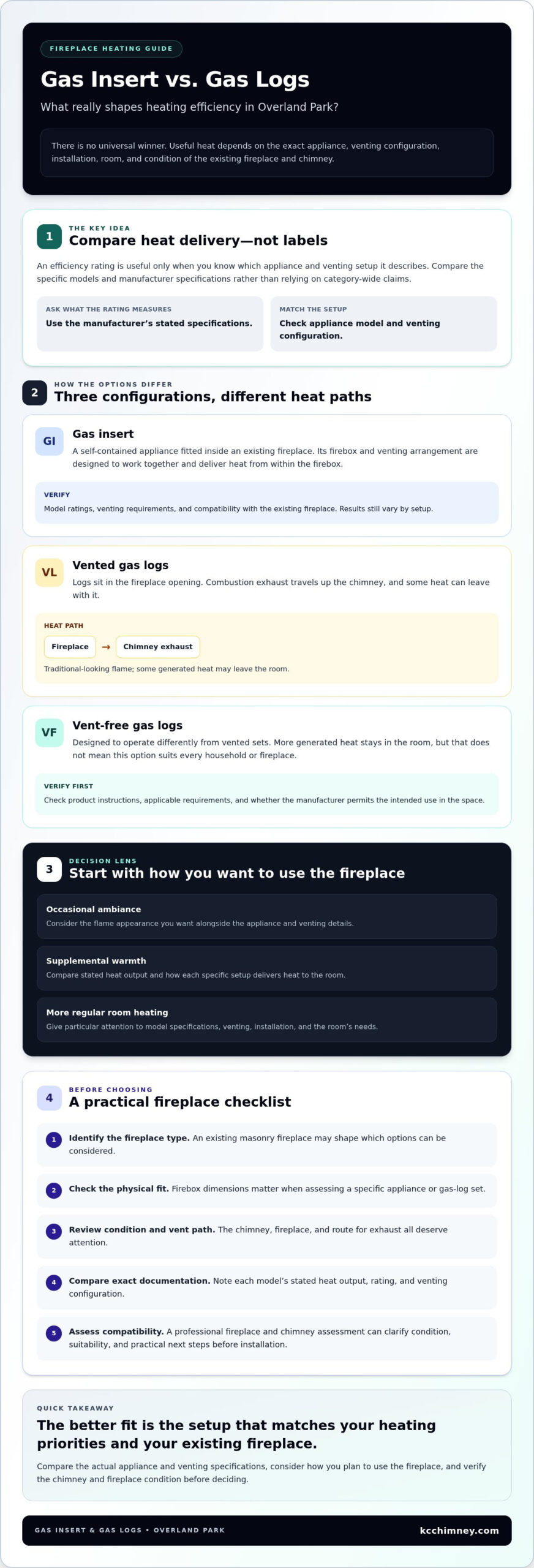
A Practical Overland Park Checklist Before Choosing Gas Logs or an Insert
Before comparing efficiency claims, start with the fireplace you have and how you plan to use it. This checklist can help you gather the right information before choosing gas logs or an insert in Overland Park.
- Identify the fireplace type and condition. Note whether it’s masonry or another construction type, and gather records about past chimney work or inspections if available. Have the fireplace and chimney assessed before deciding what equipment may fit.
- Be clear about the heating goal. Decide whether you mainly want an occasional flame for appearance or supplemental heat for a frequently used room. Your intended use helps put product performance information in context.
- Compare exact manufacturer specifications. Look up the rating or performance information for each specific model. Confirm that it applies to the planned venting and installation configuration, not a different setup.
- Read operating instructions and limitations. Check what the manufacturer says about use, venting, and the conditions required for operation. Don’t assume instructions for one model or configuration apply to another.
- Confirm project details with qualified professionals. Ask about fuel supply, installation scope, compatibility with the existing fireplace, and applicable local requirements. Have those requirements verified for your home and project.
Questions to ask before comparing efficiency claims
Ask the seller or installer: What performance information applies to this exact model? Does it match the planned venting and installation? What limitations, clearances, or operating instructions does the manufacturer identify? These questions make the gas insert vs gas logs efficiency Overland Park comparison more useful than relying on broad category claims.
What a fireplace and chimney assessment can clarify
An assessment can help identify existing condition concerns and whether the fireplace and chimney appear compatible with the option you’re considering. Findings may point to issues that need attention before equipment selection or installation. For more background, read this Kansas City chimney inspection guide.
If you’re in Overland Park and want to discuss your fireplace and chimney needs, contact a local chimney professional.
Choosing and Installing a Gas Fireplace Option in Overland Park
There’s no reliable shortcut based on “insert” or “logs” alone. Compare the exact appliance and venting configuration, your intended heating use, the manufacturer’s specifications, and whether the equipment is compatible with your fireplace. A setup chosen mainly for flame appearance may involve different heat considerations than one selected for supplemental warmth.
Before installation, have the existing fireplace and chimney evaluated. An inspection can help identify condition concerns and factors that may affect compatibility or the work involved. That context matters in Overland Park, where the practical choice depends on the home’s existing fireplace as well as the appliance documentation. Confirm applicable local requirements with a qualified professional rather than relying on assumptions or specifications for a different configuration.
How Best Chimney Services can help with the decision
Best Chimney Services provides chimney sweeping, inspections, repairs, and gas fireplace insert installation for homeowners in the Kansas City metro, including Overland Park. A chimney and fireplace evaluation can help you understand the condition of the existing system and identify questions to resolve before selecting equipment. It doesn’t guarantee that a particular insert or gas-log configuration will be suitable, but it can make the next steps clearer. For related information, see the Overland Park gas fireplace repair guide.
Your next step toward a well-informed installation
Before discussing options, gather any available fireplace or chimney inspection records and the manufacturer details for appliances you’re considering. Make a short note of your priorities: supplemental heat, flame appearance, and how often you expect to use the fireplace. Those details help frame a focused conversation about your home and potential installation considerations.
The gas insert vs gas logs efficiency Overland Park decision is best made with the exact product information and the condition of your fireplace in view. If you’re considering a gas insert, ask Best Chimney Services about insert installation and which chimney inspection or assessment may be appropriate for your home.
Make Your Fireplace Choice With Confidence
The right choice isn’t decided by a broad efficiency label. Compare the exact appliance and venting configuration, consider how you plan to use the fireplace, and make sure the existing chimney and fireplace are assessed for compatibility. That’s the practical approach to the gas insert vs gas logs efficiency Overland Park question.
A professional evaluation can help clarify the condition of your fireplace and what to consider before installation. Best Chimney Services offers gas fireplace insert installation and professional chimney services in the Kansas City metro. The team can help you consider your options in the context of your chimney, without assuming one setup is right for every home.
Gather the appliance information you’re considering and note your heating priorities. Then talk with Best Chimney Services about your Overland Park fireplace options. Homeowners in Mission Hills, Stilwell, Bucyrus, and Spring Hill can also discuss their fireplace needs with the local team.
Frequently Asked Questions
Which is more efficient, a gas insert or gas logs?
A gas insert is generally designed as a dedicated heating appliance, while gas-log performance depends heavily on whether the set is vented or vent-free. There’s no universal efficiency percentage or guarantee that one category will perform better in every home. For the gas insert vs gas logs efficiency Overland Park comparison, check verified ratings for the exact models and configurations, consider whether the appliance suits your fireplace, and have a professional assess the setup.
Are vent-free gas logs more efficient than vented gas logs?
Vent-free gas logs return more heat to the room because they don’t send combustion exhaust up an open chimney. That doesn’t mean they’re suitable for every home or fireplace. Review the exact product’s operating instructions and requirements, and confirm that the room and fireplace are appropriate for that configuration. A qualified professional can help assess your setup and clarify what requirements apply before you select or operate the appliance.
Do gas fireplace inserts heat a room better than gas logs?
A gas insert is designed to function as a heating appliance, but its actual performance varies by model, venting, installation, and room conditions. Vented logs may prioritize flame appearance, and some heat can leave through the chimney. Other log configurations deliver heat differently. Don’t assume every insert will outperform every log set. Compare the manufacturer’s specifications for the exact appliances and configurations you’re considering for your Overland Park home.
Can I install gas logs in my existing fireplace in Overland Park?
Possibly, but an existing fireplace isn’t automatically compatible with every gas-log set. Suitability depends on the fireplace and chimney, fuel connection, chosen venting configuration, and manufacturer requirements. Before buying or operating equipment, arrange a professional evaluation. Homeowners in Overland Park and nearby Mission Hills, Stilwell, Bucyrus, and Spring Hill should also ask the installer or relevant authority to confirm which local requirements apply to their specific project.
How do I compare efficiency ratings for gas inserts and gas logs?
Compare documentation for the exact model and configuration, including the rating type and specified venting setup. Ratings may not be directly comparable across appliance categories or different test methods. Also, don’t treat advertised heat output as the same thing as efficiency. Ask an installer to explain what the figures mean for your planned setup, and verify that the manufacturer’s information matches the fireplace and venting configuration being considered.
Should my chimney be inspected before installing a gas insert or gas logs?
Have the existing fireplace and chimney evaluated before installation, especially if their condition or previous use is uncertain. An assessment can identify condition or compatibility concerns that may affect planning. The appropriate inspection scope depends on the home and project, so don’t assume every installation requires the same evaluation. Ask a qualified professional what assessment makes sense for your fireplace before selecting equipment or proceeding with installation.
Are gas logs cheaper to operate than a gas insert?
Operating expense depends on fuel use, appliance settings, runtime, local utility rates, and the specific product. There isn’t one option that always costs less to run. Compare verified fuel-consumption information for the exact appliances, and consider how much useful heat each configuration delivers for your intended use. If you’re choosing for supplemental warmth, weigh the expected room heat alongside fuel use rather than comparing operating costs in isolation.