
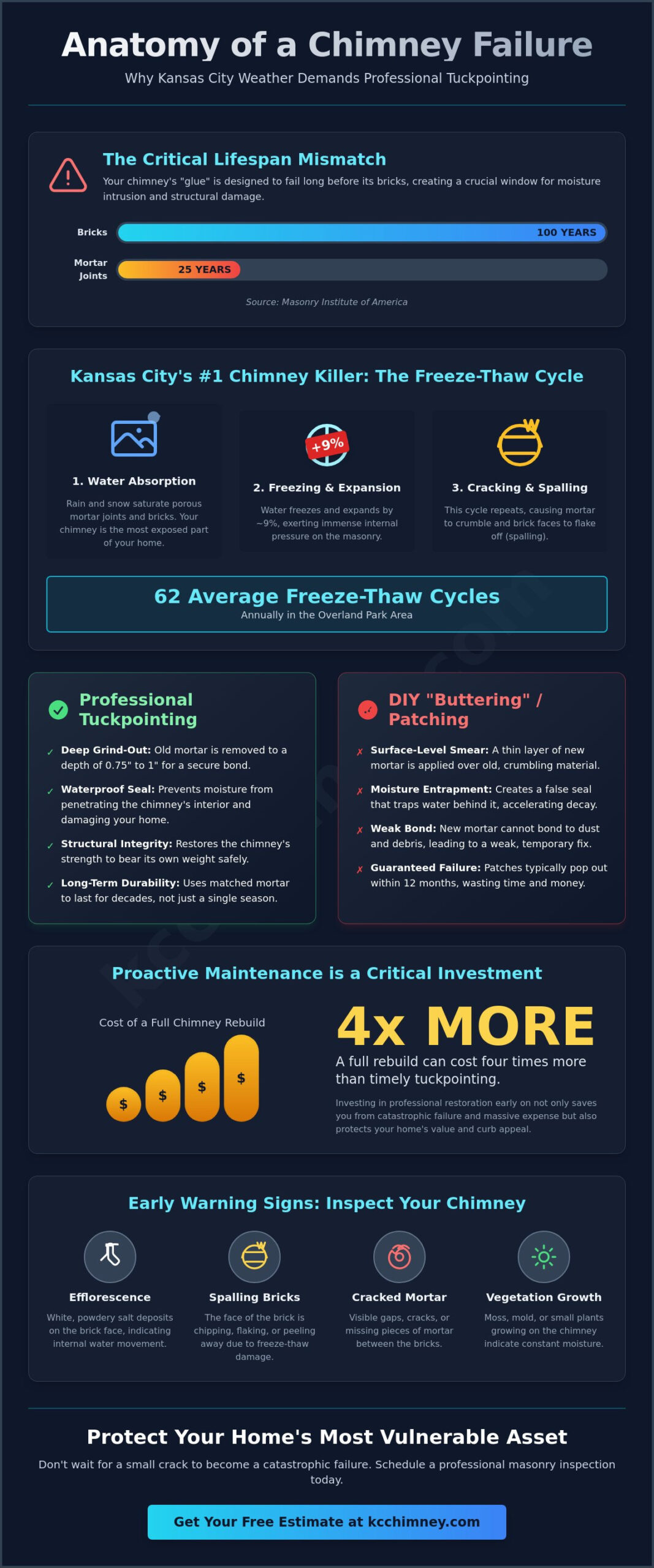
Imagine waking up after a heavy Kansas City thunderstorm to find water pooling at the base of your fireplace. For many homeowners, this isn’t just a hypothetical scenario; it’s a reality that often starts with a single crumbling mortar joint. According to the Masonry Institute of America, mortar joints typically last 25 years, while bricks can last 100. This creates a critical window where your chimney’s “glue” fails long before the structure does, leaving your home vulnerable to the elements. You probably know that your chimney is the most exposed part of your property, constantly battling our local freeze-thaw cycles. It’s stressful to see a brick loose or a crack forming, especially when you’re searching for reliable tuckpointing services Overland Park to prevent a total collapse.
We’ll show you how professional masonry restoration can stop moisture in its tracks and restore the structural integrity of your chimney. You’ll learn how to identify early warning signs and why proactive maintenance prevents the need for a full rebuild. This guide breaks down the 2026 standards for restoration, helping you distinguish between surface-level aesthetics and the deep repairs that keep your family safe and your curb appeal intact.
Key Takeaways
- Learn how Overland Park’s specific freeze-thaw cycle damages your masonry and how to stop moisture from causing “spalling” in your brickwork.
- Discover how professional tuckpointing services Overland Park residents rely on can restore your chimney’s structural integrity while matching the unique mortar of historic homes.
- Understand the technical differences between repointing and tuckpointing so you can make an informed decision on the best restoration method for your fireplace.
- Explore the precision steps of a professional masonry repair, from high-tech Level 2 video inspections to dust-controlled mortar grinding.
- Identify how proactive masonry maintenance protects your home’s value and prevents the high costs and safety hazards of a complete chimney tear-down.
Understanding Tuckpointing Services in Overland Park
Tuckpointing is a precision masonry technique that restores the mortar joints between your chimney’s bricks. It involves removing deteriorated mortar and replacing it with new material that matches the original color and strength. For homeowners seeking Understanding Tuckpointing as a restoration tool, it’s vital to recognize that this isn’t just about looks. It’s a critical safety measure. In Overland Park, where many homes date back to the mid-20th century, the local architecture relies on specific mortar compositions that allow the structure to breathe during Kansas City’s intense 40-degree temperature swings.
Professional tuckpointing services Overland Park residents rely on act as a preventative shield. Mortar erosion is a natural process, but structural failure is an avoidable catastrophe. When mortar joints reach a 25 percent loss of their original volume, the chimney’s weight begins to crush the remaining material. This leads to leaning stacks or internal flue collapses. By investing in restoration early, you avoid the high costs of a total masonry teardown. Industry data suggests a full rebuild can often cost four times more than a timely tuckpointing project.
The Anatomy of a Mortar Joint
Mortar serves as the sacrificial element of your chimney. It’s engineered to be softer than the bricks so that it absorbs the stress of thermal expansion and contraction. Over a typical 20-year cycle, wind and rain naturally wear this layer down. To maintain chimney stability, a professional technician ensures the joint depth remains consistent. We typically grind out old mortar to a depth of 0.75 inches to 1 inch. This provides enough surface area for the new mortar to bond securely to the brick, ensuring the stack remains plumb and stable.
Tuckpointing vs. Simple Patching
Many DIY repairs involve “buttering” or smearing a thin layer of new mortar over the old, crumbling joints. This is a recipe for failure. New mortar cannot bond to dust or loose debris. Without grinding out the old joints, the patch will likely pop out within 12 months due to moisture entrapment. Professional tuckpointing services Overland Park specialists use dust-vacuum systems and diamond-blade grinders to create a clean channel. This process creates a waterproof seal that blocks moisture from entering the chimney’s interior, protecting your home’s framing and attic from water damage.
The Impact of Kansas City Weather on Your Chimney Masonry
Overland Park homeowners face a unique challenge with the local climate. Our region experiences an average of 62 freeze-thaw cycles every year. This cycle is the primary cause of masonry failure. When moisture enters the porous surface of your brickwork and freezes, it expands by approximately 9 percent. This internal pressure creates microscopic fractures that eventually lead to “spalling,” where the outer face of the brick chips or flakes away. Because your chimney stands above the roofline, it lacks the protection of eaves or overhangs. It absorbs the full force of Kansas City’s wind-driven rain and snow from every direction. While your home’s siding might stay dry under a porch, your chimney remains fully exposed to the elements 24 hours a day.
The Science of Water Intrusion
Mortar is designed to be softer and more porous than brick. This allows it to act as a sacrificial layer, but it also means it pulls in moisture through capillary action. When mortar becomes saturated during heavy spring rains, it loses its structural integrity. In Johnson County, the high clay content in the soil often leads to foundation shifting. These subtle movements put immense stress on your chimney, creating cracks that invite even more water into the system. If left unaddressed, this moisture travels downward, causing rot in your attic rafters or water stains on your interior fireplace walls. Professional tuckpointing services Overland Park residents trust can seal these entry points before the damage spreads to the home’s interior.
Seasonal Warning Signs for KC Homeowners
Identifying masonry issues early can save thousands in restoration costs. You should inspect your stack for these specific indicators after a typical Kansas City storm:
- Efflorescence: This is a white, powdery salt deposit that appears on the brick surface. It indicates that water is moving through the masonry and evaporating, leaving minerals behind.
- Vegetation Growth: If you see moss or small weeds growing in your mortar joints, it means the moisture has reached deep into the structure.
- Mortar Gaps: Any visible holes or “recessed” joints mean the mortar is no longer shedding water effectively.
Spring is the most effective time to schedule repairs. Most professional-grade mortars require temperatures to stay between 40 and 90 degrees Fahrenheit for a minimum of 24 hours to cure properly. Addressing these issues in April or May ensures your chimney is sealed and ready for the high humidity of a Kansas summer. Taking care of your masonry now protects the safety of your family and the value of your home for years to come.
Tuckpointing vs. Repointing: Which Does Your Chimney Need?
Most homeowners use these terms interchangeably, but they serve different roles in masonry health. Repointing is the structural process of removing decayed mortar and replacing it with fresh material. Tuckpointing is an aesthetic upgrade that uses two different colors of mortar to create the illusion of perfectly thin, straight joints. While you might call us for tuckpointing services Overland Park, our initial inspection usually reveals that your chimney requires structural repointing first to ensure the stack remains stable through the 2026 season and beyond.
We see a high volume of requests for “tuckpointing” from residents in older neighborhoods who notice sandy debris on their roof or patio. In 90% of these cases, the primary goal is moisture protection. We combine both techniques to give your home a chimney that is both watertight and visually striking. This dual approach ensures your masonry survives the freeze-thaw cycles common to the Kansas City climate.
Structural Repointing: The Foundation of Repair
Repointing becomes mandatory when mortar joints have eroded to a depth of 0.25 inches or more. At this stage, the structural integrity of the chimney is at risk. Our team focuses on the technical chemistry of the repair. We carefully match the new mortar strength to your existing brick type. This is a critical step that many general contractors miss.
- Mortar Compatibility: Using modern, high-strength Portland cement on a home built between 1920 and 1950 can be a disaster. If the mortar is harder than the brick, the brick will crack and “spall” during temperature shifts.
- Depth Requirements: We grind out old joints to a minimum depth of 0.5 inches to 1 inch to ensure the new mortar has a mechanical bond with the masonry.
- Waterproofing: Repointing fills the voids where driving rain and melting snow enter your home’s interior walls.
The Aesthetic Value of Tuckpointing
Once the structure is sound, we focus on the visual finish. True tuckpointing involves a “fillet” line. We use a mortar color that blends seamlessly with your brick, then apply a thin, contrasting line of lime putty or white mortar down the center of the joint. This creates a crisp, sharp appearance that hides irregularities in older, handmade bricks.
This level of masonry restoration significantly impacts property values in areas like Mission Hills and the historic corridors of Overland Park. According to regional real estate data, high-quality masonry restoration can increase a home’s curb appeal value by 5% to 12%. Our tuckpointing services Overland Park are designed to honor the architectural heritage of your neighborhood while providing a shield against the elements. We don’t just patch holes; we restore the historic character of your family’s hearth.
The Step-by-Step Chimney Tuckpointing Process
Restoring a chimney requires more than just slapping new mud into cracks. It is a methodical restoration process that ensures your fireplace remains the safe, warm heart of your home. At KC Chimney, we follow a rigorous four-phase protocol to guarantee your masonry stands up to the 50-plus freeze-thaw cycles Kansas City experiences every year.
Phase 1: Professional Diagnosis. Every project begins with a Level 2 video inspection. We use high-resolution cameras to examine the internal flue liners and external masonry. This identifies hidden structural voids and internal decay that a simple ground-level glance would miss.
Phase 2: Precision Grinding. Our team uses specialized diamond-blade saws to remove damaged mortar to a uniform depth of 3/4 of an inch. This depth is critical; it provides enough surface area for the new mortar to “key” or bond into the existing wall. When you invest in professional tuckpointing services Overland Park residents trust, you ensure this step is done without chipping or scarring the surrounding bricks.
Phase 3: Custom Mortar Blending. We don’t use “one size fits all” bags from big-box stores. We analyze the color, texture, and compressive strength of your original mortar. This ensures the new material expands and contracts at the same rate as your 20-year-old or 50-year-old brickwork, preventing future cracks.
Phase 4: Multi-Layered Tooling. The final step involves packing the joints and “striking” them with a jointing tool. This creates a specific profile, usually concave, that directs rainwater away from the soft mortar center and onto the brick face where it can evaporate safely.
Preparation and Safety Protocols
Your home is your most valuable asset, so we treat the job site like a surgical environment. We drape your roof and surrounding landscaping in heavy-duty 10-mil poly sheeting to prevent debris damage. Dust containment is our priority in residential Overland Park areas. We utilize industrial HEPA-filter vacuums attached directly to our grinding tools, capturing 99% of masonry dust before it can settle on your siding or your neighbor’s lawn. Before the first joint is ground, we also verify the chimney crown’s stability to ensure the entire structure is safe for masonry work.
Expert Mortar Application
Applying mortar is an exercise in patience. We apply the material in “lifts,” which are thin layers roughly 1/4 inch thick. This prevents the sagging and internal air gaps that lead to premature failure. Once the mortar reaches the “thumbprint hard” stage, we strike the joints to seal the edges against moisture. Because the Kansas City climate fluctuates between high humidity and dry winds, we monitor the 28-day curing cycle closely. Proper hydration during the initial 72 hours is vital to prevent shrinkage cracks and ensure the structural integrity of your tuckpointing services Overland Park project.
Ready to protect your home’s exterior with precision masonry? Schedule your Level 2 chimney inspection with KC Chimney today.
Why Professional Masonry is a Critical Investment for Your Home
Investing in tuckpointing services Overland Park is a strategic move for your property’s long-term value. It’s much cheaper to replace failing mortar than it is to rebuild a structural stack from the roofline down. According to industry data from the Chimney Safety Institute of America (CSIA), water penetration is the single greatest cause of chimney failure. Proactive masonry maintenance costs a fraction of a total chimney tear-down. While a full rebuild might take weeks and disrupt your home’s daily routine, professional tuckpointing often finishes in just a few days. This restoration can extend the lifespan of your chimney by 25 years or more when performed by experts.
The physics of a chimney depend on a perfectly sealed system to function correctly. When mortar joints fail, the internal draft is compromised. This can lead to inefficient burning or, in severe cases, carbon monoxide backing into your living space. Our team understands how air pressure and thermal expansion affect your masonry. We ensure that your home remains a safe sanctuary for your family. KC Chimney technicians maintain CSIA certification, meaning they’ve passed rigorous exams on chimney physics and fire safety. We don’t just patch holes; we restore the structural integrity of the entire venting system.
Preventing Flue and Liner Damage
Water doesn’t stay on the outside of your chimney. It migrates inward through microscopic cracks in the mortar. Once moisture reaches the flue, it reacts with creosote deposits to form highly corrosive acids. This process eats away at clay tile liners and causes stainless steel components to rust prematurely. Gaps in the exterior masonry are often the first sign of a much larger safety risk. By addressing these gaps now, you prevent the conditions that lead to dangerous chimney fires. You should consider this as part of a comprehensive plan for Expert Chimney Repair in Kansas City to keep your hearth secure.
Choosing a Local Overland Park Specialist
Overland Park homes face unique climate challenges. Our region experiences an average of 45 freeze-thaw cycles every winter. This constant expansion and contraction will destroy “cheap” masonry work within two seasons if the mortar mix is incorrect. A quality quote should detail the specific mortar type and provide a clear warranty on labor. We use materials that match the original composition of your home’s brickwork to ensure a seamless bond and lasting durability. To protect your investment, schedule a chimney inspection in Kansas City today. We’ll provide a detailed assessment of your masonry’s health and a clear path toward professional restoration.
Secure Your Home’s Structural Integrity Today
Kansas City’s unpredictable freeze-thaw cycles and heavy precipitation put constant pressure on your chimney’s mortar joints. Ignoring small cracks today often leads to structural failure and expensive water damage tomorrow. By choosing professional tuckpointing services Overland Park homeowners can stop moisture penetration and extend the life of their masonry for decades. Our team brings over 10 years of experience serving the Kansas City Metro area to every project. We rely on CSIA Certified Technicians who understand the specific architectural needs and weather challenges of local homes. As 5-star rated local masonry experts, we focus on precision and durability so you don’t have to worry about crumbling brickwork or leaks during the next storm season. Investing in high-quality restoration now ensures your chimney remains a safe, functional centerpiece for your family. We take pride in our craft and look forward to helping you preserve your home’s long-term value. Request a Professional Tuckpointing Estimate in Overland Park today. You’ll feel better knowing your chimney is ready for whatever the Kansas weather brings next.
Frequently Asked Questions
How much does tuckpointing cost in Overland Park?
Tuckpointing costs in Overland Park typically range from $5 to $25 per square foot based on national averages reported by HomeAdvisor. Your final investment depends on the chimney height and the level of mortar decay. We provide detailed inspections to ensure you only pay for the specific restoration your masonry requires to remain structurally sound and safe for your family.
How do I know if my chimney needs tuckpointing or a full rebuild?
You need tuckpointing when mortar is crumbling but bricks remain intact; a full rebuild is necessary if more than 25% of the bricks are loose or spalling. If you notice the chimney leaning or see large cracks through the bricks themselves, the structural integrity is likely compromised. We use 14 point safety inspections to determine if a targeted repair or a complete masonry overhaul is the safest path for your home.
Can I tuckpoint my chimney myself?
You can attempt DIY tuckpointing, but it often leads to moisture traps and accelerated brick decay if the mortar mix is incorrect. Professional tuckpointing services Overland Park homeowners rely on involve precise color matching and specific lime-to-cement ratios. Improperly applied mortar lacks the necessary bonding strength, which can result in the entire repair failing within 24 months and requiring more expensive professional correction.
How long does professional tuckpointing last in the Kansas City climate?
Professional tuckpointing typically lasts 20 to 30 years in the Kansas City climate. Our region experiences roughly 50 freeze-thaw cycles annually, which puts immense pressure on masonry joints. High quality mortar work protects your chimney from this thermal expansion. When done correctly, these repairs act as a long term shield for your home’s structural core and prevent expensive interior water damage.
Does tuckpointing stop chimney leaks?
Tuckpointing stops leaks caused by mortar deterioration, but it won’t fix problems with the chimney crown or flashing. About 70% of chimney moisture issues stem from a combination of porous mortar and cracked crowns. We inspect the entire system to ensure a comprehensive seal. If water enters through the brick pores, we may also recommend a vapor-permeable water repellent after the mortar cures.
Is tuckpointing the same as repointing?
Repointing is the process of removing old mortar and replacing it, while tuckpointing adds a contrasting line of fillet to create the illusion of perfect joints. Most tuckpointing services Overland Park residents request are technically repointing jobs focused on structural health. We use the tuckpointing technique specifically on historic homes to restore the sharp, aesthetic lines typical of early 20th-century craftsmanship while ensuring the chimney remains watertight.
Will tuckpointing change the look of my historic brickwork?
Professional tuckpointing preserves the original aesthetic of your historic brickwork by using custom-pigmented mortar. We analyze the existing masonry to match the texture and hue of the original 1920s or 1940s materials. Our goal is a seamless transition where the repair is invisible to the naked eye. This process maintains your home’s character while reinforcing its physical durability for decades to come.
What is the best time of year to perform tuckpointing in Kansas City?
The best time for tuckpointing in Kansas City is during the spring or fall when temperatures stay between 40 and 90 degrees Fahrenheit. Mortar requires a steady curing environment to reach its full 3,000 PSI strength. We avoid mid-winter projects because freezing temperatures can cause the wet mortar to crystallize and fail. Scheduling during moderate weather ensures the bond between the brick and mortar stays permanent.