
If your fireplace passes a basic municipal building inspection, does that actually mean it’s safe to light a fire tonight? Many homeowners in Johnson and Miami counties assume that being “up to code” is the same as being “safe,” but these terms often mean very different things in practice. It’s natural to feel anxious about hidden hazards like carbon monoxide leaks or flue cracks, especially when you’re facing the added pressure of a real estate inspection during a home sale. You want to protect your family, but the technical jargon of chimney safety standards kansas city can feel intentionally confusing.
We believe that every neighbor deserves a home that’s both a sanctuary and a secure structure. This guide will help you bridge the gap between local building codes and the rigorous 2027 NFPA 211 national safety standards. You’ll learn exactly what differentiates Level 2 and Level 3 inspections, how Kansas City’s specific climate affects your masonry, and what’s required to keep your fireplace legal in 2026. By the end of this article, you’ll have a clear checklist for maintaining your chimney’s integrity and the confidence that comes from expert-backed knowledge.
Key Takeaways
- Distinguish between basic legal code compliance and the professional safety standards required for a truly safe fireplace.
- Learn how the latest chimney safety standards kansas city homeowners need to follow can prevent common regional house fires.
- Find out which of the three NFPA inspection levels is necessary for your specific situation, from annual maintenance to property transfers.
- Understand the unique impact of the local climate on your masonry, including how freeze-thaw cycles create hidden structural risks in Johnson County.
- Access a practical checklist for identifying the early warning signs of creosote buildup and flue liner damage before they require costly repairs.
Understanding Kansas City’s Chimney & Fireplace Building Codes
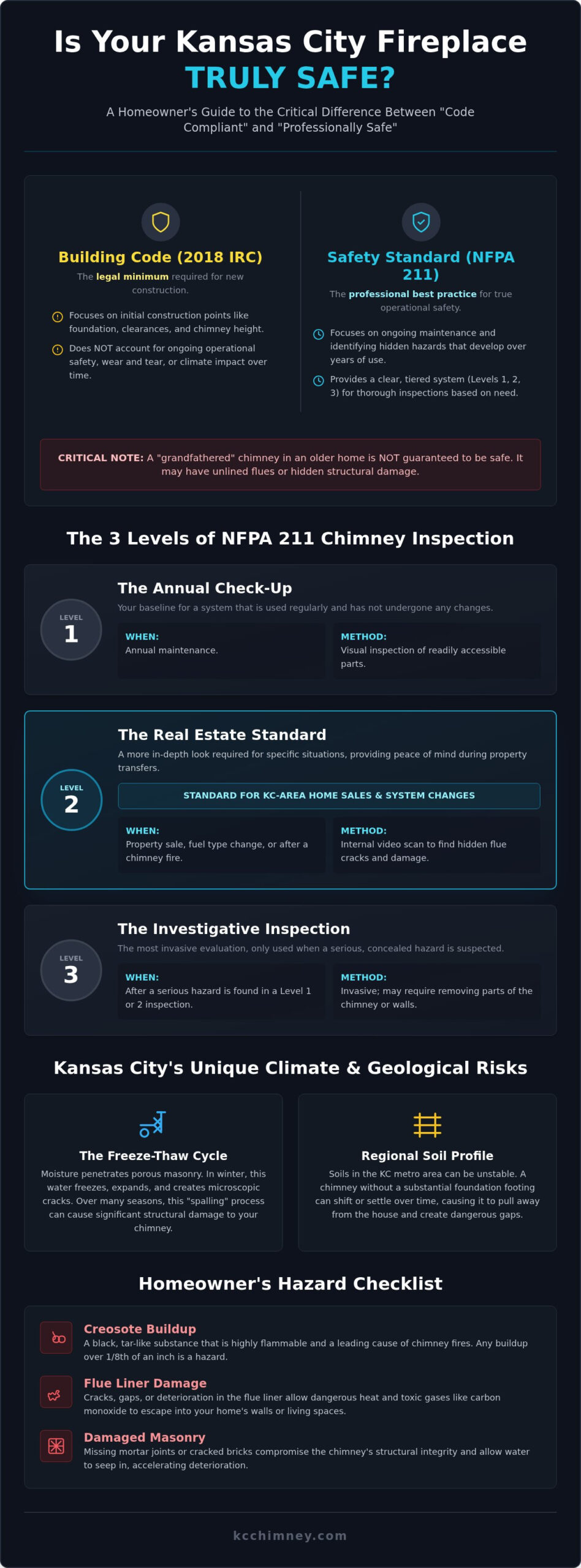
Kansas City, Missouri, along with many municipalities in the metro area like Overland Park, currently operates under the 2018 International Residential Code (IRC). While this provides a legal framework for new builds, homeowners often confuse “code compliance” with comprehensive safety. Code compliance is the legal minimum required to build a structure. In contrast, chimney safety standards kansas city professionals follow involve ongoing operational safety and maintenance that goes beyond the initial blueprint. Local amendments often exist because our regional soil and weather patterns require more robust solutions than national defaults.
Municipalities across the metro, from Mission Hills to Overland Park, enforce these codes through the permitting process. If you’re planning a major repair or a new installation, you’ll likely interact with the CompassKC portal or local building departments. These agencies ensure that contractors meet the 2018 IRC benchmarks, but they don’t typically perform the annual safety evaluations necessary for an active fireplace. That’s where voluntary adherence to chimney safety standards kansas city experts recommend becomes your primary line of defense.
The 2018 IRC: What Homeowners Need to Know
The 2018 IRC sets strict requirements for masonry fireplace footings. In the specific soil profile of the KC metro, foundations must be substantial enough to prevent the chimney from pulling away from the house. Another critical safety metric is the “2-inch rule,” which requires a minimum two-inch clearance between masonry chimneys and any combustible materials like wood framing. This gap prevents heat transfer that could lead to a house fire. Additionally, the IRC dictates the specific height a chimney must reach above the roofline and nearby ridges to ensure proper draft and smoke termination.
Why ‘Grandfathered’ Doesn’t Mean ‘Safe’
If you live in an older home in Stilwell or Bucyrus, your fireplace might be “grandfathered in,” meaning it was legal when built. However, this doesn’t guarantee it’s safe for use in 2026. Many historic Kansas City homes feature unlined flues, which lack the protective barrier needed to contain heat and toxic gases. Over decades, structural shifts in the foundation can create new gaps in the masonry that weren’t there twenty years ago. These hidden defects are primary contributors to Understanding Chimney Fires and their prevention. Relying on outdated construction methods often leads to a false sense of security that puts your property at risk.
The NFPA 211 Standards: Three Levels of Inspection
While Kansas City’s local building codes provide the legal framework for how a fireplace is built, the NFPA 211 Standards dictate how it should be inspected and maintained. These national guidelines ensure that your system remains safe to operate year after year. Adhering to these chimney safety standards kansas city homeowners can rely on protects not just the property, but the lives within it. These standards categorize inspections into three distinct levels based on the specific circumstances of the evaluation.
A Level 1 inspection is the baseline for systems that haven’t changed and appear well-maintained. We examine the readily accessible portions of the chimney and fireplace to check for basic structural integrity and creosote buildup. If you use your fireplace regularly and haven’t noticed any changes in performance, this is your standard annual checkup. It verifies that the chimney is free of obstructions and that the basic structure is sound without requiring any specialized tools or invasive techniques.
Level 2 Inspections: The KC Real Estate Standard
In high-demand markets like Overland Park and Leawood, a Level 2 inspection is a non-negotiable part of a responsible property transfer. This level is required whenever you sell a home, change the fuel type, or experience an event like a chimney fire. We use advanced video scanning technology to look deep inside the flue, identifying cracks or gaps that are invisible from the hearth. This technology provides a clear, documented record of the internal condition, offering peace of mind to both buyers and sellers. You can find more detail on this process by reading about Expert Chimney Inspection in Kansas City.
When is a Level 3 Inspection Necessary?
This is the most invasive level of evaluation. We only recommend it when a serious structural hazard is suspected but cannot be confirmed through standard methods. It often follows a catastrophic event where the safety of the chimney is in question. The process involves removing specific components of the building, such as drywall or masonry, to access concealed areas of the flue. Adhering to the chimney safety standards kansas city professionals use ensures that every hidden crack is accounted for. It is the final word in structural safety verification after major storm damage or a significant fire.
If you are preparing for a home sale or have recently moved, scheduling a Level 2 inspection is the best way to ensure your new hearth is ready for its first fire.
Common Safety Hazards in Kansas City Chimneys
Understanding the risks is the first step toward prevention. While building codes ensure a chimney is constructed correctly, they don’t prevent the accumulation of hazardous byproducts or the wear of time. In Missouri and Kansas, creosote buildup remains the leading cause of chimney fires. This byproduct of wood combustion is highly flammable and often hides in plain sight. Beyond fire risks, deteriorating flue liners and failing masonry pose structural threats that can compromise your home’s safety. Adhering to the chimney safety standards kansas city experts recommend is the only way to identify these hidden dangers before they become emergencies.
Acidic combustion byproducts naturally eat away at traditional clay tile liners over time. When these liners crack or flake, heat and toxic gases can escape into the home’s structure. This leads to carbon monoxide risks, often called the “silent killer.” Poor drafting or a blocked flue can force these odorless, colorless gases back into your living space. Regular evaluations ensure your system meets the safety benchmarks required to vent these gases away from your family.
The Danger of Creosote Accumulation
Creosote develops in three distinct stages. Stage one is a flaky, soot-like substance that’s relatively easy to remove. Stage two becomes a hard, crunchy deposit that adheres more firmly to the flue walls. Stage three is a thick, waxy, or glazed coating that’s extremely difficult to clean and highly combustible. Regular chimney sweeping in Kansas City is your primary defense against these stages reaching a critical flashpoint. Creosote accumulation ignores building codes entirely and creates an immediate fire hazard regardless of how well your chimney was originally built.
Structural Integrity and Tuckpointing
Masonry is resilient, but it isn’t indestructible. Moisture penetration is the enemy of brick and mortar. In our region, this often manifests as “spalling,” where the face of the brick pops off due to internal water pressure. When mortar joints fail, they can allow fire to spread from the flue directly to your home’s wooden framing. Maintaining these components according to the Kansas City Building and Rehabilitation Code ensures your home stays protected from structural collapse. If you notice crumbling mortar or loose bricks, seeking expert chimney repair in Kansas City is essential to restore the integrity of your hearth. Professional tuckpointing stops moisture from migrating deeper into the chimney stack and prevents internal degradation that could lead to a total rebuild.
Regional Factors: How KC Weather Impacts Safety Standards
Kansas City’s climate presents unique challenges that directly influence the chimney safety standards kansas city homeowners must maintain. Our region experiences aggressive freeze-thaw cycles. When moisture enters porous bricks or mortar joints and then freezes, it expands. This expansion creates hairline fractures that grow larger with each passing winter. Over time, these small cracks compromise the structural stability of the entire stack. By 2026, safety protocols have shifted to emphasize proactive waterproofing as a non-negotiable part of chimney maintenance.
High winds and severe spring storms are common in Johnson County. These weather events often target the most vulnerable parts of your chimney, such as the cap or chase cover. While a building code might have been met during the initial construction, it doesn’t account for the ongoing wear and tear from Midwestern weather. Ensuring your system remains compliant with modern safety benchmarks requires regular checkups after major storm seasons.
Crown and Cap Integrity
The chimney crown is the concrete slab at the very top of your masonry. It acts as your home’s first line of defense by shedding water away from the structure. If the crown develops cracks, water seeps directly into the chimney’s core. This is a safety emergency because it leads to internal rot and masonry failure that can’t be seen from the ground. Similarly, chimney caps serve a dual purpose. They keep sparks from landing on your roof and prevent animals from nesting in your flue. Identifying wind-damaged chase covers after a typical KC storm is vital to preventing blockages that lead to smoke backup.
Moisture Penetration and Fire Safety
Water doesn’t just damage bricks; it creates significant fire hazards. If water enters the flue, it can cause “thermal shock” when you light your first fire of the season. The rapid temperature change causes moisture-saturated masonry or liners to crack or even explode under the stress. Moisture also causes dampers to seize and fireboxes to deteriorate. Homeowners in Mission Hills and Stilwell should look for white staining on bricks or rusted metal components as early warning signs of moisture intrusion. Proactive maintenance ensures these components remain durable and safe for decades.
If you’ve noticed new cracks or masonry debris after a heavy storm, it’s time for a professional evaluation. You can protect your home’s future by scheduling a comprehensive safety inspection to catch moisture issues before they become structural failures.
Meeting Safety Standards with Best Chimney Services
Maintaining chimney safety standards kansas city families can trust requires more than a quick look with a flashlight. Since 2012, Best Chimney Services has specialized in the rigorous multi-level safety evaluations defined by the Chimney Safety Institute of America (CSIA). We believe that professional service should be transparent and thorough. That’s why we utilize advanced video camera equipment during our inspections. This technology allows us to identify internal hazards like flue liner cracks or hidden creosote that would otherwise remain invisible to the naked eye. By seeing what we see, you gain total peace of mind regarding your hearth’s integrity.
Scheduling your 2026 safety check before the peak winter season ensures your system is ready for the first cold snap. We focus on Johnson and Miami counties, understanding that our local architecture requires specific attention to detail. Whether you need a standard Level 1 check or a more complex Level 3 structural verification, our goal is to provide a reliable remedy for your household concerns. We treat every home as if it were our own, prioritizing longevity and durability in every repair.
Why Choose Our Certified Technicians?
Our technicians are not just laborers; they’re certified professionals who understand the nuances of the 2018 IRC and local Kansas City amendments. We use specialized, mess-free sweeping techniques to ensure that soot and dust stay out of your living room, protecting your home’s indoor air quality. We also value your time and budget. Our service model includes flat-rate inspection and sweeping fees, allowing for predictable seasonal budgeting without the stress of hidden costs. This honest, no-nonsense approach is why we’ve become a fixture in the community.
Protect Your Home Today
Before you light your next fire, run through this final safety checklist. Look for these “red flags” that indicate your system may not meet current safety benchmarks:
- Visible white salt deposits (efflorescence) on the exterior masonry.
- A strong, campfire-like odor coming from the fireplace when it’s not in use.
- Bits of clay tile or brick appearing on the floor of the firebox.
- A damper that feels stuck or grinds when you try to open it.
If you notice any of these signs, it’s time to call in the experts. Don’t wait for a small crack to become a major structural failure. Take a proactive step toward protecting your property and your loved ones. Schedule your KC chimney safety inspection today and ensure your fireplace remains a safe, warm center for your home throughout 2026.
Securing Your Hearth for the Season Ahead
Understanding the difference between the legal minimum of a building code and the rigorous chimney safety standards kansas city homeowners deserve is the first step in protecting your property. We’ve explored how our local freeze-thaw cycles can silently degrade your masonry and why a Level 2 inspection is the gold standard for anyone buying or selling a home in the metro area. Safety isn’t just about passing a basic inspection; it’s about having the technical authority of a certified expert to verify that every flue joint and mortar line is secure.
Since 2012, our locally owned team has prioritized your peace of mind by following CSIA-aligned safety protocols and providing advanced video flue scanning. This level of transparency ensures you know exactly what’s happening inside your chimney before you ever strike a match. Don’t leave your family’s comfort to chance during the next cold snap. Take a proactive step today to ensure your fireplace remains a safe and reliable source of warmth for years to come.
Book Your 2026 Chimney Safety Inspection & Sweep
Frequently Asked Questions
What are the legal chimney inspection requirements for selling a home in Kansas City?
Most real estate transactions in the Kansas City metro area require a Level 2 inspection as part of the due diligence process. While building codes like the 2018 IRC govern initial construction, the NFPA 211 standards mandate this specific evaluation during any property transfer. This ensures that the internal flue is documented as safe for the next owner. Skipping this step often causes significant delays during the closing process in Mission Hills or Stilwell.
How often does a chimney need to be swept to meet safety standards in 2026?
You should schedule a professional evaluation at least once per year to remain compliant with chimney safety standards kansas city professionals recommend. The actual need for a sweep depends on how much creosote has accumulated within the flue. If our technicians identify more than 1/8th of an inch of buildup, a cleaning is necessary to prevent a chimney fire. Regular use of your wood-burning fireplace in Johnson County typically requires annual maintenance.
Is a Level 2 inspection required by law in Overland Park?
While specific municipal ordinances can vary, most insurance providers and mortgage lenders in Overland Park require a Level 2 inspection for property transfers and system changes. This standard follows the NFPA 211 guidelines, which are the non-negotiable baseline for chimney professionals. It isn’t just about legality; it’s about verifying the structural integrity of the flue before a new family begins using the fireplace for the winter. It protects your investment and your family.
What happens if my chimney fails a safety inspection?
If we identify a “red flag” hazard, we provide a detailed report explaining why the system is unsafe to operate. Common failures in Bucyrus or Spring Hill include cracked liners, masonry decay, or excessive creosote. We then recommend a professional remedy, such as tuckpointing for exterior damage or chimney relining for internal breaches. You shouldn’t use your fireplace until these critical repairs are completed to avoid fire or carbon monoxide risks in your home.
Can I perform my own chimney safety inspection using a DIY kit?
DIY kits cannot replace a professional evaluation because they lack the specialized video scanning technology required to see internal flue damage. A technician certified in chimney safety standards kansas city protocols has the training to identify subtle masonry shifts and liner cracks that a homeowner might miss. Professional documentation is also usually required for insurance claims or real estate sales, making a DIY attempt insufficient for safety, structural verification, or legal protection.
Does a gas fireplace need the same safety inspections as a wood-burning one?
Yes, gas fireplaces require annual inspections to ensure proper venting and to check for carbon monoxide leaks. While they don’t produce creosote like wood-burning units, they can still suffer from blocked flues, failing pilot lights, or rusted components. We examine the gas lines and the ventilation system to ensure everything meets modern safety benchmarks. Keeping your gas insert well-maintained protects your indoor air quality throughout the heavy heating season in the Kansas City metro.
What is the difference between a chimney sweep and a chimney inspection?
A chimney sweep is a mechanical cleaning process designed to remove soot and creosote from the flue. A chimney inspection is a comprehensive safety evaluation of the entire system’s structural integrity. While a sweep keeps the fireplace running efficiently, the inspection identifies hidden hazards like masonry gaps or failing crowns. At Best Chimney Services, we perform both during a standard visit to ensure your home is both clean and secure before the winter starts.
Why is video inspection considered the gold standard for chimney safety?
Video technology allows us to see every inch of the flue liner from top to bottom, revealing cracks that are invisible from the hearth. This level of transparency is essential for meeting modern chimney safety standards kansas city homeowners expect. It provides a visual record of your chimney’s condition, which is invaluable for documenting safety during a home sale in Mission Hills. We don’t guess about your safety; we verify it with high-definition clarity for your peace of mind.