
Imagine sitting down for a quiet evening only to hear the frantic scratching of a squirrel trapped inside your chimney flue. For many Spring Hill homeowners, this unsettling noise is the first warning of a much larger problem involving fire hazards from nests and the potential for expensive animal removal fees. You likely already know that an open chimney is an invitation for trouble, but you shouldn’t have to worry every time a storm rolls through or a new season begins.
In this guide, you’ll discover how to implement a permanent solution by choosing the right chimney cap for animal protection Spring Hill homes require to stay secure. We’ll look at how high-quality materials like stainless steel and copper withstand the unique combination of Kansas wind and ice while keeping local wildlife out of your living space. We will also explain why following Johnson County building standards and opting for professional installation ensures your home remains a safe haven for your family, not the local critter population.
Key Takeaways
- Understand how a properly fitted cap serves as the primary barrier against both invasive animals and potential fire hazards.
- Learn why a high-quality chimney cap for animal protection Spring Hill residents prefer often utilizes stainless steel for its durability in the Kansas climate.
- Identify the specific behaviors of local raccoons and squirrels that turn an unprotected flue into a serious safety risk for your family.
- Discover the advantages of a professional installation process that creates a permanent seal while protecting the integrity of your roof and chimney crown.
What is a Chimney Cap and Why is it Essential for Spring Hill Homes?
A chimney cap is a protective covering installed over the top of your chimney flue. It’s much more than a simple metal lid; it’s the primary line of defense for your entire heating system. You can learn more about the technical details of What is a Chimney Cap and how it functions as a chimney cowl to prevent downdrafts and entry. For homeowners in our area, this component serves a dual role. It keeps invasive critters out while keeping dangerous sparks in. Without a functional spark arrestor, hot embers can escape the flue and land on your roof or nearby dry grass, posing a significant fire risk to your property.
Spring Hill features beautiful open landscapes and wooded areas that are home to thriving wildlife populations. Raccoons, squirrels, and birds view your chimney as a warm, hollow “tree” perfect for nesting. Installing a high-quality chimney cap for animal protection Spring Hill homeowners can rely on is a proactive step that respects the local ecosystem while protecting your property. It’s essentially an insurance policy for your home. The cost of a professional cap installation is a fraction of what you’ll pay for emergency wildlife removal and the subsequent repairs to a damaged flue liner or attic space. Prevention is always more affordable than a crisis.
The Anatomy of a Protective Chimney Cap
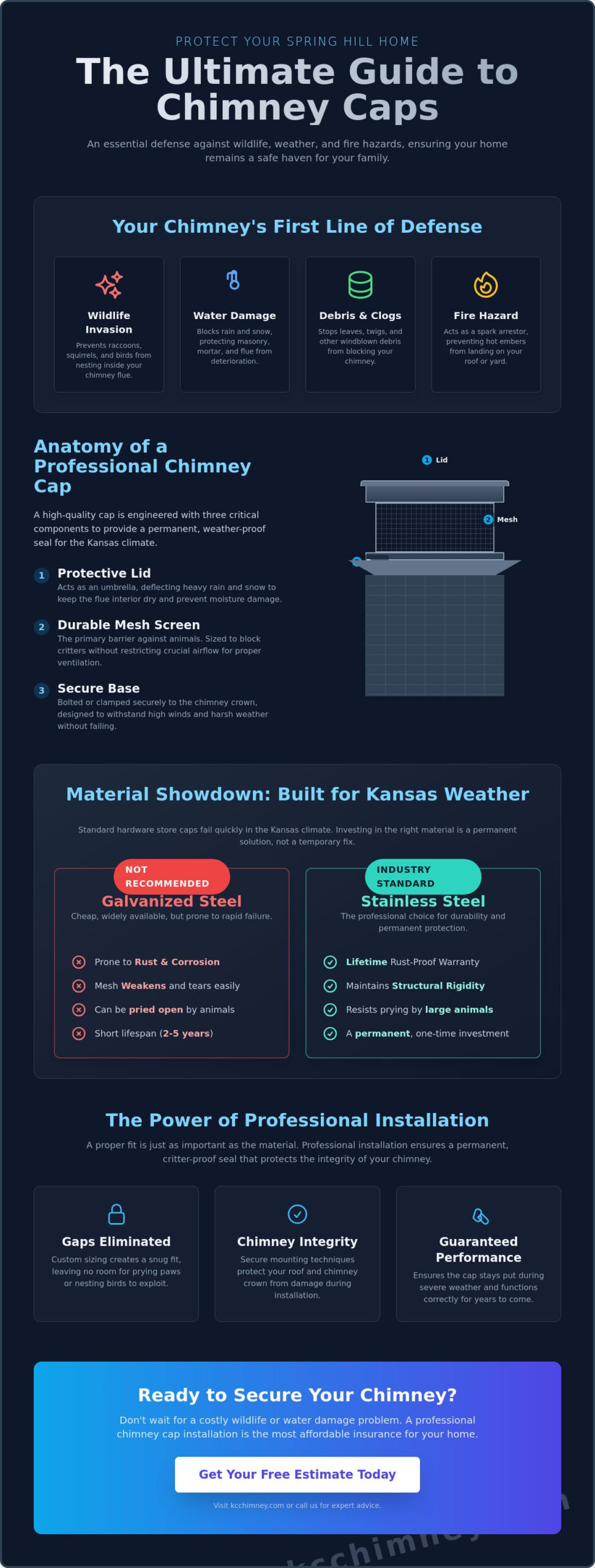
A reliable cap consists of three main components engineered for the Kansas climate. The lid acts as an umbrella, shielding the flue from heavy rain and snow. Below the lid, the mesh or screen is the critical barrier. The size of this mesh is carefully chosen to block even small rodents without restricting the airflow necessary for your fireplace to vent safely. Finally, the base must be sturdy. In Spring Hill, we experience high winds that can easily blow away cheap, hardware-store caps. A professional base is bolted or clamped securely to ensure it stays put during a storm, providing a permanent seal that won’t rattle or fail when the weather turns harsh.
Beyond Animals: Water and Debris Protection
While animals are a major concern, water is actually a chimney’s greatest enemy. Without a cap, rain falls directly into the flue, causing the mortar and masonry to deteriorate from the inside out. This moisture also erodes the chimney crown, leading to cracks and leaks that can travel into your walls. Additionally, caps block leaves, twigs, and windblown debris from clogging the passage. If you’re concerned about the current state of your system, scheduling a chimney inspection kansas city service can identify hidden damage before it becomes a costly structural failure. Keeping the flue clear ensures your fireplace operates at peak efficiency all winter long.
Choosing the Right Materials for Animal Protection in Kansas
Selecting the right material for your chimney is a decision that dictates how often you’ll be climbing a ladder for repairs. While many big-box retailers sell galvanized steel caps, these often fail within a few years in the Kansas City metro climate. The combination of high summer humidity and the acidic nature of fireplace exhaust causes galvanized steel to rust and flake. Once the integrity of the mesh is compromised, it only takes one persistent raccoon to peel back the metal and gain entry. Investing in a chimney cap for animal protection Spring Hill families can trust means looking toward more resilient options like stainless steel or copper.
A critical factor often overlooked is the fit. A stock cap might leave small gaps that rodents can exploit. A custom-sized cap ensures a “snug fit” that leaves no room for prying paws or nesting birds. When Choosing the Right Materials for Animal Protection, it’s also helpful to consider the local wildlife, such as the chimney swift. These migratory birds are protected by federal law, and understanding their behavior can help you decide on the best timing for your installation to ensure your home stays secure without disrupting the local ecosystem.
Stainless Steel: The Industry Standard
Stainless steel is widely regarded as the industry standard for a reason. It doesn’t just resist rust; it maintains its structural rigidity under pressure. When a large animal like a raccoon attempts to pry at the mesh, stainless steel holds its shape. Most professional-grade stainless caps come with a lifetime warranty against rust, providing a permanent exclusion strategy. This material is particularly effective at withstanding the corrosive effects of coal or gas exhaust, making it a versatile choice for any Spring Hill home.
The Aesthetic Advantage of Copper
For homeowners in neighborhoods like Stone Creek or Woodland Ridge, copper offers a blend of high-end aesthetics and unmatched durability. Copper doesn’t just last; it evolves. Over time, the Spring Hill environment causes the metal to develop a beautiful verdigris patina that complements traditional and historic architectural styles. While it requires a larger initial investment, it serves as a long-term asset that increases the property’s value. If you’re looking to upgrade your home’s exterior while ensuring total security, a professional chimney cap installation using copper is the ultimate “set it and forget it” solution.
Common Wildlife Threats in Spring Hill Chimneys
In our part of Johnson County, the sounds coming from your fireplace are rarely just the house settling. Spring Hill residents often report scratching, chirping, or thumping noises that indicate a wildlife intrusion. Identifying the specific occupant is the first step toward a solution. While many generic guides focus on the Spring Hill in Tennessee, our local ecosystem in Kansas presents unique challenges. From the heavy-duty strength of raccoons to the protected status of migratory birds, your chimney cap for animal protection Spring Hill strategy must account for the specific behaviors of Midwestern wildlife.
The presence of animals in your flue isn’t just a nuisance; it’s a serious safety hazard. Nesting materials like dried grass, twigs, and leaves are highly flammable and can ignite the moment you light a fire. Even if a fire doesn’t start, these nests create blockages that force carbon monoxide back into your living room. Beyond the physical blockage, the Internet Center for Wildlife Damage Management highlights that animals often bring parasites, fleas, and respiratory health risks into the home through their droppings. Dealing with these issues requires a proactive approach to exclusion before the nesting season begins.
Raccoons and Squirrels: The “Heavy Lifters”
Raccoons are notorious for viewing chimneys as secure, vertical dens for raising their young. They possess surprising physical strength and can easily pry off a loose or low-quality cap. Once inside, they’re difficult to remove and can cause extensive damage to the flue liner. Squirrels, on the other hand, are the primary culprits for massive debris accumulation. They often build multi-layered nests in the offsets of a chimney, which can be nearly impossible to clear without professional tools. A sturdy, bolted-down cap is the only way to stop these determined climbers.
Chimney Swifts: The Protected Summer Visitors
Chimney Swifts are migratory birds that arrive in Kansas during the warmer months. Unlike other birds, they can’t perch on branches and must cling to vertical surfaces like the inside of your chimney. It’s vital to understand that these birds are protected by the Migratory Bird Treaty Act. This federal law makes it illegal to remove the birds, their eggs, or their nests once they’ve moved in. You must wait until they migrate south in the fall before you can take action. To avoid being stuck with a noisy, soot-covered chimney all summer, you should ensure your cap is installed or repaired well before the spring migration begins.
Professional Installation: Ensuring a Critter-Proof Seal
Installing a chimney cap for animal protection Spring Hill residents can count on involves more than just a trip to the local hardware store. A professional installation serves as the final barrier between your home and the elements. It ensures that every component meets NFPA 211 safety standards, which govern the safe construction and maintenance of chimneys. When a cap is installed incorrectly, it can restrict airflow or even cause structural damage to the chimney crown. Our approach prioritizes a precise fit that respects both the mechanical needs of your fireplace and the structural integrity of your roof.
Before the cap goes on, it’s essential to ensure the system is clear. Integrating your new installation with a chimney sweep kansas city service allows our technicians to remove any existing creosote or nesting debris. Sealing a cap over an old nest is a recipe for a chimney fire. Starting with a clean flue ensures your system is safe to use the moment the installation is complete.
The Professional Installation Process
Our systematic approach guarantees a secure result through three primary steps:
- Step 1: Thorough Cleaning and Inspection. We remove any current blockages or wildlife to ensure the flue is clear and ready for the new hardware.
- Step 2: Precise Measurement. We measure the flue tile or chase cover down to the millimeter. There’s no such thing as “one size fits all” when you’re trying to keep out a determined raccoon.
- Step 3: Mounting Selection. Based on your chimney’s construction, we select a bolt-on mounting for masonry flues or a top-mount system for prefab chimneys. This ensures the cap is anchored directly to the strongest part of the structure.
Why Proper Fitment Matters
A poorly fitted cap often creates a “wind whistle,” an annoying high-pitched sound that occurs during Kansas storms. Beyond the noise, a loose cap is a liability. Spring Hill frequently experiences thunderstorm gusts exceeding 60 mph. If a cap isn’t anchored correctly, it can become a dangerous projectile or tear away pieces of the chimney crown as it fails. We also ensure the spark arrestor mesh is perfectly balanced. It must be fine enough to catch embers but open enough to prevent soot buildup from choking your fireplace’s draft. If you want the peace of mind that comes with a secure flue, schedule a professional chimney cap installation today.
Best Chimney Services: Spring Hill’s Trusted Cap Experts
Choosing a local partner for your home maintenance means finding someone who understands the specific environmental challenges of our region. We’ve spent years building a reputation as the primary provider for a chimney cap for animal protection Spring Hill homeowners trust to keep their properties secure. Our team doesn’t just bolt on hardware; we act as guardians for your hearth, ensuring every installation is thorough, durable, and reliable. We understand that your home is your most significant investment. We treat it with the respect it deserves, from our detailed safety checks to our mess-free guarantee on every service call.
Our commitment to the Spring Hill and Johnson County community goes beyond simple installations. We provide comprehensive hearth care that addresses the entire system. If our technicians discover that moisture or wildlife have already caused structural issues, we offer expert chimney repair kansas city services to restore your flue’s integrity. This holistic approach ensures that once your new cap is in place, it’s protecting a system that is fundamentally sound and safe for your family to use throughout the winter months.
Local Expertise You Can Count On
Since 2012, we’ve served the communities of Spring Hill, Stilwell, and Bucyrus with a focus on high-integrity service. Because we live and work in the KC metro, we’re intimately familiar with the regional wildlife patterns and the intense Kansas weather cycles mentioned in previous sections. We also stay current on the local building codes adopted by Johnson County, such as the 2018 International Residential Code. This local knowledge allows us to recommend a chimney cap for animal protection Spring Hill needs to withstand 60+ mph winds while remaining fully compliant with municipal safety standards.
Schedule Your Animal Protection Evaluation
When you schedule your first consultation, you can expect a methodical and professional inspection process. We don’t use high-pressure sales tactics. Instead, we provide a clear, honest assessment of your chimney’s health. We offer transparent, flat-rate pricing for our professional inspections, giving you a baseline understanding of your system’s needs without any hidden fees. Our goal is to build a long-term relationship based on trust and the shared goal of keeping your home critter-free and safe.
Protect your Spring Hill home—schedule your cap installation today!
Secure Your Hearth for the Seasons Ahead
Your chimney is a vital part of your home’s infrastructure that deserves high-quality protection. By choosing durable materials like stainless steel and ensuring a professional fit, you eliminate the risk of invasive wildlife turning your flue into a den. Investing in a chimney cap for animal protection Spring Hill residents rely on is the most effective way to prevent fire hazards and expensive repairs. It’s a simple step that provides long-term peace of mind for your entire household and protects the integrity of your masonry.
Our team of Certified Chimney Technicians has been serving Spring Hill and Johnson County since 2012. We take pride in our A+ rated local service and our commitment to keeping your family safe. Don’t wait for the next storm or nesting season to discover a problem. Taking action now ensures your fireplace remains a source of comfort rather than a source of stress. We’re here to help you maintain a safe and efficient home for years to come.
Protect Your Home from Wildlife—Book Your Spring Hill Chimney Cap Install
Frequently Asked Questions
Do I really need a chimney cap if I have a damper?
Yes, you still need a cap even if your fireplace has a damper. While a damper closes the flue when the fireplace isn’t in use, it doesn’t protect the interior masonry from rain or prevent birds from nesting on top of the damper plate. A cap provides constant protection for the chimney crown and flue liner regardless of whether you’re burning a fire or not.
Can a chimney cap prevent birds from nesting in my flue?
A properly installed cap is the most effective way to prevent birds from entering your chimney. The mesh screen acts as a physical barrier that keeps out chimney swifts and other local birds while still allowing smoke and gases to exit safely. It’s essential to choose a cap with the correct mesh size to ensure smaller birds can’t squeeze through the openings.
What is the best material for a chimney cap in the Kansas City climate?
Stainless steel and copper are the superior choices for our regional weather. Galvanized steel tends to rust quickly when exposed to the high humidity and acidic exhaust common in the KC metro. Stainless steel is the industry standard for a chimney cap for animal protection Spring Hill homeowners choose because it offers a lifetime of durability without the risk of structural failure from corrosion.
How much does it cost to install a chimney cap in Spring Hill?
The total investment for a cap installation depends on several factors specific to your home. These variables include the material you select, the size of your flue tile, and the accessibility of your roof. Custom-sized caps or high-end materials like copper will influence the final price. You should consult with a local specialist to get an accurate estimate tailored to your chimney’s specific dimensions and mounting requirements.
Will a chimney cap affect how my fireplace draws smoke?
A correctly sized and professionally installed cap will not interfere with your fireplace’s draft. Technicians ensure the cap has enough “open area” to allow exhaust to escape without restriction. Problems only arise when a cap is too small for the flue or if the mesh becomes clogged with creosote, which is why regular inspections are so important for maintaining safety.
What should I do if I already hear animals in my chimney?
Don’t light a fire if you suspect an animal is inside your flue. This can lead to a dangerous blockage or a chimney fire if nesting materials ignite. Your first step is to identify the occupant. If you have protected migratory birds, you’ll need to wait for them to leave naturally. Once the flue is clear, a technician can clean the area and install a chimney cap for animal protection Spring Hill property owners need to prevent a recurrence.
How often should I have my chimney cap inspected?
You should have your cap inspected at least once a year. This is typically done during your annual chimney sweeping or a Level 1 inspection. A professional will check for loose mounting hardware, damage to the mesh from persistent animals, and any signs of rust or soot buildup that could compromise the cap’s performance or your home’s safety.
Are custom chimney caps necessary for older Spring Hill homes?
Custom caps are often the best solution for the unique masonry found in older local homes. Many historic chimneys have non-standard flue sizes or multiple flues that sit close together. A custom-fabricated cap ensures a precise, snug fit that stock hardware cannot achieve. This tailored approach provides the most reliable seal against both the elements and the most determined local wildlife.