
A chimney fire doesn’t end when the roaring sound stops and the flames die down. Creosote fires frequently exceed 2,000°F, unleashing intense thermal shock that fractures clay tiles and breaks mortar joints out of sight. If you recently had an incident, scheduling a thorough chimney inspection after chimney fire Mission Hills specialists perform is the only dependable way to confirm heat hasn’t reached nearby wall framing. It’s completely natural to fear hidden structural damage and feel uncertain about insurance claim requirements before touching your hearth again.
You deserve clear answers and complete peace of mind. In this safety checklist, you’ll discover the exact post-chimney fire inspection steps required to verify structural integrity and protect your Mission Hills home. We’ll examine the mandatory NFPA 211 Level 2 internal camera evaluation, explore how digital video documentation protects your insurance claim, and outline the flue restoration options that keep your property secure.
Key Takeaways
- Understand why extreme flue temperatures require a mandatory NFPA 211 Level 2 camera inspection rather than a basic visual sweep.
- Discover the diagnostic checklist certified technicians follow during a chimney inspection after chimney fire Mission Hills homeowners trust to verify structural safety.
- Learn how pre-sweep digital video documentation provides the objective forensic proof needed for insurance claim processing.
- Explore long-term restoration solutions, such as stainless steel chimney relining and masonry tuckpointing, that protect your home against future heat transfer.
- Identify the core certifications and diagnostic equipment to look for when selecting a local specialist to restore your hearth.
Why a Chimney Fire Demands an Immediate Professional Inspection
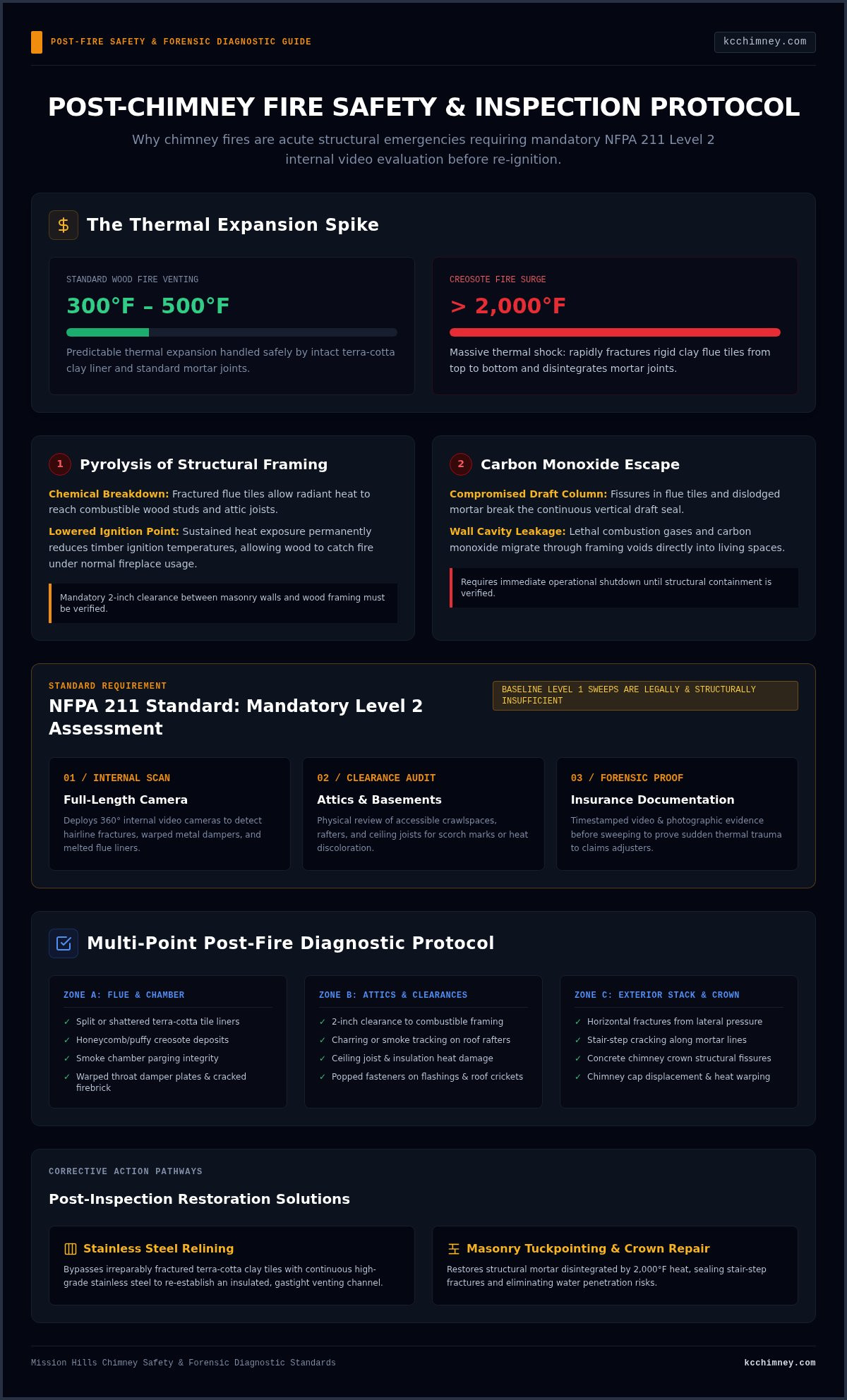
A chimney fire is an acute structural emergency, not a routine maintenance event. When accumulated creosote ignites inside a flue, temperatures rapidly surge past 2,000°F. By comparison, standard wood fires produce venting temperatures between 300°F and 500°F. This massive thermal spike triggers immediate, violent expansion that shatters rigid terra-cotta flue tiles and disintegrates mortar joints. Even if the fire appeared to burn out quickly without exterior flames, the structural integrity of the venting system has been compromised. A single incident requires an immediate operational shutdown. Scheduling a dedicated chimney inspection after chimney fire Mission Hills professionals conduct is the only safe way to verify your system before striking another match.
The Hidden Dangers of Thermal Shock and Pyrolysis
Clay tiles can’t absorb sudden heat without cracking. During a creosote fire, the interior face of the clay expands rapidly while the outer face remains cool, splitting the tiles open from top to bottom. These fractures expose surrounding combustible framing to extreme radiant heat. Over time, recurring heat exposure initiates pyrolysis, a chemical breakdown of wood studs and attic joists that permanently lowers their ignition temperature. Once pyrolysis sets in, dry structural timber can catch fire at normal fireplace temperatures. Additionally, fractured flue walls allow deadly carbon monoxide to escape the draft column, seeping through wall cavities and directly into living spaces.
NFPA 211 Standard: Why a Level 2 Inspection Is Mandatory
Shining a flashlight up from the hearth cannot uncover hairline fractures or detached mortar joints hidden sixty feet above. That is why National Fire Protection Association (NFPA) Standard 211 strictly mandates an NFPA 211 Level 2 inspection after any chimney fire, operational malfunction, or seismic event. A baseline Level 1 visual check is legally and structurally insufficient. During a Level 2 assessment, technicians deploy specialized internal video scanning cameras to examine every inch of the flue interior, along with accessible clearances in basements, attics, and crawlspaces.
- Internal camera scanning: Documents hidden tile splits, warped dampers, and melted flue liners.
- Attic and clearance checks: Verifies that high heat didn’t scorch adjacent roof rafters or wall framing.
- Forensic insurance records: Provides the certified, timestamped documentation insurance adjusters require to approve repair claims.
Relying on a formal chimney inspection after chimney fire Mission Hills standards require gives your family reliable protection and ensures your property meets strict national safety codes.
The Post-Chimney Fire Inspection Checklist: What Technicians Examine
A certified diagnostic evaluation follows a rigorous, multi-point protocol designed to detect structural damage that remains invisible from the living room. Technicians systematically evaluate every component of the venting system, moving from the hearth up through the roofline. When conducting a chimney inspection after chimney fire Mission Hills specialists search for telltale physical markers that distinguish sudden fire trauma from routine weathering. Here is what certified technicians inspect during each stage of the diagnostic evaluation.
Flue Liner and Smoke Chamber Integrity Scan
Technicians guide a specialized, full-color camera through the vertical flue column from top to bottom. This diagnostic pass identifies broken terra-cotta tile walls, separated mortar joints, and puffy, honeycomb-textured creosote created during combustion. Technicians also evaluate the parging across the corbeled smoke chamber above the throat damper, verifying that intense heat hasn’t warped metal dampening plates or split the firebrick lining.
Attic Framing and Roof Penetration Safety Review
Post-fire evaluations always move beyond the chimney stack into attic spaces and adjacent chases. Technicians verify the mandatory two-inch clearance between masonry walls and nearby wood framing. They examine rafters, ceiling joists, and surrounding insulation for heat discoloration, charring, or smoke penetration. If smoke or heat damage extends into framing or living areas, working with remediation professionals such as Fire Industry Restoration Experts ensures the broader structure is properly treated and restored. Flashings and roof crickets are also checked to ensure that thermal expansion didn’t pop fasteners or break watertight roof seals.
Exterior Masonry, Crown, and Cap Assessment
Extreme thermal expansion creates immense lateral pressure against exterior brick and stone. Technicians evaluate the outer chimney stack for horizontal fractures and stair-step cracking along mortar lines. They examine the concrete chimney crown for structural fissures and inspect the spark arrestor cap for warped wire mesh or heat damage. Confirming exterior stability is essential before completing any internal flue repairs.
This thorough forensic process provides complete clarity regarding your home’s safety. If your fireplace recently experienced an active flue fire, scheduling a Level 2 chimney inspection guarantees you receive the precise documentation required to restore your hearth safely.
Navigating Insurance Claims and Documentation After a Fire
Filing an insurance claim after a flue fire can feel daunting, especially while worrying about your home’s safety. Most standard homeowners policies cover sudden and accidental fire damage, but underwriters examine these claims closely. Adjusters look for specific physical indicators to differentiate between a sudden thermal event and gradual structural aging. Scheduling a certified chimney inspection after chimney fire Mission Hills adjusters require provides the objective forensic documentation needed to validate your claim before you authorize any repairs.
Essential Evidence Your Adjuster Will Request
Carriers rarely approve chimney claims based on visual surface checks alone. To secure coverage for necessary relining or structural repairs, you must present undeniable evidence of a high-temperature event. Certified technicians provide comprehensive claim documentation, including:
- Continuous video scans: Unbroken high-resolution recordings documenting fractured clay tiles, warped liners, or compromised joints along the entire flue run.
- Forensic imagery: Close-up photos showing expanded honeycomb creosote, scorched parging, and freshly fractured tile edges.
- NFPA 211 violation reports: Written assessments detailing how the fire compromised code clearances and venting safety.
- Itemized repair scopes: Clear restoration proposals linked directly to the heat damage caused by the incident.
Preventing Common Claim Denials
The most critical mistake homeowners make after a fire is sweeping the flue before the adjuster arrives. Sweeping scrubs away the charred, puffy creosote and freshly shattered tile fragments, eliminating the visual evidence that proves an active fire occurred. Without that physical proof, adjusters might argue the fractures stem from ground settling or deferred maintenance. A thorough chimney inspection after chimney fire Mission Hills professionals carry out documents these specific markers in their undisturbed state. Having your certified technician communicate directly with the adjuster ensures technical findings are explained accurately, keeping the claims process moving forward smoothly.
Restoration Solutions: Relining and Masonry Repair for Mission Hills Homes
Mission Hills architecture is renowned for its distinguished Tudor Revival, French Normandy, and Colonial Revival estates. Many of these historic residences feature multi-flue masonry systems, custom limestone accents, and intricate brickwork that cannot easily be duplicated. A chimney fire threatens both the structural safety and historic character of these properties. Fortunately, receiving a comprehensive chimney inspection after chimney fire Mission Hills technicians conduct helps establish a targeted repair plan that avoids unnecessary, destructive teardowns.
Stainless Steel Relining vs. Total Chimney Rebuild
Replacing shattered terra-cotta clay tiles previously meant dismantling the entire brick stack from roof to hearth. Modern restoration uses a far less invasive approach. Technicians remove the broken clay remnants and insert an insulated, continuous stainless steel flue liner directly into the existing cavity. These high-grade liners withstand intense heat cycles and prevent future thermal transfer to attic framing. Wrapping the liner in specialized ceramic insulation ensures proper operating drafts while keeping adjacent timber completely protected. This approach restores the flue to full code compliance while preserving every course of original exterior masonry.
Custom Brickwork, Tuckpointing, and Firebox Reconstruction
Intense fire temperatures don’t stop at the flue liner; they frequently punish the firebox and exterior mortar joints. Restoring an older property requires specialized masonry care tailored to traditional construction methods:
- Historic tuckpointing: Repairing stair-step cracks using custom-blended mortar matched in lime ratio, texture, and pigmentation to original historic joints.
- Firebox reconstruction: Replacing spalled or loose firebricks using high-temperature refractory mortar rated to survive direct flame contact.
- Smoke chamber parging: Applying a smooth coat of refractory mortar across corbeled brickwork to eliminate dangerous smoke turbulence and seal heat pathways.
Protect your home’s historic charm and structural integrity with proven restoration techniques. Contact our certified team to schedule chimney relining and masonry tuckpointing tailored specifically to your home’s architectural needs.
Selecting a Certified Inspection Specialist in Mission Hills
Questions to Ask Before Hiring an Inspector
Before letting anyone evaluate your venting system, confirm their technical capabilities and testing standards. Asking targeted questions weeds out unqualified handymen and protects your insurance standing:
- Diagnostic imaging: Do you record full, continuous video footage of the flue interior for insurance submission?
- Code credentials: Are your technicians trained to generate formal NFPA 211 Level 2 and Level 3 inspection reports?
- Claims coordination: Can you provide itemized repair estimates and speak directly with my claims adjuster?
- Local estate experience: How much experience do you have with historic brickwork and complex multi-flue residential designs?
Schedule Your Comprehensive Mission Hills Inspection
The moment you suspect or experience a flue fire, cease using your fireplace immediately. Continued operation risks igniting combustible framing behind cracked masonry walls. Arranging a formal chimney inspection after chimney fire Mission Hills homeowners rely on gives you a documented, safe path forward.
Our locally owned team has served the metro area since 2012, bringing the specialized diagnostic cameras and rigorous NFPA 211 compliance required to evaluate severe fire events. If you need a thorough diagnostic assessment, schedule an expert chimney inspection in Kansas City today. Should your flue show thermal fractures, we provide complete solutions like stainless steel relining and expert chimney repair in Kansas City to restore lasting safety to your hearth.
Restore Safety and Confidence to Your Mission Hills Hearth
Experiencing a flue fire is unsettling, but taking the proper recovery steps ensures your home remains safe for seasons to come. Extreme internal heat fractures clay tiles long before damage appears on exterior brickwork. Scheduling a certified chimney inspection after chimney fire Mission Hills specialists perform is the only dependable way to confirm structural integrity, prevent attic heat transfer, and secure insurance coverage.
Since 2012, Best Chimney Services has protected historic estates across Mission Hills and Johnson County with meticulous, neighborly care. Our technicians use advanced video camera flue diagnostics to verify every inch of your venting system, generating comprehensive NFPA 211 Level 2 safety reports for your adjuster. Whether your home needs specialized masonry tuckpointing or a durable stainless steel liner, we deliver lasting solutions built for longevity.
Don’t let lingering doubts keep you from enjoying your hearth. Schedule your professional post-fire chimney inspection with Best Chimney Services today and bring complete peace of mind back to your living room.
Frequently Asked Questions
How do I know if I had a chimney fire in my Mission Hills home?
Signs include a loud roaring noise resembling a freight train, dense acrid smoke, sparks or flames shooting from the chimney top, or a vibrating stovepipe. Often, however, chimney fires burn silently without external flames. You might only discover puffy, expanded honeycomb creosote in your firebox or cracked clay tile pieces on the hearth days after the event occurred.
Can I use my fireplace after a chimney fire before an inspection?
No, you should never light another fire before a certified technician evaluates the system. A flue fire damages internal clay liners and opens pathways for extreme heat and carbon monoxide to escape into your attic or wall framing. Scheduling a chimney inspection after chimney fire Mission Hills specialists conduct ensures the venting system is thoroughly checked and certified safe before future use.
What is the difference between a Level 1 and Level 2 chimney inspection?
A Level 1 inspection is a basic visual check of accessible components, appropriate for regular annual servicing with no operational changes. A Level 2 inspection is strictly mandated by NFPA 211 after an unexpected event like a chimney fire. It includes everything in Level 1 plus an attic and crawlspace review, alongside a complete digital video camera scan of the internal flue walls.
Does homeowners insurance cover a chimney inspection and repairs after a fire?
Most standard homeowners policies cover chimney damage resulting from sudden and accidental fires. Coverage typically applies to professional inspection reports, digital video documentation, and necessary remediation like stainless steel flue relining or masonry tuckpointing. Insurance adjusters require clear visual proof of thermal shock, so avoid sweeping the chimney before your inspector captures the required video evidence for the claims adjuster.
How does a chimney technician detect hidden cracks inside the flue?
Technicians lower or raise an advanced, full-color internal video camera through the entire vertical flue column. This specialized equipment illuminates and magnifies the flue surface, displaying live footage on a monitor. The high-resolution lens reveals micro-fissures, separated mortar joints, spalled clay fragments, and heat distortion that remain completely hidden from view when looking upward from the firebox with a flashlight.
Will my chimney need to be torn down and rebuilt after a fire?
In most situations, an entire teardown is unnecessary. If the exterior masonry structure remains straight and stable, technicians can reline the compromised flue rather than rebuilding the chimney. Inserting an insulated stainless steel liner directly into the existing brick stack restores drafting efficiency and structural safety. This non-invasive solution preserves the historic architectural exterior while meeting all current NFPA 211 residential building codes.
How long does a post-fire chimney inspection take to complete?
A thorough post-fire chimney inspection after chimney fire Mission Hills homeowners schedule typically takes between one and two hours. Technicians need time to run the video scanner down each individual flue, examine the smoke chamber and damper, and inspect adjacent attic framing and roofline flashing. If your home has multiple fireplaces or multi-flue stacks, the inspection process may require additional diagnostic time.