
What if your fireplace responds to its remote but still isn’t ready to burn? For homeowners searching “gas fireplace turns on but no flame Bucyrus,” that difference can explain why the controls seem active while the room stays cold. Depending on the model, “turns on” may mean the display, blower, or ignition sequence has started, not that a flame should already be present.
It’s natural to wonder whether the cause is the remote, pilot, ignition system, or gas supply. This guide explains what the symptom may indicate, which external checks are reasonable, and what to leave to a professional. Repeated resets and guesswork aren’t a safe substitute for model-specific troubleshooting. If you smell gas, stop checking the fireplace and seek appropriate help. If basic checks don’t resolve the issue, a professional assessment can help Bucyrus homeowners identify a safe next step.
Key Takeaways
- “Turns on” can mean the controls or blower respond even when the main burner hasn’t ignited. Your fireplace manual explains what startup should look like for your model.
- For a gas fireplace turns on but no flame Bucyrus concern, consider possible control, power, pilot, or ignition issues without assuming any one cause.
- Use the symptom comparison to describe what you observe and choose a safe next step, not to diagnose a failed part.
- Keep homeowner checks external and follow only the instructions in your model’s manual. Don’t open or attempt to repair the appliance.
- If ignition problems persist, the pilot won’t stay lit, or the fireplace repeatedly fails, a professional assessment can help determine what to do next.
Gas Fireplace Turns On but No Flame in Bucyrus: What the Symptom Means
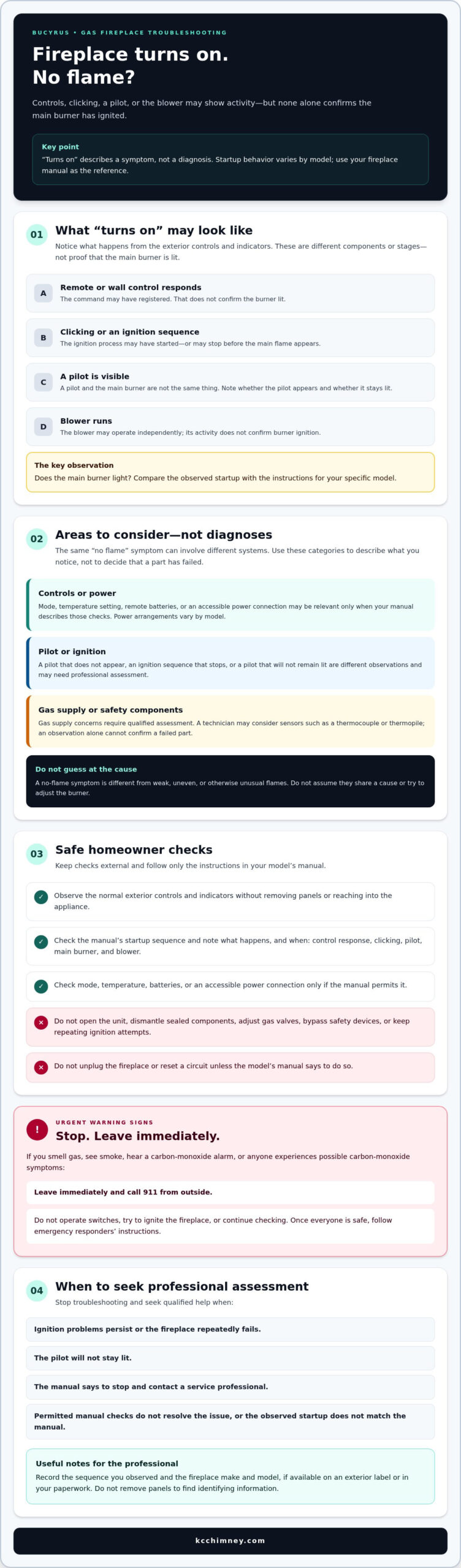
A gas fireplace can appear to start without lighting its main burner. The control panel may respond, the igniter may click, a pilot may be visible, or the blower may run, yet there may be no main flame. These are different components or stages of operation, so one sign of activity doesn’t confirm that the fireplace has ignited successfully.
Models vary in how they start and what indicators they display. Check the owner’s manual for your fireplace’s normal startup sequence before drawing conclusions. Background on modern fireplaces can explain how fireplace designs differ, but your manual is the reference for operating your specific unit.
What does “turns on” mean on a gas fireplace?
Notice what happens, in order, without removing panels or reaching into the appliance. Does the remote or wall control respond? Do you hear clicking? Can you see a pilot, and does the main burner light? Does the blower start? A blower may operate independently, so it doesn’t confirm that the burner has ignited. If the manual describes visible indicators, note what you see and when. This sequence can help a professional understand the symptom.
A fireplace with no flame is different from one that lights but has weak, uneven, or otherwise unusual flames. Those symptoms may call for different diagnostic questions. Don’t assume they share a cause or try to adjust the burner yourself.
When should you stop and leave the home?
Stop troubleshooting if you smell gas, see smoke, hear a carbon-monoxide alarm, or anyone experiences possible carbon-monoxide symptoms. Leave immediately and call 911 from outside. Don’t operate switches, attempt to ignite the fireplace, or continue checking when an urgent hazard is suspected. Once everyone is safe, follow instructions from emergency responders.
If there’s no urgent warning sign, limit your observations to the appliance’s normal exterior controls and indicators. For a gas fireplace turns on but no flame Bucyrus concern, first identify exactly what “turns on” means for your model, then compare that sequence with the manual. Avoid repeated attempts or opening the unit. If its documented startup behavior doesn’t match what you see, stop and seek a professional assessment.
Why a Gas Fireplace Starts but Does Not Ignite: Areas to Consider
A search for “gas fireplace turns on but no flame Bucyrus” describes a symptom, not a diagnosis. The same visible result can involve different parts of a fireplace, and startup designs vary by model. Use these categories to describe what you observe, not to decide which component has failed.
Could the remote, thermostat, or power supply be involved?
Check the controls only if your owner’s manual describes what to do. Confirm that the selected mode and temperature setting match the instructions. If the manual says the remote uses replaceable batteries or identifies an accessible power connection, you can check those without opening the fireplace. A responsive control shows only that the command was registered. It doesn’t confirm that the main burner lit.
Power behavior varies by model. Some fireplaces use electronic ignition, while others have different control arrangements. Don’t assume that unplugging the unit or resetting a circuit is appropriate. Follow the manual and stop if it directs you to contact a service professional.
Could the pilot or ignition system need service?
A standing-pilot fireplace and an electronic-ignition model won’t necessarily show the same signs during startup. A pilot that doesn’t appear, an ignition sequence that stops, or a pilot that won’t remain lit can each point to different diagnostic areas. A technician may also consider sensors such as a thermocouple or thermopile, but an observation alone can’t confirm that a part has failed.
Gas supply concerns also require qualified assessment. Don’t adjust gas valves, bypass safety devices, or dismantle sealed components. If ignition repeatedly fails, or the manual says to stop and call for service, don’t keep trying to start the unit. For general precautions around a suspected gas leak, consult the American Gas Association’s Natural gas safety guidance.
These categories help organize the symptom, but they don’t replace model-specific diagnosis. Before seeking help, note the fireplace make and model if you can find it on an exterior label or in your paperwork. Record the sequence you observed, and don’t remove panels to find identifying information. That record can help a professional understand what happened without guesswork.
If the manual’s permitted control checks don’t resolve the issue, a local professional assessment is a sensible next step. Bucyrus homeowners can review local chimney and fireplace information when considering whom to contact. Confirm the provider’s current services and availability directly.
Compare the Symptoms Before Choosing Your Next Step
Use the pattern you observe to describe the problem, not to diagnose a failed part. The table is a starting point, but fireplace designs and normal startup sequences vary. Check your owner’s manual to confirm what’s expected, and don’t remove panels to inspect internal components.
| What you observe | Possible system area | Safe next step |
|---|---|---|
| The manual describes a standing pilot, but you can’t see it | Pilot or ignition system; the observation alone doesn’t identify a cause | Check the manual’s description of the pilot. Don’t reach inside or use generic relighting instructions. |
| A pilot appears, then goes out | Pilot operation or a related safety component may need assessment | Note when it goes out and follow the manual’s service guidance. |
| You hear ignition clicking, but see no flame | The ignition sequence may have started, but that doesn’t confirm burner ignition | Stop if attempts repeatedly fail. Record the sequence and check the manual for next steps. |
| The blower runs, but there’s no visible flame | Blower operation doesn’t establish whether ignition succeeded | Use the manual to identify expected startup behavior. Don’t infer an ignition fault from the blower alone. |
| Gas odor, an alarm, repeated failed ignition, or uncertainty about safety | Potential urgent hazard or unresolved appliance issue | For gas odor or a carbon-monoxide alarm, leave and call 911 from outside. For repeated failure or uncertainty without an urgent hazard, stop operating the fireplace and seek professional guidance. |
Pilot-light fireplace: what should you observe?
First, check whether your manual describes a standing pilot or a different pilot-start procedure. From outside the appliance, note whether the pilot is visible, absent, or goes out. These observations can help clarify what is happening, but they don’t confirm why. Follow only your model’s instructions. If the manual doesn’t clearly cover the situation, contact a technician rather than attempting a universal relighting procedure.
Electronic ignition or blower response: what can it tell you?
Clicking may indicate that an ignition sequence is underway, but it doesn’t prove that a flame has formed. Likewise, a running blower describes blower activity, not the condition of the ignition system. For a gas fireplace turns on but no flame Bucyrus issue, write down the order of events, any indicator lights or messages, and the fireplace’s make and model. Share those details with a service professional, and use the manual to confirm what the indicators mean for your unit.
Keep the observations separate: pilot status, clicking, burner flame, and blower operation each tell you something different. Together, they provide a clearer account of the symptom without requiring you to open or repair the fireplace.
Safe Homeowner Checks for a Gas Fireplace With No Flame
For a gas fireplace turns on but no flame Bucyrus concern, limit checks to safety, exterior controls, and instructions written for your specific model. The goal isn’t to repair the fireplace yourself. It’s to gather useful observations and know when to stop.
A cautious, manual-led check sequence
- Rule out urgent warning signs. If you smell gas or suspect a carbon-monoxide problem, leave the home and call 911 from outside. Don’t operate switches, try to ignite the fireplace, or continue checking.
- Identify the fireplace model. Use paperwork or an identification label you can see without removing a panel. Find the matching owner’s manual, since startup procedures and permitted checks vary by model.
- Review the control settings. Compare the selected mode and temperature setting with the manual. Check remote batteries or an accessible power connection only if the manual specifically identifies those as homeowner checks.
- Observe the startup sequence. From outside the appliance, note any indicator lights, clicking, visible pilot activity, burner flame, or blower operation. Don’t reach inside or remove panels to get a better view.
- Stop when the manual’s checks are complete. If the fireplace still doesn’t operate as described, or the manual tells you to seek service, don’t move on to internal troubleshooting.
Keep a brief note of what happened and in what order. “The control responded, clicking followed, but I didn’t see a flame” gives a service professional more useful information than simply saying the fireplace turns on.
What not to do when ignition fails
Don’t repeatedly cycle the ignition if the manual says to wait or stop. Avoid opening sealed compartments, bypassing safety components, or adjusting gas controls. Those steps go beyond external observation and can create additional safety risks. A pilot that won’t stay lit or ignition that keeps failing should be assessed rather than tested again and again.
If the manual’s listed checks don’t restore normal operation, arrange a professional assessment. A technician can consider the specific fireplace model and follow its service requirements. Homeowners in Bucyrus can contact Best Chimney Services about a fireplace assessment and ask whether the issue is within the company’s current services. Confirm service details and availability directly.
When to Call for Gas Fireplace Repair in Bucyrus
Stop using the fireplace and seek a professional assessment if ignition remains unresolved after the manual’s permitted checks, the pilot won’t stay lit, or the unit repeatedly fails to start. These symptoms can involve components or operating requirements that need model-specific evaluation. Don’t keep cycling the ignition or try to adjust the appliance yourself.
If you smell gas or a carbon-monoxide alarm sounds, leave the home and call 911 from outside. For a persistent no-flame issue without an urgent warning sign, a professional can inspect the appliance and follow the service requirements for its make and model. That’s safer than guessing at a cause based on clicking, pilot activity, or blower operation alone.
What information helps a fireplace technician?
Before you call, gather details that can help explain what the fireplace is doing. Don’t remove panels to find information. Share what you can safely access:
- The fireplace make and model, plus the owner’s manual if available.
- The startup sequence, including control response, clicking, visible indicators, pilot behavior, and whether the blower runs.
- Any recent change you noticed, such as a new symptom or a change in operation.
- Any gas odor, alarm, or previous failed ignition attempts. If there’s an urgent warning sign, leave first and call 911 from outside rather than continuing with a routine service call.
For a gas fireplace turns on but no flame Bucyrus concern, these observations help distinguish what you’ve seen from what still needs professional diagnosis. They don’t confirm a failed component, but they give the professional a clearer starting point.
Choose a fireplace-focused next step in Bucyrus
Best Chimney Services lists Bucyrus among its service areas. The company’s gas fireplace repair guide offers related homeowner information, and its Kansas City chimney inspection guide provides broader inspection context. Best Chimney Services also provides chimney inspection and fireplace insert installation services. Contact the company to confirm whether it currently handles your specific concern and whether appointments are available in Bucyrus.
When you’re ready, contact Best Chimney Services to describe the symptom and ask about service options. Have your model information and notes about the startup sequence nearby so the conversation can begin with clear, useful details.
Choose a Safe Next Step for Your Fireplace
A gas fireplace can respond to a control without lighting its main burner, and the cause isn’t always clear from the first symptom. Check only the external controls and indicators described in your model’s manual. Note what happens during startup, and stop if the manual’s checks don’t resolve the problem. Repeated ignition failures or a pilot that won’t stay lit call for professional assessment, not more guesswork.
If you’re dealing with a gas fireplace turns on but no flame Bucyrus issue, share the fireplace’s make and model, the startup sequence, and any warning signs with the professional you contact. If you smell gas or a carbon-monoxide alarm sounds, leave and call 911 from outside.
Best Chimney Services lists Bucyrus among its service locations and provides chimney inspections and fireplace insert installation. You can contact Best Chimney Services to discuss your gas fireplace symptoms and ask whether the company can help with your specific issue. With the right model information and a careful assessment, you can move toward a clear next step.
Frequently Asked Questions
Why does my gas fireplace turn on but not produce a flame?
Several systems could be involved, including the controls, ignition, pilot, or gas supply. A light, click, or running blower doesn’t confirm that the burner has ignited. If you’re searching for “gas fireplace turns on but no flame Bucyrus,” start by checking your model’s manual and noting what happens during startup. If manual-approved checks don’t help, have a fireplace professional assess the appliance. Don’t open it or adjust gas components.
Can I relight my gas fireplace pilot myself?
Only follow the manufacturer’s relighting instructions for your exact fireplace model. Pilot procedures aren’t universal, so don’t rely on generic directions. Don’t attempt to relight the pilot if you smell gas, hear an unusual sound, or aren’t sure you understand the instructions. Leave and call 911 from outside if you suspect a gas emergency. If the manual’s procedure doesn’t work as written, stop and arrange professional guidance rather than repeating attempts.
Is it safe to keep trying to start a gas fireplace with no flame?
Repeated ignition attempts aren’t a substitute for diagnosis, especially if your manual tells you to stop or wait. Follow the appliance instructions and stop if ignition continues to fail. Never bypass a safety device or open a sealed compartment. If you smell gas, see smoke, or hear a carbon-monoxide alarm, leave immediately and call 911 from outside. Without an urgent warning sign, seek professional assessment if the manual’s checks don’t resolve the issue.
Could a dead remote battery make my gas fireplace turn on without a flame?
A weak remote battery or incorrect setting may affect the startup command on some models, but it won’t explain every no-flame symptom. Check the remote batteries and operating mode only if your fireplace manual describes those steps. If the control responds but the burner doesn’t light, note the startup sequence and any indicators. If manual-approved checks don’t resolve the problem, have the appliance assessed instead of opening it or adjusting components.
What should I do if my gas fireplace clicks but does not light?
Clicking may mean the ignition sequence is being attempted, but it doesn’t identify the cause or confirm that gas has ignited. Consult the instructions for your fireplace model and note how the sequence behaves. Don’t dismantle the appliance or adjust gas controls. Stop if the manual directs you to, or if ignition repeatedly fails. If you notice an unusual odor or feel uncertain about safety, stop troubleshooting and seek appropriate help.
Can a fireplace blower run when there is no flame?
Yes, blower activity alone doesn’t confirm that the burner is operating. Observe whether you see a flame, whether a pilot is present if your model uses one, and what indicators appear. Use the owner’s manual to understand what those signs mean for your specific fireplace. If there’s still no flame after the manual-approved checks, stop operating the unit and arrange a professional diagnosis rather than trying to infer the fault from the blower.
When should I call for gas fireplace repair in Bucyrus, KS?
Contact a fireplace professional if manual-approved external checks don’t restore normal operation, ignition repeatedly fails, or you can’t confidently identify the system’s status. Share the make and model, startup sequence, and any indicator lights. Best Chimney Services lists Bucyrus, Overland Park, Mission Hills, Stilwell, and Spring Hill among its service locations. Contact the company to discuss your symptoms and confirm current service options and appointment availability. For gas odor or a carbon-monoxide alarm, leave and call 911 from outside.