
A chimney cover can look intact and still allow water into your home. For Mission Hills homeowners, a poor fit, corrosion, or warping may leave the chimney vulnerable, and the right solution isn’t always obvious from the ground. Choosing a custom chimney chase cover Mission Hills homes need means accounting for the chase’s dimensions and flue layout, not just the cover’s appearance.
Rust streaks, water stains near the fireplace, or visible damage can point to a problem, but they don’t prove that the chase cover is the source. The cover protects the top of the chimney chase, while a chimney cap fits over a flue. Knowing which component is affected helps define the right repair.
This guide explains what affects fit, how to compare replacement options, and what to expect from a professional assessment. You’ll also learn how chase cover replacement fits into broader chimney care in Mission Hills, so you can take a practical next step to protect your home.
Key Takeaways
- A custom-fit cover is designed around the chase’s footprint and openings, so dimensions and flue placement matter.
- Compare custom and standard options by fit, opening layout, and the condition of the existing cover.
- Prepare for an assessment by noting symptoms, taking photos from the ground, and describing when you noticed changes.
- For a custom chimney chase cover Mission Hills home, matching the replacement to the specific chimney can address fit concerns.
- Best Chimney Services is a locally owned Kansas City-area company founded in 2012 that offers chase cover replacement in Mission Hills.
Why a custom chimney chase cover matters for Mission Hills homes
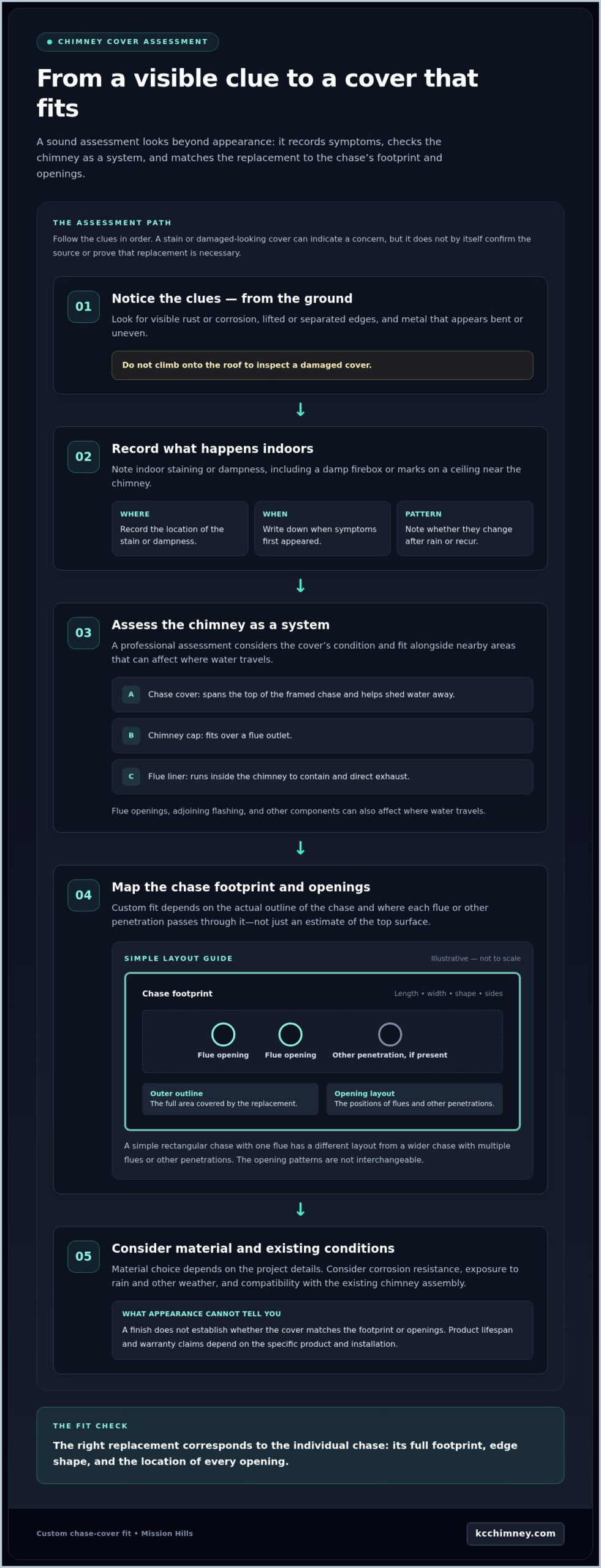
A chimney chase cover is the top covering on a framed chimney chase, the structure built around a prefabricated chimney. It spans the chase opening and helps keep rain and debris out. Because it is exposed to the weather, corrosion, a lifted edge, warping, or a poor fit can create a path for water. A custom chimney chase cover Mission Hills homeowners choose should fit the actual chase, not simply look right from the ground.
Water intrusion can damage areas around the chimney and show up indoors as staining or dampness. A stain is a clue, not a diagnosis: water may be entering at the cover or another part of the chimney. The cover’s shape and fit matter because it should direct water away from the chase opening.
What signs can point to a chase-cover problem?
From the ground, look for visible rust, corrosion, lifted or separated edges, and metal that appears bent or uneven. These signs can indicate that the cover’s protective function has weakened, but none confirms that replacement is necessary. Interior water stains, a damp firebox, or marks on a ceiling near the chimney can also have more than one possible source.
- Note where rust, separation, or deformation appears on the cover, if visible from the ground.
- Record where you see indoor staining or dampness, and whether it changes after rain.
- Write down when the symptoms first appeared and whether they recur.
This history helps a professional assess the chimney as a system instead of treating one visible mark as proof of the cause. Don’t climb onto the roof to inspect a damaged cover.
How does a chase cover help protect the chimney?
A well-matched cover spans the top of the framed chase and sheds water away from its opening. It isn’t the same as a chimney cap, which fits over a flue outlet, or a flue liner, which runs inside the chimney to contain and direct exhaust. A chimney has several components with different roles; What is a Chimney? offers a general overview.
The cover is one part of the chimney’s water-management system. Flue openings, adjoining flashing, and other components can also affect where water travels. An assessment should consider the cover’s condition and fit alongside nearby areas rather than assume a leak has one obvious source. In Mission Hills, where chimney designs vary from home to home, matching the replacement to the specific chase is a practical part of protecting it. Best Chimney Services also serves homeowners in Overland Park, Stilwell, Bucyrus, and Spring Hill.
What a custom chimney chase cover in Mission Hills needs to fit
A custom-fit chase cover is designed around the footprint of an individual framed chimney chase and the openings through it. It isn’t simply a flat piece sized by eye. Its dimensions, shape, edges, and flue locations need to correspond to the chase so the cover sits appropriately and directs water away from the opening. For a custom chimney chase cover Mission Hills homeowners need, an accurate assessment is more useful than a ground-level guess.
Which measurements and layout details affect fit?
The chase’s length and width establish its footprint. Its shape and sides determine where the cover edges sit, while the positions of the flues determine where the openings need to be. A cover with openings that don’t align with the flues won’t match the chimney layout, even if its outer dimensions seem close.
For example, a simple rectangular chase with one flue has a different layout from a wider chase with multiple flues or other penetrations. The opening patterns aren’t interchangeable. An assessment should account for the chase outline and each opening, not just estimate the size of the top surface.
Simple layout guide, not to scale:
- Chase footprint: the full outer area covered by the replacement.
- Flue openings: the positions within that footprint where flues pass through.
Imagine a rectangle enclosing the entire top surface, with smaller circles inside it marking the flue openings. The rectangle describes the footprint; the circles describe the opening layout.
These details are assessed together because a mismatch at an edge or opening can affect how the cover sits. A rough visual estimate can help describe the chimney, but it can’t replace accurate assessment. For safety context, the NFPA 211 Standards for Chimney Safety address chimney-related safety. The cover’s fit still depends on the individual assembly.
Which material considerations should homeowners understand?
Material choice involves considering corrosion resistance and the conditions the cover will face. Exposure to rain and other weather can affect how a material holds up, and the existing chimney assembly also influences what is suitable. The right choice depends on those project details.
Consider how the proposed material suits the chimney’s exposure and existing components rather than relying on appearance alone. A finish can affect the look, but it doesn’t establish whether the cover matches the footprint or openings. Lifespan and warranty claims also depend on the specific product and installation, so avoid assuming them without supporting information.
Best Chimney Services offers chase cover replacement in Mission Hills, with an assessment centered on the individual chimney rather than a generic cover size.
Custom vs. standard chase covers: choosing the right Mission Hills option
A standard cover may suit a chase with a straightforward shape when its dimensions and flue openings align with the cover. A similar-looking size alone doesn’t establish a suitable fit. The choice depends on the chimney’s actual footprint, opening layout, and condition. Comparing these factors helps determine whether a standard option fits or whether the custom chimney chase cover a Mission Hills home needs should be assessed for its specific configuration.
Fit
Standard: Suits a chase that matches its dimensions.
Custom: Can be designed around the individual chase footprint.
Opening layout
Standard: Works when flue openings align with the cover.
Custom: May better address multiple flues or an unusual opening arrangement.
Condition
Standard: Could be appropriate when the chase and surrounding components support a straightforward replacement.
Custom: May be considered when the existing cover’s shape or layout doesn’t match a standard configuration.
Project-specific assessment
Both: Require attention to the chimney’s actual dimensions and condition. Appearance alone can’t establish fit.
When might a custom-fit cover make more sense?
A custom-fit approach may be worth assessing for nonstandard chase dimensions, an unusual outline, or multiple flue openings. For example, a cover that looks close in width may still place an opening incorrectly or fail to match the chase edges. The right option depends on the actual layout and condition, not just the apparent size. A professional assessment helps distinguish a genuine fit issue from a problem elsewhere.
Does a damaged cover always mean full replacement?
No. A visible symptom doesn’t establish the full repair scope. Corrosion or distortion may point to a cover concern, while water entry could also involve flashing, masonry, or the chimney crown. These components have different roles and may require different work. An assessment considers the cover alongside nearby parts to determine whether replacement is appropriate or another chimney repair is needed.
Keeping the scope clear matters. Chase cover replacement addresses the covering at the top of a framed chase; it doesn’t automatically correct a separate issue in flashing, masonry, or the crown. The Chimney Safety Institute of America (CSIA) provides general chimney-safety information about why professional evaluation matters. Best Chimney Services offers chase cover replacement in Mission Hills as part of broader chimney care. To learn more about the service, explore chase cover replacement.
How Mission Hills homeowners can prepare for a chase-cover assessment
A few clear details can make a chimney assessment more useful. You don’t need to identify the source of a leak or measure the cover yourself. Record what you’ve noticed and let a professional evaluate the chimney and its replacement needs. For a custom chimney chase cover Mission Hills home, the assessment should consider the cover and the surrounding chimney areas.
What information helps clarify the concern?
Before the assessment, note where you see moisture or staining, indoors and outdoors. Record when the symptoms first appeared and whether they change after rain or other weather exposure. This context is helpful without assuming the cover is the only possible cause.
- Describe the location and appearance of any interior stains or dampness.
- Note visible deterioration from the ground, such as rust or a cover that appears uneven.
- Take photos from a safe location and include the date or approximate timing of the concern.
Keep the record simple. A photo of a ceiling stain and a note that it appeared after a rainy period may be more useful than a guess about what is happening on the roof. Don’t climb onto the roof, lean out of a window, or handle a cover that may be damaged. Leave close inspection to a professional.
What happens during a professional assessment?
Best Chimney Services assesses the visible chase cover and relevant surrounding chimney areas to help determine whether replacement is appropriate. The evaluation can also help distinguish a cover concern from other repair needs. That broader view matters because water entry may involve nearby chimney components, not just the cover.
Chimney inspections provide broader context by examining the condition of the chimney and its components. A focused chase-cover concern can be considered alongside that wider picture, helping clarify what needs attention instead of treating a single symptom as a complete diagnosis.
To prepare, keep your notes and ground-level photos together, and be ready to describe when you first noticed the issue. Share whether the dampness or staining changes after weather exposure. This gives the assessment a useful starting point while leaving diagnosis and the scope of work to the professional.
If you’ve noticed possible cover damage or water entry, arrange a chase-cover assessment with Best Chimney Services. The company serves Mission Hills and can evaluate the chimney and replacement needs as part of its broader chimney care.
Arrange custom chimney chase cover replacement in Mission Hills
Best Chimney Services is a locally owned Kansas City-area company founded in 2012. It offers chase cover replacement in Mission Hills as part of broader chimney care. If you’re considering a custom chimney chase cover Mission Hills home, start by describing what you’ve observed and having the chimney’s condition assessed before deciding on replacement.
What to expect from Best Chimney Services
Start with the concern you’ve noticed: staining indoors, visible deterioration from the ground, or a cover that appears uneven. Share where the issue shows up and when you noticed it. Safe photos and a brief description of whether symptoms change after rain can provide useful context without requiring you to inspect the roof yourself.
During the assessment, Best Chimney Services considers the chase cover’s visible condition and how it relates to the surrounding chimney. The findings help establish whether cover replacement is appropriate and what the project scope should address. This matters because moisture concerns can involve other chimney components, and replacing a cover alone may not resolve an issue elsewhere.
If the assessment points to a related concern, Best Chimney Services also offers chimney repair and inspection services. These services help homeowners consider the chimney’s broader condition alongside a cover replacement, rather than treating the cover as an isolated product. The aim is to understand the concern and identify work that fits the chimney’s needs.
Take the next step for your Mission Hills chimney
Before arranging service, gather a few useful details:
- Where you’ve noticed moisture, staining, or visible cover damage.
- When the symptoms began and whether they change after rain.
- Any photos you’ve taken safely from the ground.
These notes can help explain the concern, but you don’t need to diagnose it or estimate the cover dimensions. Leave roof access and close handling of a damaged cover to a professional. A measured assessment can clarify whether replacement is the right next step and how the work relates to the rest of the chimney.
Schedule chase cover replacement service with Best Chimney Services through the company website, and share the symptoms and safe photos you’ve gathered. This can help address a potential path for moisture and protect your Mission Hills home.
Move forward with a clearer plan for your chimney
You don’t need to decide on replacement based on a stain or a glimpse of rust alone. Use what you’ve observed as a starting point for a professional assessment, then let the chimney’s condition guide the next step. A well-matched custom chimney chase cover Mission Hills home needs starts with understanding the specific chase, not choosing a cover by appearance.
Best Chimney Services can assess your chase cover and consider replacement as part of your home’s broader chimney care. Sharing where you’ve noticed moisture and when it appears can make the assessment more useful. Schedule chimney service in Mission Hills with Best Chimney Services.
Frequently Asked Questions
Can a custom chimney chase cover help prevent leaks?
A properly matched cover can help limit water entry through the top of the chase, but it can’t guarantee that the chimney won’t leak. Water may enter through another component or travel before it becomes visible indoors. If a ceiling mark appears away from the chimney, note its location and when it shows up. That context can help narrow down the source during an assessment.
What is the difference between a chimney cap and a chase cover?
A chase cover spans the top of a framed chimney chase, while a chimney cap attaches at an individual flue outlet. They serve different parts of the chimney and aren’t substitutes for one another. For example, a cap may be present above a flue while the larger chase cover below it has a separate condition concern. Identifying the component involved helps focus the assessment and repair plan.
Can I measure a chimney chase cover from the ground?
You can make a rough visual estimate from the ground, but it shouldn’t be used as the final dimensions for replacement. Roof height and viewing angle can make edges appear closer or farther apart, and openings may be partly hidden. Don’t climb onto the roof or reach toward the cover to get a better measurement. Share ground-level photos and let a professional assess the fit safely.
What should I do if my chimney still leaks after a chase cover replacement?
Arrange an assessment rather than assuming the new cover is the source or trying to seal the area yourself. Water can enter through another part of the chimney, including flashing or masonry, and may appear indoors some distance from its entry point. Note when the leak returns, which rooms or surfaces are affected, and whether it follows rain. Those details help guide a broader evaluation.
Does a chase cover need to be replaced if it has rust?
Not necessarily. Surface rust is a reason to pay attention, but it doesn’t show by itself how much the cover has deteriorated or whether it still fits properly. The location and extent of corrosion, along with any separation or distortion, matter. Avoid scraping or handling the cover to investigate. A professional assessment can determine whether replacement is appropriate for the chimney’s condition.
How many flue openings can a custom chase cover accommodate?
A custom cover’s layout can account for the flue openings on the individual chase. The number and placement depend on the chimney, so there isn’t one opening pattern for every home. For example, two flues positioned close together require a different layout from two flues set farther apart. An assessment should establish their locations before the cover configuration is planned.
Can a chase cover be replaced without repairing the whole chimney?
Yes. Replacement may be limited to the cover if an assessment shows the surrounding chimney components don’t need related repairs. A separate concern, such as damaged flashing or masonry, could require attention too. The right scope depends on the chimney’s condition, not just the cover’s appearance. Best Chimney Services serves Mission Hills and nearby communities, including Overland Park, Stilwell, Bucyrus, and Spring Hill.