
A visible crack in your chimney crown may not be the only path letting water in. The crack deserves attention, but moisture can also enter through worn mortar, flashing, or other parts of the chimney. Repairing the crown before identifying the source can leave the actual problem unresolved. If you’re considering chimney crown repair Stilwell homeowners can rely on, start by understanding what an inspection reveals.
It’s reasonable to wonder whether the crown needs repair, waterproofing, or both. The right approach depends on the crown’s condition and how water is getting in, not on a one-treatment-fits-all assumption. This guide explains which signs warrant professional assessment, how crown damage and water entry are evaluated, and when repair or waterproofing may make sense. It also covers what to expect from local service in Stilwell. Best Chimney Services provides chimney inspection and repair for homeowners in the Kansas City metro area. The goal is to help you protect your chimney with an approach suited to the actual problem.
Key Takeaways
- Learn how the chimney crown sheds water and why its condition matters to the masonry.
- See why waterproofing may help protect suitable material but cannot replace damaged crown sections.
- Use a condition-led approach to chimney crown repair Stilwell homeowners can match to the source of moisture.
- Understand how an assessment reviews the crown and nearby components before defining the repair scope.
- Connect crown repair with chimney inspection to make a more informed plan for protecting your chimney.
Chimney Crown Repair in Stilwell: What the Crown Protects
The chimney crown covers the top of a masonry chimney and sheds water away from the masonry below. It forms the exposed surface around the flue, helping limit how much rain reaches the chimney structure. A sound crown helps protect the masonry, but it isn’t the chimney’s only defense against water. A visible crack alone also doesn’t prove where a leak starts.
A chimney crown is the masonry or concrete cover around the flue that directs water away from the chimney’s masonry walls. In Stilwell, seasonal rain and freezing conditions can expose the crown and surrounding materials to repeated moisture. If water enters an existing weakness and later freezes, expansion can put added stress on that area. Over time, this may worsen cracks or contribute to deterioration. That possibility deserves attention, but a small crack doesn’t automatically mean severe damage.
How a masonry chimney crown differs from a chimney cap
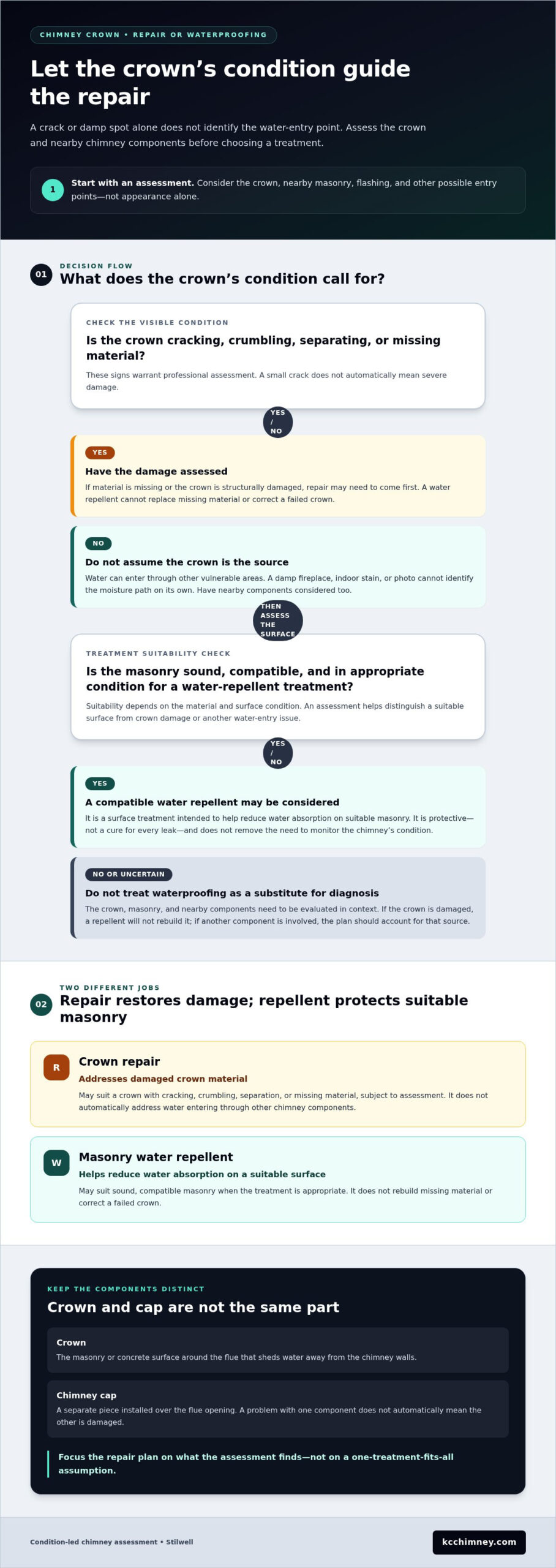
The crown and cap sit near the same opening, but they’re separate components. The crown is the masonry or concrete top surface surrounding the flue. The chimney cap is a separate piece installed over the flue opening. A cap helps cover that opening, while the crown sheds water away from the chimney top. A general overview of chimney components, including the crown, is available on chimney crown on Wikipedia.
Because they serve different roles, they also call for different solutions. A damaged cap may need attention to the cap itself; cracks or deteriorated material in the crown call for an assessment of the crown. A problem in one doesn’t automatically mean the other is damaged. Distinguishing between them helps focus repair on the component that needs it.
What water exposure can do to chimney masonry
Cracks in a crown can create pathways for water to reach masonry beneath or around it. Water may also enter through other vulnerable areas, so a damp fireplace or stain inside the home can’t identify the crown as the source on its own. The route moisture takes isn’t always visible from indoors.
Repeated wetting and freezing can put stress on an existing weakness. That doesn’t mean every crack will lead to major structural damage, but it does mean the crown’s condition matters. A small opening and loose or missing material aren’t the same repair problem. The right response depends on what’s present and whether nearby components may also be contributing.
Photos can help document what you’ve noticed, but they can’t reliably show the full condition of the crown or trace a moisture path. A professional assessment puts the damage in context by considering its location, visible extent, and relationship to adjacent chimney components. That evaluation is a useful starting point for chimney crown repair Stilwell homeowners may need, rather than choosing a treatment based on appearance alone.
Chimney Crown Repair or Waterproofing: What Each Approach Does
Repair and waterproofing address different conditions. Crown repair restores or addresses damaged crown material. A compatible masonry water repellent is a surface treatment intended to reduce water absorption on suitable masonry. One isn’t a substitute for the other. The decision should follow an inspection of the crown and nearby masonry, so the work responds to observed conditions instead of assuming every crack calls for the same treatment.
| Approach | Purpose | May suit | Limitation |
|---|---|---|---|
| Crown repair | Address damaged crown material | A crown with cracking, crumbling, separation, or missing material, subject to assessment | Doesn’t automatically address water entry through other chimney components |
| Masonry water repellent | Help reduce water absorption at a suitable masonry surface | Sound, compatible masonry where a treatment is appropriate | Doesn’t rebuild missing material or correct a failed crown |
When crown repair should come before waterproofing
Visible cracking, crumbling, separation, or missing crown material warrants professional assessment. If the crown has lost material or is structurally damaged, applying a water repellent won’t replace that material or correct the underlying failure. Repair may need to come first, depending on the inspection findings. For chimney crown repair Stilwell homeowners should have damage assessed before treating it as a surface-water problem.
When exterior chimney waterproofing may be appropriate
A water-repellent treatment may be considered for suitable masonry that’s in appropriate condition. The material and surface condition matter: the treatment needs to be compatible with the masonry and suitable for the intended application. It’s a protective measure, not a cure for every leak, and it doesn’t remove the need to monitor the chimney’s condition over time.
A useful assessment considers the crown alongside nearby masonry, rather than recommending waterproofing based only on a damp spot or a picture. Moisture may have more than one possible entry point, so the repair plan should distinguish crown damage from other issues. The National Fire Protection Association publishes NFPA 211 standards for chimneys; its information provides broader context for chimney construction and maintenance, not a diagnosis of an individual crown.
Best Chimney Services provides crown repair and chimney inspections for Stilwell homeowners. If you see cracking or missing material, a chimney crown repair assessment can help clarify whether repair or attention to another component belongs in the plan.
How to Compare Chimney Crown Repair Options in Stilwell
A useful repair plan starts with a clear explanation of the problem, not a treatment chosen before anyone has assessed the chimney. Compare options by asking what condition was observed, what work is proposed, whether materials suit the affected surface, and what guidance follows the work. A durable repair plan should address the diagnosed moisture path. If the source is elsewhere, crown work alone may not resolve the concern.
For chimney crown repair Stilwell homeowners can compare recommendations by checking whether each proposed task connects to an observed issue. A proposal should make clear which work addresses damaged crown material and whether any water-repellent treatment is a separate consideration. It should also explain which nearby components were reviewed, rather than treating every sign of moisture as proof of crown failure.
Questions a clear repair proposal should answer
A clear proposal identifies the crown’s observed condition and explains why the recommended work fits it. It describes the repair scope in practical terms, distinguishing work on damaged material from a treatment intended to reduce water absorption. It also says which adjacent components were assessed, so you can understand whether the recommendation is limited to the crown or reflects a broader chimney concern.
As you review the explanation, look for a direct connection between the finding and the work. If the crown is described as damaged, the scope should address that condition rather than rely on a surface treatment alone. If a water repellent is discussed, its role should be distinct from structural repair. You should be able to tell what the proposed work addresses and what it does not.
- Diagnosis: What condition was observed, and how might it relate to water entry?
- Scope: Which crown work is included, and is any water-repellent treatment separate?
- Compatibility: Is the suggested treatment suitable for the surface and its condition?
- Assessment: Were nearby components reviewed, and what follow-up guidance was provided?
When the leak may involve more than the crown
Water can enter around other parts of the chimney, so indoor symptoms don’t identify the entry point by themselves. An assessment may include flashing where the chimney meets the roof, the chimney cap over the flue opening, and masonry joints. These parts have different functions: flashing manages the roof-to-chimney intersection, a cap covers the flue opening, and mortar joints connect masonry units.
If mortar joints near the crown show deterioration, tuckpointing may be relevant to those joints; it isn’t a substitute for crown repair. A cap concern calls for attention to the cap rather than an assumption that the crown is responsible. Looking at these components separately helps keep the repair scope focused while recognizing that more than one area may need attention.
Best Chimney Services offers crown repair alongside chimney inspections and broader chimney repair, supporting an assessment based on the condition observed. For a wider view of related repair concerns, the Kansas City chimney repair guide can help put crown findings in context.
What to Expect During a Crown Assessment and Repair
A careful assessment connects what you’ve noticed at home with the chimney’s visible condition. It helps clarify whether the crown is damaged, whether nearby components may be involved, and what repair scope fits the findings. For chimney crown repair Stilwell homeowners can expect recommendations to depend on the crown’s condition, not on a one-treatment-fits-all assumption.
- Review the symptoms. Share where you’ve noticed moisture or staining and when it appears. Recurring dampness after rain, for example, may help guide the inspection, but it doesn’t identify the entry point by itself.
- Inspect the crown. The technician assesses visible conditions such as cracks, crumbling, separation, or missing material. What can be seen depends partly on safe roof access and the visibility of affected surfaces.
- Assess nearby components. The review may include areas around the flue, masonry joints, flashing, and the roof-to-chimney intersection. These components serve different purposes, and checking them helps distinguish crown damage from other possible water-entry paths.
- Explain the repair scope. Findings inform the recommended work. The technician can describe which condition the repair addresses and whether related masonry work may also be relevant.
Signs to note before scheduling an assessment
Before the visit, record visible cracks, loose or crumbling material, staining, or recurring moisture near the chimney. Note when symptoms appear, such as after rain or during seasonal temperature changes. These details give the technician helpful context. Don’t climb onto the roof or disturb damaged chimney material; leave close inspection to a professional with appropriate access and equipment.
How inspection findings shape the repair plan
The technician evaluates the crown and nearby areas where water might enter, then uses those observations to explain the scope. If the crown itself is damaged, the repair plan should address that condition. If masonry joints are also deteriorated, related tuckpointing may be considered. The specific method depends on what the inspection reveals, including the extent and location of damage. For more on the broader inspection process, the Kansas City chimney inspection guide offers additional context.
Roof access matters because some surfaces may be difficult to see from the ground, while weather, roof layout, or other conditions can limit what’s safely observable during a visit. An assessment describes visible findings and the resulting scope; it shouldn’t assume that an indoor stain proves a particular exterior cause. Best Chimney Services connects chimney inspections with crown repair, helping Stilwell homeowners understand the condition before deciding on the work.
To discuss a chimney crown assessment in Stilwell, reach out to Best Chimney Services.
Choose Local Chimney Crown Repair in Stilwell with Confidence
A sound decision starts by identifying where moisture is entering, then matching the work to the condition found. If the crown is cracked, loose, or missing material, repair may be needed before anyone considers a water-repellent treatment. If the crown is in suitable condition, an appropriate protective treatment may be worth discussing. Waterproofing shouldn’t be presented as a replacement for masonry repair, and neither approach should be treated as a guaranteed fix for every leak.
That condition-led sequence helps keep the plan focused: diagnose the possible moisture path, address observed damage, then consider suitable protection. An assessment can look at the crown alongside nearby masonry and other chimney components, helping distinguish crown concerns from issues involving mortar joints, a cap, or the roof connection. The findings give homeowners a clearer basis for understanding what the proposed work addresses and what may need separate attention.
Why a condition-led repair plan matters
The crown and the surrounding chimney work together, but damage in one area doesn’t automatically establish the cause of moisture elsewhere. A professional assessment can put visible crown concerns in context with adjacent conditions. Best Chimney Services provides chimney inspections and crown repair, helping determine an appropriate repair path based on what’s observed, not on an assumption that one treatment fits every chimney.
Best Chimney Services is locally owned and operated in the Kansas City metro and serves Stilwell. The company provides chimney repair and inspection for homeowners assessing crown concerns. A practical conversation can start with what you’ve seen and when it happens; an assessment can then help clarify which repair steps fit the chimney’s condition. No repair approach should be described as leak-proof or assigned a specific lifespan without support.
Take the next step for your Stilwell chimney
Before requesting service, note any visible crown cracks or loose material, interior staining, or recurring moisture near the chimney. Record whether you’ve noticed a pattern, such as symptoms appearing after rain or during seasonal temperature changes. You can also raise questions about which areas were assessed, what the repair scope covers, and whether any suggested protection is separate from crown repair. These details help make the discussion specific and useful.
Protecting your home starts with a clear understanding of the chimney’s condition. You don’t need to diagnose the moisture path yourself; share what you’ve observed and let a professional assessment guide the next step. For local help with chimney crown repair Stilwell, discuss your concerns and arrange service through Contact Best Chimney Services about crown repair.
Give Your Chimney a Clear Next Step
You don’t need to decide on waterproofing before you understand what’s happening at the crown. A focused assessment can turn uncertainty into a practical plan based on the chimney’s condition and the areas that may need attention. That way, your next step responds to the home’s needs rather than treating a visible symptom in isolation.
For chimney crown repair Stilwell homeowners can start by sharing what they’ve noticed, such as visible damage or recurring moisture, and asking how the findings shape the repair scope. Best Chimney Services brings crown repair and chimney inspection together to help guide that conversation for local homeowners in Stilwell, Overland Park, Mission Hills, Bucyrus, and Spring Hill.
Protecting your chimney starts with a clear view of its condition. Schedule a chimney crown assessment in Stilwell with Best Chimney Services and move forward with a plan suited to your home.
Frequently Asked Questions
Can chimney waterproofing repair a cracked crown?
No. Waterproofing can’t replace crown material that’s cracked through, loose, or missing. Think of it as a protective treatment for a suitable surface, not a material that fills or rebuilds damage. If you’re unsure whether a crack is superficial or part of a larger problem, have the crown assessed before applying a treatment. The crown’s condition determines whether repair, waterproofing, or another response is appropriate.
How do I know if my chimney crown needs repair?
Visible cracks, crumbling edges, separated sections, or missing material are reasons to arrange a professional assessment. You might also notice water staining indoors, but that symptom alone can’t confirm the crown is responsible. Avoid climbing up to check. From the ground, note what you can see and when moisture appears, then share those observations with a chimney professional who can assess the crown safely.
Is chimney crown waterproofing different from sealing a chimney?
The terms can mean different things in everyday use, so ask what material and area a proposed treatment is intended to address. A water repellent is generally applied to suitable masonry to reduce water absorption. Sealing may refer to treating a particular joint or opening. Neither term should be taken to mean that damaged crown material has been rebuilt or that every possible leak has been resolved.
What happens if a cracked chimney crown is left unrepaired?
An unrepaired crack can allow water to reach vulnerable parts of the chimney, and repeated exposure may contribute to further deterioration. The outcome depends on the crack’s condition and whether moisture is entering through it, so a visible crack doesn’t automatically mean serious damage has occurred. Having it assessed can help establish whether the crown needs attention and whether nearby masonry should also be reviewed.
Can a chimney leak in Stilwell come from somewhere besides the crown?
Yes. Possible sources include flashing at the roof, a damaged chimney cap, deteriorated mortar joints, or another part of the roof-to-chimney connection. Water stains indoors don’t pinpoint the entry route, since moisture can travel before becoming visible. Homeowners in Stilwell, Overland Park, Mission Hills, Bucyrus, and Spring Hill can share where and when they notice dampness to help guide a chimney assessment.
When is the best time to repair a chimney crown in Stilwell?
Arrange an assessment when you notice damage or recurring moisture rather than waiting for a particular season. Appropriate repair timing can depend on the crown’s condition and the weather and material requirements for the work. If you’ve noticed a crack after rain or freezing temperatures, record when it appeared and whether symptoms changed. That history can help the technician evaluate the concern.
Should I repair the chimney crown or replace the chimney cap?
It depends on which component is damaged. The crown is the masonry surface around the flue; the cap is a separate part covering the flue opening. A cracked crown doesn’t automatically mean the cap needs replacement, and a damaged cap doesn’t by itself call for crown repair. An inspection can identify which component needs attention and whether both show separate concerns.