
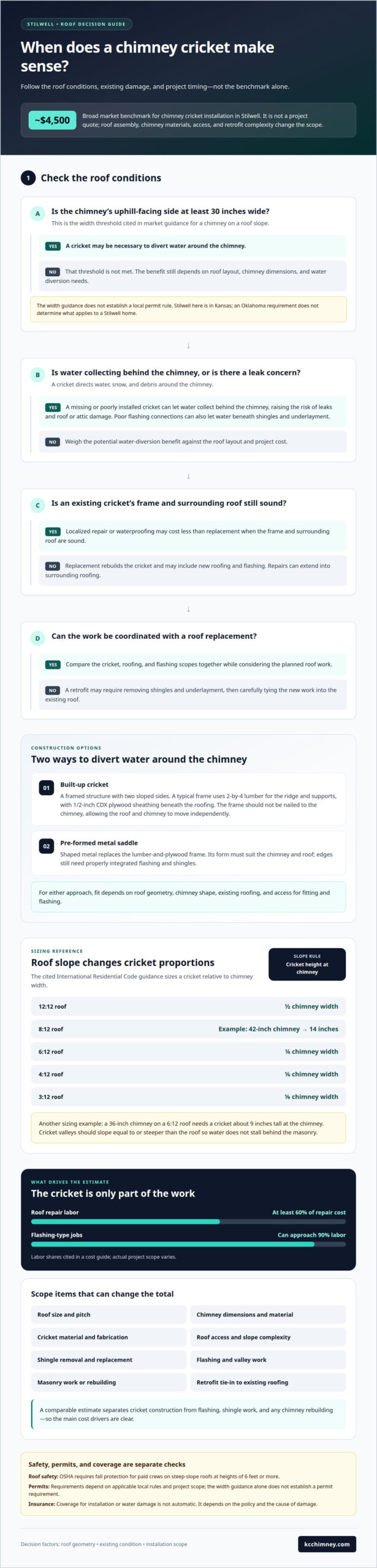
Around $4,500 is a useful market benchmark for chimney cricket installation in Stilwell, though the cost of a particular project depends on the roof, chimney, materials, and access. It’s reasonable to weigh that expense carefully, especially when the roof is already finished and the work involves more than adding a small structure behind the chimney.
A chimney cricket can help protect the roof behind a chimney by directing water, snow, and debris around it. Whether that protection is worth the cost depends on the roof layout, chimney dimensions, and whether installation can be combined with flashing work or a roof replacement.
This article explains what affects chimney cricket installation cost in Stilwell, how built-up crickets differ from pre-formed metal saddles, and when installation may make sense. Roof pitch, materials, and retrofit complexity can all change the scope of work, helping you understand the decision before moving ahead.
Key Takeaways
- Weigh the cricket’s water-diversion benefit against your roof layout and whether the work can be coordinated with a roof replacement.
- Learn how a framed, sheathed cricket differs from a pre-formed metal saddle and what each approach involves.
- See how roof pitch, chimney dimensions, materials, access, and flashing work shape the installation scope and cost.
- Understand when chimney cap installation may help address a separate source of water entry around your chimney.
Is a Chimney Cricket Worth the Cost?
A cricket protects the roof behind a chimney by directing water, snow, and debris around it. Its value depends on the chimney’s width, the roof pitch, and whether installation can be combined with roofing work.
Installation, Repair, and Replacement Costs
A repair addresses localized damage, while replacement rebuilds the cricket and may include new roofing and flashing. Repairing or waterproofing an intact cricket may cost less than replacing it, provided the frame and surrounding roof are sound.
Those figures help explain why timing matters: existing shingles and underlayment may need removal and careful tie-in during a retrofit. A cricket should also be sized to the roof slope. For example, a 36-inch chimney on a 6:12 roof needs a cricket about 9 inches tall at the chimney.
Local Requirements and Permits
Cricket requirements and permits depend on the applicable local rules and project scope. Stilwell in this article is in Kansas, not Oklahoma, so an Oklahoma requirement doesn’t establish what applies to a Stilwell home. Market guidance identifies a cricket as necessary when a chimney on a roof slope has a side facing the slope at least 30 inches wide, but that alone doesn’t establish a local permit rule.
A missing or poorly installed cricket can allow water to collect behind the chimney, increasing the risk of leaks and roof or attic damage. Poor flashing connections can also let water get beneath the shingles and underlayment. Repairs may then extend beyond the cricket to the surrounding roofing.
Roof work also needs safe access. The Occupational Safety and Health Administration requires fall protection for paid crews working on steep-slope roofs at heights of 6 feet or more. A trained crew must measure the roof, build the cricket to suit its slope, and integrate the flashing without creating a leak path.
Homeowners insurance doesn’t automatically cover cricket installation or damage linked to a missing cricket. Coverage depends on the policy and the cause of the water damage, so review the relevant terms when assessing a claim.
Built-up crickets and pre-formed metal saddles
A built-up cricket is a framed roof structure; a pre-formed metal saddle is another way to divert water around masonry. Both sit uphill from the chimney, but their construction differs. The right option depends on the roof geometry, chimney shape, and connection to the existing roofing.
For a built-up cricket, the framing creates two sloped sides that guide water away from the chimney. A typical frame uses 2-by-4 lumber for its ridge and supports, with 1/2-inch CDX plywood sheathing beneath the roofing. The frame shouldn’t be nailed to the chimney. That separation allows the roof and chimney to move independently, reducing stress at the joint where leaks can develop.
Measurements matter. The 2015 International Residential Code gives cricket dimensions according to roof slope: a 12:12 roof calls for a cricket half the chimney width, while a 6:12 roof calls for one-quarter. For example, a 42-inch chimney on an 8:12 roof has a cricket height of 14 inches at the chimney face. The cricket valleys should have a slope equal to or steeper than the roof, so water doesn’t stall behind the masonry.
A pre-formed metal saddle uses shaped metal instead of a lumber-and-plywood frame. Its form must suit the chimney and roof, and its edges still need properly integrated flashing and shingles. That makes the surrounding roof repair important, not just the saddle itself. Homeowners weighing the two methods should consider the existing roofing, chimney profile, and access for fitting and flashing. An inspection can also help identify related chimney concerns; a chimney inspection assesses the structure and visible water-entry points.
Chimney cricket installation cost
The chimney cricket installation cost in Stilwell depends on the roof assembly, chimney materials, and retrofit complexity. A broad market benchmark is around $4,500, but that figure is not a project quote. Straightforward work and complex rebuilding are different scopes, especially when a contractor must open shingles or rebuild flashing behind the chimney.
These figures describe different project conditions, not interchangeable options.
Labor and roof access can shape the total substantially. Roof repair labor accounts for at least 60% of repair cost in a January 2026 cost guide, and flashing-type jobs can approach 90% labor. A contractor may need to remove shingles, expose the underlayment, build the cricket, then reconnect the roofing and flashing. Steeper roof slopes, masonry work, and carefully formed valleys add complexity.
A cricket can be necessary when the chimney face wider than 30 inches meets the uphill roof slope, but dimensions and materials still affect the work. A useful estimate should describe the cricket material, flashing scope, shingle removal and replacement, and any chimney rebuilding. That breakdown lets homeowners see whether the main expense is the saddle, roof access, or surrounding repairs.
When requesting quotes from local roofers near Stilwell, describe the chimney material, roof slope, existing shingles, and any visible leaks or damaged flashing. Ask for a written scope that separates cricket construction from flashing and roofing repairs, so you can compare equivalent estimates.
What factors affect the price of a chimney cricket, such as roof size, pitch, and materials?
Roof pitch affects the cricket’s required shape and the work needed to connect it to the roof. Under the International Residential Code guidelines, a cricket on a 4:12 roof should be one-sixth the chimney width; on a 3:12 roof, it should be one-eighth. A wider chimney therefore needs a wider cricket, while the roof’s geometry determines how the structure fits behind it.
Material choice affects fabrication and installation. A built-up cricket uses lumber, sheathing, roofing, and flashing; a metal saddle needs shaping and secure integration with the surrounding roof. Copper, galvanized steel, and aluminum each have different material and fabrication requirements. Shingle type matters too: the roofer must tie the cricket into the existing roofing and underlayment, not leave exposed seams where water can enter.
Roof access and condition affect the labor involved. A steep roof, limited access, or brittle shingles can make removal and replacement more difficult. During an inspection, the roofer assesses the slope, chimney dimensions, existing flashing, and roof area behind the chimney. If the shingles or underlayment are damaged, the work may extend beyond the cricket to include those repairs.
Flashing complexity is another cost factor. The cricket’s valleys must direct water away from the chimney, and the flashing must connect those channels to the roof without gaps. Irregular masonry may require more precise fitting than a straight-sided chimney. The estimate should separately identify the cricket material, flashing, roofing removal, and any repairs. That breakdown clarifies whether the cost comes mainly from materials, access, or surrounding roof work.
Best Chimney Services: Chimney Cap Installation
Best Chimney Services installs chimney caps to help protect the chimney opening from outside elements. A cap serves a different purpose from a cricket: it covers the top of the flue, while a cricket directs water around the chimney at roof level. A cap won’t replace damaged cricket flashing or fix water pooling behind the chimney.
Consider a chimney cap if yours is missing or damaged, or if you’re addressing another concern at the chimney opening. If water is entering around the roof-to-chimney connection, the cricket, flashing, and nearby roofing are the areas to assess. Distinguishing these functions helps focus attention on the source of the problem.
For help with a chimney cap, contact Best Chimney Services.
Plan the Next Step for Your Roof
Before scheduling roof work, gather details about the chimney and roof: note where water appears, describe visible damage, and consider whether roofing work is already planned. This helps clarify the source of the problem, the work involved, and whether a chimney issue needs separate attention. Chimney cricket installation cost in Stilwell is only one part of the decision; protecting your home starts with identifying which component needs attention.
A cricket directs water around the chimney at roof level. A cap protects the flue opening, while other chimney concerns may require a different service. Distinguishing these functions helps you focus on the right next step instead of treating every leak as the same repair.
For chimney care beyond the roofline, Best Chimney Services also provides sweeping, relining, and gas fireplace inserts. To discuss your needs and request an estimate, contact Best Chimney Services. A clear conversation is a practical start toward protecting your home.
Frequently Asked Questions
What is a Roof Cricket?
A roof cricket is a raised, peaked structure that splits runoff into two paths around an obstruction. Behind a chimney, it guides water toward the roof valleys instead of letting it collect against the uphill wall. “Saddle” describes the structure’s shape and position. Its drainage channels must connect cleanly with the surrounding roof covering to carry water away.
Can you build a cricket yourself?
Although a homeowner can build a cricket, professional installation is the safer choice because it involves connecting framing, roofing, and chimney flashing. An error in the cricket’s shape or its connection to the roof can create a path for water into the attic. The work also requires roof access and precise fitting around masonry, making it more involved than a surface patch.
What is the average cost to install a chimney cricket in Stilwell, Oklahoma?
Stilwell is in Kansas, not Oklahoma. For the chimney cricket installation cost in Stilwell, around $4,500 is a market benchmark, not a guaranteed local quote or an average for every roof. A homeowner in Stilwell, Overland Park, Mission Hills, Bucyrus, or Spring Hill should expect the project scope to depend on chimney construction, roof access, materials, and whether related flashing needs rebuilding.
How much does chimney cricket installation cost per square foot?
A per-square-foot calculation can be misleading because a cricket is shaped to fit a specific chimney and roof. Even a small chimney may require careful flashing work, while a larger roof area doesn’t automatically call for a larger cricket. For a useful estimate, consider the cricket dimensions, affected roofing, material, and whether the scope includes repairs to the roof-to-chimney connection.
What materials are commonly used for chimney crickets, and how do their costs compare?
Built-up crickets commonly use lumber, plywood sheathing, roofing, and flashing; pre-formed saddles use shaped metal. These are component costs, not a complete installed price, because fabrication and integration with the roof add work.
How much do chimney cricket labor, flashing, and roofing repairs typically cost?
Costs also depend on how much roofing must be opened and restored. Shingle replacement, underlayment repairs, and difficult access can expand the scope. An estimate should separate labor, flashing, and roof repairs so the work is clear.