
What if that hairline crack in your chimney mortar is actually a warning sign that Kansas City’s 30-inch frost depth is already compromising your home’s safety? It’s a common sight for local homeowners. You might notice a few flakes of brick on the roof or a bit of moisture near the firebox and hope it’s just a minor cosmetic flaw. You’re right to be concerned; ignoring these small signals often leads to expensive structural failures or hidden water damage inside your walls.
We understand that the thought of a leaning chimney or a full reconstruction is daunting. That’s why we’ve built this 2026 guide to chimney masonry repair in Kansas City. You’ll learn how to identify specific climate-driven damage, understand which professional repairs stop leaks for good, and discover how to maintain your home’s curb appeal without the stress of a total rebuild. We’ll walk through everything from the latest building code requirements to the specialized tuckpointing techniques that protect your masonry from 115 mph winds. Our goal is to ensure your chimney remains a safe, durable asset for your family for years to come.
Key Takeaways
- Discover how Kansas City’s specific freeze-thaw cycles and deep frost depth create unique structural risks for your chimney’s brickwork.
- Learn the difference between cosmetic hairline cracks and structural red flags to determine when it’s time for a professional safety evaluation.
- Understand why proactive chimney masonry repair in Kansas City prevents water leaks and saves you from the high cost of a full reconstruction.
- Explore the benefits of tuckpointing as a specialized restoration technique that restores mortar joints and protects your home’s long-term value.
- Get a step-by-step look at the mess-free restoration process, including multi-level safety inspections that prioritize your family’s peace of mind.
Why Kansas City Chimneys Face Unique Masonry Challenges
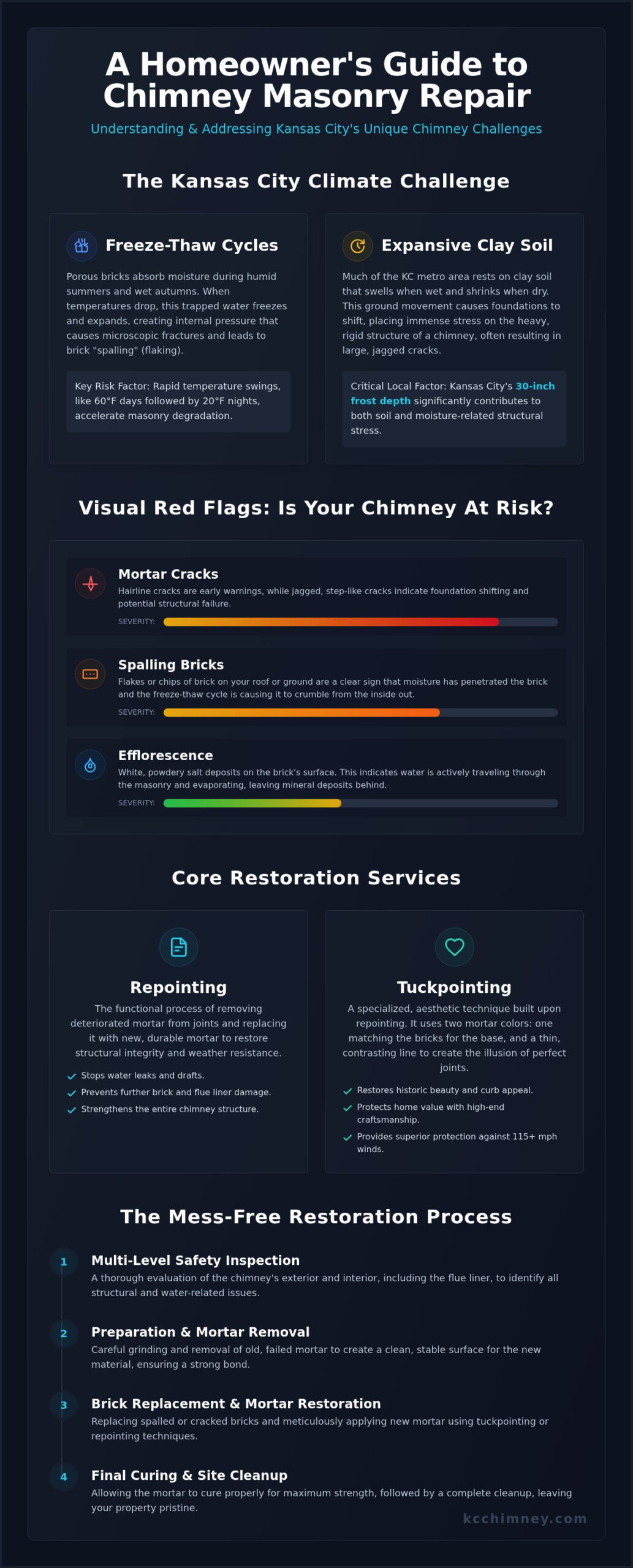
Kansas City’s weather is uniquely aggressive toward brick and mortar. While homeowners in other regions might ignore their chimney for decades, local residents in Johnson County quickly learn that our climate demands a more proactive approach. The primary culprit is the “freeze-thaw” cycle. Because brick is a naturally porous material, it acts like a sponge during our humid summers and wet autumns. When winter hits, that absorbed moisture freezes and expands. This internal pressure creates microscopic fractures that eventually turn into “spalling,” which is when the face of the brick flakes or pops off entirely.
Soil conditions also play a massive role in the health of your masonry. Much of the Kansas City metro sits on expansive clay soil. This earth swells when wet and shrinks during the dry summer months, causing foundations to shift. Since a chimney is a heavy, vertical structure, even a slight foundation movement can result in jagged cracks throughout the mortar. Neglecting these issues often leads to structural failure, turning a manageable chimney masonry repair in Kansas City into a full-scale reconstruction. Adopting a “set it and forget it” mindset often results in moisture reaching the home’s interior, causing wood rot and mold long before the chimney actually leans.
The Impact of Kansas City Weather on Brickwork
Early spring is arguably the most dangerous season for local masonry. We often see 60-degree afternoons followed by 20-degree nights. This rapid temperature swing accelerates the expansion and contraction of mortar joints, causing them to crumble. When moisture stays trapped behind the brick, it doesn’t just damage the exterior; it can seep into the interior flue. Over time, this causes the clay tile liners to crack or flake, compromising the safety of your entire fireplace system. Before diving into repairs, understanding the core components of a chimney helps in recognizing how external water penetration eventually threatens the internal structure and fire safety of your home.
Regional Architectural Styles and Common Masonry Issues
In historic areas like Mission Hills and Stilwell, many homes feature older, high-porosity clay bricks. These materials have a beautiful, classic aesthetic but are more susceptible to water absorption than modern, denser alternatives. Modern builds in the suburbs face different challenges, often utilizing brick veneers that can trap moisture against the house frame if the masonry isn’t sealed correctly.
- Historic Homes: These frequently require specialized mortar mixes that match the original lime-based materials to prevent the new mortar from crushing the old, softer bricks.
- Modern KC Builds: These often use different expansion joint techniques. If these joints aren’t maintained, the chimney can pull away from the siding.
- Common Red Flags: Look for white, powdery salt deposits, known as efflorescence, on the brick. This indicates that water is actively moving through the masonry and leaving minerals behind.
Core Masonry Services: Tuckpointing, Bricks, and Restoration
Maintaining a chimney in the Midwest requires more than a quick patch. High-quality chimney masonry repair in Kansas City focuses on restoring the water-tight integrity of the structure while preserving its aesthetic appeal. Whether your home is a historic Mission Hills estate or a modern suburban build, the right masonry service stops small cracks from becoming structural disasters. We prioritize long-term durability, ensuring that every repair acts as a barrier against our region’s harsh weather cycles.
Tuckpointing vs. Repointing: What Is the Difference?
Many homeowners use these terms interchangeably, but they serve different purposes in the restoration process. Repointing is the technical act of removing old, crumbling mortar and replacing it with fresh material. Tuckpointing goes a step further by using two different colors of mortar to create a specific visual effect. We use a base mortar that matches the color of the brick and a thin, contrasting “fillet” line in the center. This creates the illusion of perfectly fine, thin joints, which is a hallmark of high-end craftsmanship in older neighborhoods. Using the correct mortar density is vital; if the new mortar is harder than the original bricks, the bricks will eventually crack under the pressure of seasonal expansion.
Safety is the primary concern when it comes to firebox restoration. This internal masonry must withstand extreme heat without transferring it to your home’s framing. Cracks in the firebox floor or walls are not just cosmetic flaws. They are serious fire hazards. According to the EPA, a professional chimney inspection is the most reliable way to identify these hidden dangers before they lead to a house fire. Restoration usually involves replacing individual firebricks with high-heat resistant materials to ensure your hearth remains a safe sanctuary for your family.
Structural Brick Replacement and Stabilization
Sometimes, the damage goes deeper than the mortar joints. Spalling occurs when the face of the brick flakes off due to internal moisture pressure. These compromised bricks no longer provide structural support and must be replaced to prevent the chimney from leaning or collapsing. Our team specializes in sourcing reclaimed or precisely matched bricks that blend seamlessly with Kansas City’s local architecture. We don’t just swap bricks; we ensure the entire structure is stabilized throughout the process.
If you’re noticing flakes of brick on your roof or white powdery stains on your chimney, it’s time to consider a professional masonry evaluation. Catching these issues early allows us to utilize tuckpointing to save your chimney from the much higher cost of a full rebuild.
Identifying Structural Red Flags: When to Call a Mason
Homeowners in Mission Hills and Overland Park often walk past their chimneys every day without noticing the subtle shifts in the brickwork. Identifying the need for chimney masonry repair in Kansas City before it becomes an emergency requires a keen eye and a bit of local context. While a tiny hairline crack on the surface might be cosmetic, any gap that allows water to penetrate the structure is a threat to your home’s integrity. It’s much easier to address a few loose bricks now than to deal with a structural collapse after a heavy Midwest storm.
One of the simplest ways to evaluate your mortar joints is the “Penny Test.” Take a standard penny and try to insert it edge-first into a crack or a recessed mortar joint. If the penny fits easily into the gap, the mortar has likely eroded beyond the point of protection. This depth allows Kansas City’s heavy rains to pool inside the masonry, leading to the freeze-thaw damage that destroys bricks from the inside out. Inside the home, look for dampness in the firebox or brown water stains on the ceiling around the chimney breast. These signs indicate that water has already bypassed the exterior masonry and is actively damaging your interior finishes.
Top 5 Signs of Chimney Masonry Failure
If you notice any of the following during your seasonal walk-around, it’s time to consult a professional mason to prevent further deterioration. Catching these early protects your home’s value and your family’s safety.
- Spalling Bricks: Look for flakes of brick on the ground or roof. This means the brick’s “skin” has popped off due to internal moisture pressure.
- Mortar Deterioration: If the mortar feels sandy to the touch or is missing entirely in sections, your bricks are no longer properly supported.
- Chimney Leaning: A chimney that tilts away from the house is a critical safety hazard. This is usually caused by foundation settling in our local clay soil or severe internal rot. For those dealing with foundation-related structural issues, Crown Leveling Inc. provides expert insights into how stabilizing the ground beneath your home protects the masonry above.
- Efflorescence: White, powdery stains on the brick surface are salt deposits. They prove that water is moving through the masonry and evaporating on the surface.
- Vegetation Growth: Moss or weeds growing in your mortar joints mean there is significant, constant moisture trapped inside the structure.
The Hidden Dangers of a Cracked Chimney Crown
The chimney crown is the concrete slab at the very top of your chimney. It acts as a roof, shedding water away from the masonry below. Because it’s exposed to the most direct sunlight and rain, it often cracks first. Even a small fissure in the crown acts like a funnel, directing gallons of water straight into the center of your chimney structure. This leads to rapid deterioration of the flue tiles and the surrounding brickwork. For more detail on this specific issue, read about Cracked Chimney Crown? Why You Need a Repair in KC to understand why this component is your first line of defense.
The Restoration Process: What to Expect During Your Repair
A professional restoration starts long before the first brick is laid. We begin every project with a multi-level safety evaluation, utilizing specialized video camera equipment to inspect the internal flue and external structure. This thoroughness ensures we don’t just treat the symptoms of a crack but address the root cause. When you schedule a chimney masonry repair in Kansas City, you deserve a process that respects your property. Our team prioritizes a mess-free service, using heavy-duty drop cloths and specialized dust-containment tools to protect your landscaping and roof from debris throughout the workday.
Material selection is the most technical part of the preparation phase. We don’t use a one-size-fits-all mortar. Instead, we match the mortar strength and color to your existing masonry. This is vital for long-term durability; if the new mortar is significantly harder than the original bricks, it will cause the bricks to crack during the next freeze-thaw cycle. Once the masonry work is finished, we apply a professional-grade, breathable sealant. Unlike hardware store silicone, these sealants allow internal moisture vapors to escape while preventing liquid water from entering the pores of the brick.
Step-by-Step: The Professional Tuckpointing Process
The core of masonry restoration is a methodical tuckpointing process. This isn’t a simple smear of new material over the old. First, we grind out the damaged mortar to a precise depth, usually about one inch, to create a clean channel. We then clean the joints thoroughly to ensure a permanent bond between the old structure and the new material. After applying the new mortar, we finish the joints with a specific profile designed to shed water away from the brick. This attention to detail ensures the repair remains water-tight for decades rather than just a few seasons.
Timeline and Maintenance After the Repair
Most standard masonry repairs in the Johnson County area take between one and three days. However, the work requires specific weather conditions to cure correctly. We monitor local forecasts to ensure the temperature stays within the safe range for mortar hydration. To extend the life of your investment, we recommend a few simple annual habits. Visually check the chimney crown every spring and keep tree branches trimmed at least ten feet away from the masonry to prevent physical scraping and excess moisture retention.
Ready to restore your home’s safety and curb appeal? You can schedule a professional masonry evaluation with our certified team today to ensure your chimney is ready for whatever the Midwest weather brings next.
Choosing a Local Expert for Your KC Chimney Masonry
Choosing the right partner for your home’s restoration is about more than just finding the lowest bid. A chimney is a mechanical ventilation system that must withstand extreme heat and freezing winds. A general mason might understand how to build a garden wall, but they often lack the specialized training needed to manage the thermal stresses of a firebox or the intricacies of a chimney crown. Effective chimney masonry repair in Kansas City requires a deep familiarity with our region’s unique architectural styles and the specific materials used in historic neighborhoods like Mission Hills.
At Best Chimney Services, we’ve served as a guardian of the local home since 2012. Being locally owned and operated means we aren’t just technicians; we’re your neighbors. We understand how the local frost depth and expansive clay soils affect your brickwork. When you request a quote for chimney repair in Overland Park, you’re getting a team that prioritizes multi-level safety evaluations and long-term durability over quick, cosmetic patches.
Questions to Ask Your Masonry Contractor
Before you sign a contract, ensure your provider meets a high standard of professional accountability. Ask these three critical questions to protect your investment:
- Do you specialize specifically in chimney masonry or general brickwork? Chimneys require different mortar mixes and safety standards than standard walls. You want a specialist who understands flue liners and ventilation.
- How do you handle dust and debris during the grinding process? Professional teams use specialized vacuums and heavy-duty drop cloths to ensure a mess-free service for your yard and roof.
- Are you familiar with the local building codes in Mission Hills or Stilwell? Compliance with the latest fire safety standards is non-negotiable for your insurance coverage and your family’s safety.
The Best Chimney Services Difference
We believe in doing the job right the first time. Our commitment to integrity means we never recommend a full rebuild when a targeted tuckpointing project will suffice. By utilizing a comprehensive chimney inspection in Kansas City, we identify masonry issues early. This proactive approach saves you from the fear of structural collapse or the high cost of interior water damage. We take pride in our specialized niche, blending the grit of manual labor with the precision of modern safety standards. Our goal is to protect your hearth and home for the next decade, ensuring your fireplace remains a safe, efficient, and beautiful centerpiece for your family.
Secure Your Home Against the Midwest Seasons
Protecting your property from the relentless Kansas City freeze-thaw cycle starts with understanding your chimney’s specific vulnerabilities. We’ve explored how small mortar gaps lead to significant structural failure and why specialized techniques like tuckpointing are essential for long-term durability. By identifying red flags early and choosing a partner who understands our local architectural needs, you ensure your fireplace remains a safe asset for your family. Catching these issues now prevents the fear of a structural collapse and the high cost of interior water damage later.
Best Chimney Services has been a fixture in the community since 2012. As a local, family-owned and operated business, we prioritize your peace of mind by using certified technicians and specialized video camera inspections to uncover hidden damage. Don’t wait for a minor crack to become an expensive structural emergency. You can Get a Professional Chimney Masonry Quote in Kansas City today to secure your home’s exterior.
Investing in professional chimney masonry repair in Kansas City today preserves your property’s curb appeal and protects your loved ones for the next decade. We’re here to help you keep your hearth warm and your home secure through every season. Stay proactive, and your chimney will continue to serve as a reliable centerpiece for your home.
Frequently Asked Questions
How much does chimney masonry repair cost in Kansas City?
Costs for chimney masonry repair in Kansas City vary based on the extent of the damage and the accessibility of the structure. Minor mortar touch-ups are more affordable than addressing deep structural gaps or firebox issues. You should check with the city regarding permit requirements, as most significant repair work in Kansas City requires one. We recommend a professional evaluation to determine the specific scope before assuming the scale of the investment.
What is the difference between tuckpointing and a full chimney rebuild?
Tuckpointing is a maintenance procedure where we remove and replace damaged mortar joints to stop water penetration. It’s the best option when your bricks are still structurally sound. A full rebuild becomes necessary when the bricks themselves have crumbled or the chimney has begun to lean. If more than 25 percent of the masonry is compromised, a rebuild is often the only way to ensure long-term safety and stability.
Can I repair chimney masonry myself with a kit from a hardware store?
We don’t recommend using hardware store kits for chimney work. These materials often don’t match the thermal expansion rates or the compressive strength of your original bricks. If the new material is too hard, it can actually cause your bricks to crack under pressure. Professional masonry requires specialized tools to grind out old mortar safely without damaging the surrounding structure, ensuring a bond that lasts through Midwest winters.
How long does a typical tuckpointing job last in the KC climate?
A high-quality tuckpointing job can last between 20 and 30 years. However, Kansas City’s unique climate, characterized by 105 to 115 mph wind speeds and frequent freeze-thaw cycles, can shorten this lifespan if the work isn’t sealed correctly. Using a breathable, professional-grade water repellent after the repair helps extend the life of the mortar by preventing moisture from soaking into the pores of the brickwork during heavy rains.
Is crumbling brick a fire hazard or just a structural issue?
Crumbling brick is both a structural and a fire safety concern. When exterior masonry fails, it often allows moisture to reach the internal flue liner. If that liner cracks, heat and sparks can escape the chimney and reach the combustible wooden framing of your home. Any sign of failing brickwork should be treated as a priority for chimney masonry repair in Kansas City to prevent a potential house fire.
Does homeowners insurance cover chimney masonry repair?
Homeowners insurance typically covers chimney damage caused by sudden, accidental events like lightning strikes, fallen trees, or severe storms. It rarely covers standard maintenance or damage caused by long-term neglect and normal wear. We recommend reviewing your specific policy and documenting any storm-related damage immediately. A professional inspection report can often help provide the necessary evidence if you need to file a claim after a major weather event.
What is the best time of year to schedule masonry work in Kansas City?
Late spring and early fall are the ideal times for masonry work in our region. Mortar requires moderate temperatures to cure properly; it shouldn’t freeze before it dries, nor should it dry too quickly in the 100-degree summer heat. Scheduling your repair during these windows ensures the material reaches its maximum strength. It also prepares your chimney for the heavy usage it will see during the cold winter months ahead.
How do I know if my chimney crown needs repair or replacement?
You can identify crown issues by looking for cracks or missing pieces on the very top slab of the chimney. Small hairline cracks can often be sealed with a professional crown repair to prevent water from entering the structure. However, if the concrete is crumbling or chunks are missing, a full replacement is necessary. Since the crown is your first line of defense against rain, ignoring these signs leads to rapid masonry failure below.