
In Kansas City, your chimney flashing isn’t just a simple piece of metal trim. It’s a dynamic seal that must survive 100-degree summers and sub-zero winters to keep your living room dry. If you’ve spotted a growing brown stain on your ceiling or feel a sense of dread every time a Midwest thunderstorm rolls through, you aren’t alone. Damaged or improperly installed flashing is the number one reason for chimney leaks, yet homeowners often receive conflicting advice from general roofers and specialists. When you’re worried about structural integrity and the fear of mold, you need a professional solution for chimney flashing repair in Kansas City that actually lasts.
We understand that protecting your home is your top priority, and we’re here to provide the peace of mind you deserve. This article will teach you how to identify the early signs of flashing failure and why choosing the right materials, like durable stainless steel, is vital for our local climate. You’ll also learn about critical building codes, such as the requirement for crickets on wider chimneys, and how a certified expert secures a leak-proof seal. By the end, you’ll know exactly how to stop water intrusion for good and keep your home’s interior safe from the elements for years to come.
Key Takeaways
- Understand why flashing acts as the essential “union point” between your roof and masonry to stop water intrusion.
- Learn to spot the five warning signs, including ceiling stains and visible rust, that indicate you need chimney flashing repair in Kansas City.
- Discover why stainless steel is the gold standard for durability against the Midwest’s extreme temperature swings and corrosive gases.
- See how a professional repair process uses custom-fabricated metal and thorough deck inspections to create a permanent, leak-proof seal.
- Gain peace of mind by following local building codes that protect your home’s structural integrity from long-term moisture damage.
What is Chimney Flashing and Why Does it Fail in Kansas City?
Chimney flashing is the primary moisture barrier for the roof-to-chimney junction. This metal transition seals the gap between your shingles and the masonry, acting as the critical union point for your home’s exterior. Without it, water would simply slip behind your shingles and flow directly into your attic or down your chimney’s interior walls. To understand the technical basics of this system, you can explore What is Chimney Flashing to see the various materials and styles commonly used in the industry.
In Kansas City, the primary reason flashing fails is the region’s extreme temperature swings. Our summers often reach triple digits, and our winters can drop well below zero. These fluctuations cause the metal to expand and contract at a different rate than your chimney’s brick and mortar. Over time, this constant movement pulls the metal away from the masonry, breaking the watertight seal. When this happens, professional chimney flashing repair in Kansas City becomes necessary to prevent structural rot and costly interior damage; if you’ve already experienced water or mold issues, you can discover Hays + Sons Complete Restoration for expert mitigation and remediation services.
The Anatomy of a Watertight Seal
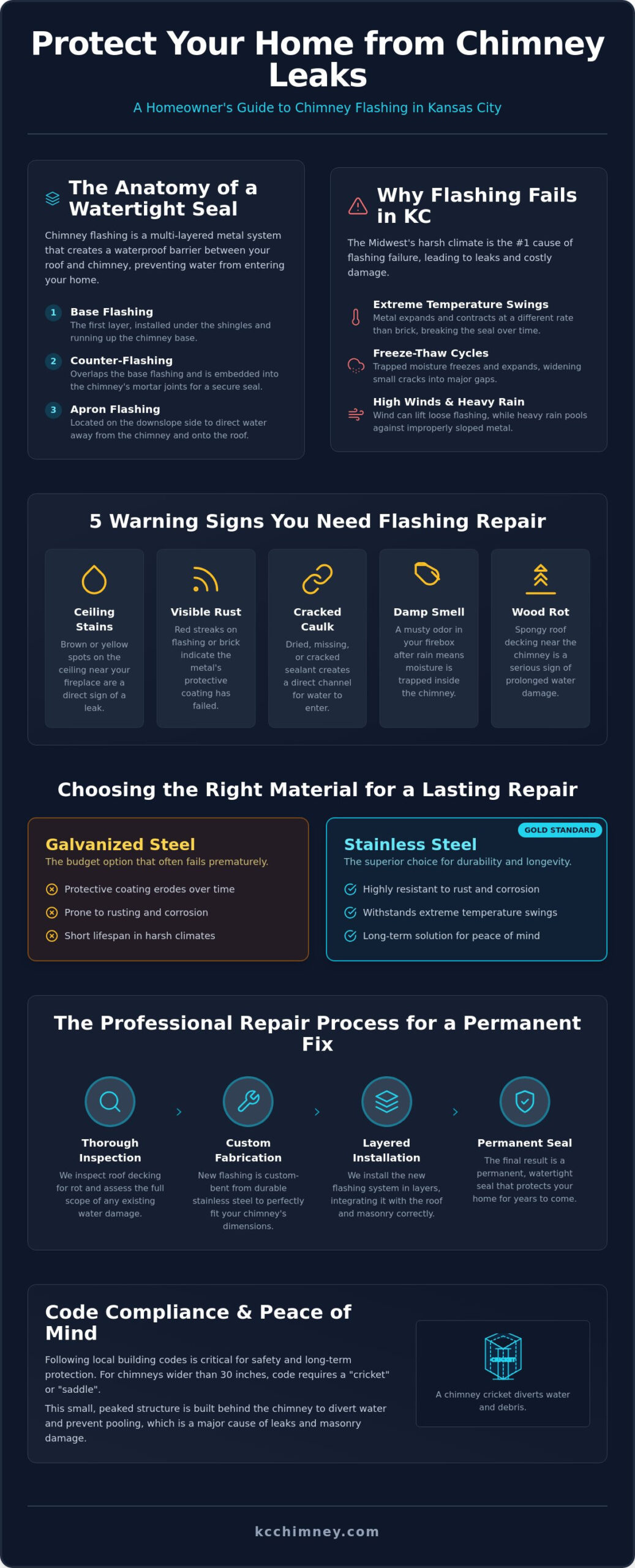
A properly installed flashing system isn’t just one piece of metal; it’s a layered defense designed to shed water efficiently. Our technicians focus on three main components to ensure your home stays dry. Base flashing is the first layer, which sits underneath your shingles and extends up the side of the chimney wall. Counter-flashing is the second layer; it overlaps the base flashing and is embedded directly into the mortar joints of the masonry. Finally, the apron flashing sits on the downslope side of the chimney to direct water away from the junction and back onto the roof surface.
Why KC Weather is Aggressive Toward Flashing
The Midwest climate presents unique challenges for homeowners in areas like Johnson County. Freeze-thaw cycles are particularly aggressive here. When moisture gets behind an aging seal and freezes, it expands, widening small cracks into major gaps. High Midwest winds also play a role, as they can lift improperly secured metal edges, creating a funnel for wind-driven rain. Our heavy spring rains also test the limits of your roof’s drainage. If your flashing is flat or improperly pitched, water will pool against the brick. If you ignore these signs, you’ll eventually need chimney flashing repair in Kansas City to protect your home’s structural integrity from moisture intrusion.
5 Warning Signs You Need Chimney Flashing Repair
Identifying a leak early can be the difference between a simple metal replacement and a full-scale restoration project. While some signs are obvious, others require a bit of detective work inside your attic or fireplace. If you notice any of the following indicators, it is time to consider professional chimney flashing repair in Kansas City to prevent further damage to your home.
- Ceiling Stains: Those unsightly brown or yellow water spots appearing near your chimney or on the ceiling above your fireplace are clear indicators of water bypass. Water often follows the path of least resistance, traveling down rafters before soaking into your drywall.
- Visible Rust: If you see red streaks on your flashing or rust stains running down your brickwork, the protective coating on your metal has failed. This is common with older galvanized materials that have reached the end of their lifespan.
- Missing or Loose Caulk: Many installers rely on temporary sealants that dry out and crack after just a few seasons in the Kansas City sun. When caulk pulls away from the masonry, it leaves a direct channel for rain to enter.
- Damp Smell: A musty, earthy odor inside your firebox after a heavy downpour suggests that moisture is trapped within the chimney system. This environment is a breeding ground for mold and can eventually affect your home’s air quality.
- Internal Wood Rot: Soft spots in the roof decking surrounding the chimney base are serious red flags. If the wood feels spongy when you press on it from the attic, the moisture has already begun compromising your roof’s structural integrity.
Visual Red Flags from the Ground
You don’t always need a ladder to spot trouble. Using a pair of binoculars, you can inspect the roofline for gaps where the metal meets the brick. Look for warped or “bowed” flashing that no longer sits flush against the chimney. Another common sign is “shingle lift,” where the shingles around the chimney corners appear pushed up or distorted, often caused by water swelling the wood underneath. If the silhouette of your flashing looks uneven, it’s likely failing.
The Hidden Danger of Structural Decay
A small flashing leak can rot the rafters and roof deck over time, often hidden from view until the damage is extensive. Moisture can also seep into the insulation surrounding the chimney chase, leading to hidden mold growth that compromises your home’s health. Because these issues aren’t always visible to the naked eye, a professional chimney inspection in Kansas City is vital for early detection. Our certified technicians can identify moisture entry points before they turn into major structural repairs. If you suspect your home is at risk, securing a professional evaluation is the first step toward lasting protection.
Stainless Steel vs. Galvanized: Choosing the Best Materials
Selecting the right metal is the most critical decision you’ll make during a chimney flashing repair in Kansas City. While many factors influence the total project cost, the material’s durability determines whether you’ll be dealing with another leak in five years or fifty. In the Midwest, your flashing must withstand high humidity, heavy snow loads, and corrosive flue gases that can eat through inferior metals. Choosing a material that matches the longevity of your roofing components is an investment in your home’s future.
- Galvanized Steel: This is the most common material used in new construction because it is inexpensive and easy to source. However, the protective zinc coating eventually wears off, leaving the raw steel vulnerable. In our local climate, galvanized flashing often begins to rust within 5 to 10 years, which is significantly shorter than the 15 to 25-year lifespan of standard asphalt shingles.
- Stainless Steel: We consider this the gold standard for home protection. It is naturally resistant to rust and won’t react with the acidic chemicals found in chimney smoke. It provides a permanent, high-integrity seal that often outlasts the roof itself.
- Copper: For homeowners seeking a lifetime solution with a classic aesthetic, copper is the top choice. It is virtually indestructible and develops a beautiful patina over time, though it requires a higher initial investment and specialized installation skills.
- Aluminum: While aluminum is rust-resistant, it is a soft metal. Missouri’s frequent hail storms can easily dent or puncture aluminum flashing, creating small entry points for water that are difficult to see from the ground.
The “Builder-Grade” Trap in KC Suburbs
Many homes in Overland Park and Mission Hills were originally built using “builder-grade” galvanized steel. Developers often use these materials to keep initial costs low, but it creates a recurring maintenance cycle for the homeowner. A common mistake is painting over rusted galvanized metal; this only masks the visual decay while the structural failure continues underneath. When you calculate the long-term cost, replacing cheap flashing every few years is far more expensive than a one-time stainless steel upgrade during your chimney flashing repair in Kansas City.
Why Material Choice Impacts Your Masonry
The metal you choose affects more than just your roof’s water resistance. When galvanized steel corrodes, it undergoes a process called “rust jacking.” The expanding rust creates physical pressure that can actually crack the surrounding mortar joints and loosen bricks. Additionally, inferior metals often leave unsightly red or orange streaks on light-colored stone or brickwork that are nearly impossible to scrub away. By choosing stainless steel, you protect the aesthetic and structural integrity of your masonry. High-quality metal components can last 40 to 70 years, ensuring your chimney remains a safe and beautiful fixture of your home for decades.
Our Professional Chimney Flashing Repair Process
Our approach to chimney flashing repair in Kansas City starts with a clean slate. We don’t just layer new metal over the old. Instead, we remove every piece of failed flashing to inspect the underlying roof deck for rot or water damage. Once we verify the structural integrity of the wood, we custom-fabricate new components to match your chimney’s exact dimensions. This precision ensures a snug fit that generic, off-the-shelf kits simply cannot provide. Our process follows five rigorous steps:
- Step 1: Removal of old metal and a thorough inspection of the roof deck to identify hidden structural decay.
- Step 2: Custom fabrication of stainless or galvanized steel pieces tailored to your specific masonry profile.
- Step 3: Installation of step flashing, which is woven into each individual shingle layer for maximum water shedding.
- Step 4: Cutting “reglets,” or deep grooves, into the mortar joints. We embed the counter-flashing directly into these grooves to create a permanent mechanical seal.
- Step 5: Final sealing with high-performance, UV-resistant masonry caulk that remains flexible during Kansas City’s extreme temperature shifts.
Step Flashing vs. Counter Flashing: A Dual Barrier
A “one-piece” flashing system almost always fails because it cannot handle the independent movement of your roof and chimney. We utilize a two-part system to create a dynamic, dual barrier. Step flashing handles water shedding between the shingles, while counter-flashing blocks water that runs down the brick face. This layered defense allows the roof deck to expand and contract without breaking the watertight bond at the masonry line. If you’re ready to secure your home’s primary moisture barrier, schedule a professional flashing evaluation today.
The Role of Roof Crickets and Storm Collars
Local building standards, including the International Residential Code (IRC), require a roof cricket for any chimney 30 inches or wider. A cricket is a small, peaked structure built on the “uphill” side of the chimney to divert heavy rain and snowmelt around the masonry. Without it, water pools against the brick, eventually forcing its way under the flashing. We also prioritize the storm collar, which acts like an umbrella for your flue pipe. It keeps water from entering the interior pipe system, protecting your fireplace components from rust. Additionally, we ensure the “drip edge” of the metal is properly angled. This prevents water from “wicking” back toward your siding or chimney base. As Kansas City adopted the 2021 International Energy Conservation Code (IECC) in July 2023, ensuring these components meet modern standards is more important than ever for your home’s efficiency and safety.
Expert Flashing Solutions with Best Chimney Services
Choosing a specialist for your chimney flashing repair in Kansas City ensures that the two most vulnerable parts of your home’s exterior, the masonry and the roof, work together perfectly. General roofing contractors often lack the specialized masonry tools required to cut deep reglets into brick. Conversely, general masons may not have the expertise to weave step flashing into a complex shingle system. At Best Chimney Services, our team bridges this gap. We provide custom-fabricated solutions that act as a permanent shield for your property, rather than a temporary patch.
Every project we undertake is rooted in our role as the guardian of your home. We don’t believe in quick fixes or “caulk-only” repairs that fail after a single Midwest winter. Instead, we focus on high-integrity execution that respects the specific structural needs of local architecture. By using durable materials like stainless steel and proven mechanical seals, we protect your home’s value and your family’s safety from the hidden dangers of water intrusion. Our comprehensive evaluation ensures that no hidden rot remains in your roof deck before the new metal is installed. This attention to detail is standard for all high-end exterior work, and for those considering broader home upgrades, you can visit Arkansas Home Improvement to learn about their residential remodeling services.
Why a Level 2 Inspection is the First Step
A flashing leak is rarely an isolated issue. When water enters the junction between your roof and chimney, it often seeps into the interior flue or dampens the insulation within the chimney chase. This moisture can lead to internal flue damage or accelerate the buildup of creosote, creating secondary safety hazards that aren’t visible from the roof. We use advanced video technology to see what a standard roofer might miss, ensuring your entire system is sound from the hearth to the crown. For a broader look at maintaining your hearth’s health and safety, you can refer to our Chimney Sweep Kansas City guide.
Serving Overland Park, Mission Hills, and the KC Metro
We have been locally owned and operated since 2012, serving neighbors in Overland Park, Mission Hills, and throughout the Kansas City metro area. Our technicians understand the specific challenges posed by local weather patterns and regional housing stock. We take pride in our “mess-free” guarantee, which means we treat your property with the same care we would our own. From the initial evaluation to the final sealing, we maintain a clean workspace and provide clear, honest communication. If you’ve spotted a leak or want to prevent one before the next spring storm, Contact Best Chimney Services for a Flashing Repair Quote Today. Our certified team is ready to provide the lasting chimney flashing repair in Kansas City your home requires.
Secure Your Home Against the Next Kansas City Storm
Your chimney is your home’s first line of defense against unpredictable Midwest weather. By recognizing early warning signs like ceiling stains and choosing high-integrity materials like stainless steel, you prevent minor leaks from becoming major structural headaches. A professional chimney flashing repair in Kansas City ensures your roof and masonry work together as a single, watertight unit. Our process focuses on long-term durability rather than the temporary fixes that often fail after a single season.
Since 2012, Best Chimney Services has specialized in custom masonry seals and stainless steel solutions for families in Overland Park, Leawood, and across the metro. We don’t just patch leaks; we provide permanent protection using specialized techniques that general roofers often overlook. Don’t wait for the next heavy rain to test your home’s defenses. Schedule Your Chimney Flashing Inspection with Best Chimney Services today and gain the peace of mind that comes from true local expertise. We take pride in being the guardians of your home, ensuring your hearth remains safe and dry for years to come.
Frequently Asked Questions
How much does chimney flashing repair cost in Kansas City?
The total cost for repair depends on the chimney’s size, the extent of any underlying wood rot, and your choice of materials. While minor sealant touch-ups are less involved, a full replacement of the metal layers is a more significant investment in your home’s integrity. We recommend a professional evaluation to get an accurate estimate tailored to your specific roofline and masonry condition.
Can I use roof sealant to fix a leaking chimney myself?
Using a hardware store sealant is a temporary patch that usually fails within a single season. Kansas City’s extreme temperature swings cause metal and masonry to expand at different rates, which quickly tears through standard caulk. A professional chimney flashing repair in Kansas City involves a mechanical seal where the metal is embedded into the mortar joints for a permanent bond.
How long does chimney flashing typically last?
The lifespan of your flashing depends heavily on the material used during its installation. Standard galvanized steel often begins to show signs of rust and failure within 5 to 10 years in our humid climate. In contrast, high-quality stainless steel or copper solutions can last 40 to 70 years, which often means they outlast the shingles on your roof.
Is chimney flashing repair covered by homeowners insurance?
Insurance coverage generally depends on the cause of the damage rather than the age of the flashing. Most policies cover repairs necessitated by sudden events like a severe hail storm or high winds that rip the metal away. However, standard maintenance for rust or gradual wear and tear is typically an out of pocket expense for the homeowner.
What is the difference between chimney flashing and a chimney crown?
Chimney flashing is the metal barrier at the base of the chimney where it meets the roofline. The chimney crown is the large masonry slab at the very top of the chimney that sheds water away from the flue. While both are essential for water prevention, flashing protects your attic and ceilings, while the crown protects the chimney’s internal masonry structure.
Do I need a roofer or a chimney sweep for flashing repair?
A certified chimney specialist is often the better choice for masonry chimneys because they understand both roofing and brickwork. Our technicians have the specific tools needed to cut reglets into the masonry to properly embed the counter-flashing. This ensures the metal is integrated into the chimney structure rather than just being nailed to the shingles or held on with glue.
What happens if I ignore a small flashing leak?
Ignoring a minor leak can lead to thousands of dollars in structural damage to your roof rafters and ceiling joists. Constant moisture creates a perfect environment for mold growth in your insulation and can eventually cause the masonry to pull away from the house. Addressing the issue early with a professional chimney flashing repair in Kansas City is the most cost-effective way to protect your property.
Can animals enter my house through damaged flashing?
Damaged flashing itself doesn’t usually create a hole large enough for animals, but the resulting wood rot certainly does. When water leaks through failed flashing, it softens the surrounding roof deck over time. Small animals like squirrels and raccoons can easily claw through this weakened wood to gain access to your warm attic space near the chimney chase.