
Why does a brand-new roof often fail to stop a chimney leak? It’s a frustrating question many homeowners face when they see water stains creeping across their ceiling after a heavy Kansas downpour. If you’re currently looking for chimney flashing repair Stilwell KS, you’ve likely realized that a quick fix from a general handyman doesn’t stand up to our local freeze-thaw cycles. We know you’re looking for a solution that actually lasts, not a temporary patch that peels away in a single season.
It’s common to feel caught between roofing and masonry responsibilities when water finds its way inside. We understand that your home is your most important investment, and protecting it requires more than just a bucket of tar. This article will teach you how to identify flashing failure and what it takes to prevent leaks specifically in Stilwell’s unique climate. You’ll learn how we apply professional standards to ensure your chimney remains a safe, dry feature of your home. We’ll walk through the technical requirements of the 2018 International Residential Code used here in Johnson County and the steps to achieving a permanent, leak-proof seal.
Key Takeaways
- Learn to distinguish between surface rust and deep corrosion to determine if your chimney needs a simple reseal or a complete flashing replacement.
- Discover how high Kansas wind loads and seasonal temperature swings stress metal-to-brick bonds, making a durable seal essential for protection.
- Understand the technical steps of professional chimney flashing repair Stilwell KS, including the precision removal of old materials and cleaning masonry channels.
- Find out why temporary “caulk and go” fixes often fail and how to identify a permanent, leak-proof installation that protects your ceiling and walls.
- See how a professional safety evaluation from a local expert provides the peace of mind that your home is guarded against the next heavy downpour.
Signs You Need Chimney Flashing Repair in Stilwell, KS
Identifying the need for chimney flashing repair Stilwell KS often begins with a single drop of water. However, the underlying damage usually starts months before you see a stain on your ceiling. Understanding the difference between a minor roofing issue and a masonry failure is the first step in protecting your home. To understand why these signs matter, it helps to ask: What is Chimney Flashing? It is the critical barrier that bridges the gap between your vertical chimney stack and your horizontal roofline. When this barrier fails, your home is vulnerable to the elements.
Look for these common indicators of flashing failure:
- Water stains: Discolored patches on the ceiling or walls near the fireplace.
- Visible gaps: Any space where the metal strips have pulled away from the brick or shingles.
- Corroded metal: Rusted or pitted flashing at the base of the chimney stack.
- Attic moisture: Damp smells or visible mold growth in the attic space surrounding the flue.
- Temporary patches: Large amounts of roofing tar or excessive caulk from previous “handyman” repairs.
Interior Indicators of Flashing Failure
During heavy Johnson County thunderstorms, water can move in unpredictable ways. If you notice bubbling drywall or discolored rings, your flashing is likely compromised. These leaks are often hidden. Water frequently travels down the chimney stack and settles behind the fireplace mantel where it remains out of sight. This constant moisture leads to wood rot in the roof decking and framing. By the time you smell mildew, the structural integrity of the wood near the chimney may already be at risk.
Exterior Visual Inspection Tips
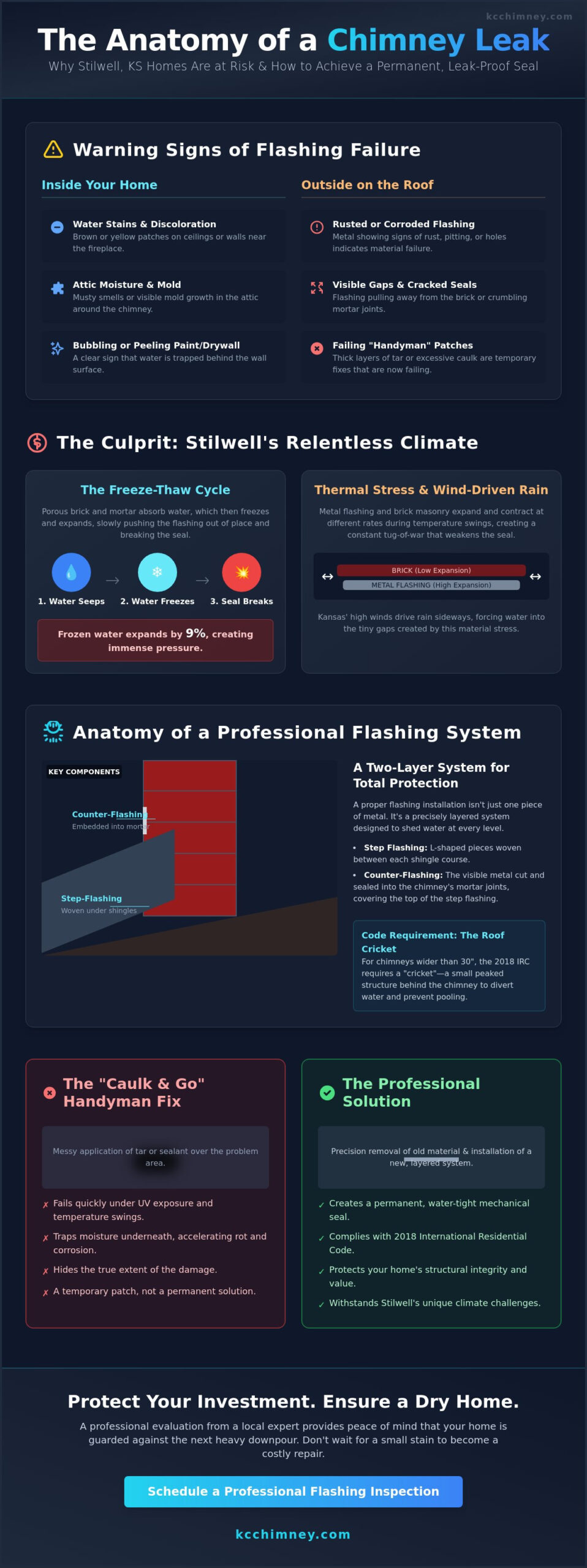
A proper flashing system actually consists of two layers. Step flashing is installed under the shingles; counter-flashing is the visible metal embedded into the masonry joints. You should check for loose counter-flashing that has pulled away from the brick. If the mortar joints where the metal is embedded are cracked or crumbling, water will bypass the metal entirely. You might also spot shingles that are lifting or “waving” around the chimney base. This usually happens when moisture gets trapped underneath the metal, causing the materials to expand and contract unevenly. If you see thick layers of black roofing tar, it is a sign that a permanent fix was skipped in favor of a temporary seal that is now failing.
Why Stilwell’s Climate Accelerates Chimney Flashing Damage
Stilwell’s climate isn’t just a backdrop for your home; it’s an active force that tests every exterior seal. When you need chimney flashing repair Stilwell KS, the culprit is often the relentless cycle of Kansas weather. Our region experiences extreme temperature swings that force materials to move in ways that standard roofing isn’t always designed to handle. Brick and stone homes, which are common in Stilwell, have high thermal mass. They hold heat and cold differently than the metal flashing attached to them, creating a constant tug-of-war at the seal.
The Freeze-Thaw Cycle and Masonry Expansion
Masonry is naturally porous. During a winter storm, snow melts and seeps into the small pores of your mortar and brick. When the temperature drops below freezing at night, that water turns to ice and expands by about 9 percent. This expansion creates internal pressure that slowly pushes the counter-flashing out of its designated masonry channel. Winter is the most common time for these seals to fail because the constant expansion and contraction creates new gaps for water to enter. This happens because the thermal expansion coefficient of metal is significantly higher than that of brick, causing the flashing to grow and shrink more aggressively than the chimney it protects.
Storm Season Stress in Johnson County
Spring in the KC metro area brings heavy, wind-driven rain that seeks out even the smallest weakness. While standard rain falls vertically, our high winds push water horizontally against the chimney stack. This pressure forces water behind old, brittle caulking that has lost its flexibility. If your chimney is wider than 30 inches, the 2018 International Residential Code adopted by Johnson County requires a roof cricket. This small, peaked structure sits behind the chimney to divert water around the stack, preventing a “dam” effect that would otherwise overwhelm the flashing. If you notice dampness after a storm, a Level 2 Inspection can help verify if your flashing or crown is the source of the leak.
Stilwell’s architectural styles often feature heavy limestone or deep-set brickwork. These textures are beautiful but require custom-bent flashing to ensure a tight fit. Unlike generic metal strips used by some contractors, professional chimney flashing repair Stilwell KS requires tailoring the metal to the specific contours of your masonry. Heavy humidity in the summer months further complicates things by accelerating oxidation. If your flashing wasn’t properly galvanized or treated, this moisture leads to rust that eats through the metal from the inside out, often hidden from view until the damage is significant.
Repair vs. Replacement: Finding the Right Solution
Deciding between a quick fix and a total overhaul depends on the physical integrity of the metal. If the flashing only shows surface debris or minor dirt, a thorough cleaning and professional resealing might suffice. However, if you see pitting, thinning, or actual holes, the protective galvanized layer has vanished. In these cases, chimney flashing repair Stilwell KS must shift toward a full replacement to ensure your home remains dry. We believe in doing the job right the first time, which means looking past the surface to see what the metal is actually telling us.
The Problem with Temporary Patching
Many homeowners fall into the “Caulk and Go” trap. Applying thick layers of roofing cement or silicone over existing leaks creates a short-term seal but leads to long-term headaches. These heavy patches trap moisture against the masonry rather than shedding it. Because the water can’t evaporate, it seeps into the brickwork. In our local climate, this trapped moisture causes spalling, where the brick face literally pops off due to internal pressure. If you see layers of black tar on your chimney, it’s a sign that a previous “repair” is likely hiding deeper structural decay. This is often where we integrate flashing work with expert chimney repair in Kansas City to address both the metal and the masonry integrity.
Criteria for Full Flashing Replacement
A full replacement becomes non-negotiable under several specific conditions. First, we must evaluate the condition of the underlying roof deck. If leaks have persisted, the wood beneath the shingles often rots, requiring structural attention before new metal can be safely installed. Second, if you’re investing in a new roof, it’s the only appropriate time to replace the step flashing. Reusing old, bent metal on a brand-new roof is a common mistake that leads to early failure. While standard aluminum is common, we often recommend custom-fabricated lead or copper for Stilwell homes. These materials are more malleable, which allows for a tighter fit against irregular stone or brick surfaces. They also offer superior longevity, often lasting decades longer than standard thin-gauge steel.
Choosing the right path requires an honest assessment of the current damage. A professional evaluation distinguishes between a simple maintenance task and a necessary investment in your property’s future. We prioritize durability over speed. This ensures that once the work is finished, you can listen to a thunderstorm without wondering where the water might be hiding.
Our Professional Process for Chimney Flashing Restoration
Restoring a chimney’s watertight integrity requires a methodical approach that goes beyond simply layering new metal over old. When we perform chimney flashing repair Stilwell KS, we follow a rigorous process designed to address the root cause of moisture entry. We begin with a multi-level safety evaluation to identify every leak source. This ensures we aren’t just treating a symptom while a larger structural issue remains hidden. Our team removes every trace of old, compromised flashing and cleans the masonry channels to create a pristine surface for the new installation.
Our restoration process includes these critical steps:
- Removal and Prep: We strip away failed sealants and rusted metal to expose the underlying roof deck and masonry.
- Step Flashing Installation: We interlace individual L-shaped metal pieces with your roofing shingles to create a shingled water-shedding effect.
- Reglet Cutting: We cut a precision groove into the mortar joints to house the new counter-flashing.
- Mechanical Bonding: The new metal is tucked into the masonry for a permanent, physical connection.
- High-Performance Sealing: We apply UV-resistant, industrial-grade sealants that remain flexible through years of temperature swings.
Step Flashing vs. Counter-Flashing
Effective chimney protection relies on a two-part system. Step flashing consists of L-shaped metal pieces that protect the junction where the roof meets the chimney wall. These pieces must overlap each shingle layer to direct water downward. Counter-flashing is the second layer that hangs over the step flashing. Counter-flashing must be embedded into the brick because surface-mounted metal relies entirely on caulk, which eventually peels away under the intense Kansas sun. The reglet method of flashing installation involves cutting a precision groove into the masonry joint to mechanically secure the metal’s top edge. This creates a “drip edge” that prevents water from ever reaching the roof-wall junction.
Masonry Integration and Sealing
Before we finalize any repair, we emphasize the importance of an expert chimney inspection in Kansas City. This step verifies that the masonry itself is sound enough to hold the new flashing. We select sealants specifically engineered for our regional climate. These materials maintain their bond during the transition from sub-zero winter nights to 100-degree summer days. We also pay special attention to the “shoulder” of the chimney. This is the sloped area where the chimney narrows. We ensure this area is properly shed-protected so water cannot pool and saturate the brickwork.
If you’ve noticed water stains or suspect your current seals are failing, don’t wait for the next storm to test your home’s defenses. You can schedule a Level 2 Inspection today to get a professional assessment of your chimney’s integrity.
Choosing Best Chimney Services for Your Stilwell Home
Selecting a partner for chimney flashing repair Stilwell KS involves more than just finding a contractor with a ladder. It’s about trusting your home to experts who understand the regional nuances of Johnson County architecture. Since 2012, Best Chimney Services has operated as a locally owned fixture in the community, prioritizing the safety and peace of mind of our neighbors. Our technicians are specifically trained in both masonry and fireplace safety, ensuring that every flashing restoration project protects the structural integrity of your entire chimney system. We also provide comprehensive maintenance, including chimney sweeping in Kansas City, to keep your hearth clean and functional year-round.
The Neighborly Approach to Stilwell Service
We’ve spent over a decade working on homes ranging from the historic Mt. Auburn area to the newer developments in suburban Stilwell. This local experience means we’ve seen how Kansas weather affects different brick types and roofing styles. We don’t believe in high-pressure sales tactics. Instead, we focus on protection and reliability. To ensure you feel confident in our recommendations, we document our findings using high-definition video and photos. You’ll see exactly what our technicians see, from rusted step flashing to cracked mortar joints, before any work begins. This transparency is a cornerstone of our service, providing you with a clear record of your home’s condition and the steps we take to secure it.
Our commitment to your home extends to how we work. We maintain a mess-free job site, using specialized drop cloths and dust containment systems to protect your property. We treat your house with the same care we’d give our own, ensuring that the only sign we were there is a chimney that no longer leaks. By focusing on long-term solutions rather than temporary patches, we help you avoid the cycle of repetitive, failing repairs that often plague homeowners in our area.
Schedule Your Stilwell Flashing Inspection
When you contact our team for a consultation, you can expect a no-nonsense evaluation of your chimney’s needs. We provide direct answers regarding repair timelines and the specific materials required for your home’s unique masonry. Whether you’re dealing with an active leak or want a professional verification of your flashing’s integrity, we’re here to help. Our process is methodical and thorough, mirroring the precision required by the 2018 International Residential Code standards we follow on every project. Don’t let a small gap in your flashing turn into a major interior renovation. Contact Best Chimney Services today to stop your chimney leak!
Secure Your Home Against the Next Kansas Storm
Protecting your home starts with recognizing that your chimney is more than just masonry; it’s a complex system that requires precise weatherproofing. You’ve learned how Stilwell’s unique climate stresses these seals and why temporary patches often lead to deeper structural rot. Investing in professional chimney flashing repair Stilwell KS ensures that your roof-to-wall junctions are mechanically sound and ready for the next heavy downpour. A permanent, leak-proof seal is the only way to avoid recurring water damage on your ceilings and walls.
Best Chimney Services has served Stilwell and the broader Johnson County area since 2012. Our team consists of Certified Chimney Safety Professionals who take pride in maintaining a 5-star local reputation on platforms like Angi and Google. We prioritize long-term durability and safety over quick sales. Ready to stop that leak for good? Request Your Stilwell Chimney Flashing Inspection today to gain the peace of mind that comes from a job done right. We look forward to helping you protect your home and your family.
Frequently Asked Questions
How much does chimney flashing repair typically cost in Stilwell, KS?
The total for chimney flashing repair Stilwell KS varies based on the chimney’s size and the specific materials required for the job. Since every home in Stilwell is unique, a professional inspection is the only way to determine the scope of work. Factors like roof pitch, the height of the stack, and the level of masonry decay will influence the final project requirements.
Can a roofer fix my chimney flashing or do I need a chimney sweep?
A chimney professional is typically the better choice for this task because they understand masonry bonds and fireplace safety. While roofers excel at shingle work, they often lack the specialized tools to cut reglets into brick or stone. A chimney expert ensures the metal is mechanically integrated into the masonry, which provides a more permanent seal than surface-mounted roofing patches.
How long does a professional chimney flashing repair last?
High-quality metal flashing can last between 20 and 40 years if it’s installed correctly by a specialist. However, the sealants used at the joints may require maintenance every 5 to 10 years due to the intense Kansas sun. Regular inspections help you catch minor sealant cracks before they turn into a full system failure that threatens your home’s interior.
What is the best material for chimney flashing in the Kansas City climate?
Lead and copper are the superior choices for the Kansas City climate because of their extreme durability and malleability. These metals allow for custom shaping around the irregular stone or brick surfaces common in Stilwell homes. Unlike thin aluminum or galvanized steel, these heavier metals don’t warp or rust as easily during our intense seasonal temperature shifts.
Will a leaking chimney flashing cause mold in my Stilwell home?
Persistent leaks from compromised flashing create an environment where mold can thrive in your attic or wall cavities. Moisture seeps into the insulation and wood framing surrounding the chimney stack where it stays trapped. If you don’t address the leak quickly, this hidden dampness can lead to poor indoor air quality and expensive remediation costs later on.
Do I need a chimney cap if my flashing is already being repaired?
You should consider a chimney cap even if your flashing is in perfect condition because they serve different protective roles. Flashing protects the junction where the chimney meets the roof, while a cap protects the top of the flue from rain and debris. Think of them as two different layers of armor that work together to keep your entire fireplace system dry.
Is chimney flashing repair covered by homeowners insurance in Kansas?
Homeowners insurance in Kansas typically covers flashing repairs only if the damage resulted from a sudden, covered peril like a hail storm or fallen tree. Standard wear, rust, or simple lack of maintenance are generally excluded from most policies. It’s best to review your specific policy or speak with your agent to see if a recent storm event qualifies you for a claim.