
Could routine cleaning damage your gas fireplace if you move a log or use the wrong glass cleaner? It can. Knowing how to clean a gas fireplace safely starts with understanding what not to disturb. If you’re unsure how to shut off the gas or pilot light, pause and follow the appliance manual before you begin.
You can clean a gas fireplace without taking on work that could damage the glass, ceramic logs, burner, or other components. This guide explains how to prepare the unit, which accessible surfaces you may be able to clean, and when to stop and call a trained technician.
The key is to follow the manufacturer’s instructions for your exact model, not a generic cleaning routine. If you notice a problem or the manual calls for service, Best Chimney Services provides gas fireplace maintenance and repair. Its CSIA-certified technicians serve homeowners across the Kansas City area and follow NFPA standards.
Key Takeaways
- Clean only the surfaces and parts your specific fireplace manual permits.
- Prepare carefully, and don’t disturb logs, burners, or other gas components unless the manual explicitly instructs you to.
- Use a visual check to spot signs that mean you should stop cleaning and seek professional service.
- Treat unusual odors, visible damage, or abnormal operation as reasons for caution, not DIY adjustment or repair.
- Best Chimney Services provides gas fireplace maintenance and repair for homeowners across the Kansas City area.
What Does It Mean to Clean a Gas Fireplace Safely?
Safe cleaning means following the steps the manufacturer allows for your specific appliance. A gas fireplace may have ceramic logs, decorative media, or an insert, and its vent configuration may also vary. These differences affect which parts you can access and how they should be handled. Don’t assume that a method suitable for one fireplace is right for another.
Surface cleaning removes dust or residue from owner-accessible areas; servicing involves inspecting, adjusting, or repairing operating components. Cleaning permitted surfaces doesn’t replace scheduled maintenance or an inspection. A fireplace can look clean and still need professional attention under its manufacturer’s instructions.
General descriptions of fireplace components can help explain how fireplaces are arranged, but they aren’t a cleaning guide for your unit. For how to clean a gas fireplace safely, use the appliance manual as your authority, not a generic method that may not match your model.
Which parts of a gas fireplace can a homeowner clean?
Limit DIY cleaning to exterior and accessible surfaces that the owner’s manual specifically permits. The instructions may treat the glass, surrounding trim, logs, and decorative media differently. Some surfaces may call for a particular cleaning method, while other parts should stay in place. Don’t move logs or media unless the manual explicitly directs you to. If the manual doesn’t clearly cover a surface or component, leave it untouched.
Why the appliance manual matters
Manufacturers set cleaning methods and restrictions for individual models. Find the fireplace’s make and model, then locate its owner’s manual. Check the cleaning section for approved surfaces, handling instructions, and warnings about components or products. Don’t assume another model’s instructions apply or that an online tip overrides the manual. If you can’t find clear guidance for a task, skip it and leave that work to a professional.
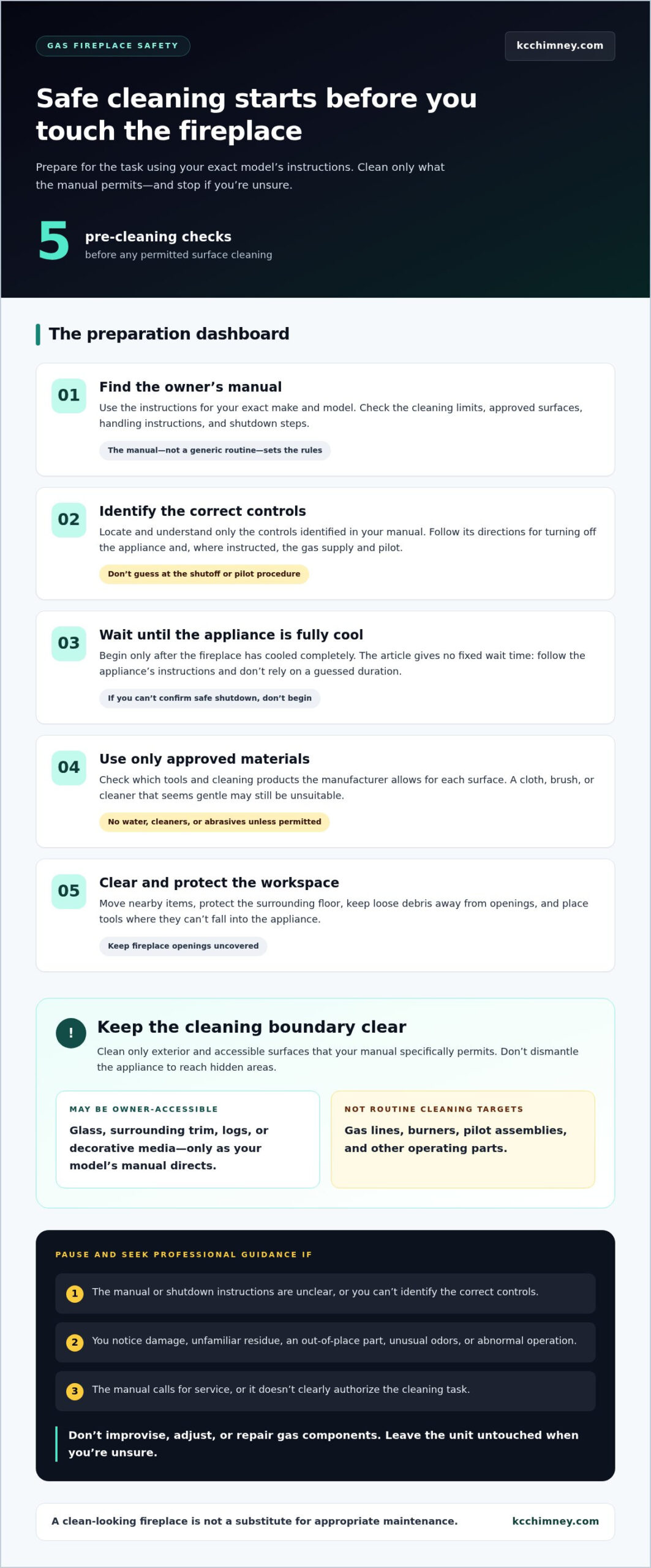
Keep the boundary simple: clean only what the manual identifies as homeowner-accessible, and don’t dismantle the appliance to reach hidden areas. Gas lines, burners, pilot assemblies, and other operating parts aren’t routine surface-cleaning targets. If you notice damage, residue you can’t identify, or a part that appears out of place, don’t try to correct it yourself. Stop and seek professional guidance. A clean-looking hearth is no substitute for appropriate maintenance.
Before Cleaning a Gas Fireplace: Prepare Safely and Know Your Limits
Before starting, confirm that the task is permitted for your model and that you can shut the appliance down exactly as its manufacturer directs. Gas fireplaces can have different controls and pilot arrangements, so don’t rely on a valve location or shutdown sequence you’ve seen on another unit. If you can’t identify the correct instructions, stop before touching the controls or opening the fireplace.
- Owner’s manual: Find the instructions for your exact make and model, including cleaning limits and shutdown steps.
- Controls: Locate and understand only the controls identified in the manual. Don’t guess at the gas shutoff or pilot procedure.
- Cool appliance: Wait until the fireplace is fully cool before beginning any permitted cleaning. Don’t rely on a fixed wait time.
- Approved materials: Gather only the tools and cleaning products the manufacturer allows for the surfaces you plan to clean.
- Clear workspace: Move nearby items out of the way and protect the surrounding floor without covering fireplace openings.
Shut down and cool the fireplace according to its manual
Use the model-specific directions to turn off the appliance and, where instructed, the gas supply and pilot. Controls and their locations vary, so don’t assume a shutoff valve is behind a particular panel or that every fireplace has the same pilot arrangement. Let the appliance become fully cool before cleaning. If instructions are unclear or a control looks damaged, don’t proceed. Leave the unit untouched and seek professional help.
Gather appropriate materials and protect the area
Check the manual before choosing cleaning materials. A cloth, brush, or cleaner that seems gentle may still be unsuitable for a particular surface or finish. Protect nearby flooring, keep loose debris away from openings, and place tools where they can’t fall into the appliance. Don’t apply water, cleaners, or abrasives to any component unless the manufacturer specifically permits it.
Read the instructions from start to finish before beginning, so you don’t discover a restriction halfway through the task. The Comprehensive Gas Fireplace Maintenance Guide offers broader maintenance context, but your own fireplace manual should govern its shutdown and cleaning procedures. If the manual calls for service or you’re unsure about a step, leave the work to a trained technician. Best Chimney Services provides gas fireplace maintenance in the Kansas City area.
How to Clean a Gas Fireplace Safely: A Careful Step-by-Step Routine
A safe routine is deliberately limited: follow your appliance manual, clean only the surfaces it identifies, and stop if anything looks damaged or unfamiliar. There isn’t one procedure that fits every gas fireplace. Use these steps only where they match your model’s instructions. If the manual doesn’t authorize a task, don’t improvise.
- Confirm shutdown and cooling. Check that the fireplace is off and fully cool, following the manual’s shutdown instructions for your specific model. Don’t assume the pilot, gas controls, or shutoff are arranged like those on another fireplace. If you can’t confirm the unit is safely shut down, don’t begin.
- Clean permitted surfaces only. Use only the tools and method approved for the areas you’re allowed to reach. For example, if the manual permits dusting an accessible surround, use the recommended tool gently and keep debris away from openings. Don’t remove a panel or part just to reach behind it.
- Inspect what you can see. Look for visible damage, unusual residue, or openings that appear blocked. Keep this check visual. Don’t poke into openings, test components, or try to clear anything inside the appliance.
- Restore the fireplace only as directed. Follow the manual for any permitted reassembly and for returning the unit to use. Don’t guess how a part fits or follow generic relighting instructions. If a component appears out of place, leave the fireplace off and arrange professional service.
Clean only the accessible areas approved for your model
Glass instructions can differ between fireplaces. Use only the cleaning method and products the manual permits. Ordinary household cleaners may be unsuitable for some glass or finishes. Logs and decorative media also have model-specific handling requirements. Don’t brush, wash, lift, or reposition them unless your manual explicitly allows or instructs that action. Take care not to shift anything while cleaning nearby surfaces.
Burner and gas-control work is not routine surface cleaning. Don’t remove or adjust burners, valves, pilot assemblies, or other gas components. A guide for another model doesn’t make that work appropriate for yours. If cleaning appears to require access to these parts, stop and leave the task to a trained professional.
Inspect visually and finish without guessing
As you finish, compare what you see with the manual’s instructions for restoring the fireplace. Don’t force a cover, log, or other part into place. If anything looks damaged, doesn’t fit correctly, or leaves you uncertain about whether the appliance is ready to use, keep it off and seek service. A cautious pause is safer than an improvised repair.
That boundary is central to how to clean a gas fireplace safely: complete only the owner-approved surface care, then leave servicing and repairs to a professional.
When Should You Stop Cleaning and Call a Gas Fireplace Professional?
Stop if you notice a warning sign, can’t confirm the fireplace is safely shut down, or aren’t sure what you’re seeing. Don’t try to solve a possible gas or appliance problem by relighting the unit, adjusting a control, or taking parts apart. A symptom alone may not reveal the cause, but it is reason enough to pause cleaning and avoid using the fireplace until the concern has been assessed.
- Unusual odor: Stop work if you notice an unexpected smell near the appliance. If you suspect a gas leak, leave the area and contact emergency services or your gas utility from a safe location. Don’t operate fireplace controls or try to identify the source yourself.
- Visible damage or deterioration: Cracked, displaced, or visibly deteriorated parts warrant professional attention. Don’t attempt to reposition or repair them.
- Abnormal operation: Stop if the fireplace behaves differently than usual or develops a recurring operating problem. Don’t repeatedly restart it to see whether the issue goes away.
- Uncertainty about shutdown: If the instructions aren’t clear or a control appears damaged, leave the appliance alone and seek help.
Warning signs that need professional attention
Keep your check observational. You can notice a change, such as a damaged-looking component, unusual residue, or a recurring issue, without diagnosing its cause. Don’t probe openings, adjust parts, or use cleaning to test whether the fireplace works properly. If you’re unsure whether it’s safe to operate, leave it off. Best Chimney Services’ gas fireplace repair guide explains how repair concerns differ from routine owner care.
Cleaning is not a substitute for inspection or repair
Wiping an approved surface can improve its appearance, but it can’t assess hidden components or correct abnormal operation. Surface cleaning and professional service have different purposes. Follow the owner’s manual for any maintenance it calls for, and arrange service if you find a concern or the fireplace isn’t operating as expected. A chimney inspection is a separate evaluation, not an automatic add-on to every cleaning task. The Kansas City chimney inspection guide provides more context.
The goal of learning how to clean a gas fireplace safely is also knowing when to stop. If a warning sign appears, don’t relight, adjust, or repair the appliance yourself. Best Chimney Services provides gas fireplace repair.
Keep Your Gas Fireplace Ready With Professional Kansas City Service
Owner cleaning has a clear limit: it can care for approved surfaces, but it can’t replace maintenance or repair when the appliance needs attention. If the manual calls for service, you notice a concern during cleaning, or the fireplace isn’t operating as expected, a professional can take the next step. Knowing how to clean a gas fireplace safely includes recognizing when the work goes beyond what a homeowner should handle.
What professional gas fireplace service can address
Best Chimney Services provides gas fireplace maintenance and repair, including service for gas logs and gas inserts. The company also installs gas logs and gas fireplace inserts. A technician can address concerns that aren’t appropriate for surface cleaning, such as a component that appears damaged or operation that seems abnormal, without asking you to dismantle or adjust gas controls yourself. The work needed depends on the fireplace and the concern.
If the issue relates to the chimney, an inspection may be relevant as a separate service. Best Chimney Services uses advanced video inspections in chimney inspection work where relevant. That’s distinct from cleaning a fireplace’s accessible surfaces, and it doesn’t mean every cleaning task calls for an inspection or repair.
Local fireplace care across the Kansas City area
Best Chimney Services is locally owned and operated, serving homeowners and businesses in Johnson and Miami counties, Kansas, and the greater Kansas City metro. Homeowners in Overland Park, Mission Hills, Stilwell, Bucyrus, and Spring Hill can turn to local support when cleaning uncovers a concern or the appliance manual calls for professional care. The company also serves Leawood and Olathe.
Technicians are CSIA-certified, and the company follows NFPA standards. Transparent pricing with no hidden fees helps homeowners understand the work being considered before service begins. Clear communication supports informed decisions about the fireplace concern.
A clean exterior is a useful part of fireplace care, but it’s only one part. If your manual calls for maintenance, or you’ve noticed a change that makes you unsure about using the appliance, leave it off and arrange professional help rather than experimenting with components. Best Chimney Services provides gas fireplace maintenance, repair, and installation across the Kansas City area.
For local fireplace care, explore Best Chimney Services and learn about support for Kansas City-area homeowners.
Make Fireplace Care Part of Your Home Routine
Keep the appliance’s manual with your home records, and note any change in appearance or operation so you can describe it clearly if you need professional help. A simple record can help you discuss maintenance without guessing at a fix or taking on work beyond your comfort level.
Knowing how to clean a gas fireplace safely isn’t about doing every task yourself. It’s about caring for what the manufacturer permits and recognizing when a trained technician should take over. Best Chimney Services’ homepage displays 184 Google reviews, offering homeowners another point of reference as they consider fireplace care.
If your fireplace needs professional attention, explore fireplace service from Best Chimney Services for support in the Kansas City area. A careful approach today can help you feel more prepared for the next heating season.
Frequently Asked Questions
Can I clean a gas fireplace myself?
You can clean only the accessible surfaces and parts your specific appliance manual permits. First follow its shutdown instructions and let the fireplace cool completely. Do not assume logs, glass, burners, or decorative media can be removed or cleaned the same way across models. If the manual is unclear, a component is damaged, or operation seems abnormal, stop and arrange professional service. That boundary is central to how to clean a gas fireplace safely.
Should I turn off the gas before cleaning a gas fireplace?
Follow the shutdown and gas-supply instructions in the owner’s manual for your exact fireplace. Gas controls and pilot arrangements vary, so do not assume the valve location or use a generic procedure. Make sure the appliance is fully cool before permitted cleaning. If you cannot confidently identify the correct controls, do not start cleaning or attempt to relight the fireplace. Keep the manual nearby so you can refer to the correct steps as you prepare.
Can I remove gas fireplace logs to clean them?
Only remove logs if the manufacturer’s instructions for your specific model explicitly allow it and explain how to do so. Log placement can be appliance-specific, so moving pieces without guidance may affect correct operation. Do not handle burners, valves, or pilot components as part of routine cleaning. If logs are damaged or their placement is uncertain, leave them undisturbed and contact a fireplace professional. A photo of the arrangement may help you describe what you noticed without touching the logs.
What should I use to clean gas fireplace glass?
Check the owner’s manual before cleaning glass because approved methods and products can differ by model and glass type. Let the fireplace cool completely and follow the manufacturer’s directions. Do not assume household glass cleaner, abrasive pads, or water are suitable. If the glass is cracked, loose, or otherwise damaged, do not use the fireplace until a qualified professional has assessed it. If the manual is missing, identify the appliance model before choosing a cleaning method.
How often should I clean my gas fireplace?
Follow the maintenance schedule in the owner’s manual because cleaning needs and recommended intervals vary by appliance and use. Dust on accessible surfaces can be addressed when the manufacturer’s instructions permit, but surface cleaning is not a substitute for professional maintenance. Schedule fireplace maintenance annually. Schedule sooner if you notice damage, unusual odors, or abnormal operation. Keep a note of the date of any cleaning or service for your household records.
When should I call a professional instead of cleaning my gas fireplace?
Stop and seek professional help if you notice unusual odors, visible damage, abnormal operation, or uncertainty about shutting down or cleaning the appliance safely. Do not probe, adjust, or repair gas components as a DIY task. Best Chimney Services installs, repairs, and maintains gas logs and gas inserts in its Kansas City service area. Use the exact appliance manual for routine owner care. Service areas include Overland Park, Mission Hills, Stilwell, Bucyrus, and Spring Hill, Kansas.