
Can chimney maintenance help keep carbon monoxide out of your home? It can support safe venting, but it can’t eliminate every carbon monoxide risk. For Bucyrus homeowners, chimney maintenance to prevent carbon monoxide means keeping the flue clear and in sound condition while also maintaining working carbon monoxide alarms. A blockage, damaged liner, or masonry problem can interfere with exhaust venting, and some concerns aren’t easy to spot from the hearth.
It can be hard to know when a chimney needs cleaning or inspection, especially before fireplace season. Freeze-thaw cycles can also put stress on chimney masonry, so visible damage or changes in fireplace performance deserve attention. Best Chimney Services provides chimney sweeping and inspections in Bucyrus, Overland Park, Mission Hills, Stilwell, and Spring Hill. Inspections can include specialized video equipment to help identify concealed concerns.
This guide explains how a clear, sound flue supports safe exhaust flow, which warning signs need prompt attention, and how to plan maintenance and professional inspections. You’ll also learn why chimney care works alongside, not in place of, carbon monoxide alarms and immediate action if an alarm sounds.
Key Takeaways
- A clear, sound flue helps fireplace exhaust leave the home. Chimney maintenance to prevent carbon monoxide in Bucyrus is one part of a broader home-safety plan.
- Obstructions, heavy deposits, liner damage, and deteriorating masonry are concerns a professional chimney inspection can assess.
- Chimney sweeping removes deposits and debris. An inspection evaluates the chimney’s condition, and video equipment can help examine concealed areas.
- Follow your carbon monoxide alarm manufacturer’s instructions for placement, testing, and replacement. Treat an alarm as an urgent warning.
- Build a practical maintenance routine and learn when Best Chimney Services’ sweeping, inspection, or video inspection can help assess your chimney.
How Chimney Maintenance Supports Carbon Monoxide Safety in Bucyrus
Carbon monoxide (CO) is an odorless, potentially dangerous gas created when fuel doesn’t burn completely. Because you can’t rely on smell to detect it, a fireplace and chimney need to vent combustion gases outdoors, and working CO alarms need to warn household members if the gas is detected. Chimney care is one part of that safety picture. It doesn’t replace alarms or attention to other fuel-burning equipment.
How a chimney helps move combustion gases outdoors
The flue is the passage inside a chimney that carries smoke and other combustion products outside. As warm gases rise, the chimney’s draft helps draw them upward and out. A blockage, damaged flue, or condition that weakens the draft can interfere with that flow and allow exhaust to spill back into the living space. For a basic overview of chimney parts and how they work, see What is a Chimney?
Venting and detection serve different purposes. A sound, unobstructed chimney helps move exhaust outdoors; a CO alarm detects carbon monoxide in the home and warns occupants. Neither function replaces the other. Keep alarms working and follow the manufacturer’s instructions for placement, testing, and replacement.
What chimney maintenance can and cannot do
A professional inspection can assess the chimney’s visible condition and identify concerns such as obstructions, deterioration, or signs of venting trouble. Specialized video equipment can help examine areas of the flue that aren’t easy to see from the fireplace opening. Sweeping removes applicable deposits and debris, but it doesn’t repair a damaged liner or address every possible source of carbon monoxide.
Chimney maintenance supports safe venting, but it cannot eliminate every carbon monoxide hazard. That distinction matters when planning chimney maintenance to prevent carbon monoxide in Bucyrus as one layer of protection. Inspection and sweeping address chimney-related concerns; properly maintained alarms provide a separate warning if CO is present. Problems with other fuel-burning appliances may also need attention beyond chimney care.
If your fireplace is venting poorly or you’re concerned about the chimney’s condition, arrange an inspection rather than relying on appearance alone. Best Chimney Services provides chimney inspections and sweeping in Bucyrus, helping homeowners understand what their chimney needs before continued use.
Which Chimney Problems Can Raise Carbon Monoxide Concerns in Bucyrus?
A chimney-related carbon monoxide concern often starts with a venting problem, but you can’t confirm the cause by looking at the fireplace or judging how it burns. A flue may be partly blocked, deposits may narrow the passage, or damage may affect the liner or masonry. These conditions deserve professional assessment because anything that interferes with exhaust flow can affect how combustion gases leave the home.
Obstructions, buildup, and flue damage
Nests, leaves, and other debris can obstruct a flue. Creosote and other deposits may also accumulate, especially in wood-burning systems. A cracked or deteriorating liner can be difficult to spot from the firebox, while damaged masonry can signal that the chimney needs attention. Seasonal freeze-thaw exposure can stress masonry over time, so visible cracking or crumbling shouldn’t be ignored.
A professional chimney inspection can assess these concerns and determine whether sweeping, repair, or further evaluation is appropriate. The Kansas City chimney inspection guide explains what an inspection can help uncover. NFPA 211 addresses chimney and venting safety; homeowners can review the NFPA 211 safety standards for more background.
Not every fuel-burning appliance vents through a masonry chimney. A wood fireplace, gas fireplace, furnace, and water heater may use different venting arrangements and have different service needs. A chimney inspection focuses on the chimney and its venting pathway, so it shouldn’t be treated as an assessment of every appliance in the home.
Warning signs that call for immediate attention
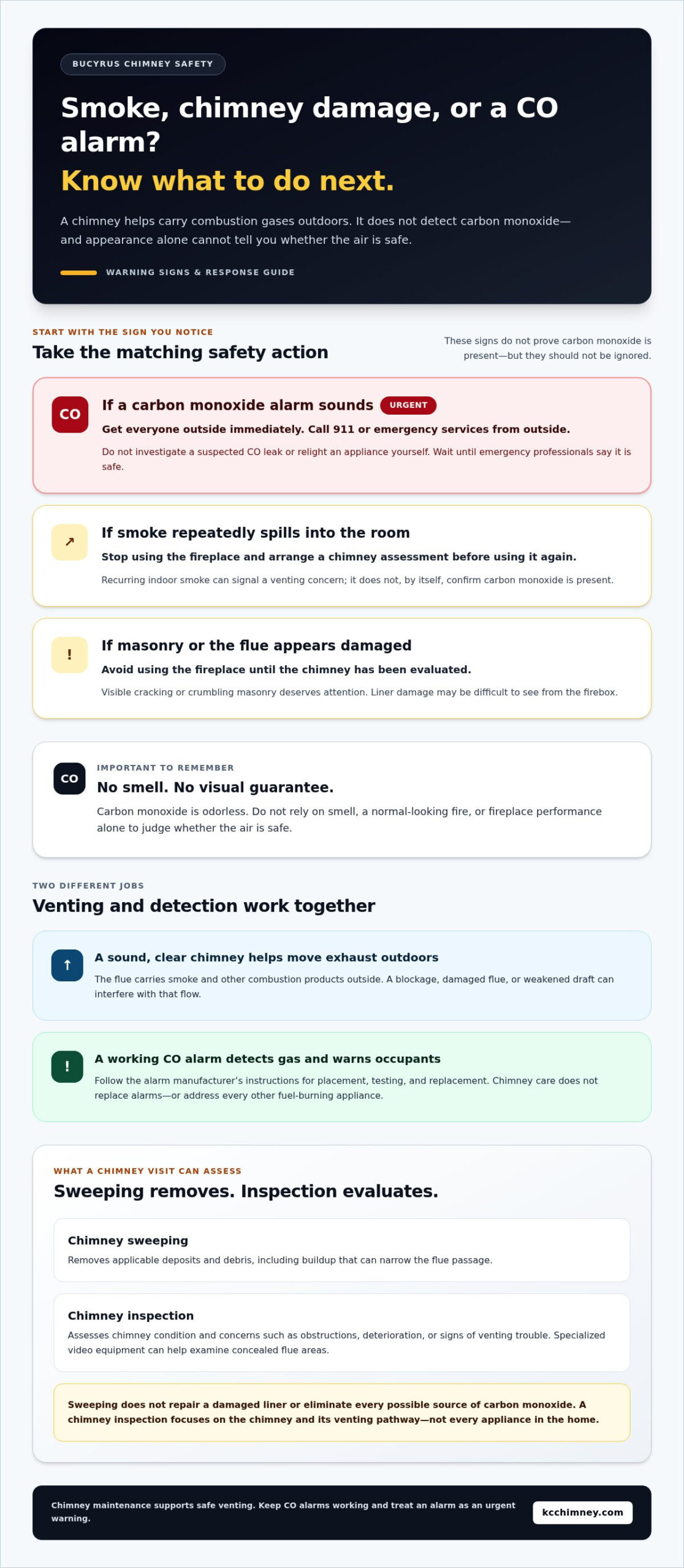
Recurring smoke spilling into the room, unusual appliance operation, or visible chimney damage calls for a pause and closer assessment. These signs don’t prove carbon monoxide is present, and normal-looking operation doesn’t prove the air is safe. Since carbon monoxide has no odor, don’t rely on smell, appearance, or fireplace performance alone to judge the risk.
- If a CO alarm sounds, get everyone outside immediately and call 911 or emergency services from outside.
- If smoke repeatedly spills indoors, stop using the fireplace and arrange a chimney assessment before using it again.
- If you see damaged masonry or suspect flue damage, avoid using the fireplace until the chimney has been evaluated.
Don’t relight an appliance or investigate a suspected carbon monoxide leak yourself. Wait until emergency professionals say it’s safe. For Bucyrus homeowners, a measured approach to chimney maintenance means responding promptly to warning signs and arranging an inspection to understand the chimney’s condition. Best Chimney Services provides chimney inspections and sweeping in Bucyrus, as well as Overland Park, Mission Hills, Stilwell, and Spring Hill.
Chimney Sweeping vs. Inspection: What Bucyrus Homeowners Need
Sweeping and inspection are related parts of chimney care, but they answer different questions. Sweeping removes applicable deposits and debris. An inspection evaluates the chimney’s condition and can identify concerns that cleaning alone won’t resolve. If you’re planning chimney maintenance to prevent carbon monoxide in Bucyrus, knowing the difference helps match the next step to your chimney’s needs.
| Service | What it addresses | What it helps reveal or do |
|---|---|---|
| Chimney sweeping | Applicable deposits and debris inside the chimney | Removes buildup that may obstruct the flue; it doesn’t assess every part of the chimney’s condition. |
| Visual inspection | Accessible chimney and venting components | Assesses visible condition and can identify signs of damage or other concerns needing follow-up. |
| Camera-assisted inspection | Portions of the flue that are difficult to see directly | Uses specialized video equipment to examine concealed areas and help assess their condition. |
What a chimney sweep and inspection each address
A sweeping visit may involve removing applicable deposits and debris. The work depends on the chimney’s condition and needs. An inspection is a condition assessment, not simply another name for cleaning. It focuses on accessible components and visible signs that could affect safe use or venting. Best Chimney Services provides both chimney sweeping and inspections for Bucyrus homes. For more homeowner guidance, see the Kansas City chimney sweeping safety guide.
Cleaning removes buildup; inspection evaluates condition. One may be needed without the other, and a professional assessment can help determine whether both are appropriate. Neither should be treated as a guarantee against carbon monoxide.
When a closer inspection may be appropriate
Changes in fireplace operation, suspected flue or liner damage, visible deterioration, or an incident affecting the chimney may call for a closer assessment. A camera-assisted inspection can help examine areas that aren’t readily visible, but the appropriate inspection scope depends on the observed conditions. The goal is to understand what the chimney needs, not to assume every home requires the same level of evaluation.
For Bucyrus homeowners, a professional inspection can pair a visual assessment with specialized video equipment when useful. This provides clearer information about chimney condition and helps guide the next maintenance or repair decision.
A Practical Carbon Monoxide and Chimney Maintenance Plan for Bucyrus
A steady routine helps keep chimney care and carbon monoxide protection working together. There’s no single schedule that fits every fireplace or venting system, so base maintenance on the appliance, chimney condition, and professional findings rather than relying on a fixed interval. These steps give Bucyrus homeowners a practical place to start.
A step-by-step safety routine before fireplace use
- Check your carbon monoxide alarms. Follow the manufacturer’s instructions for placement, testing, and replacement. Don’t assume an alarm is working simply because it looks intact.
- Arrange chimney inspection and sweeping as conditions warrant. An inspection assesses the chimney’s condition, while sweeping removes applicable deposits and debris. Seek professional assessment if you notice visible damage, a suspected obstruction, or changes in fireplace operation.
- Address identified defects before using the fireplace. Have chimney concerns evaluated and resolved as appropriate. Use the fireplace and other fuel-burning appliances according to their manufacturers’ instructions.
Inspection findings can help clarify what comes next. A clear flue doesn’t rule out every possible hazard, and an alarm doesn’t replace chimney care. For Bucyrus homeowners, these measures work together as complementary layers of protection.
What to do if an alarm sounds or symptoms appear
If a carbon monoxide alarm sounds, take it seriously. Get everyone outside immediately, then call 911 or emergency services from outdoors. Don’t re-enter until emergency responders say it’s safe. Don’t try to locate the source or restart an appliance while a possible CO hazard is being assessed.
Headache, dizziness, nausea, and confusion can be possible symptoms of carbon monoxide exposure, but they don’t confirm the cause. If anyone feels unwell, leave the home and seek emergency help rather than trying to diagnose the problem indoors. Protecting people comes first; chimney troubleshooting can wait until the home is cleared as safe.
For routine concerns, such as suspected flue damage or recurring changes in fireplace operation, pause use and arrange a professional chimney assessment before lighting another fire. Best Chimney Services provides chimney sweeping and inspections for Bucyrus homeowners, with video inspection equipment to help assess concealed areas of the flue. Arrange a professional chimney inspection to better understand your chimney’s condition.
Professional Chimney Maintenance for Bucyrus Homes: Your Next Step
Routine chimney care helps you understand whether the flue and accessible chimney components are ready for use. If the chimney hasn’t been assessed recently, arranging an inspection before seasonal fireplace use can provide a clearer picture of its condition. Suspected damage, an obstruction, or unusual fireplace operation calls for prompt professional attention. Keep the fireplace unused until it’s assessed.
What to expect from a professional chimney visit
A professional visit can include an assessment of accessible chimney components and visible concerns affecting the venting system. Best Chimney Services provides chimney sweeping and inspections in Bucyrus, and specialized video equipment can help technicians examine portions of the chimney interior that aren’t easy to see directly. Recommendations depend on observed conditions. An inspection or cleaning supports informed maintenance, but it can’t guarantee protection from every carbon monoxide hazard.
Best Chimney Services is locally owned and operated, and its certified technicians serve Bucyrus homeowners as well as homeowners in Overland Park, Mission Hills, Stilwell, and Spring Hill. If an inspection identifies damage that needs repair, the next steps depend on the specific findings. The Kansas City chimney repair guide offers further information about addressing chimney repair needs.
When Bucyrus homeowners should schedule service
Consider scheduling an assessment if you’re unsure when the chimney was last inspected, especially before putting a fireplace back into seasonal use. Don’t wait for a routine appointment if you suspect a blockage or damage, or notice unusual operation. Pause fireplace use and arrange a professional evaluation so concerns can be assessed before the appliance is used again.
A carbon monoxide alarm changes the priority. Leave the home immediately and call 911 or emergency services from outside. Don’t re-enter until responders say it’s safe. Chimney maintenance is important, but an alarm requires urgent action, not a routine service appointment.
For Bucyrus homeowners, chimney maintenance to prevent carbon monoxide means pairing professional chimney care with working CO alarms and safe appliance use. Best Chimney Services can assess chimney condition through sweeping, inspection, and video inspection. Arrange chimney maintenance with Best Chimney Services for a clear, practical next step.
Make Chimney Care Part of Your Home Safety Plan
A clear, well-maintained flue supports safe exhaust venting. Sweeping and inspection serve different purposes: sweeping removes applicable deposits and debris, while inspection assesses chimney condition. Working carbon monoxide alarms remain essential because chimney care can’t eliminate every CO hazard.
For Bucyrus homeowners, a practical approach to chimney maintenance means keeping alarms maintained, arranging professional attention when the chimney needs assessment, and addressing identified concerns before using the fireplace. Best Chimney Services is a locally owned and operated Kansas City metro business. Its certified technicians serve Bucyrus, Overland Park, Mission Hills, Stilwell, and Spring Hill with chimney sweeping and inspections, and specialized video equipment can help assess the chimney interior.
If you’re unsure about your chimney’s condition or have noticed a change in fireplace operation, arrange an assessment. Schedule professional chimney maintenance for your Bucyrus home and take a clear, practical step toward caring for your chimney before fireplace season.
Frequently Asked Questions
Can chimney maintenance prevent carbon monoxide in my home?
Chimney maintenance can reduce some chimney-related venting risks, but it can’t prevent every source of carbon monoxide or guarantee a home is CO-free. A clear, sound flue helps fireplace exhaust move outdoors, while an inspection can identify chimney concerns that need attention. Keep working carbon monoxide alarms in your home and follow the manufacturers’ instructions. For Bucyrus households, chimney maintenance to prevent carbon monoxide is one layer of a broader safety plan.
Can a chimney sweep detect carbon monoxide?
A chimney sweep assesses the chimney and may identify conditions that could affect venting, such as deposits, debris, or visible damage. That work is different from detecting carbon monoxide in the air. A working CO alarm is designed to alert occupants when it detects the gas. If an alarm sounds, leave the home and call emergency services from outside. Don’t rely on a chimney inspection or your senses to determine whether CO is present.
How often should a chimney be inspected in Bucyrus, Kansas?
There isn’t one timing recommendation that fits every chimney and appliance. Arrange an inspection if you’re unsure when the chimney was last assessed, before using a fireplace after a period of disuse, or if you notice damage, blockage, or unusual operation. A professional can assess the chimney’s condition and suggest next steps based on what’s observed. Bucyrus homeowners can also ask local authorities about any applicable local requirements.
What should I do if my carbon monoxide alarm sounds?
Get everyone outside immediately and call 911 or emergency services from outdoors. Don’t stay inside to look for the source, silence the alarm, or restart an appliance. Don’t re-enter until emergency responders say it’s safe. Headache, dizziness, nausea, or confusion can be possible symptoms of CO exposure, but don’t try to diagnose the cause yourself. Treat the alarm as an urgent warning even if no one feels unwell.
Can a blocked chimney cause carbon monoxide to enter a home?
A blocked chimney can interfere with the movement of combustion exhaust and may contribute to exhaust spilling into the home. Nests, debris, or deposits can restrict airflow, while damage elsewhere in the venting system may also affect performance. You can’t confirm a CO hazard from smoke patterns or fireplace appearance alone. Stop using the fireplace if you suspect a blockage, and arrange professional assessment before using it again.
Do gas fireplaces need chimney maintenance too?
Gas fireplaces need care for their specific appliance and venting system. Some vent through a chimney, while others use a different arrangement, so the right assessment depends on the installation. Follow the appliance manufacturer’s use and maintenance instructions, and arrange a professional chimney inspection if the unit vents through a chimney or you notice unusual operation. Chimney care doesn’t replace service needs for other fuel-burning appliances or working CO alarms.
Does chimney sweeping guarantee protection from carbon monoxide?
No. Sweeping removes applicable deposits and debris, but it doesn’t repair every defect or assess every possible source of carbon monoxide. An inspection evaluates chimney condition and can help identify concerns that cleaning alone won’t address. Keep carbon monoxide alarms working, follow appliance instructions, and respond promptly to an alarm. Best Chimney Services provides chimney sweeping and inspections for homeowners in Bucyrus and nearby Kansas City metro communities.