
Choking down your air intake before bed won’t guarantee an all-night burn; it usually just smothers your fire and coats your flue in dangerous creosote. True efficiency comes from high fuel density and progressive airflow throttling, not starving combustion air. For homeowners focused on optimizing wood insert burn time Bucyrus winters demand a precise approach, especially when January temperatures drop into the teens and exterior masonry chills your chimney draft.
You already know how frustrating it is to pack your firebox at midnight only to wake up to a freezing living room, soot-stained glass, and a bed of cold ash. You want dependable, steady warmth that protects your home without creating a hidden chimney fire hazard. In this guide, you’ll master the firewood selection standards, dense loading arrangements, and air control adjustments required to achieve consistent 8-to-10-hour burns with glowing coals ready every morning. We’ll walk through the practical operating habits and maintenance checks that help you extract maximum heat from every cord while keeping your system safe and clean.
Key Takeaways
- Understand how modern secondary combustion works so you can measure true room heating through prolonged coaling cycles rather than visible flames alone.
- Discover why optimizing wood insert burn time Bucyrus homes require depends on selecting dense local hardwoods tested strictly below 20% internal moisture content.
- Master the dense loading technique and progressive draft throttling process that sustains steady warmth for 8 to 10 hours overnight.
- Pinpoint draft leaks, worn door gaskets, and exterior chimney chill factors that cause firewood charges to burn out prematurely.
- Learn how annual flue sweeps and safety inspections safeguard internal secondary air tubes and prevent hazardous glazed creosote buildup.
Understanding Wood Insert Combustion and Burn Cycles in Bucyrus
Getting a long, steady burn from your fireplace insert starts with understanding how modern sealed combustion works. Unlike traditional open fireplaces that pull heated room air up the chimney, modern inserts function inside an airtight firebox engineered to extract every available BTU. For local homeowners, optimizing wood insert burn time Bucyrus winter nights require means understanding that true burn time isn’t measured solely by dancing flames. A proper burn cycle includes the extended charcoal coaling phase, which delivers radiant heat long after the visible flames subside.
Many rural properties around Bucyrus feature exterior masonry chimneys exposed to sweeping prairie winds. These uninsulated brick columns create intense draft resistance when cold, pulling heat out of the flue and complicating airflow control. Balancing internal draft prevents the fire from burning out in two hours while stopping dangerous, low-temperature smoldering.
How EPA-Certified Inserts Extend Combustion Efficiency
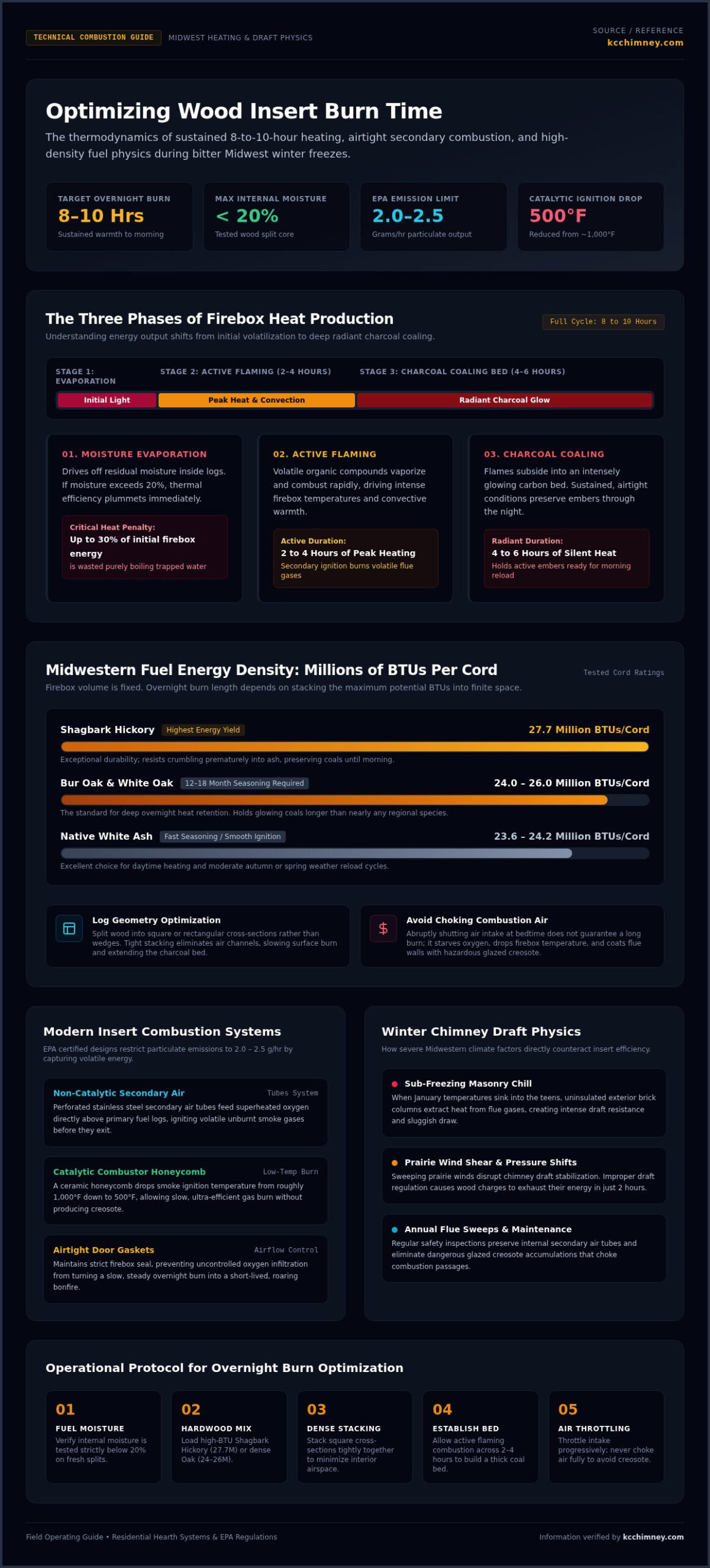
Current EPA regulations restrict particulate emissions to 2.0 to 2.5 grams per hour, driving remarkable advancements in insert engineering. Inside modern non-catalytic units, perforated stainless steel secondary air tubes introduce superheated oxygen directly above the primary logs. This ignites volatile smoke gases that traditional fireplaces waste up the flue. In catalytic designs, a ceramic honeycomb combustor drops the ignition point of those gases from roughly 1,000°F down to 500°F. By referencing basic wood-burning stove combustion mechanics, you can see how airtight door gaskets preserve this delicate environment, keeping stray oxygen from turning a steady overnight burn into a roaring, short-lived bonfire.
The Three Phases of Firebox Heat Production
Every load of hardwood moves through three distinct combustion stages:
- Moisture Evaporation: The initial stage drives off residual moisture. If your wood holds excessive moisture, the firebox expends up to 30% of its initial energy boiling water rather than heating your living space.
- Active Flaming Combustion: Volatile organic compounds vaporize and ignite, delivering peak firebox temperatures and vigorous convective heat across the first two to four hours.
- Charcoal Coaling: Once the flames die down, the remaining carbon bed enters a deep charcoal glow. In an airtight system, this stage radiates sustained, quiet warmth for four to six hours.
Mastering this progression is essential for optimizing wood insert burn time Bucyrus properties need against bitter seasonal cold, turning a stubborn firebox into a reliable, all-night heating source.
Selecting and Preparing Midwestern Hardwoods for Extended Burns
Your insert firebox has a fixed volume. To stretch your heating cycle across eight to ten hours, you have to pack the greatest number of potential BTUs into that finite physical space. Lightweight softwoods burn up too rapidly to sustain an overnight coaling bed, making species selection critical. For homeowners dedicated to optimizing wood insert burn time Bucyrus woodlots offer some of the most energy-dense fuel in the Midwest.
Log geometry matters just as much as species weight. Splitting wood into square or rectangular cross-sections lets you stack pieces tightly with minimal airspace between them. Tightly packed charges slow down surface combustion and prolong the charcoal phase, keeping thermal energy in your living area rather than rushing up the flue.
Best Local Firewood Species: Oak, Hickory, and Ash
Not all hardwoods perform equally when you need sustained overnight warmth:
- Bur Oak and White Oak: Delivering roughly 24 to 26 million BTUs per cord, these slow-growing oaks represent the standard for overnight heating. They require 12 to 18 months of seasoning, but they hold coals longer than almost any other regional hardwood.
- Shagbark Hickory: Clocking in around 27.7 million BTUs per cord, hickory produces an exceptionally hot, durable ember bed. It resists crumbling to ash prematurely, ensuring glowing coals remain by morning.
- Native White Ash: With roughly 23.6 to 24.2 million BTUs per cord, ash seasons faster than oak and ignites smoothly. It makes an outstanding choice for daytime reloading or moderate autumn and spring weather.
Testing and Stacking Wood for Peak Performance
Even the densest hickory fails if it contains high internal moisture. Waterlogged wood wastes heat boiling off sap, dragging firebox temperatures below the threshold needed for clean secondary combustion. Following established EPA Burn Wise best burn practices, always confirm your firewood tests below 20% moisture before loading. Don’t measure the weathered bark or the end grain; split a test piece in half and press the pins of a digital moisture meter firmly into the fresh internal center.
Stack your split wood off the damp ground on elevated stringers or pallets. Position piles perpendicular to prevailing winds so air circulates freely between the rows. Cover only the top face of the stack with a tarp or metal roofing, leaving the cut sides open to accelerate ambient evaporation. If your system still struggles to sustain long burns despite seasoned wood, having certified wood fireplace insert specialists evaluate your draft pressure and flue liner condition can pinpoint hidden airflow issues.
Guide: Loading and Air Management for Overnight Burns
Loading your firebox right before bedtime requires patience. Simply tossing cold logs onto fading ash and sliding the damper shut creates an incomplete burn that cakes your flue in soot. Establishing an eight-hour burn demands a structured routine where temperature and airflow work together. For anyone serious about optimizing wood insert burn time Bucyrus winter conditions require disciplined air management to prevent the draft from dying mid-cycle.
Your goal is to transition the insert into secondary combustion before you walk away. Once volatile gases catch fire above the wood load, the unit operates efficiently with minimal incoming oxygen, maintaining clean heat without rapid fuel consumption.
Building the Foundation: The Charcoal Bed Raking Method
Never add fresh wood over scattered ashes. Use a fire iron to pull hot embers forward into a concentrated mound directly behind the primary air boost opening at the front hearth. This concentrates incoming air onto the coals, creating an immediate forge effect. Place your largest, densest hardwood splits along the back and bottom of the chamber. Pack subsequent pieces tightly beside and above them, minimizing gaps. Consulting regional hardwood heat values and seasoning guidelines helps you select the dense oak or hickory best suited for this bottom layer, ensuring the fire burns slowly from front to back rather than engulfing the entire stack at once.
The 45-Minute Progressive Damper Schedule
Managing primary air is a three-step protocol that stabilizes the firebox:
- Minutes 0 to 15 (Initial Charring): Open the bypass damper and leave primary air completely wide open. Let energetic flames fully char the outer surfaces of all new logs until the flue collar thermometer reaches 400°F to 500°F.
- Minutes 15 to 30 (Secondary Transition): Close the bypass damper. Push the primary draft control halfway down. Watch for rolling blue and yellow flames dancing near the baffle board or secondary air tubes.
- Minutes 30 to 45 (Overnight Cruising): Step the air slide down to its final low setting in small quarter-inch increments. The flames should become lazy and slow, but they must not extinguish completely. If the firebox gets dark or smoky, reopen the draft slightly for ten minutes before settling back down.
Managing Blower Fan Speeds for Maximum Room Comfort
Running your convection fan on high all night actually works against you. Excessive airflow cools the exterior firebox jacket too quickly, lowering internal combustion temperatures and dragging the fire out of its secondary burn zone. Set the blower switch to low or medium. This steady speed pulls continuous convective warmth into your living space without robbing the firebox core of the heat it needs to keep secondary gases burning cleanly.
Following this measured approach is the most dependable path to optimizing wood insert burn time Bucyrus homeowners can count on for comfortable mornings and clean chimneys.
Troubleshooting Fast Burns and Heat Loss in Bucyrus Homes
When a full load of seasoned oak vanishes in under three hours, your firebox is pulling unmetered oxygen from somewhere it shouldn’t. An airtight wood insert functions as a precision-metered combustion system. Any unintended air leak circumvents your primary slide, turning what should be a slow, controlled smolder into an aggressive blast furnace. For rural properties, optimizing wood insert burn time Bucyrus winters demand requires diagnosing mechanical air leaks and outdoor draft pressures that sap your heat.
Most burn-rate failures stem from two distinct culprits: deteriorating physical seals around the firebox or external chimney overdrive caused by regional weather patterns.
Testing Firebox Air Seals and Gasket Integrity
Deteriorated fiberglass door rope is the most common reason inserts run out of control. Over several heating seasons, repeated door clamping crushes the braided fiberglass core, leaving tiny channels where extra air slips past. In fact, a gasket gap as narrow as 1/16 to 1/8 inch can slash your overnight burn cycle by 30% to 50%.
You can test this seal easily with a standard dollar bill:
- Insert the dollar bill flat against the stove frame across the top, sides, and bottom of the door.
- Latch the door shut firmly over the bill.
- Pull the bill outward. If it drags with firm friction or tears, the seal is sound. If it pulls free without resistance, the gasket is crushed and needs immediate replacement.
- Inspect the window glass perimeter as well. Hardened, frayed, or missing ceramic tape around the glass frame allows air washes to leak excess air into the fuel bed.
Correcting Chimney Draft Anomalies and Flue Overdrafts
Location plays an enormous role in draft stability. Across open Bucyrus acreage, sustained winter gusts sweep across rooflines, creating intense low-pressure zones above exposed masonry stacks. This natural suction pulls exhaust upward with immense force, pulling extra combustion air through every intake and draining warmth straight out of your home. If your insert vents into an oversized, uninsulated clay tile flue rather than a continuous, properly sized stainless steel liner, you face unpredictable drafts and accelerated creosote accumulation.
Installing a specialized draft-regulating chimney cap helps deflect turbulent prairie wind, stabilizing the flue draw during blustery January nights. If you cannot get your stove to slow down, schedule a professional chimney inspection in Kansas City to evaluate draft pressure and liner condition. Our certified technicians use multi-level video cameras to detect hidden joint leaks, ensuring your system holds heat securely throughout the season. Contact Best Chimney Services to book your diagnostic inspection today.
Annual Maintenance to Preserve Insert Performance and Flue Safety
Running slow, sustained burns all winter delivers incredible comfort, but it comes with a natural trade-off. Lower flue temperatures inevitably leave light soot and creosote deposits along the venting run. Over months of steady burning, fine fly ash drifts upward and settles across horizontal surfaces inside the firebox. When evaluating techniques for optimizing wood insert burn time Bucyrus homeowners must recognize that internal soot and ash accumulation quietly choke appliance performance from the inside out.
Preventative upkeep restores designed air velocities, protects metal components from corrosion, and ensures your insert produces maximum heat safely throughout the winter.
Cleaning Baffles, Secondary Burn Tubes, and Blowers
Combustion demands unrestricted airflow through engineered channels. You can protect this delicate balance with a few seasonal cleaning steps:
- Clear Baffle Boards: Slide or remove the top baffle blankets and vacuum the fly ash resting on top of the ceramic fiber insulation boards. Heavy ash blankets insulate the baffles improperly and restrict exhaust exit space.
- Scrub Secondary Air Ports: Use a soft nylon bristle brush to clear the tiny air distribution holes along the stainless secondary burn tubes. Clear ports ensure hot secondary air enters evenly, keeping secondary ignition active.
- Service Convective Blowers: Dust and pet hair gather inside the lower blower housing. Vacuum the squirrel cage fan blades and lubricate motor bearings to prevent overheating and ensure steady room air circulation.
Scheduling Professional Flue Sweeping and System Care
While clearing firebox ash is simple enough to do between wood cords, the chimney liner requires trained diagnostic care. Scheduling routine service with an experienced chimney sweep Kansas City technician before every winter guarantees that powdery soot doesn’t bake into hazardous, glazed creosote. Certified sweeps examine the full chimney run with internal video cameras, verify joint integrity, and check that termination spark screens haven’t clogged with carbon.
If your current hearth continues to waste cordwood or struggles with chronic drafting failures, explore upgrading to modern fireplace insert installation in KC to convert an open hearth into an efficient, EPA-certified heating powerhouse. Protecting your family and maximizing heating reliability starts by partnering with the trusted local technicians at Best Chimney Services.
Master Your Hearth for Reliable Overnight Heat
Waking up to a warm home doesn’t require luck or restless midnight reloads. Consistently optimizing wood insert burn time Bucyrus winters demand comes down to using seasoned local hardwoods, packing fuel tightly, and adjusting dampers gradually to protect secondary combustion. When you pair properly dried oak or hickory with an airtight door seal, your insert delivers continuous, radiant warmth across the entire night.
If your appliance burns through cordwood too quickly or struggles against erratic drafts, professional diagnostic care provides lasting peace of mind. Locally owned and trusted in Johnson and Miami counties since 2012, our team uses multi-level video camera evaluations to identify hidden liner faults and ensure your system vents cleanly. Let our certified hearth specialists keep your firebox running efficiently with dependable, mess-free service. Schedule your wood insert inspection and sweeping with Best Chimney Services today, and enjoy cozy, worry-free heating all winter long.
Frequently Asked Questions
How long should a wood fireplace insert burn on a single load of wood?
A modern non-catalytic wood insert typically delivers six to eight hours of usable heat, while catalytic or hybrid units can sustain steady warmth for ten to fourteen hours. Real-world burn duration depends on wood density, split size, and draft settings. Remember that total heating time includes the glowing charcoal stage, which continues radiating comfortable warmth long after visible flames die down.
Can closing the damper too much cause creosote build-up in Bucyrus homes?
Yes, choking down your air supply too early starves combustion and drops flue temperatures below 250°F, forcing vaporized gases to condense as creosote. When optimizing wood insert burn time Bucyrus homeowners must allow the firebox and chimney flue to reach operating temperature before dialing back the air intake. Slow burns must remain hot enough to keep secondary combustion active without smoldering.
What is the best firewood to burn for overnight heat in Miami County?
Dense regional hardwoods like Shagbark Hickory, White Oak, and Bur Oak provide the highest heat values and the most durable coal beds for cold nights. Hickory generates nearly 28 million BTUs per cord, while cured white oak delivers sustained, slow-burning embers. Regardless of species, your firewood must season until internal moisture levels measure strictly between 15% and 20%.
Why does the glass on my wood insert door get black during slow burns?
Blackened glass happens when internal firebox temperatures drop too low, allowing creosote and unburned wood tars to condense onto the ceramic window. Modern inserts utilize an air-wash system that sweeps preheated air down the glass to keep it clear. Burning wet wood or shutting your primary draft control down too quickly disables this air wash, leaving dark carbon deposits behind.
Is it safe to leave a wood insert burning unattended overnight?
Yes, modern EPA-certified wood fireplace inserts are engineered specifically for safe, airtight overnight heating when installed according to manufacturer specifications. Because the firebox remains sealed behind latching gasketed doors, sparks and embers cannot escape into your living space. Safety depends on burning properly seasoned hardwood and maintaining a clean, code-compliant stainless steel chimney liner free of creosote.
How do I know if my wood insert door gasket needs replacement?
Your door gasket needs replacement if a dollar bill pulls out easily with little resistance when clamped into the closed door frame. You should also replace the gasket if the braided fiberglass cord feels brittle, flattened, or frayed. For homeowners optimizing wood insert burn time Bucyrus wind conditions will quickly pull excess air through even an eighth-inch gasket gap.
What happens if my chimney liner is the wrong size for my insert?
Venting an insert into an oversized flue causes exhaust gases to expand, cool rapidly, and lose velocity, leading to weak draft and heavy creosote deposits. Conversely, an undersized liner restricts flow, causing smoke to spill into your home whenever you open the loading door. Inserts require a properly sized, continuous stainless steel liner matched to the appliance exhaust collar.