
What if the very bricks protecting your home are actually soaking up water like a giant sponge? Most homeowners assume their masonry is naturally waterproof, but the reality is that brick is a porous material. When moisture gets trapped inside during our intense freeze-thaw cycles, it expands and causes bricks to crack or flake away. Investing in professional chimney waterproofing kansas city is the most effective way to stop this cycle before it leads to a $10,000 chimney rebuild. If you’ve noticed water stains on your ceiling or spalling bricks in your yard, you’re facing a common local problem that requires a specialized solution.
This 2026 guide explains how professional waterproofing protects your investment from structural leaks and masonry damage. We’ll demystify the confusing marketing around sealants versus vapor-permeable waterproofing compounds. You’ll learn how to identify active leaks before winter hits and why a professional application is the most reliable way to maintain your home’s curb appeal. By the end, you’ll have a clear roadmap to keep your chimney bone-dry and structurally sound for the long haul.
Key Takeaways
- Understand how Kansas City’s unique humidity and freeze-thaw cycles turn porous brick into a structural liability.
- Learn why vapor-permeable waterproofing is superior to standard sealants for allowing internal moisture to escape safely.
- Identify early red flags like white salt stains (efflorescence) and moss growth to prevent a total chimney rebuild.
- Discover how professional chimney waterproofing kansas city uses a methodical, multi-step process to extend the life of your masonry.
- See why local expertise is vital for protecting specific Kansas City home styles, from Tudor to Ranch.
The Science of Kansas City Weather and Your Masonry Chimney
Chimney waterproofing kansas city is more than a surface treatment; it’s a specialized hydrophobic barrier designed specifically for masonry. Unlike standard paint or thick sealants that sit on top of the brick, professional-grade waterproofing penetrates deep into the pores. It creates a shield that repels liquid water while still acting as a breathable vapor barrier. This breathability is vital because it allows moisture trapped inside the structure to escape as gas, preventing internal rot and keeping the masonry healthy.
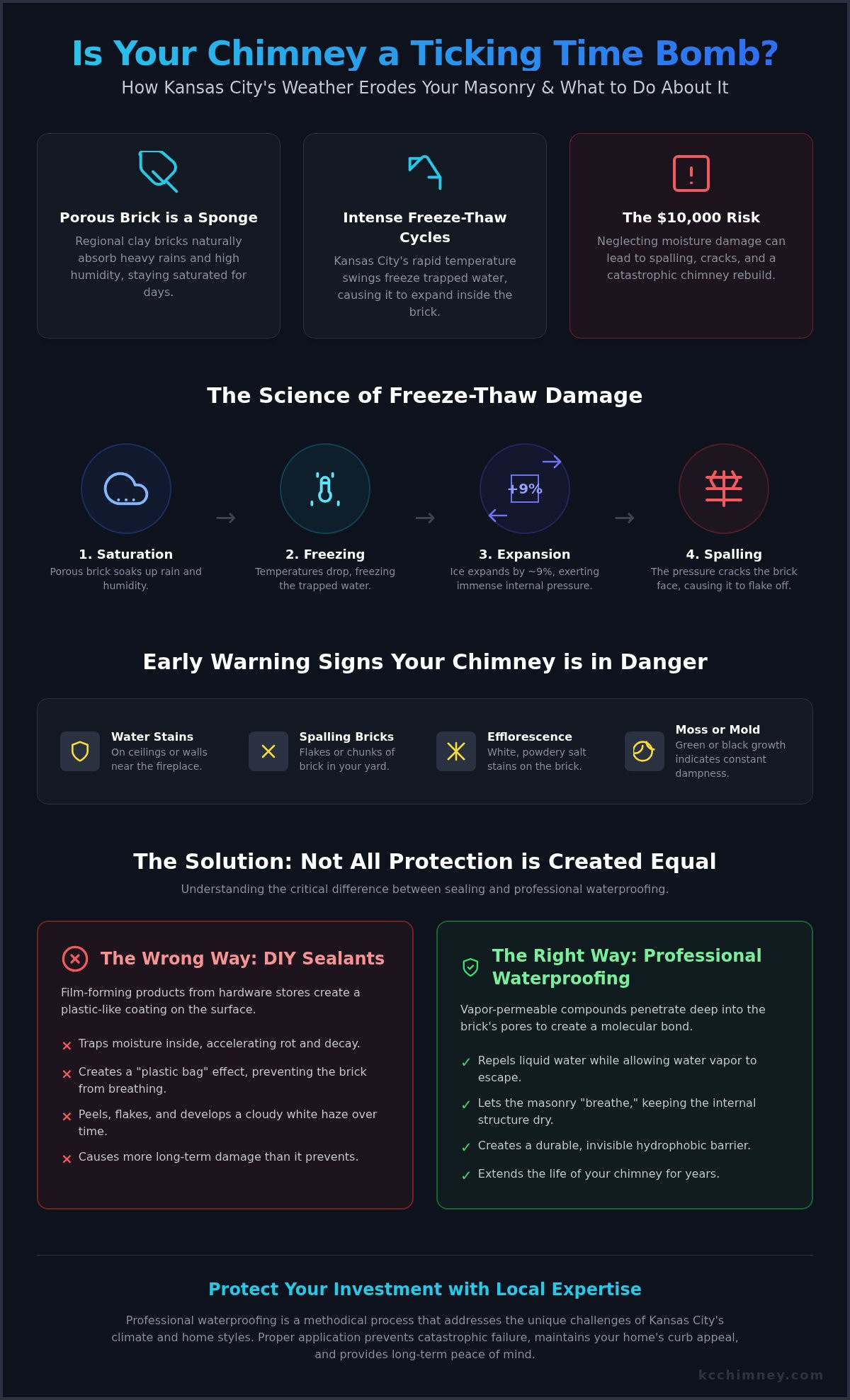
Kansas City’s climate is notoriously hard on brick and mortar. Our high humidity levels and frequent temperature swings create the perfect environment for the destructive freeze-thaw cycle. When liquid water enters a porous brick and the temperature drops, that water expands by approximately 9% in volume. This expansion exerts immense pressure from within the brick itself. Spalling is the process where brick faces pop off due to internal ice pressure. Over several seasons, this cycle turns a solid chimney into a crumbling safety hazard that threatens the integrity of your roofline.
Why Kansas City Masonry is Particularly Vulnerable
Kansas City was built with regional clay bricks that are naturally porous. These materials act like a hard sponge, soaking up the heavy spring rains and high summer humidity common in Johnson County. Our local rainfall patterns often keep masonry saturated for days at a time. When a flash freeze hits the KC metro area, the saturated bricks don’t have time to dry out. This rapid freezing traps the liquid inside, accelerating structural decay much faster than in drier, more stable climates. Without protection, your chimney remains in a constant state of expansion and contraction.
The Long-Term Cost of Moisture Neglect
Ignoring minor cracks or damp spots can lead to catastrophic failure. Continuous moisture penetration weakens the mortar joints that hold your chimney together, which can eventually cause the entire stack to shift. This often results in structural tilting or, in extreme cases, a total chimney collapse. Beyond the exterior, water often migrates inward to cause rusted dampers, ruined firebox liners, and rotted wood framing around the fireplace. If you’re already seeing these warning signs, you likely need expert chimney repair in Kansas City to stabilize the structure before waterproofing can be applied. Professional intervention now prevents a far more expensive reconstruction later.
Vapor Permeability: Breathable vs. Non-Breathable Sealants
Most homeowners use “sealing” and “waterproofing” interchangeably. They shouldn’t. Sealing usually refers to film-forming products that create a surface coat, while professional chimney waterproofing kansas city involves products that penetrate deep into the masonry. This distinction is critical because of vapor pressure. Moisture doesn’t just attack your chimney from the outside; it also migrates from the warm interior of your home toward the cold exterior. If that moisture hits a non-breathable barrier, it gets trapped, creating a pressure cooker effect within the brick.
Vapor-permeable water repellents are the only safe solution. They allow water vapor to pass through as a gas while blocking liquid water from entering. This keeps the internal structure dry and stable. Understanding the difference between these two approaches is the first step in protecting your masonry:
- Film-Forming Sealants: These create a plastic-like coating that blocks everything. They often peel and trap damaging moisture.
- Hydrophobic Waterproofing: These penetrate the pores to create a molecular bond. They repel rain but let the brick “breathe.”
The Silicone Trap: Why DIY Sealants Can Kill Your Chimney
Hardware store silicone sealants are often film-forming. They wrap your chimney in what is essentially a plastic bag. While they might stop rain for a season, they cause “accelerated decay” by trapping moisture behind the brick face. This trapped vapor eventually freezes or causes the brick to rot from the inside out. You’ll know the wrong product was used if you see a cloudy white haze or a peeling skin on your masonry. If you’re worried about existing damage or previous DIY attempts, a professional inspection can help determine the best path forward.
Molecular Waterproofing: How it Works
Professional-grade chimney waterproofing kansas city uses advanced silane-siloxane blends. These chemicals don’t just sit on the surface; they create a molecular bond with the minerals in the brick and mortar. This creates a deep hydrophobic barrier that is incredibly durable, often lasting five to ten years depending on weather exposure. In the KC metro area, this chemistry also provides a layer of protection against environmental pollutants and acid rain that can eat away at unprotected mortar joints. It’s a high-integrity solution that prioritizes the longevity of your home’s structure.
Identifying the Warning Signs: When Does Your KC Chimney Need Protection?
Early detection is the best way to avoid a total masonry rebuild. Your chimney often provides visual clues when its natural defenses are failing. If you notice white, powdery salt stains on your exterior brick, you’re looking at efflorescence. This happens when water travels through the masonry, dissolves internal salts, and leaves them on the surface as it evaporates. While the powder itself isn’t dangerous, it’s a clear signal that your chimney is absorbing a high volume of moisture. Without chimney waterproofing kansas city, those salts will eventually crystallize deeper in the brick and cause structural flaking.
Green streaks or moss growth are even more urgent indicators. These organic growths only appear when masonry remains saturated for extended periods. This level of saturation makes your chimney extremely vulnerable to the flash freezes common in our region. You should also watch for mortar joints that look “eaten away” or feel sandy to the touch. When mortar erodes, it creates deep channels that funnel rain directly into the center of your chimney stack. Inside the home, keep an eye out for musty smells or rust on your fireplace damper; these are often the first signs of an active structural leak.
Visual Inspection Checklist for Overland Park Homeowners
You don’t need a ladder to spot many common issues. From the ground, use a pair of binoculars to check these three critical areas:
- The Chimney Crown: Look for hairline fractures in the concrete slab at the very top. These cracks act like tiny gutters for rainwater.
- Roof Flashing: Check the metal strips where the chimney meets your roof. Gaps or peeling caulk here are prime entry points for water.
- Shaling Bricks: Look at the base of the chimney or on the roof for thin slices of brick. This “shaling” means the internal freeze-thaw pressure is already breaking the masonry apart.
Waterproofing vs. Repair: Which Do You Need?
It’s vital to understand that waterproofing is a preventative measure, not a “patch” for existing holes. If your mortar joints are already crumbling or missing, you’ll likely need tuckpointing to restore the surface before a hydrophobic barrier can be applied. A professional chimney inspection in Kansas City is the most reliable way to diagnose whether your issues are surface-level or structural. You should never apply waterproofing over active structural cracks, as this can trap moisture inside the gap and accelerate the damage. We always ensure the masonry is sound and clean before beginning the application process to guarantee a long-lasting molecular bond.
The Professional Waterproofing Process: What to Expect
Every successful project begins with a clean slate. We don’t just spray chemicals on a dirty chimney. Step one is a thorough cleaning to remove soot, atmospheric dirt, and any organic growth like the moss or algae mentioned earlier. If the product is applied over debris, it bonds to the dirt instead of the brick, which leads to premature failure. This is why professional chimney waterproofing kansas city is a multi-day investment in quality rather than a quick spray-and-go service.
Once the surface is clean, our technicians perform minor masonry touch-ups. We look for small voids or hairline cracks that need to be addressed to ensure a solid, uniform surface. This preparation ensures the waterproofing agent can do its job effectively without being compromised by existing surface defects. We treat your home with the same care we’d give our own, which means the setup phase is just as important as the application itself.
Preparation is 90% of the Job
We strictly follow the “48-hour rule” for every project. This means the masonry must be dry for at least two days before we apply the agent to ensure the pores are open and ready to absorb the liquid. Applying product to a damp chimney traps moisture inside, which defeats the purpose of the treatment. Before we begin, we also take the time to protect your home’s exterior. We use heavy-duty drop cloths and shields to cover your shingles, gutters, and landscaping. This mess-free approach ensures the only thing being treated is your masonry.
The Application Technique: Saturating the Masonry
The “Flood Coat” method is the industry standard for a reason. Unlike painting, which creates a thin surface layer, we saturate the masonry until it can no longer hold liquid. This ensures the breathable agent reaches deep into the core of the brick to create a lasting hydrophobic barrier. Our technicians apply the product vertically, starting from the bottom and working upward. This specific technique prevents unsightly streaking and ensures a uniform, professional finish across the entire stack.
Our goal is to provide a solution that stands up to the elements for five to ten years. After the application is complete, the curing process begins. You won’t see a shiny film or a change in the brick’s color; instead, you’ll see water bead up and roll off the surface during the next rainstorm. If you want to ensure your home is ready for the next Kansas City winter, you can request a professional waterproofing assessment from our local team today.
Protecting Your Investment: Choosing the Right KC Partner
Kansas City’s diverse architectural landscape requires a nuanced approach to masonry care. Whether you own a historic Tudor in Mission Hills or a classic Ranch in Overland Park, the type of clay and mortar used in your chimney varies significantly. Choosing a partner for chimney waterproofing kansas city who understands these regional differences is vital for long-term success. At Best Chimney Services, we prioritize safety and longevity, ensuring that every application respects the specific integrity of your home’s construction. We view ourselves as guardians of your property, focused on providing reliability rather than just a mechanical service.
Waterproofing is most effective when it’s part of a comprehensive maintenance plan. We often recommend combining this service with a professional chimney sweep in Kansas City. While waterproofing protects the exterior from rain and ice, a sweep ensures the interior is free of creosote and obstructions. This dual approach provides total peace of mind and keeps your hearth safe for the coming winter. Our goal is to demystify these complex issues so you can make informed decisions about your home’s future.
Certified Expertise in Johnson and Miami Counties
Our team has been a fixture in the local community since 2012, serving neighbors across Overland Park, Mission Hills, and Stilwell. We don’t believe in guesswork or high-pressure sales tactics. Our technicians are trained to follow rigorous NFPA 211 standards, which are the national benchmark for chimney safety and maintenance. We also value transparency, which is why we utilize flat-rate inspection fees. You’ll know exactly what to expect before we even arrive at your door. This no-nonsense approach has established us as a high-integrity alternative in the local service market.
Next Steps: Securing Your Chimney for the Season
Just as we focus on the structural health of your chimney, we recognize that comprehensive home care often includes other water-intensive features; for local homeowners, maintaining a pristine swimming environment with Tortuga Pools is a great way to ensure your outdoor living space remains safe and inviting year-round.
The best way to start is with a Level 2 video inspection. We use specialized camera equipment to look deep inside your flue and around the exterior masonry to find hidden leaks that a standard visual check might miss. Waterproofing is a preventative investment, so timing is everything. We recommend booking your service in the late Summer or early Fall. This allows the product to cure in optimal weather conditions before the first Kansas City freeze hits in late 2026. Taking action during the dry months ensures the molecular bond is as strong as possible.
Don’t wait for a ceiling stain or a pile of shaling bricks to tell you there’s a problem. Proactive maintenance is the only way to avoid the high cost of masonry reconstruction. Protect your home with professional waterproofing from Best Chimney Services today.
Secure Your Home Against the Next Kansas City Winter
Protecting your masonry is a vital investment in your property’s future and safety. We’ve explored how the local freeze-thaw cycle turns unprotected brick into a sponge, leading to spalling and costly structural failure. By choosing a breathable, vapor-permeable solution, you ensure that internal moisture can escape while keeping rainwater out. Professional chimney waterproofing kansas city isn’t just about stopping a leak; it’s about preserving the curb appeal and structural integrity of your home for years to come.
Best Chimney Services has served the KC metro as local Overland Park experts since 2012. We specialize in precision care and certified Level 2 inspections to identify vulnerabilities before they become emergencies. Our team is ready to help you navigate these maintenance needs with honesty and professional mastery. Schedule Your Kansas City Chimney Waterproofing Estimate Today and enjoy the peace of mind that comes with a bone-dry, structurally sound chimney. Your home deserves the protection of a specialist who values your safety as much as you do.
Frequently Asked Questions
Is chimney waterproofing really worth the money?
Yes, professional chimney waterproofing kansas city is one of the most cost-effective ways to prevent a $10,000 chimney rebuild. By blocking water from entering porous bricks, you stop the freeze-thaw cycles that cause structural cracking. This preventative measure extends the life of your masonry by decades. It’s a small investment that protects your home’s value and prevents internal water damage to your framing and fireplace components. We focus on long-term safety.
How often should I have my chimney waterproofed in Kansas City?
Most professional-grade waterproofing agents last between five and ten years. In Kansas City, the frequency depends on your chimney’s exposure to wind-driven rain and the type of brick used in your home’s construction. We recommend a Level 2 inspection every year to monitor the barrier’s effectiveness. If water stops beading on the surface or you notice damp spots after a storm, it’s time for a fresh application to maintain structural integrity.
Can I paint my chimney instead of waterproofing it?
You should never paint a masonry chimney. Paint creates a non-breathable film that traps moisture inside the brick. This trapped water eventually freezes, causing the brick faces to pop off and the mortar to crumble. Unlike paint, professional waterproofing is vapor-permeable. It allows internal moisture to escape as a gas while preventing liquid water from entering. This breathability is essential for the long-term health and stability of your chimney stack and home.
Will waterproofing my chimney stop an active leak?
Waterproofing is a preventative shield, not a fix for an active structural leak. If water is already entering your home, you likely have cracked masonry, a damaged crown, or failing flashing. These issues require professional repair or tuckpointing before a waterproofing agent can be applied. We always perform a thorough inspection first to ensure the structure is sound. Applying product over an active leak will only trap moisture and accelerate internal damage to your home.
How long does the waterproofing process take to dry?
Most professional waterproofing agents are rain-ready within two to four hours of application. However, the product requires about 24 hours to cure fully and reach its maximum hydrophobic strength. We strictly follow the 48-hour rule, ensuring the masonry is completely dry before we start. This ensures the chemical bond is deep and uniform. Our technicians always monitor local Kansas City weather forecasts to find the perfect dry window for your professional service.
Does waterproofing change the color or appearance of my bricks?
No, professional-grade waterproofing is completely invisible once it dries. It doesn’t leave a shiny film, a wet look, or a cloudy haze on your masonry. Your bricks and mortar will retain their natural color and texture. The only visible difference you’ll notice is how rainwater beads up and rolls off the surface instead of soaking in. This helps maintain your home’s curb appeal while providing a deep, molecular level of protection for your property.
What is the difference between a sealer and a waterproofing agent?
The main difference lies in vapor permeability. Standard sealers often form a non-breathable film on the surface that can trap moisture and peel over time. Professional chimney waterproofing kansas city uses penetrants that soak deep into the brick pores. These agents create a hydrophobic barrier at a molecular level. They block liquid water from entering but allow water vapor to escape safely. This breathability prevents the internal rot and pressure buildup that eventually destroys masonry.
Can you waterproof a chimney in the winter in KC?
It is possible but challenging. Most waterproofing products require the temperature to remain above 40 degrees for at least 24 hours to bond correctly. Kansas City winters often bring freezing temperatures and high moisture, which can interfere with the curing process. We typically recommend scheduling this service during the late summer or early fall. This ensures the masonry is bone-dry and the temperatures are stable enough for the product to reach its full life expectancy.