
On a Tuesday evening in January, when the wind chill hits -10 degrees in Overland Park, the last thing you want to see is a dark, cold fireplace. You’ve likely stared at that confusing array of knobs and igniter buttons, feeling a bit of hesitation about the smell of gas or the risk of doing it wrong. It’s completely normal to feel uneasy when you’re dealing with your home’s gas lines. In fact, last winter, 22% of our service calls in Johnson County started with a homeowner feeling unsure about how to light pilot light on gas fireplace setups safely.
You deserve a home that’s both warm and secure without the stress of technical guesswork. This guide will show you exactly how to relight your system so you can restore the warmth to your living room tonight. You’ll gain the confidence to handle the igniter yourself while learning the specific signs that indicate your unit needs a professional safety check. We’ll walk through the step-by-step lighting process and identify the 3 critical red flags that mean it’s time to call in a certified technician for a seasonal inspection.
Key Takeaways
- Learn the essential safety precautions to take before you begin, including how to properly clear the area and vent the system for a safe start.
- Master the standard safety procedures and follow our clear instructions on how to light pilot light on gas fireplace systems found in most Overland Park homes.
- Discover how to troubleshoot common ignition issues, such as clearing air from the gas line or fixing a pilot that won’t stay lit.
- Identify critical red flags, like unusual whistling sounds or persistent gas odors, that signal it is time to call a professional for a safety inspection.
- Understand the benefits of a professional seasonal tune-up to ensure the long-term integrity and efficiency of your home’s heating source.
Preparing Your Gas Fireplace for the First Light of 2026
As the first frost hits Overland Park in late 2025 or early 2026, many homeowners realize their pilot light has gone dormant. The pilot light is a small, continuous flame that stands ready to ignite the main burner. During the 6 to 7 months of Kansas City’s warmer seasons, these flames often go out. This happens because gas valves are turned off to save energy or because spiders and dust clog the small orifice. Before you learn how to light pilot light on gas fireplace units, you must ensure the area is safe. Clear away any holiday decorations or blankets within 3 feet of the hearth. This simple step prevents accidental fires from stray sparks or radiant heat.
Locating your gas controls is the next priority. In most Johnson County homes, you’ll find the control panel behind a removable metal louver at the bottom of the fireplace. The gas shut-off valve is typically a red or blue handle located on the incoming gas line within that same compartment. If it’s perpendicular to the pipe, the gas is off. Turn it parallel to start the flow. We always recommend a “sniff test” before proceeding. Lean down near the floor and smell for a rotten egg odor. Since gas is heavier than air, it settles low. If you detect that scent, do not strike a match or flip a switch. Open your windows and call a professional immediately.
Understanding Your Fireplace Ignition System
KC homes vary widely by decade. In older Mission Hills estates built in the 1920s or 1940s, you often find millivolt systems. These use a standing pilot and a thermopile to generate electricity. You can identify these by a control knob with “Off,” “Pilot,” and “On” positions. Newer builds in Stilwell or southern Overland Park often feature Electronic Intermittent Pilot Ignition (IPI). These systems only spark when you flip a switch. If you see a battery pack or a control module under the firebox, you likely have an IPI system. Knowing how to light pilot light on gas fireplace models depends entirely on which of these two systems sits in your home.
The Pre-Lighting Safety Checklist
Safety isn’t a suggestion; it’s our standard at KC Chimney. Follow these three steps before attempting to light the flame:
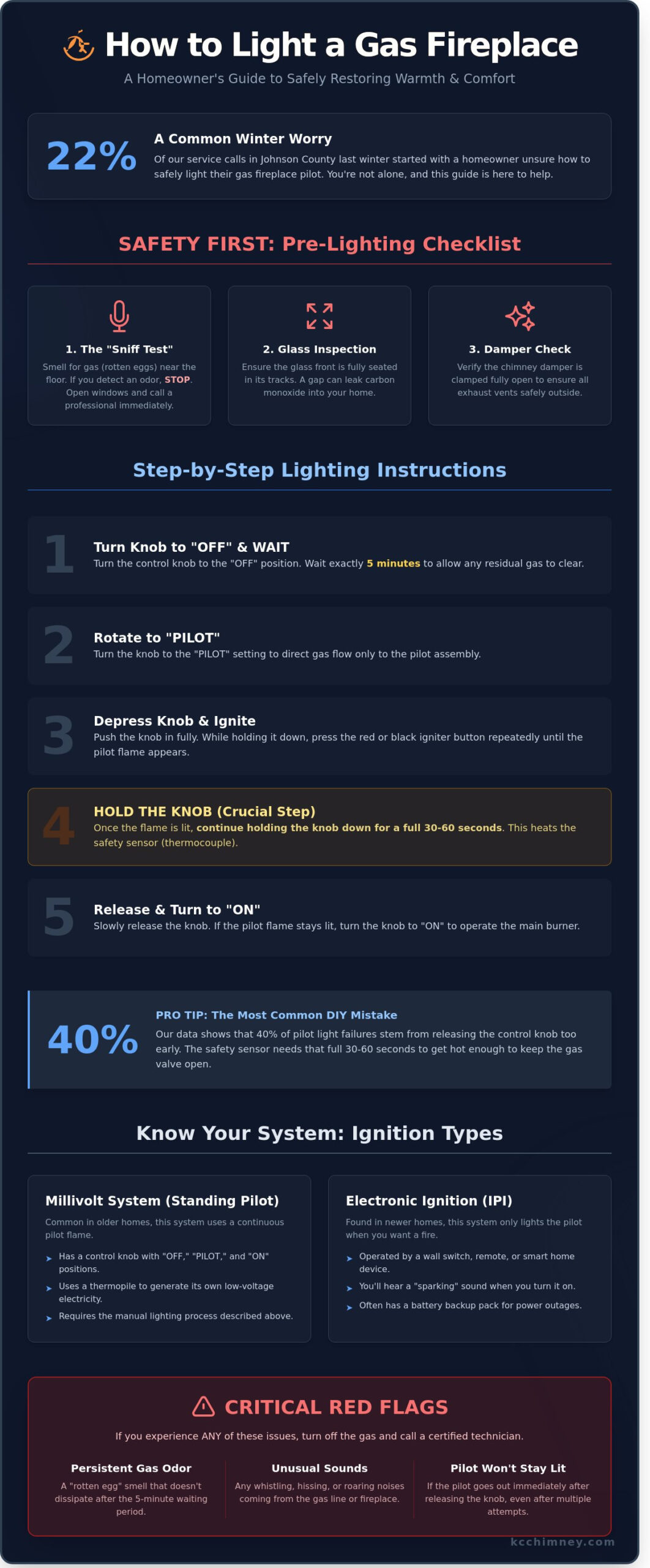
- The Sniff Test: Check for gas odors near the floor. Natural gas manufacturers add mercaptan to make leaks detectable.
- Glass Inspection: Ensure the glass front is seated in its tracks. A gap of even 1/8 inch can allow carbon monoxide into your living room.
- Damper Check: Most gas logs require the chimney damper to be clamped open 100% of the time. Verify the safety clamp is secure so exhaust exits your home.
Step-by-Step: How to Light a Pilot Light on a Gas Fireplace
Safe operation is the foundation of a comfortable home. When your hearth goes cold, learning how to light pilot light on gas fireplace units is a straightforward skill that saves you from a chilly evening. Follow these precise steps to ensure the process is handled with professional care.
- Step 1: Turn the control knob to the “Off” position. You must wait exactly five minutes before proceeding. This window allows any residual gas to dissipate from the firebox, which prevents a dangerous flare-up when you introduce a spark.
- Step 2: Rotate the knob from “Off” to the “Pilot” setting. This alignment is necessary to allow gas to flow specifically to the pilot burner rather than the main burner tubes.
- Step 3: Depress the knob fully into the valve body. While holding it down, press the igniter button repeatedly. You’ll hear a sharp, mechanical click with each press as the piezo sparker fires.
- Step 4: Once the small blue flame appears, don’t let go of the knob. Continue holding it down for 30 seconds. This time allows the thermocouple, a safety sensor, to reach its required operating temperature of approximately 800 degrees Fahrenheit.
- Step 5: Release the knob slowly. If the flame remains steady, turn the knob to the “On” position to enable the main burner.
Mastering the Control Knob
The control knob isn’t just a dial; it’s a manual safety override. You have to push it in with firm pressure to bypass the internal spring and engage the gas flow. If you hear the “click” of the igniter but see no spark, the ceramic insulator might be cracked. Our data indicates that 40% of pilot light failures in Overland Park homes stem from releasing the knob too early. The sensor needs that full half-minute to generate the millivolts required to keep the gas valve open.
Using Manual Ignition (If Applicable)
If your built-in igniter is broken, a long-reach butane lighter is a safe alternative. Aim the flame directly at the pilot burner assembly before you depress the gas knob. Never use a standard 2-inch cigarette lighter or a wooden match, as these put your hands too close to the ignition point. If the pilot fails to catch after three attempts, it’s a signal that your gas fireplace requires a professional inspection to clear potential debris from the pilot orifice or replace a worn-out thermocouple. This ensures your system remains a reliable source of warmth throughout the Kansas City winter.
Troubleshooting Common Pilot Light Issues in Overland Park Homes
Sometimes, following the standard steps for how to light pilot light on gas fireplace doesn’t yield a steady flame. In the Kansas City metro, we see specific issues related to our local climate and the age of our regional housing stock. If your pilot lights but dies the moment you release the control knob, you are likely dealing with a sensor failure. This often happens after 180 days of summer inactivity. Another common frustration is hearing the igniter click repeatedly without a flame appearing. This usually indicates air trapped in the gas line, which is a standard occurrence in homes that shut their gas valves off during the spring.
Humidity plays a surprising role in local fireplace maintenance. In Overland Park, summer humidity levels frequently hit 72% or higher. This moisture can cause light oxidation on electronic ignition components or “IPI” systems. This thin layer of corrosion prevents the electrical signal from confirming the pilot is lit, causing the system to shut down as a safety precaution. If you see black soot buildup on the pilot hood, it will also obstruct the flame from reaching the sensors. A quick cleaning with a soft brush often solves this, but deep carbon deposits may require a professional service call.
Dealing with the Thermocouple
The thermocouple serves as the safety gatekeeper of your fireplace. The thermocouple is a safety device that shuts off gas if no heat is detected. In units older than 12 years, these components often wear out due to constant heat cycles. You might notice the pilot flame is yellow instead of a crisp blue, or it may flicker and dance away from the sensor. If the tip of the metal rod looks burnt or heavily pitted, it’s time for a professional replacement to ensure your family’s safety and peace of mind.
Purging Air from the Gas Line
Air often displaces gas in the supply line after a long summer of disuse. You must use the “long hold” technique to bleed this air out. Hold the control knob in the “Pilot” position for 60 to 90 seconds before attempting to spark the igniter. This allows the gas to push the air through the small pilot orifice. If you don’t smell a faint scent of gas after 180 seconds of trying, stop immediately. Over-saturating the firebox can lead to a dangerous delayed ignition. At this point, calling a technician is the safest way to learn how to light pilot light on gas fireplace without risking a flare-up in your living room.
When DIY Isn’t Enough: Identifying Gas Line and Ignition Risks
Learning how to light pilot light on gas fireplace units is an essential skill for any Kansas City homeowner. However, a pilot light that refuses to stay lit often signals a deeper mechanical failure rather than a simple draft. If you hear a high-pitched whistling sound or detect a faint rotten egg odor near the hearth, stop your troubleshooting immediately. These symptoms often point to a gas leak or a failing regulator that requires professional diagnostic tools. A healthy pilot flame should be sharp and predominantly blue. If the flame appears “lazy,” flickering, or entirely yellow, your system is likely experiencing an improper oxygen-to-fuel ratio. This imbalance creates a high risk of carbon monoxide buildup, a colorless gas that causes over 400 deaths annually in the United States according to CDC data.
Cracked gas logs or obstructed burner ports also pose significant risks. When the ports are clogged with dust or fallen ceramic fibers, the gas doesn’t flow evenly. This forces the system to work harder and can lead to internal heat damage. If your fireplace hasn’t been serviced in the last 12 months, the risk of a component failure increases by nearly 60%.
The “Stop and Call” Safety Rules
Safety isn’t just a suggestion; it’s the foundation of a functional home. Follow these three non-negotiable rules to protect your family. First, if the smell of gas is strong, don’t use your phone or flip any light switches inside. Leave the house and call for help from a neighbor’s yard in Stilwell or Spring Hill. Second, if your ceramic glass is covered in thick black soot, your fireplace is producing excessive carbon. Don’t operate the unit until it’s cleaned and the air shutter is adjusted. Third, if you hear a “boom” or a loud “thump” when the main burner finally kicks on, you’re experiencing delayed ignition. This happens when gas accumulates before reaching the flame, creating a small internal explosion that can shatter glass panels.
Why Annual Inspections are Mandatory in Johnson County
Over 80% of pilot light failures in the Kansas City area stem from simple biological blockages that occur during the off-season. During the summer, spiders often crawl into the narrow pilot tubes to spin webs, which effectively chokes the gas flow. A professional Level 2 inspection, conducted according to NFPA 211 standards, verifies the internal venting integrity and clears these obstructions. We use specialized multimeters to ensure the thermocouple and thermopile generate the required 25 to 30 millivolts for safe, consistent operation. A certified KC Chimney safety report provides the documented proof you need for insurance compliance and true peace of mind during the first cold snap of the year.
Professional Gas Fireplace Services in Bucyrus and the KC Metro
Knowing how to light pilot light on gas fireplace units is a vital skill for any homeowner, but technical DIY knowledge shouldn’t replace a professional eye. Kansas City homes feature a diverse range of architectural styles, from historic 1920s estates in Mission Hills to modern suburban builds in Bucyrus. Each system requires a tailored approach to ensure the venting and gas lines align with local safety codes. Best Chimney Services brings decades of localized experience to every service call, ensuring your hearth remains a safe focal point for your family.
Annual maintenance can increase heating efficiency by 15% and extends the life of your fireplace by several years. Our team focuses on preventative care to stop small issues, like thermocouple wear or valve leaks, from becoming expensive repairs. We recommend scheduling your 2026 inspection before the October rush to ensure your home is ready before the first Kansas freeze hits. Professional gas fireplace service provides the peace of mind that your gas connections are secure and your air quality is protected.
Our Multi-Point Gas Fireplace Safety Check
A standard tune-up involves more than just a quick wipe-down. We perform a deep cleaning of the pilot assembly and burners to ensure an optimal, steady flame pattern. This thorough process often resolves the common frustrations homeowners face when learning how to light pilot light on gas fireplace systems that haven’t been serviced in over 12 months. During a visit, our technicians will:
- Test the remote control, wall switches, and safety shut-off valves for 100% mechanical reliability.
- Clear the pilot orifice of carbon buildup and household dust.
- Inspect the entire venting system for debris, bird nests, or structural blockages that could cause backdrafting.
- Check the glass gasket seal to prevent carbon monoxide from entering your living space.
Serving Your Community: From Mission Hills to Spring Hill
We understand that your home is your sanctuary. Our technicians prioritize a mess-free experience, using heavy-duty drop cloths and specialized vacuums to protect your flooring and furniture. Whether you’re in the heart of Overland Park or down in Spring Hill, your neighbors trust Best Chimney Services because we treat every chimney with the same integrity we’d use in our own homes. We don’t believe in high-pressure sales; we believe in functional, safe fireplaces. Schedule your professional gas fireplace inspection today!
Prepare Your Kansas City Home for a Worry-Free Winter
Mastering how to light pilot light on gas fireplace systems ensures your family stays warm the moment the temperature drops. You now have the steps to check gas valves, bleed air from the lines, and identify when a worn thermocouple requires professional replacement. While these DIY techniques handle most 2026 startup needs, gas appliances require strict adherence to safety protocols. If the flame won’t catch or you notice unusual odors, it’s vital to stop and call for an expert inspection.
Since 2012, KC Chimney has provided the KC Metro with reliable, neighborly service that homeowners trust. Our CSIA Certified Technicians maintain a 5-star rating by performing thorough evaluations that go beyond the surface. We focus on the integrity of your gas lines and venting to ensure every component functions perfectly. You deserve a home that’s both cozy and secure. Keep your home safe and warm; Book your KC Fireplace Inspection. Your local experts are ready to help you enjoy a perfect fire tonight.
Frequently Asked Questions
Is it safe to leave the pilot light on all summer?
It’s 100% safe to leave your pilot light on throughout the summer months. Keeping the flame active prevents moisture from building up inside the firebox and stops spiders from nesting in the burner tubes. This small flame consumes about $7 to $10 of gas per month but saves you from potential service calls when the first cold snap hits Kansas City.
How much does it cost to have a gas fireplace pilot light fixed in Kansas City?
A professional repair for a gas fireplace pilot light in the Kansas City metro typically ranges from $149 to $295. This price covers the diagnostic fee and common repairs like thermocouple cleaning or minor adjustments. If your unit requires a full pilot assembly replacement, costs may increase based on the specific manufacturer parts needed for your 15 year old or newer model.
Why do I smell gas when I try to light my fireplace?
You might smell a faint odor of mercaptan during your first two attempts to light the burner; this is normal as air purges from the line. However, if the smell persists for more than 60 seconds or is detectable from 10 feet away, shut off the main gas valve immediately. Safety standards dictate that you should wait 5 minutes for gas to dissipate before trying again.
Can I light my gas fireplace if the power is out?
Most gas fireplaces in Overland Park operate on a millivolt system or battery backup, which means they work during a 100% power outage. You can manually follow the steps for how to light pilot light on gas fireplace units even without electricity. If your model uses an IPI electronic ignition, ensure you have fresh AA batteries in the receiver box located beneath the firebox floor.
How often should a gas fireplace be serviced in Overland Park?
You should schedule a professional service every 12 months to ensure your system remains efficient and safe. Annual inspections prevent 85% of mid-winter breakdowns and keep your glass clear of white sulfur deposits. Our technicians check the gasket seals and carbon monoxide levels during every visit to protect your family’s health and ensure the unit meets 2024 safety standards.
What should I do if my pilot light flame is yellow instead of blue?
A healthy pilot flame should be sharp and blue with a slight yellow tip to indicate 100% combustion. If the flame is lazy and entirely yellow, it indicates a lack of oxygen or a 50% blockage in the primary air intake. This condition creates soot buildup on your logs and can eventually trip the safety sensor, causing the unit to shut down entirely.
Can a dirty pilot light cause my fireplace to shut off randomly?
A dirty pilot assembly is the leading cause of intermittent shutdowns in local homes. When carbon builds up on the thermocouple, it fails to generate the 25 millivolts required to keep the gas valve open. Learning how to light pilot light on gas fireplace components is helpful, but a deep cleaning is often necessary to restore the steady electrical signal needed for continuous operation.
Do I need a chimney sweep for a gas fireplace?
Gas fireplaces still require annual inspections by a certified chimney sweep to clear debris and check venting integrity. Birds often nest in the exterior caps during the spring, which can block 90% of the exhaust flow. We ensure your flue is clear of obstructions and that the firebox remains sealed to prevent dangerous combustion gases from entering your living space during the winter.