
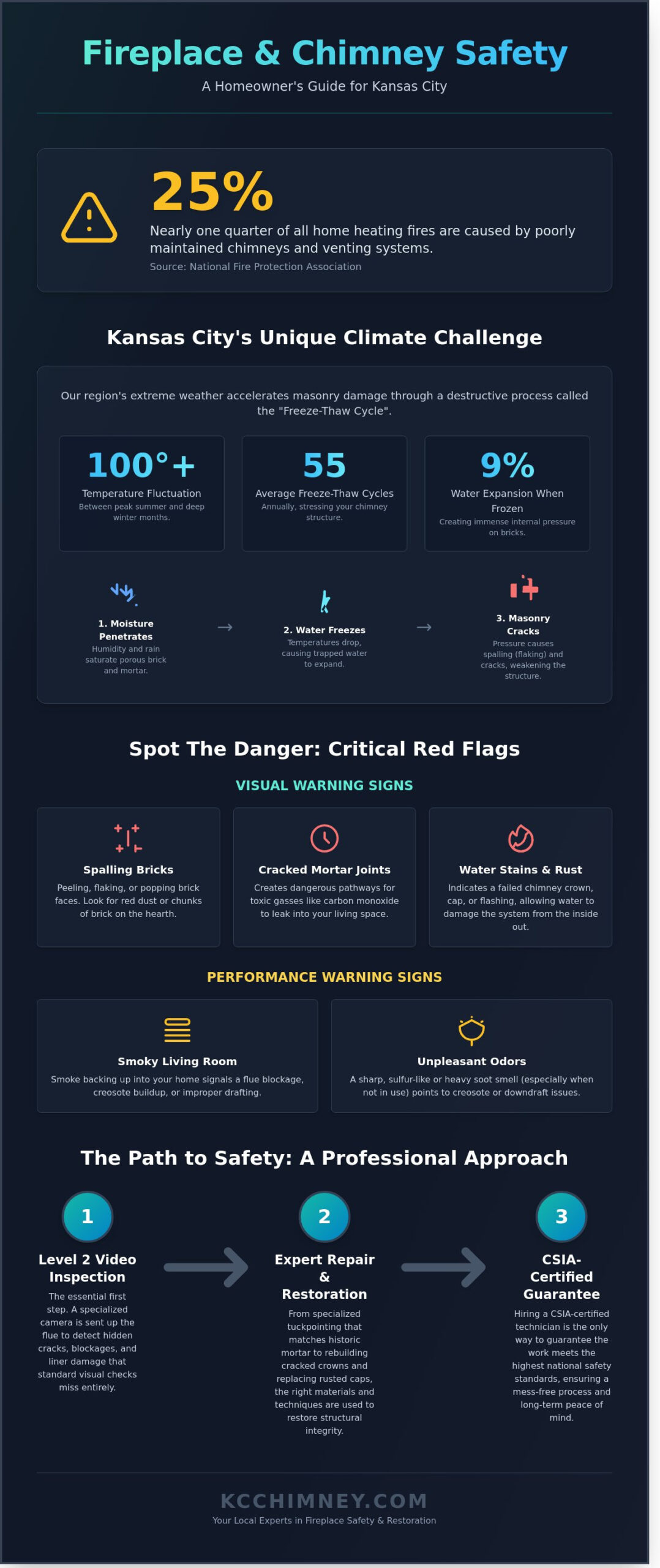
According to the National Fire Protection Association, nearly 25 percent of all home heating fires result from a failure to maintain or clean equipment like chimneys and flues. You likely view your hearth as the heart of your home, a place for comfort during those 15-degree Kansas City January nights. It’s a space where memories are made, but that sense of security disappears quickly when you notice a cracked flue liner or the smell of gas. When these issues arise, finding a reliable expert for fireplace repair becomes your top priority to prevent carbon monoxide leaks or expensive masonry failure.
We understand that the technical side of venting systems can feel overwhelming. That’s why we’ve compiled this 2026 guide to help you identify critical red flags and understand the professional repair process tailored for our region’s unique architecture. You’ll learn how to spot early signs of deterioration before they become five-figure emergencies. We’ll walk you through the essential safety checks for both wood-burning and gas units, giving you the confidence to choose a local expert who does it right the first time. This FAQ ensures your home remains a safe haven for your family throughout the winter season.
Key Takeaways
- Learn how Kansas City’s unique freeze-thaw cycles accelerate masonry damage and how to identify the specific red flags that compromise your chimney’s safety.
- Understand the critical mechanical and structural differences between gas and wood-burning systems to ensure your hearth remains a reliable source of protection.
- Discover why a professional fireplace repair begins with a Level 2 video inspection to detect hidden cracks and venting issues that standard visual checks miss.
- Find out why hiring a CSIA-certified technician is the only way to guarantee a mess-free restoration that meets the highest safety standards in Johnson County.
Recognizing the Need for Fireplace Repair in Overland Park & KC
Fireplace repair focuses on two critical pillars: restoring structural integrity and ensuring venting safety. It’s more than a cosmetic fix; it’s a technical restoration that ensures your home remains a sanctuary rather than a fire hazard. In the Kansas City metro, our local climate puts unique stress on residential masonry. We frequently experience 100-degree temperature fluctuations between our peak summer and deep winter months. These rapid thermal cycles cause bricks and mortar to expand and contract, which leads to microscopic fractures that compromise the entire system.
For families in Johnson County, a “Safety First” mindset is essential for responsible homeownership. Statistics from the Chimney Safety Institute of America indicate that over 25,000 residential fires start in the chimney or fireplace annually in the United States. While an annual sweep is routine maintenance, Structural Masonry and Chimney Repair addresses deeper, more dangerous issues like damaged flue liners or failing crowns. Investing in professional fireplace repair ensures that heat and toxic byproducts are contained within the venting system rather than reaching combustible house framing.
Visual Red Flags in Your Hearth and Firebox
Spalling bricks look like the face of the masonry is peeling, flaking, or popping off. This happens when Kansas City’s 70% average summer humidity allows moisture to penetrate the porous brick, which then freezes and expands during winter. If you notice piles of red dust or brick chunks on your hearth, the structural integrity of your firebox is failing. Cracked mortar joints are equally dangerous; they act as pathways for toxic gasses to enter your living space. Rust on your damper or water stains in the firebox indicate that your chimney’s external defense has failed.
Performance Issues: When Your Fireplace Acts Up
A smoky living room isn’t just an inconvenience; it’s a sign of a structural flue blockage or an undersized venting system. If you notice a sharp, sulfur-like odor or a heavy soot smell during humid months, your chimney is likely struggling with creosote buildup or downdrafts. Proper drafting requires a specific chimney height and a functional cap to maintain the pressure balance. When these components fail, your fireplace loses its ability to exhaust carbon monoxide safely. We often find that drafting problems stem from damaged caps or internal obstructions that require immediate professional attention.
Structural Masonry and Chimney Repair Challenges in Kansas City
Kansas City homeowners face a unique set of meteorological hurdles. Our region experiences an average of 55 freeze-thaw cycles annually. This process is the primary enemy of exterior masonry. When moisture enters the pores of your brickwork and freezes, it expands by approximately 9%. This expansion exerts internal pressure that eventually causes the brick faces to pop off, a condition known as spalling. Without timely fireplace repair, this moisture migrates deeper into the structure, compromising the entire venting system.
Tuckpointing and Masonry Restoration
Tuckpointing is the specialized process of grinding out failing, sandy mortar and replacing it with fresh, high-quality material. It’s a critical maintenance task for the historic homes in Mission Hills and the Country Club Plaza area. Many of these residences feature 100 year old masonry that requires precise mortar color matching to preserve their architectural value. Ignoring small cracks leads to water saturation, which can compromise the chimney’s structural load. Choosing Professional Fireplace Restoration ensures that the new mortar matches the strength and permeability of the original brick. This prevents the “sandwich effect” where hard modern mortar destroys softer historic bricks, leading to total chimney collapse.
Chimney Crown and Cap Repair
The chimney crown acts as the roof of your chimney system. In Kansas and Missouri, crowns often crack due to the extreme temperature swings between 100 degree summers and sub-zero winters. A simple crown wash might suffice for minor hairline fractures, but a full masonry rebuild is necessary when the concrete has separated from the flue. For homeowners with pre-fab systems, a rusted top is a major liability. Investing in a chase cover replacement prevents water from leaking into the wooden framing of the chimney chase, which can rot out the structure in as little as 3 years.
Water penetration doesn’t stay outside. It eventually reaches the firebox, where it causes the refractory panels to crack or the steel damper to rust. This internal damage makes comprehensive fireplace repair essential for preventing house fires. When you notice white, powdery staining (efflorescence) on your exterior bricks, it’s a sign that water is moving through the masonry. Addressing these issues early protects your family’s safety and prevents a $10,000 chimney rebuild later. If you’re concerned about the state of your masonry, you can schedule a professional assessment to catch these problems before the next big storm hits.
Gas vs. Wood-Burning Fireplace Repair: Key Differences
Understanding the difference between a mechanical failure and a structural defect is the first step in a successful fireplace repair. Gas fireplaces function like high-efficiency furnaces, relying on a complex network of valves, sensors, and burners. Wood-burning systems are traditional masonry structures that depend on physical integrity and airflow dynamics. While a gas unit might fail because of a 10-year-old thermocouple, a wood-burning hearth usually faces issues like mortar erosion or dangerous creosote accumulation.
Our technicians find that gas systems require precision calibration, while wood systems demand rigorous cleaning and masonry restoration. Both require a professional eye to ensure the venting system safely carries carbon monoxide and smoke out of your Kansas City home. Choosing the right path depends on whether your system’s “brain” or its “bones” are failing.
Gas Fireplace Troubleshooting and Maintenance
In Overland Park homes, the most frequent service calls involve gas valve and ignition failures. If your pilot light won’t stay lit, the thermopile or thermocouple has likely reached the end of its 12-year lifespan. These components generate the millivolts required to open the gas valve; if they’re coated in carbon, the system shuts down for safety. We also focus on cleaning ceramic logs and glass enclosures, as dust buildup can cause a 15% drop in heat output.
- Ignition Issues: Worn-out spark igniters often fail after 5,000 to 7,000 cycles.
- Sooting and Ghosting: If you see dark streaks on your walls or logs, it indicates improper combustion. This requires immediate fireplace repair to prevent indoor air quality degradation.
- Glass Health: White film on the glass is a byproduct of gas combustion and can permanently etch the surface if not cleaned annually.
Wood-Burning Flue and Liner Restoration
Wood-burning systems face extreme thermal stress, with internal temperatures often exceeding 1,000 degrees Fahrenheit. A primary concern for Kansas City homeowners is a cracked clay flue liner. Even a 1/16-inch gap in the masonry can allow heat to reach combustible wall studs, significantly increasing house fire risks. Since clay tiles are prone to “thermal shock,” we often recommend stainless steel chimney relining for homes built before 1990. This creates a seamless, insulated path for smoke.
Safety remains our top priority during every inspection. The U.S. Environmental Protection Agency suggests that scheduling professional fireplace and chimney inspections is the only reliable way to identify hidden hazards like Stage 3 creosote or firebox floor cracks. If your firebox shows signs of heat shield degradation, we use high-temperature refractory mortar to restore the structural integrity of your hearth. When a unit is more than 25 years old or has sustained major flue damage, we’ll help you determine if a repair or a full fireplace insert upgrade is the most cost-effective long-term solution for your home’s safety.
The Safety Inspection: Why Repair Starts with a Level 2 Evaluation
A successful fireplace repair doesn’t begin with a trowel; it starts with a high-definition camera. National Fire Protection Association (NFPA) 211 standards dictate that a Level 2 inspection is mandatory during property transfers, after a chimney fire, or when changing fuel types. We treat your home with the same care we’d give our own families, ensuring every hidden inch of the venting system is structurally sound before any work begins. This methodical approach identifies the root cause of the problem rather than just patching the symptoms.
What to Expect During a Professional Visit
Our technicians don’t guess about the health of your chimney. We use internal video scanning technology to look inside the flue. This 360-degree view reveals hairline cracks and shifted liners that the naked eye misses from the hearth. While a standard sweep focuses on removing creosote, a repair-focused inspection is a diagnostic deep dive. We also perform a comprehensive exterior evaluation, checking the masonry crown and the metal flashing for signs of water intrusion or freeze-thaw damage that often plagues Kansas City homes.
- Internal Video Scanning: High-resolution footage identifies gaps in flue tiles that could leak carbon monoxide into your living spaces.
- Rooftop Evaluation: We inspect the chimney cap and mortar joints to prevent moisture from rotting your home’s framing.
- Structural Integrity Check: We verify the clearance to combustibles, ensuring your fireplace meets current safety codes and local building regulations.
Evaluating the Diagnostic Report
Once the inspection is complete, we provide a detailed report that removes the guesswork from your home maintenance. In cities like Leawood, documented Level 2 inspections are often a non-negotiable requirement for closing a home sale. Buyers and sellers rely on these reports to ensure there are no $5,000 surprises hidden in the chimney stack. This report serves as a powerful tool for insurance claims or real estate negotiations, providing clear evidence of the chimney’s condition. Our expert fireplace services prioritize findings so you aren’t paying for cosmetic fixes when structural issues exist.
We categorize every finding into priority levels. An “Immediate Hazard” identifies a risk that requires attention before you light another fire. “Recommended Maintenance” highlights items that will extend the life of your masonry but don’t pose an imminent threat. This honesty prevents unnecessary fireplace repair costs and builds a foundation of trust. You’ll know exactly what’s happening behind your walls, giving you total peace of mind during the cold Kansas City winters. We’ve seen hundreds of cases where a clear report saved a closing or justified a necessary price adjustment.
Choosing Professional Fireplace Restoration in Johnson County
Safety isn’t a luxury when dealing with fire and carbon monoxide. Hiring a CSIA-certified technician is the only way to guarantee your home meets the 100 rigorous safety standards established by the Chimney Safety Institute of America. These professionals undergo testing every three years to maintain their credentials; ensuring they stay current on the latest venting technologies and fire prevention methods. When we perform a fireplace repair, we prioritize these technical benchmarks to protect your family from preventable hazards.
Local building codes in Bucyrus, Spring Hill, and Stilwell have specific requirements for masonry clearance and flue sizing. For example, many Johnson County municipalities follow the 2021 International Residential Code, which mandates at least two inches of space between chimney masonry and combustible materials. Our team manages these permit and code requirements so you don’t have to worry about future insurance claims or inspection failures during a home sale.
We use a specialized “Best Chimney Services” approach that focuses on a mess-free experience. Our technicians use industrial-grade HEPA vacuums and custom-fit floor protection to ensure not a single speck of soot touches your carpet. Don’t wait for the first Kansas City frost, which typically arrives by late October, to discover a blockage or a cracked liner. Scheduling your restoration in the late summer or early fall secures your spot before the peak winter rush begins.
The Local Advantage: Why KC Experts Matter
The Kansas City metro sits on expansive clay soil that shifts constantly with our extreme temperature swings. This movement often causes chimney separation or foundation cracks that out-of-state contractors might misdiagnose. When you research fireplace companies near me, look for teams that understand our 40-mph prairie winds and how they affect draft and downdrafts. We are neighbors serving neighbors, building trust through honest evaluations rather than high-pressure sales tactics.
Investing in Your Home’s Safety and Value
Homeowners in Overland Park often see a 12 percent return on investment for high-quality masonry updates. A functional, safe fireplace can add between $1,000 and $4,000 to a property’s resale value based on recent regional real estate data. Beyond the financial gain, preventative fireplace repair and masonry maintenance stop small leaks from becoming $10,000 structural failures. Protect your investment and your peace of mind by requesting a professional evaluation today to keep your hearth the heart of your home.
Secure Your Kansas City Hearth for the 2026 Season
Your fireplace is the heart of your home, but it requires professional oversight to remain a safe sanctuary. Prioritizing a Level 2 safety evaluation is the most effective way to identify hidden flue hazards or masonry decay before they become costly emergencies. Since 2012, we’ve helped thousands of families across the KC metro and Johnson County maintain their peace of mind through precise diagnostics and durable restoration techniques. Every home has unique needs. Understanding the structural differences between local masonry styles is vital for a lasting fix.
Our CSIA Certified Technicians utilize advanced video inspection technology to provide a clear view of your chimney’s internal health. This technical precision ensures that your fireplace repair meets the highest industry standards for 2026 and beyond. We take pride in our no-nonsense approach, focusing on integrity and the long-term safety of your household. You don’t have to guess about the state of your venting system when you have a trusted local expert ready to help. We’re committed to doing the job right the first time.
Protect your home and family-schedule your professional fireplace repair with KC Chimney today.
We look forward to keeping your home warm and secure for many winters to come.
Frequently Asked Questions
How do I know if my fireplace needs a professional repair?
Look for white salt-like staining on 15% or more of your bricks or crumbling mortar joints. If you notice a rotten egg smell near a gas unit or see visible cracks in the flue liner, it’s time for a professional fireplace repair. These signs indicate structural compromise or venting failures that increase the risk of carbon monoxide exposure in your home.
Is it safe to use a fireplace with a small crack in the back wall?
It’s not safe to use a fireplace with any visible cracks in the refractory panels or back wall. Even a hairline fracture 1/16th of an inch wide allows extreme heat to reach the combustible framing behind the firebox. This creates a high risk of a house fire. According to NFPA 211 standards, these panels must be replaced once a crack is large enough to fit a nickel edgewise.
What is the average cost of fireplace repair in Kansas City?
Most Kansas City homeowners spend between $450 and $2,500 on repairs depending on the severity of the damage. A simple crown repair might cost $500, while a full stainless steel flue relining can reach $3,000 or more. We provide written estimates based on 2024 regional labor rates to ensure you receive fair, transparent pricing for your specific masonry needs.
How long does a typical chimney masonry repair take to complete?
A standard tuckpointing or crown repair project usually takes 4 to 8 hours to finish. Larger structural jobs, such as rebuilding a chimney stack from the roofline up, require 2 to 3 days of onsite work. Our teams arrive at 8:00 AM to maximize daylight and ensure your hearth is safe for use by the following weekend.
Can I repair a gas fireplace myself or do I need a pro?
You must hire a certified technician for fireplace repair on gas units to ensure your home remains compliant with local mechanical codes. Working with gas lines involves risks like leaks or improper venting that a DIY approach can’t safely manage. Professional 2024 safety protocols require specialized equipment to test for gas pressure and millivolt output, ensuring your system functions correctly.
What happens if I ignore a leaky chimney in Johnson County?
Ignoring a chimney leak leads to structural rot and can decrease your home’s value by 10% or more due to water damage. In Johnson County, the freeze-thaw cycle happens approximately 45 times per winter, which causes trapped moisture to expand and shatter your masonry. This water eventually destroys the ceilings and floorboards surrounding your hearth, leading to expensive mold remediation.
Why is my fireplace smoking even after I cleaned it?
Smoking is often caused by a cold hearth or a mechanical blockage in the 13-by-13 inch flue tiles. If your chimney is clear, the issue likely stems from a negative pressure environment where your HVAC system competes for air. You can test this by opening a window 1 inch to see if the draft improves immediately. If smoke persists, you may have a damaged damper.
Do I need a permit for fireplace or chimney repairs in Overland Park?
You don’t need a permit for minor masonry repairs like tuckpointing, but Overland Park requires one for structural rebuilds or new liner installations. The city’s Planning and Development Services department oversees these codes to ensure every installation meets the 2021 International Residential Code. We handle the permit application process for you to ensure every safety standard is met correctly the first time.