
Last October, a Stilwell homeowner noticed a hairline crack in their chimney that grew to a half-inch gap after just one freeze-thaw cycle. You probably look at your exterior brickwork and worry if a small fracture is a sign of a looming structural collapse. It’s normal to feel concerned about the high cost of a total chimney rebuild or feel confused when searching for masonry repair Stilwell. We agree that your home should be a place of safety, not a source of constant maintenance anxiety. Protecting your property’s curb appeal requires a professional eye that understands how the heavy clay soil in Johnson County affects your foundation.
This 2026 guide will show you exactly how to identify, repair, and prevent damage to protect your home’s value and structural integrity. We’ll examine the specific impact of Stilwell’s climate on your masonry and provide a clear roadmap for maintaining a functional, beautiful hearth. From spotting early warning signs to choosing a reliable local contractor, you’ll gain the technical authority needed to make informed decisions for your family’s safety.
Key Takeaways
- Understand how Stilwell’s unique expansive clay soil affects your chimney foundation and what early signs indicate structural shifting.
- Learn the critical difference between minor tuckpointing and major restoration to ensure you invest in the right level of care for your masonry.
- Get a practical seasonal maintenance checklist to identify moisture entry points and protect your home from the harsh Kansas climate.
- Discover how proactive masonry repair Stilwell services safeguard your property’s structural integrity and long-term resale value.
- Explore why prioritizing professional safety standards and expert techniques is essential for maintaining a secure and reliable family hearth.
Why Masonry Repair is Critical for Stilwell, KS Homes
Maintaining the exterior of your home involves more than just aesthetics. For homeowners in southern Johnson County, professional masonry repair Stilwell is a vital part of protecting your property’s structural integrity. Masonry repair involves the specialized restoration of brick, stone, and mortar elements to ensure they remain load-bearing and weather-resistant. When these materials fail, the stability of your entire chimney or porch foundation is at risk.
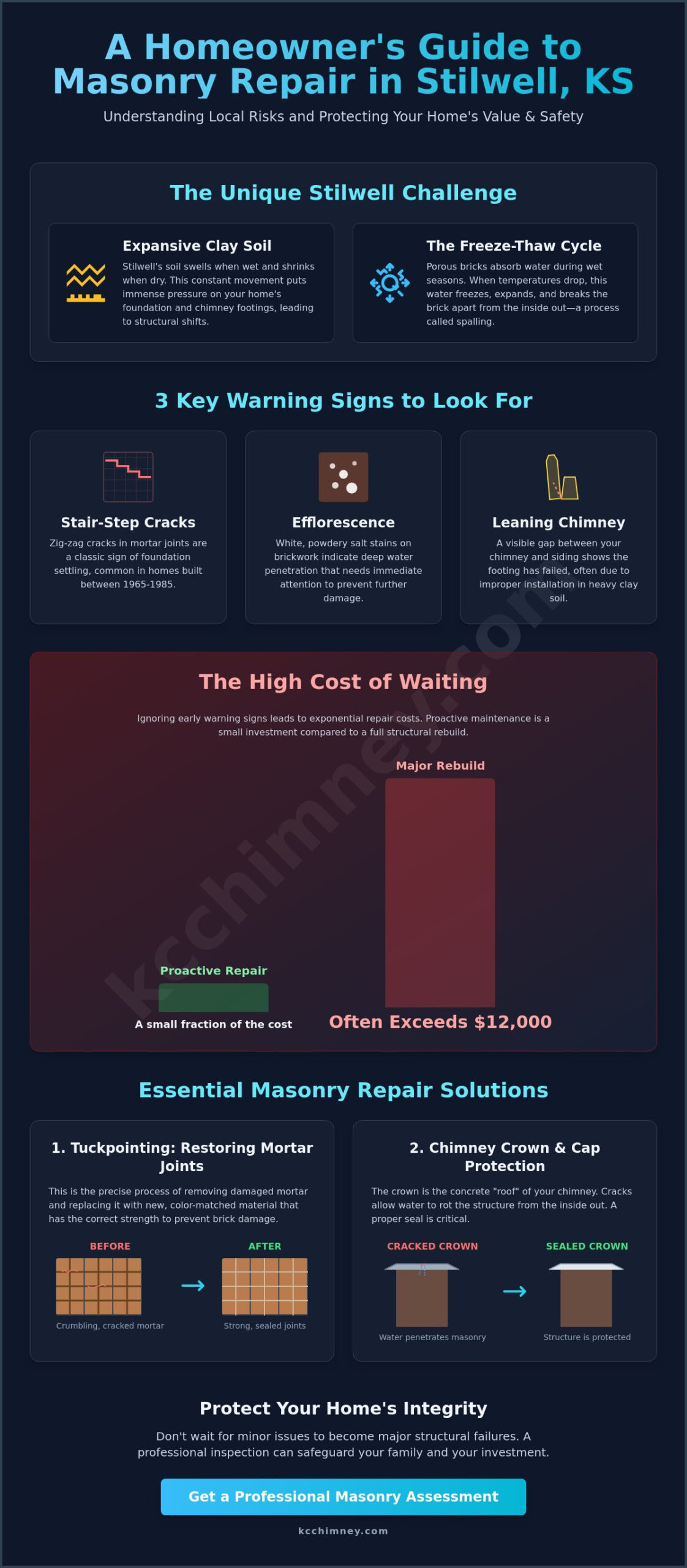
Stilwell homes face a unique challenge often called the “Stilwell Factor.” The region sits on high concentrations of expansive clay soil. This soil type expands significantly during wet seasons and contracts during droughts. This constant ground movement exerts thousands of pounds of pressure on masonry footings. Without proactive maintenance, this shifting leads to foundation instability that can crack a chimney stack in a single season. Safety remains our highest priority. Crumbling masonry is a leading contributor to chimney fires and carbon monoxide leaks, as cracks allow heat and toxic gases to bypass the flue and enter your living spaces.
Ignoring these issues often leads to an economic disaster. While a mortar touch-up or a crown repair is a manageable investment, waiting until the structure fails can result in a total teardown. In 2024, industry data showed that full chimney reconstructions often exceed $12,000, while early intervention costs a small fraction of that amount. Proactive care ensures your home remains a safe haven for your family.
The Kansas Freeze-Thaw Cycle and Your Bricks
Kansas springs are notoriously wet, and porous bricks act like sponges during these months. When temperatures drop below 32 degrees Fahrenheit in January, the trapped moisture freezes and expands. This internal pressure causes the brick material to break apart from the inside out. Spalling is the flaking or popping of brick faces due to internal pressure.
Signs of Masonry Distress in Local Architecture
You can often spot the need for masonry repair Stilwell by looking for specific patterns in your home’s exterior. Many Stilwell farmhouses built between 1965 and 1985 show “stair-step” cracks in the mortar joints, which indicates foundation settling. You might also notice efflorescence, which appears as white, powdery salt stains on your brickwork. This is a clear sign of deep water penetration that requires immediate attention. In newer Johnson County subdivisions developed after 2012, leaning chimneys have become a frequent sight. This usually happens when the original footings don’t account for the heavy clay soil, causing the masonry to pull away from the house siding.
Essential Masonry Services: Tuckpointing, Crowns, and Fireboxes
Your home’s exterior serves as the first line of defense against the elements. In Stilwell, where freeze-thaw cycles can happen 30 times or more in a single winter, the mortar between your bricks often bears the brunt of the weather. Professional masonry repair Stilwell ensures these small cracks don’t turn into structural failures. We focus on four key areas: the mortar joints, the chimney crown, the firebox, and the final protective seal. Each component must work in harmony to keep your hearth safe and your walls solid.
The Tuckpointing Process Explained
Tuckpointing is the precise art of removing damaged mortar and replacing it with fresh material. It’s not just about aesthetics; it’s about structural chemistry. We use specialized grinding equipment to remove old mortar to a uniform depth, usually about one inch. This creates a clean channel for the new material to bond. We match the new mortar’s strength and color to your original masonry. If the new mortar is harder than the brick, it’ll cause the brick faces to pop off during temperature changes. This technical detail is a core part of chimney repair Kansas City standards. For a deeper look at the technical requirements of this work, the National Park Service provides an excellent guide on Repointing Mortar Joints that emphasizes using the correct materials for longevity.
Protecting the Top: Chimney Crown and Cap
The chimney crown is the concrete slab that sits atop your chimney. Think of it as the roof of the structure. When this “hat” develops cracks, rain flows directly into the internal masonry. This moisture rots the chimney from the inside out, often hidden from view. A simple patch with hardware store caulk won’t last more than a season. We provide full crown resurfacing using fiber-reinforced materials that flex with the heat. A professional chimney inspection Kansas City is the only reliable way to catch these top-side issues before they cause ceiling leaks in your living room.
Inside the home, the firebox requires equal attention. This area must withstand temperatures exceeding 1,000 degrees Fahrenheit. We use high-heat refractory mortar to repair cracks in the firebrick, ensuring your family stays safe during every burn. Once the repairs are complete, we apply a vapor-permeable waterproofing sealant to the exterior. This allows the masonry to “breathe” while blocking liquid water from entering. If you’ve noticed crumbling mortar or white salt stains on your brick, it’s time to schedule a professional assessment to protect your home’s structural integrity. Taking action now prevents the need for a full chimney rebuild in the future.
Assessing the Scope: Minor Repair vs. Major Restoration
Deciding between a quick fix and a total overhaul is the most critical step in maintaining your home’s exterior. Choosing the right level of masonry repair Stilwell homeowners need depends on how deep the damage goes. If the mortar joints are receding but the bricks remain stable, you’re in the window for tuckpointing. This process involves scraping out old mortar and replacing it with fresh material, effectively sealing the system against the harsh Kansas freeze-thaw cycles of 2026.
The “Nick of Time” rule states that if more than 25% of the mortar is missing or crumbled, you’re on the verge of structural failure. You’ll know the masonry is too far gone for simple repairs if the bricks are “spalling,” which means the faces are flaking off, or if the chimney stack is visibly leaning. At that point, the brickwork has lost its load-bearing capacity and requires a full restoration to keep your family safe.
The flue liner also plays a silent but vital role in masonry health. It acts as a heat shield for the surrounding brick. If the liner is cracked, heat and moisture transfer directly into the mortar, causing it to bake and crumble from the inside out. This is especially relevant for those who have performed gas fireplace conversions. Modern gas inserts operate at different temperatures than wood fires. Without a properly sized liner, the resulting condensation can saturate the masonry, leading to rapid decay that tuckpointing alone can’t fix.
Evaluating Vertical Cracks vs. Horizontal Shifts
Vertical cracks often appear because of the expansive clay soils found in Stilwell. These usually signal that the foundation is settling. While they need attention, they’re often less urgent than horizontal shifts. Horizontal cracks suggest lateral pressure or a significant structural failure that could lead to a collapse. Any crack wider than a nickel requires immediate professional evaluation to prevent a total loss of the structure. You should also watch for “loose bricks” at the top of the chimney stack; these are falling hazards that indicate the crown has failed.
The Cost-Benefit of Early Intervention
Early intervention is a financial win for any property owner. Based on 2025 industry data, a standard tuckpointing job is significantly more affordable than a full chimney rebuild, which can cost five to ten times more. Beyond immediate safety, high-quality masonry repair Stilwell increases home resale value in our competitive local real estate market. Buyers want to see a “certified-safe” hearth during inspections. For residents who have already upgraded their systems, our guide on gas fireplace repair offers additional insights into keeping modern inserts and their masonry surrounds in peak condition.
A Maintenance Checklist for Stilwell Homeowners
Preventative care is the most effective way to protect your home’s value and ensure the safety of your family. In Stilwell, the 2026 weather patterns continue to show extreme swings between humid summers and freezing winters. These cycles put immense pressure on your brickwork. Regular monitoring allows you to catch small gaps before they turn into structural failures.
Start your routine with a visual binocular inspection every March and October. Stand back from your home and scan the chimney and exterior walls from top to bottom. Look for “stair-step” cracks in the mortar or bricks that appear to be flaking or “spalling.” This simple habit is safer than climbing a ladder and identifies 85 percent of visible exterior issues early. Don’t forget to check the attic. Look at the chimney breast for dark water staining or damp insulation. Moisture in the attic often signals a failing chimney crown or degraded flashing long before a leak reaches your ceiling.
Water management is your first line of defense. A standard 1,000 square foot roof section sheds approximately 600 gallons of water for every inch of rainfall. If your gutters are clogged or poorly positioned, that volume of water splashes back onto the base of your masonry. This saturation weakens the mortar and leads to the type of masonry repair Stilwell homeowners frequently face when foundation soil shifts. Finally, schedule a professional Level 2 inspection annually. These inspections follow NFPA 211 standards and utilize internal cameras to verify the integrity of your flue and masonry that the naked eye cannot see.
Seasonal Masonry Care in Johnson County
- Spring: Inspect for new cracks. The freeze-thaw cycles of a Kansas winter can cause existing gaps to expand by 10 percent or more as ice pushes against the brick.
- Summer: This is the ideal time for applying siloxane-based water repellents. These treatments require dry spells for maximum absorption into the pores of the brick.
- Fall: Clear all leaves and organic debris from the chimney crown. Debris traps moisture against the masonry, which will turn into destructive ice by December.
What to Ask Your Masonry Contractor
When interviewing a professional for masonry repair Stilwell, technical details matter. Ask if they use Type N or Type S mortar. Type N is generally preferred for residential brickwork because its lower 750 psi strength allows for more flexibility and breathability than the rigid 1,800 psi Type S. Using mortar that is too hard can actually crush your bricks over time.
Ensure the contractor is familiar with the specific brick types used in southern KC developments from the late 1990s and early 2000s. These often require custom color matching to maintain your home’s aesthetic. Always demand a video or photo report of the damage before the project begins. Transparency ensures you are paying for necessary structural work rather than cosmetic fixes.
Expert Masonry Solutions by Best Chimney Services
Best Chimney Services brings a neighborly approach to every project in Stilwell, Bucyrus, and Spring Hill. We recognize that the architectural charm of Johnson County requires specialized care, especially as homes age and face the harsh Kansas freeze-thaw cycles. Our technicians focus on the long-term health of your home. We don’t believe in quick fixes that fail after one season. Instead, we provide the high-quality masonry repair Stilwell residents need to protect their families and their property values.
Our team handles a wide range of projects with precision and technical mastery. We manage everything from minor tuckpointing that stops moisture intrusion to complex chimney relining that restores structural integrity. Every technician is trained to prioritize safety above all else. We follow a strict 15-point safety checklist on every job to ensure your venting systems meet current 2026 standards. Choosing a certified, local expert means you get the peace of mind that comes from knowing the job was done right the first time.
The Best Chimney Difference
We maintain a mess-free environment inside your home by using professional-grade dust containment systems and industrial HEPA vacuums. Our technicians treat your living room with the same respect they would their own. To provide total transparency, we utilize advanced internal video technology. This allows us to show you high-definition footage of your flue and masonry joints. You’ll see exactly where the mortar has failed and why a repair is necessary before we even pick up a trowel. Our 2026 commitment to Johnson County hearth safety ensures that we use the most durable materials available for the local climate.
Ready to Secure Your Hearth?
Booking your specialized masonry repair Stilwell evaluation early is the best way to avoid the peak winter rush. By the time the first frost hits in October, our schedule often fills up for several weeks. A proactive inspection identifies small hairline cracks before they expand into expensive structural failures. We offer a streamlined scheduling process to make protecting your home as simple as possible. Don’t leave your family’s safety to chance when the Kansas winds pick up this winter.
Protect Your Stilwell Home for the Long Term
Maintaining your home’s exterior is a commitment to safety and structural longevity. By addressing issues like deteriorating mortar or cracked crowns early, you prevent minor moisture intrusion from becoming a major structural failure. Our team has served Johnson County as a locally owned and operated business since 2012, bringing CSIA-certified expertise to every project. We focus on high-integrity restorations that respect your property, ensuring your chimney and brickwork remain resilient against the Kansas climate. Professional masonry repair Stilwell homeowners trust is about doing the job right the first time to avoid costly rebuilds later. We prioritize mess-free work sites and technical precision to keep your fireplace safe and functional.
Don’t wait for visible gaps or water damage to threaten your home’s stability. Our methodical inspection process provides the thoroughness you need for total peace of mind. Get a Professional Masonry Evaluation in Stilwell today. We’re here to help you preserve your family’s hearth with the care and precision your investment deserves.
Frequently Asked Questions
How much does masonry repair typically cost in Stilwell, KS?
Costs depend on the scope of work and the current condition of your home. According to 2024 Angi data, homeowners across the country typically pay between $500 and $2,500 for localized masonry repairs. Larger structural projects or full chimney reconstructions can exceed $5,000 depending on the materials required. We focus on providing clear, honest assessments so you only invest in the specific repairs needed to keep your family safe.
What is the difference between tuckpointing and repointing?
Repointing is the essential process of removing decayed mortar and replacing it with fresh material to restore the wall’s structural integrity. Tuckpointing includes this same repair but adds an aesthetic finish where we use two different mortar colors to create a perfectly straight, thin joint line. This technique gives your Stilwell home a sharp, renewed appearance while providing the same 25 year weatherproofing benefits as standard repointing.
How do I know if my chimney crown is cracked?
You can identify a failing chimney crown by looking for visible fissures or “spiderweb” patterns on the concrete slab at the very top of your chimney. The Chimney Safety Institute of America (CSIA) reports that even a 1/16 inch crack allows enough water to enter the system to cause serious internal damage during a Kansas winter. If you see chunks of concrete on your roof or in your gutters, the crown has likely reached a critical failure point.
Can I use regular mortar to fix my fireplace bricks?
You shouldn’t use standard Type N or S mortar for fireplace interiors because it can’t withstand the 2,000 degree Fahrenheit temperatures generated by a wood fire. We use specialized refractory mortar designed to expand and contract without crumbling under extreme heat. Using the wrong material often results in the mortar failing within 30 days of your first fire, which creates a significant safety risk for your household.
How long does a professional tuckpointing job last?
A professional tuckpointing job typically lasts between 20 and 30 years when it’s done with the correct mortar mix and proper depth. The longevity of masonry repair Stilwell projects is often influenced by our local climate, which includes over 40 freeze-thaw cycles annually. We recommend a professional inspection every 12 months to ensure your mortar joints are still shedding water effectively and protecting your home’s structural bones.
Does homeowner’s insurance cover chimney masonry repair?
Most standard insurance policies only cover masonry repair if the damage is the direct result of a sudden, unexpected event like a lightning strike or a 50 mph windstorm. They don’t usually pay for repairs caused by age, lack of maintenance, or gradual water penetration over several seasons. It’s best to check your specific policy’s “Section I – Property Coverages” to see if your chimney has protection against accidental damage or natural disasters.
What is spalling and why is it happening to my brickwork?
Spalling occurs when the face of a brick peels, flakes, or pops off entirely because of moisture trapped inside the material. This happens during the freeze-thaw cycle when water enters porous bricks and expands by 9 percent as it turns to ice, pushing the brick face outward. In Stilwell, this is a frequent issue for chimneys that haven’t been treated with a professional grade, vapor-permeable water repellent to block moisture absorption.
Is it safe to use my fireplace if I see cracks in the mortar?
It isn’t safe to use your fireplace if you see visible cracks because these gaps can allow heat, sparks, and carbon monoxide to escape into your home’s walls. According to the National Fire Protection Association (NFPA) 211 standards, any breach in masonry integrity requires a professional evaluation before you light the next fire. Small external cracks often hide larger internal voids that could lead to a house fire if they’re left unaddressed.