
Last Tuesday, a seller named Sarah in the Oak Park neighborhood of Overland Park watched a potential $450,000 sale stall because of a single cracked flue tile. It’s a scenario we see often in Johnson County, where a standard home inspection flags a fireplace but lacks the specialized video equipment to confirm if it’s actually safe to use. You’ve likely spent weeks preparing your home for the market, and the last thing you want is a surprise discovery during a chimney inspection for home sale Overland Park to delay your closing date.
We understand that the uncertainty of specialized inspections can feel like a hurdle. This guide will help you secure your transaction by explaining why a professional Level 2 inspection is your best defense against last minute negotiations. You’ll gain total clarity on the National Fire Protection Association (NFPA) 211 standards that local realtors now expect for 2026. We’ll walk through exactly what inspectors look for, how to interpret repair estimates, and the steps you need to take to ensure a passed report for a smooth closing.
Key Takeaways
- Understand why NFPA 211 standards make a professional chimney inspection for home sale Overland Park a mandatory step to protect your investment and satisfy real estate contingencies.
- Learn how high-resolution internal cameras identify hidden safety hazards in the flue and masonry that a basic visual check cannot detect.
- Identify common structural vulnerabilities unique to Overland Park’s 1980s housing stock and historic “recycled brick” masonry.
- Master the essential preparation steps for sellers and the critical questions buyers must ask to ensure a transparent and stress-free walkthrough.
- Discover how leveraging local expertise and certified safety standards helps safeguard your family’s hearth and your home’s long-term value.
Why a Chimney Inspection is Mandatory for Overland Park Home Sales
Overland Park real estate transactions move fast, but safety standards for the family hearth are non-negotiable. While a general home inspector checks the overall condition of a house, they lack the specialized tools to certify a fireplace as safe for use. This is why a professional chimney inspection for home sale Overland Park is a standard requirement for modern listings. Most buyers now expect a clean bill of health for the masonry before they sign on the dotted line. It’s about protecting the investment and the lives of the people who will live there.
Understanding NFPA 211 Standards
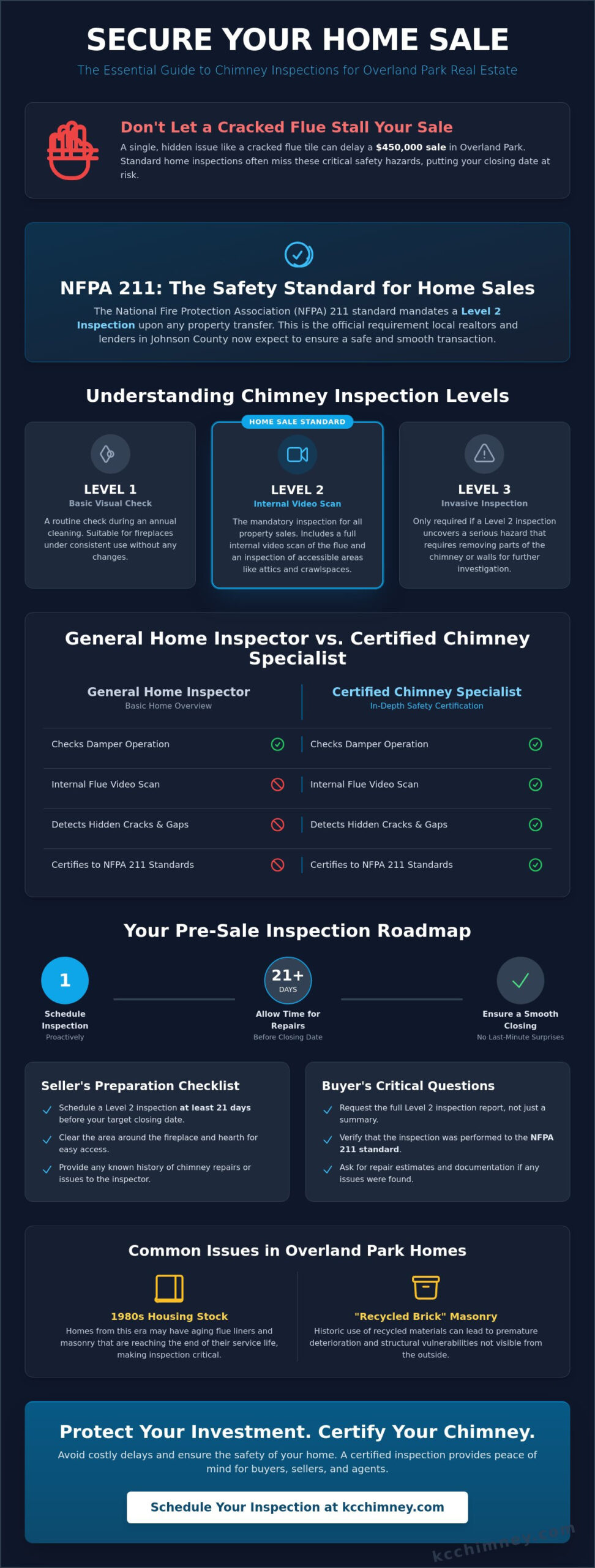
The National Fire Protection Association (NFPA) sets the benchmark for fireplace safety through a set of codes known as NFPA 211. According to these 2026 standards, any transfer of property ownership triggers a mandatory Level 2 evaluation. A Level 2 inspection is a non-invasive but comprehensive internal and external review of the chimney system, including all accessible portions of the flue and structure. While a basic maintenance check is fine for annual cleanings, a property sale requires a deeper look. This process involves a high-resolution camera lowered through the flue to check for cracks, missing mortar, or hidden creosote buildup that could lead to a house fire.
The Role of Chimney Inspections in Johnson County Real Estate
Local realtors in Overland Park use these detailed reports to protect their clients’ interests during the negotiation phase. If a flue liner is cracked or the masonry crown is crumbling, the report provides the documentation needed to request repair credits or price adjustments. A failed inspection can stall a closing or decrease a home’s valuation by several thousand dollars if major structural issues are found. To avoid delays, sellers should schedule their chimney inspection for home sale Overland Park at least 21 days before their target closing date. This allows time for any necessary repairs to be completed without rushing the process.
- Level 1: A visual check of the fireplace and damper during a routine chimney sweep visit.
- Level 2: The standard for home sales, requiring video scanning of the internal flue and inspection of attics and crawlspaces.
- Level 3: Required only when a Level 2 reveals a serious problem that requires removing parts of the wall or chimney structure to access.
A general home inspector’s report isn’t a substitute for a specialist’s certification. These inspectors often only check if the damper opens and closes. They don’t have the specialized cameras or the training needed to see the internal integrity of the clay tiles or stainless steel liners. Relying on a generalist leaves both the buyer and seller at risk of discovering expensive safety hazards after the keys have changed hands. Our team ensures that every component, from the hearth to the cap, meets the rigorous safety standards required by Johnson County lenders and insurers.
Inside the Level 2 Inspection: What Overland Park Homeowners Should Expect
When you schedule a chimney inspection for home sale Overland Park, you aren’t just getting a quick glance up the flue. A Level 2 inspection is a standardized, rigorous process required by the NFPA 211 standard whenever a property changes hands. This protocol ensures that every accessible part of the venting system is scrutinized for safety and structural integrity. Our team examines the chimney from the basement or crawlspace to the attic and the roofline. We specifically look for proper clearances to combustible materials like wooden joists and insulation; a single 1-inch deficiency in these hidden areas can pose a significant fire risk during regular use. This thoroughness protects the homeowner’s family today and the buyer’s investment tomorrow.
The Video Scanning Process
The centerpiece of a modern inspection is the high-resolution internal camera. This specialized tool travels the full length of the flue to identify issues that the naked eye simply cannot see from the hearth. We look for hairline fractures in clay liners or gaps in mortar joints that could allow heat or carbon monoxide to seep into your home’s framing. The process includes a detailed view of the smoke chamber and the damper assembly to confirm they operate smoothly and remain airtight. For both buyers and sellers, this documented video evidence provides a transparent record of the chimney’s condition, removing the guesswork from the negotiation table. If you’re preparing your home for the market, you can book a professional evaluation to ensure your hearth is ready for its close-up.
Evaluating the Exterior and Structural Integrity
Our technicians also scale the roof to inspect the “crown” of the chimney, which is the concrete slab that sheds water away from the masonry. In the variable Kansas climate, freeze-thaw cycles often cause these crowns to crack; this leads to water damage in the brickwork below. We check the metal flashing for a watertight seal and verify that the masonry joints are solid. A critical component is the chimney cap; without a properly installed cap, local wildlife like squirrels or raccoons can easily enter and nest in the flue. This comprehensive exterior check is part of our commitment to providing an Expert Chimney Inspection in Kansas City that protects your investment. The final report we provide serves as a legal document for the sale. It includes a line-by-line breakdown of the system’s health, high-definition photos of any defects, and professional recommendations for repairs. This document gives the buyer peace of mind and protects the seller from future liability claims. It ensures that the chimney inspection for home sale Overland Park process is handled with the precision your family deserves.
Common Chimney Issues in Overland Park Housing Stock
Overland Park’s housing landscape reflects the rapid suburban expansion of the 1980s. During this era, thousands of homes were constructed quickly to meet rising demand. This speed often resulted in specific architectural vulnerabilities that only become apparent during a chimney inspection for home sale Overland Park. In older, historic pockets of the city, builders frequently used “recycled brick.” While these salvaged materials offer a charming, weathered aesthetic, they often lack the structural density of modern fired brick. These porous bricks fail prematurely when subjected to the harsh Midwestern elements, leading to crumbling facades that threaten the home’s exterior integrity.
Johnson County’s heavy clay soil adds another layer of complexity. This soil is highly expansive, meaning it shifts significantly based on moisture levels. These ground movements put immense pressure on a home’s foundation and its chimney stack. This shifting frequently causes vertical cracks in clay flue liners. Because these cracks are hidden from view, they are often missed until a professional technician performs a Level 2 camera scan during a real estate transaction.
Kansas City’s climate is particularly brutal on masonry. Our region experiences 50 to 70 freeze-thaw cycles every winter. When water enters small pores in the mortar or the chimney crown, it expands by 9% upon freezing. This internal pressure shatters the bond between bricks and creates gaps in the crown. Without a solid, waterproof crown, moisture pours into the internal structure, rotting wood framing and rusting fireboxes from the inside out.
1980s Construction and Pre-Fab Fireplaces
Many subdivisions in Overland Park feature “zero-clearance” or factory-built fireplaces rather than traditional masonry. These systems are metal appliances designed with a finite lifespan. Most manufacturers rate these units for 20 to 30 years of service. Since many local homes date back to 1985 or 1995, these fireplaces are currently reaching their failure age.
Signs of trouble are often visible on the home’s exterior. Look for orange rust streaks on the metal chimney chase or the siding. If you see staining, the internal components are likely corroding. This creates a fire hazard that can stop a home sale. These systems require specialized knowledge to evaluate, as their safety depends on specific clearances to combustible materials that were often ignored during the initial construction boom.
Masonry Deterioration and Tuckpointing Needs
Moisture is the primary enemy of a brick chimney. When water becomes trapped inside the brick, it causes “spalling,” a process where the face of the brick literally pops off. This leaves the soft, unprotected interior of the brick exposed to further decay. Timely chimney repair in Kansas City is essential to stop this cycle before it leads to a total structural collapse.
Cracked clay liners remain the most common reason Overland Park chimneys fail inspections. These cracks allow heat and toxic gases to escape the flue and reach the wooden “bones” of the house. During a chimney inspection for home sale Overland Park, we prioritize identifying these hidden gaps. Ensuring the flue is gas-tight isn’t just about passing an inspection; it’s about protecting the next family that will call the house a home.
Preparing for Your Inspection: Tips for Sellers and Buyers
A chimney inspection for home sale Overland Park is a pivotal moment in the real estate transaction. It represents the transition from “interested” to “invested” for the buyer, and from “listed” to “sold” for the seller. Preparing the property correctly ensures the inspector can evaluate all 21 points of a standard Level 2 safety check without delays or “unable to access” disclaimers that can stall a closing.
The Seller’s Pre-Inspection Checklist
Sellers can streamline the process by making the fireplace the focal point of the room, but not with decor. Clear all furniture, rugs, and seasonal decorations at least 3 feet away from the hearth. This provides the technician enough space to set up specialized cameras and drop cloths. Accessibility is the most common hurdle during an inspection. If your home has an attic or a crawlspace where the chimney stack is visible, ensure the path to these areas is clear of storage boxes or debris.
- Clear the hearth: Remove ash and charred wood from the firebox so the floor and walls are visible.
- Provide utility access: Ensure the inspector can get to the roof and any basement clean-out doors.
- Document history: Gather receipts for chimney sweeping in Kansas City from the last 2 years. Showing a history of professional care builds immediate trust with a buyer.
Negotiating Repairs After the Report
When the report arrives, it won’t typically use a simple “Pass” or “Fail” grade. Instead, it identifies “Deficiencies” or “Hazards” based on NFPA 211 standards. Buyers should look for safety-critical issues like cracked flue liners, missing chimney caps, or excessive creosote buildup. These are non-negotiable safety hazards that often require immediate attention before a fireplace is used. In contrast, minor hairline cracks in exterior masonry might be labeled as maintenance items rather than urgent repairs.
If the report reveals significant issues, use a professional estimate to guide your negotiations. In the current Overland Park market, sellers often provide a closing credit based on a certified technician’s quote. This approach allows the buyer to oversee the repairs after move-in, ensuring the work meets their specific expectations. Having a CSIA-certified technician perform the repairs before the final walkthrough is another high-integrity option that prevents last-minute surprises. Don’t let a repair list derail your sale; treat it as a roadmap to a safer home.
Ready to move forward with your home sale? Schedule a professional Level 2 chimney inspection to protect your investment and ensure a smooth closing.
Trust Best Chimney Services for Your Overland Park Real Estate Inspection
Since 2012, our team has remained dedicated to the safety of families across the Overland Park and Mission Hills communities. We don’t view ourselves as just another service provider. We’re your neighbors. Our technicians hold professional certifications that ensure every inspection meets the specific architectural requirements found in Johnson County homes. Whether you own a mid-century ranch or a newer build, we understand the unique venting needs of local properties. We know that real estate transactions are high-stakes environments, so we prioritize reliability and technical mastery in everything we do.
We respect your home as much as you do. Our “No-Mess” guarantee ensures that your living space remains pristine throughout the process. We use specialized drop cloths and industrial-grade HEPA vacuums to capture every particle of soot or debris. Real estate agents and lenders trust our comprehensive reporting because it’s clear, photo-documented, and honest. These reports provide the transparency needed for quick closings, helping both buyers and sellers avoid 11th-hour surprises that could derail a contract.
Why Local Expertise Matters
Building codes vary significantly between Spring Hill, Stilwell, and Bucyrus. We’ve spent 14 years studying these local nuances to ensure your chimney inspection for home sale Overland Park meets every safety standard. Our reputation is built on honest, no-nonsense evaluations that put safety before sales. We provide the facts you need to negotiate fairly, whether a property requires gas fireplace repair or a complete stainless steel relining. We focus on the long-term integrity of the masonry so the next family can enjoy the hearth with total peace of mind.
Schedule Your Home Sale Inspection Today
The 2026 real estate market moves fast, and delays can be costly. We recommend booking your chimney inspection for home sale Overland Park as soon as you decide to list your property. This proactive step allows you to address potential issues on your own timeline rather than rushing during a closing period. We offer flat-rate inspection pricing to keep your transaction costs predictable and transparent. Call our office or visit our website today to secure your appointment. Let our experts provide the professional evaluation you need to ensure your home sale goes smoothly from start to finish.
Secure Your Overland Park Closing with Professional Confidence
Navigating the 2026 real estate market requires transparency and technical accuracy to ensure a successful transaction. A professional Level 2 inspection protects your investment by identifying hidden flue issues or masonry damage before they stall a contract. Since 2012, KC Chimney has served Johnson County homeowners by providing the clarity needed for smooth transitions. Our CSIA Certified Technicians use advanced camera equipment to deliver detailed video inspection reports that satisfy both lenders and buyers during the due diligence period. Our team understands the specific architectural needs of Kansas City homes and the rigorous safety standards required for a modern sale. Securing a professional chimney inspection for home sale Overland Park ensures your family’s hearth is safe and your property’s value remains protected. You shouldn’t leave your closing to chance when you can have a local expert verify the integrity of your venting system. We’ve built our reputation on doing it right the first time, helping thousands of neighbors move forward with total peace of mind. Let’s get your home ready for its next chapter today.
Schedule Your Overland Park Home Sale Inspection Today
Frequently Asked Questions
Is a Level 2 chimney inspection required by law in Kansas?
Kansas state law doesn’t explicitly mandate a Level 2 chimney inspection, but the National Fire Protection Association (NFPA) 211 standard requires one for every real estate transfer. Most local Overland Park lenders and insurance companies follow these safety protocols to protect the property’s integrity. Skipping this step often creates liability issues during the closing process if a fire occurs later.
How much does a chimney inspection for a home sale cost in Overland Park?
According to 2024 data from HomeAdvisor, a professional chimney inspection for a home sale in Overland Park typically ranges between $300 and $600 depending on the number of flues. This investment ensures that hidden defects like cracked flue liners or masonry gaps are identified before the sale. Costs vary based on the complexity of the venting system and the total height of the structure.
Can a general home inspector perform a Level 2 chimney inspection?
General home inspectors aren’t qualified to perform a Level 2 inspection because they lack the specialized video scanning equipment required by NFPA standards. They usually conduct a visual check that only covers readily accessible areas. A CSIA certified technician must use a chimney camera to examine the internal flue tiles for cracks or creosote buildup that a generalist will miss.
What happens if the chimney fails the inspection during a home sale?
If a chimney fails inspection, the seller usually chooses to repair the defects, offer a financial credit at closing, or lower the sale price. Common failures include damaged flue liners or masonry crowns that compromise fire safety. We provide a detailed report with internal photos so both parties can negotiate based on factual evidence of the chimney’s condition and safety status.
How long does a professional Level 2 chimney inspection take?
A thorough Level 2 inspection typically takes between 60 and 90 minutes to complete. This timeframe allows our technicians to set up the video scanning system, inspect the attic and crawl spaces, and evaluate the exterior masonry. We focus on a methodical process to ensure every safety component meets current building codes before we issue the final digital report to all parties.
Do I need an inspection if I have a gas fireplace instead of wood-burning?
You still need a professional chimney inspection for home sale Overland Park even if you only have a gas fireplace. Gas units produce carbon monoxide and moisture that can deteriorate flue liners or cause venting blockages over time. We check for proper clearance to combustibles and ensure the gas shut off valves function correctly to keep the new family safe and warm.
Should the buyer or the seller pay for the chimney inspection?
Payment for the inspection is entirely negotiable, but the buyer typically pays for it as part of their due diligence period. However, 40 percent of sellers in the Kansas City area now pay for a pre-listing inspection to prevent surprises that could delay the closing. This proactive approach builds trust with potential buyers and proves the home’s heating systems are in top condition.
How far in advance should I schedule my inspection before closing?
You should schedule your inspection at least 14 to 21 days before your scheduled closing date. This window provides enough time to review the findings and complete any necessary repairs if the technician discovers a safety hazard. During the peak autumn season, our schedule fills up quickly, so calling early ensures you meet your contract deadlines without any unnecessary stress.