
Damaged mortar joints between brick or stone can be repaired through tuckpointing, which removes deteriorated mortar and fills the joints with fresh material. For homeowners considering tuckpointing services in Stilwell, KS, an on-site assessment can show which areas need attention and help shape a free quote. The right repair depends on the condition of the masonry and the scope of the work.
It’s reasonable to want clear answers before arranging repairs, especially when mortar is cracked, missing, or weathered. This guide explains how tuckpointing works, what a site assessment typically reviews, and how to use a quote and customer reviews to understand the proposed work. You’ll also learn what can affect a project’s scope and when to consider professional help, so you can make a practical choice for your home.
Key Takeaways
- Tuckpointing renews deteriorated mortar joints between brick or stone; the condition and extent of the damage shape the repair.
- An on-site assessment can identify affected areas and clarify the work included in a quote.
- Review the written scope to understand which joints will be repaired and what the proposed work covers.
- Customer reviews are more useful when they describe the actual work and its quality, not just the overall experience.
- A free quote can help you understand the project before deciding whether to proceed.
Repairing mortar joints between brick or stone
Tuckpointing repairs mortar joints that have cracked, eroded, or separated from brick or stone. The work typically involves removing failing mortar, cleaning the joint, and packing it with compatible fresh mortar. Some tuckpointing also finishes the joint with a narrow lime-mortar ridge. In Stilwell, matching the existing masonry matters as much as filling visible gaps.
How do you know whether brick mortar needs tuckpointing or full repointing? If deterioration is limited to certain joints, a targeted repair may address those areas; widespread damage across a wall can call for repointing many joints. An inspection should distinguish surface wear from loose brick, deep gaps, or other damage before the work is defined.
Material choice depends on the brick’s age, hardness, and existing mortar. Older, softer brick can be damaged by mortar that is too hard, so the wall should be assessed before selecting a mix. Mortar that differs noticeably in texture or color can leave a patchy finish, while incompatible strength can put stress on brick faces. A sample area helps compare the repair with the surrounding masonry.
Crumbling brick needs more than fresh mortar. Tuckpointing can restore failed joints, but it doesn’t replace deteriorated brick or correct structural movement. A stepped crack through several bricks, a bulging wall, or a crack continuing into an interior ceiling calls for a broader assessment. Brick replacement or structural repair may be needed before mortar work. New masonry construction is different from tuckpointing: it builds new walls or features rather than repairing existing joints.
Do Stilwell or Johnson County permits apply to residential tuckpointing? Requirements depend on the work’s scope and the property’s jurisdiction; repairing joints differs from changing a wall or making structural alterations. Check applicable local requirements before work that extends beyond mortar repair.
Which contractors offer tuckpointing services in Stilwell, KS? Best Chimney Services provides tuckpointing in the Kansas City metro, including Stilwell and nearby communities such as Overland Park, Mission Hills, Bucyrus, and Spring Hill. When comparing proposals, look for a clear description of the mortar-joint repair and the areas included.
What materials and mortar types are suitable for tuckpointing older brick homes in Kansas? The suitable mix depends on the original mortar and brick, not a one-size-fits-all recipe. What warranty should I expect for tuckpointing work? Warranty terms differ, so review the written coverage, exclusions, and covered work before approving a project.
Cold-weather conditions also affect planning. According to the U.S. Environmental Protection Agency, below the specified minimum temperature, the contractor must submit a written proposal for protecting masonry against cold weather. A clear scope should identify the affected joints, any brick replacement, and the expected finish.
Freeman Masonry describes tuckpointing as finishing or repairing mortar joints between bricks or stones with a narrow ridge of lime mortar. The defining detail is that narrow lime-mortar ridge; this description covers both joint repair and a finished joint treatment, rather than limiting tuckpointing to only one purpose.
Free on-site estimates
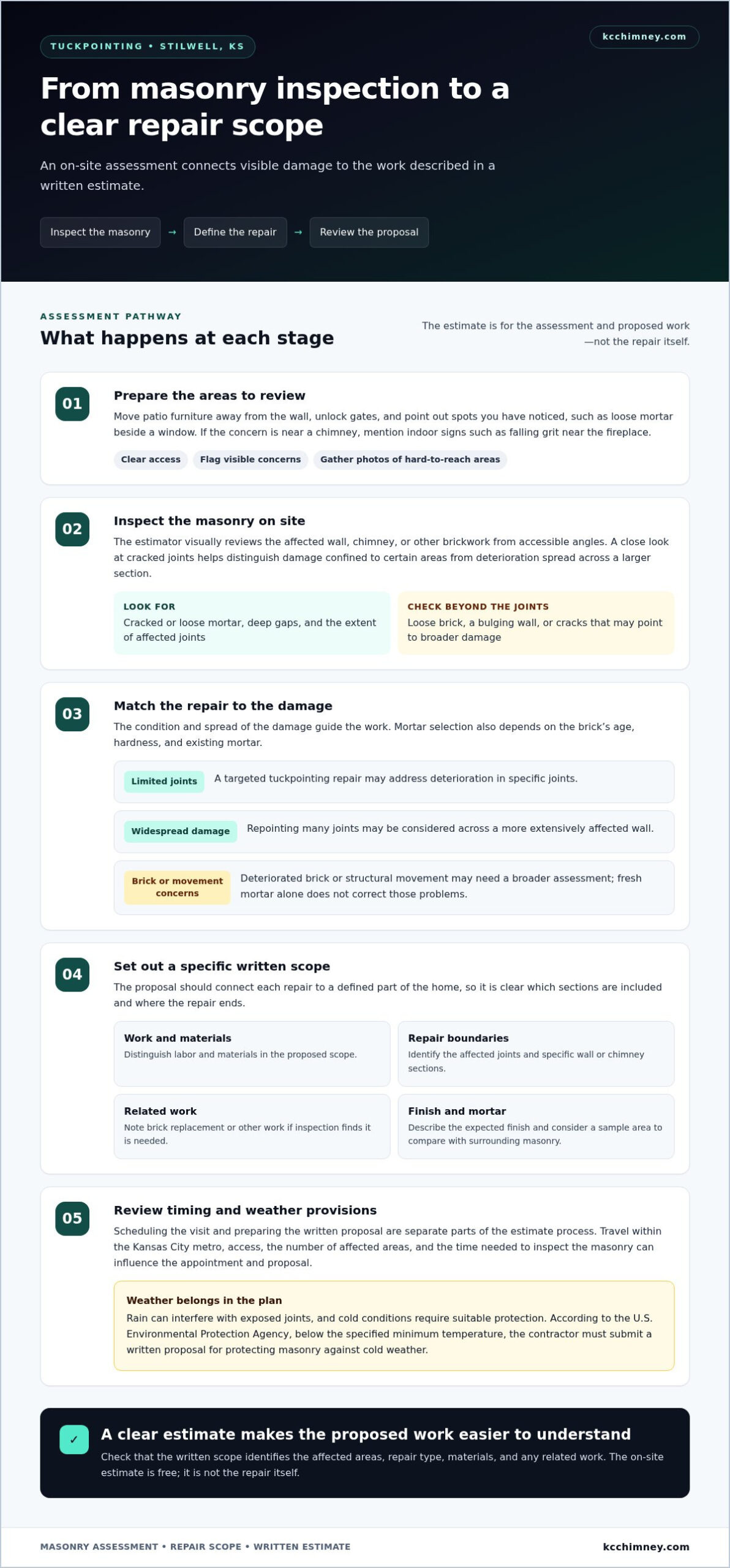
An on-site assessment begins with a visual review of the masonry, not a guess from a street view or a single photograph. The estimator looks at the affected wall, chimney, or other brickwork from accessible angles. A close view of cracked joints can show whether deterioration is local or spread across a larger area. That visit helps define the work the quote should cover.
For a home in Stilwell, clear access makes the visit more useful. Move patio furniture away from the wall, unlock gates, and point out areas you’ve noticed, such as loose mortar beside a window. If the concern is near a chimney, mention indoor signs, including falling grit near the fireplace. These details provide context but don’t replace a direct inspection.
A free estimate means there’s no charge for the on-site assessment and proposed work. It isn’t the repair itself. The estimate should distinguish labor and materials in the proposed scope, identify which sections need attention, and note related work if the inspection finds it. For example, a quote for a short wall section should describe that area, rather than leave the repair boundary unclear.
Estimate timing has two parts: arranging the visit and preparing the written proposal afterward. Travel within the Kansas City metro, access to the masonry, and the number of affected areas shape the appointment. The estimator may need more time to examine a tall chimney than an exposed ground-level wall. After the visit, the proposal takes into account joint condition, access equipment, mortar selection, and any brick replacement.
What is the tuckpointing process, and how long does a typical project take? The mason removes failing mortar, cleans the joints, installs compatible mortar, and finishes the surface. A small, accessible repair takes less work than extensive joints on a chimney or multiple walls; height, damage, and weather affect the schedule.
Kansas weather also influences when mortar work can proceed and how it cures. Rain can interfere with exposed joints, while cold conditions require suitable protection. According to the U.S. Environmental Protection Agency, below the specified minimum temperature, the contractor must submit a written proposal for protecting masonry against cold weather. Ask that the plan identify the protected work area and relevant weather precautions.
Before the visit, gather photos of hard-to-reach areas and write down the locations of visible damage. During the assessment, ask the estimator to connect each proposed repair to a specific part of the home. You can also review what to prepare for a masonry assessment before the appointment.
Customer reviews and work quality
Reviews can offer insight into how a contractor communicates, manages work areas, and finishes masonry repairs. Read comments about tuckpointing specifically, rather than relying only on general praise for punctuality or friendliness. A detailed review might describe a basement wall, the joints repaired, and how the finished mortar looked. That gives you a clearer basis for comparing customer experiences.
A Google reviewer said a home inspector who had seen hundreds of homes praised the tuckpointing in the reviewer’s basement. The useful detail is the observed work, not simply the positive rating. Look for reviews describing a particular wall or chimney, clear project communication, and cleanup after the repair. Those examples help distinguish first-hand accounts from short comments with little context.
How can you compare tuckpointing contractors and verify licenses, insurance, and reviews in Kansas? Compare written scopes for the same areas, request proof of insurance, and verify any claimed license with its issuing authority. Read detailed reviews for examples of mortar work, communication, and completed repairs.
Work quality is visible in the joints as well as the surrounding brick. Check whether repaired mortar appears consistently filled and neatly tooled, without obvious smears across brick faces. A close-up photo can help you compare the repaired section with nearby original masonry. Color differences can occur between old and new mortar, so assess the overall finish alongside the written scope, not from one detail alone.
Reviews are most useful when they match your project. A customer’s account of basement joints can inform expectations for similar interior masonry, while chimney work involves different access and exposure. Read several accounts for recurring details, such as whether the contractor explained the repair boundaries or addressed questions. One glowing comment or complaint doesn’t describe every project, but patterns across detailed reviews offer useful context.
Before choosing, use a simple comparison checklist: match the proposed repair areas, mortar work, and cleanup expectations. Keep each written scope beside relevant review examples. If a review mentions a repaired wall but the quote describes only a small section, note that difference before deciding. Also review written warranty terms for covered work and exclusions; don’t assume a positive review defines the warranty.
Photographs and reviews can support your decision, but the written scope connects expectations to the actual job. Keep the estimate, project notes, and any agreed changes together. If the assessment identifies both a chimney joint and nearby brick damage, the documents should clarify which work is included. This makes it easier to compare the finished result with the agreed repair.
A Stilwell customer requested replacement of two water-damaged ceiling areas in a kitchen and hallway, each approximately 4 x4. That kind of project detail can make a customer account easier to compare with a contractor’s stated work: the locations, damage, and approximate area are clear. When reading reviews, look for similarly concrete descriptions of what was repaired and where, then compare those details with the proposed scope rather than treating a general endorsement as proof of matching work.
On-site job assessment and written scope
An on-site assessment connects visible mortar damage to a defined repair area. The estimator examines the wall from accessible angles, noting open joints, loose brick, and areas needing closer inspection. A crack beside a window, for example, may affect several joints, while nearby mortar remains sound. Identifying both conditions helps prevent a quote from treating the whole wall as one uniform repair.
Access affects what an assessment can establish. A ground-level brick wall can be viewed closely, while a tall chimney may require additional access planning. Point out concerns on more than one side of the house, including locations partly hidden by shrubs or a roofline. Photos of hard-to-see areas can help guide the visit, but the written scope should identify what the estimator actually assessed.
How do contractors estimate tuckpointing costs for a home? They consider the amount and condition of mortar, the repair area, access requirements, mortar selection, and any related brick replacement. Best Chimney Services provides transparent pricing with no hidden fees, and the estimate sets out the proposed work.
A useful written scope names the locations and work, rather than saying only “masonry repair.” For example, it could identify joints along a chimney’s exposed side, describe mortar removal and replacement, and list brick replacement separately if needed. If one section is excluded, the document should distinguish it from included work. That gives everyone a shared reference.
Location can shape assessment logistics without changing what the masonry needs. A home in Stilwell, Overland Park, Mission Hills, Bucyrus, or Spring Hill may have different access arrangements. The scope should still describe the property areas, materials, and tasks. Don’t assume a nearby Kansas project includes the same work; compare the actual written descriptions.
Before approving a proposal, match each observed issue to a listed repair. If the estimator notes open joints beside a window, find that area in the scope. Check whether cleanup, protection of nearby surfaces, and requested brick replacement are described. Ask for unclear wording to be explained in writing, especially if “as needed” leaves the repair boundary uncertain.
Keep the assessment notes, proposal, and project photos together. If conditions change after work begins, such as loose brick appearing beneath removed mortar, document the finding and any revised scope before additional work proceeds. A clear written change records the newly discovered area and its effect on the repair plan. This helps prevent confusion between the original quote and the completed masonry work.
Free, no-obligation quotes
A quote gives you a chance to review proposed masonry work before deciding. For homeowners comparing tuckpointing services in Stilwell, KS, Best Chimney Services provides tuckpointing with transparent pricing and no hidden fees. The quote should connect the proposed work to specific joints, walls, or chimney areas. A description such as “repair brickwork” leaves the work boundary unclear; identifying the affected section and repair tasks is more useful.
A free quote means there’s no charge for receiving the proposal. It doesn’t mean the masonry repair itself is free. Best Chimney Services provides transparent pricing with no hidden fees. Key factors include the amount of deteriorated mortar, the height and access of the work area, mortar selection, and any related brick replacement.
Use the quote to understand what’s included. A proposal might cover deteriorated joints along one chimney face, while leaving other walls outside the stated scope. Look for the repair location, planned mortar work, and any separate tasks. If the home has a commercial masonry area as well as residential brickwork, make sure each area appears distinctly in the proposal.
Before accepting, compare the scope with the visible concerns you raised. If you pointed out open joints beside a doorway, check that the proposal addresses that location. Note whether the document describes access needs or related work, such as replacing damaged brick. These details help prevent a mismatch between the repair you expected and the work described.
A no-obligation quote lets you review the proposed scope without committing to the project. Take time to read it, compare its repair boundaries with your notes, and keep a copy for reference. If a line says “as needed,” ask for clearer wording about the area or task. Specific language makes the proposal easier to understand before you decide.
Quotes are also useful records when project details change. If removing deteriorated mortar exposes a loose brick, the contractor can explain the finding and document any proposed change. Compare that update with the original scope before authorizing additional work. Keep both versions together so the agreed repair and any revision remain clear.
For a free quote, share the property location, describe the masonry concern, and arrange an on-site assessment. A quote for tuckpointing services in Stilwell, KS can help define the work before you make a decision. Photos can help point out areas to examine, while the written proposal defines the work. Use request a free tuckpointing quote to take the next step for your Stilwell home.
Best Chimney Services: Chimney Sweeping
Best Chimney Services can help when a masonry concern also raises questions about fireplace or chimney care. Tuckpointing addresses deteriorated mortar joints; chimney sweeping is a separate part of maintaining fireplace safety and efficiency. If your fireplace needs routine cleaning or you’re considering chimney relining after identifying a flue concern, these services may be a relevant next step. Crown repair can address damage to the chimney crown, separate from mortar joints between bricks.
Keeping the work clearly defined helps you decide which service fits the concern. Ask about chimney sweeping for cleaning needs, and discuss tuckpointing when mortar joints require repair. For chimney care or to discuss your next step, contact Best Chimney Services or visit kcchimney.com.
Protect Your Home With a Clear Next Step
Choosing tuckpointing services in Stilwell, KS can be part of a broader plan to care for your home’s masonry and fireplace. Consider which concern needs attention first, then keep the next step focused on the issue you’ve observed. If your questions extend beyond mortar, Best Chimney Services also offers Chimney Sweeping, Chimney Relining, and Gas Fireplace Inserts. These services address chimney and fireplace needs separate from tuckpointing, helping you discuss the right category of work without blending unrelated repairs. A clear conversation about your priorities can help you decide what to address now and what belongs in a separate plan. For a helpful next step, contact Best Chimney Services today to discuss your chimney or fireplace needs. Your home deserves thoughtful care, and you can move forward one well-defined decision at a time.
Frequently Asked Questions
What risks come from poor tuckpointing or delaying mortar repairs?
Poor tuckpointing can leave gaps that let water reach brickwork, while delayed repairs allow deteriorated joints to spread. In Stilwell, seasonal moisture and temperature changes can worsen exposed masonry damage. Over time, loose bricks, interior dampness, or staining near a wall may appear. Watch for mortar falling from joints or recurring moisture marks, and document where they occur. That record helps distinguish a localized masonry problem from damage affecting a broader area.