
The tighter-sealing option isn’t automatically the right choice for every fireplace. If you’re comparing chimney damper vs top sealing damper, the key difference is where each closes: a throat damper sits just above the firebox, while a top-sealing damper closes at the top of the flue. That location affects how you operate and assess each type, but your chimney’s condition and configuration matter just as much.
When drafts, moisture, and safe operation are at stake, the most useful comparison starts with your current setup. This guide explains how both damper types work, what to look for, and which compatibility questions matter for Kansas City homes. It also separates what you can observe from what needs a closer inspection.
A professional assessment can evaluate the damper alongside the flue and other chimney components. Best Chimney Services LLC provides chimney inspections, including advanced video inspections that help show internal conditions. Its CSIA-certified technicians follow NFPA standards, giving you a clearer basis for deciding what your fireplace needs.
Key Takeaways
- In the chimney damper vs top sealing damper comparison, location is the core distinction: one closes near the firebox, the other at the top of the flue.
- Understand how each damper opens and closes, then consider how its location affects access and exposure to chimney conditions.
- Compare the damper’s condition, access, and fireplace setup before deciding. A sound throat damper may still suit your needs.
- Check the control, observe its movement, and note visible damage to prepare for an informed assessment.
- A professional chimney inspection can assess the damper and flue. Video inspection can help reveal internal conditions.
Chimney Damper vs. Top-Sealing Damper: What Is the Difference?
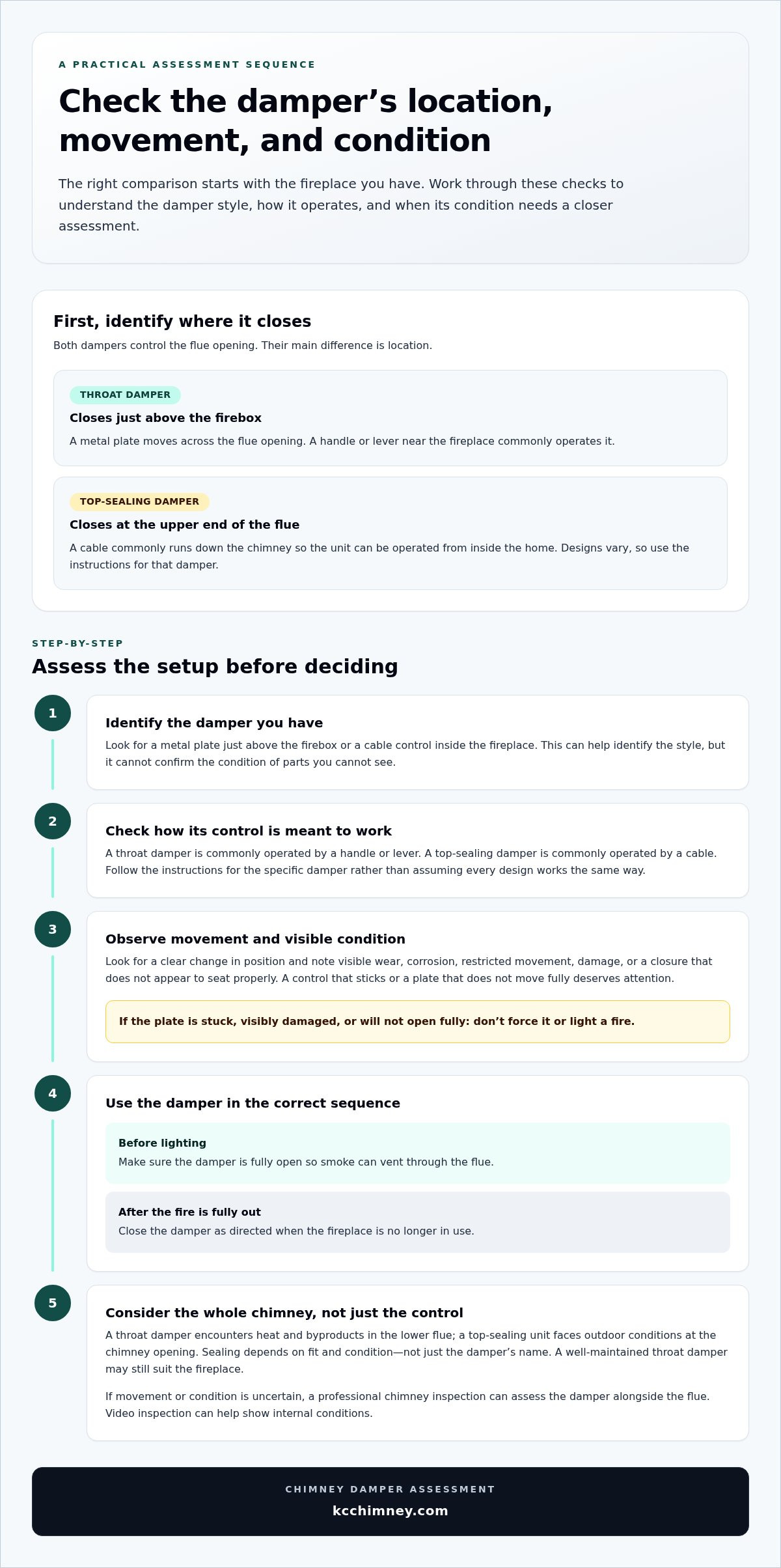
A fireplace damper is a movable component that opens or closes the passage between the firebox and the chimney. That passage is the flue, which carries smoke and combustion gases outdoors when a fire is burning. In the comparison “chimney damper vs top sealing damper,” “chimney damper” commonly refers to a traditional throat damper. The main difference is location: a throat damper sits just above the firebox, while a top-sealing damper is fitted at the upper end of the chimney flue.
Both types control the flue opening, but they operate from different points in the chimney. With either setup, the damper must be open before you light a fire. A closed damper can block smoke from venting properly, allowing it to spill into the room. After the fire is fully out and the fireplace is no longer in use, closing the damper helps shut off the open passage. Follow the fireplace and damper instructions for safe operation.
Where does a traditional throat damper sit?
A throat damper sits above the firebox, at the lower part of the flue. Its metal plate moves to open or close the passage. A handle or lever near the fireplace operates it, though the control varies by fireplace. Before lighting a fire, the plate needs to move clear of the flue opening. When closed, it rests across that opening. Age, repeated use, and the damper’s condition can affect how smoothly the plate moves and how well it seats.
Where does a top-sealing damper sit?
A top-sealing damper sits near the flue termination at the top of the chimney. A cable commonly runs down the chimney so you can operate the damper from inside the home. Pulling or releasing the cable opens or closes the unit, depending on its design. Because designs vary, check the instructions for your specific damper instead of assuming every cable-operated model works the same way.
The locations affect what you can see and how you operate each damper. A throat damper is close to the firebox, and its operating hardware is typically accessible from the fireplace opening. A top-sealing unit is positioned above the flue, so its closure is higher in the chimney and operated through the cable. With either type, a control that sticks or a plate that doesn’t appear to move fully deserves attention before you use the fireplace.
Think of the damper as a door for the smoke passage. Before lighting a fire, check that it is open. After the fireplace is no longer in use, close it as directed. To identify your damper, look for a metal plate just above the firebox or a cable control inside the fireplace. This visual check can help you identify the style, but it won’t confirm the condition of parts you can’t see. Use that distinction as you compare operation, fit, and condition.
How Each Damper Works, and What Its Location Changes
A damper opens a clear route for smoke when you use the fireplace, then closes the flue when the fireplace is out. Its location determines what you operate and which conditions it faces. A throat damper opens and closes the flue just above the firebox; a top-sealing damper does the same at the chimney’s upper end.
Before lighting a fire on a cool Kansas City evening, make sure the damper is fully open. Once the fire has burned out and the fireplace is no longer in use, close it according to its operating instructions.
Opening and closing a throat damper
A throat damper’s control is usually accessible above the firebox, often as a handle or lever, though designs differ. Operate it as directed and look for a clear change in the plate’s position. If the plate is stuck, visibly damaged, or won’t open fully, don’t force it or light a fire. A chimney professional can assess its movement and condition before you use the fireplace.
Operating a top-sealing damper
A top-sealing damper is commonly operated by a cable that runs from the chimney top down to the firebox. Depending on its design, pulling or releasing the cable moves the closure. Open it before lighting a fire, then close it after use as instructed. Since designs vary, follow the specific unit’s directions rather than assuming every cable works identically.
Placement affects exposure. A throat damper sits in the lower flue, where it encounters heat and byproducts rising from a fire. A top-sealing unit sits at the chimney opening, where it faces outdoor conditions. When assessing either type, look for wear, corrosion, restricted movement, or a closure that no longer seats properly.
Sealing performance depends on the damper’s fit and condition, not just its name. A well-maintained throat damper may close adequately, while a damaged or poorly seated one can leave a gap. A top-mounted closure also needs to move and seat as designed. Assess either type as part of the full chimney rather than judging it only by how the control feels indoors.
Proper operation is one part of safe fireplace use. The EPA Burn Wise program offers guidance on proper installation and maintenance of wood-burning systems. If the damper’s movement or condition is uncertain, a professional chimney inspection can assess it alongside the flue. For homeowners in the Kansas City area, a chimney inspection can provide a clearer picture of the components that affect fireplace operation.
Comparing Throat and Top-Sealing Dampers: Benefits and Trade-Offs
The right choice depends on more than damper style. An existing throat damper that opens, closes, and seats properly may remain suitable. A top-sealing design isn’t automatically an upgrade for every fireplace. Fit, access, and chimney condition all matter. Use this comparison to identify the practical differences, then consider what an inspection shows about your setup.
| Consideration | Throat damper | Top-sealing damper |
|---|---|---|
| Location | At the throat, just above the firebox. | At the upper end of the chimney flue. |
| Operation | A nearby handle or lever moves the plate; hardware varies. | A cable commonly connects the closure to a control near the firebox; designs vary. |
| Access and position checks | The plate and control are near the fireplace, though visibility can be limited by the firebox layout. | The control is indoors, but the closure itself is at the chimney top. |
| Condition checks | Look for restricted movement, visible damage, or a plate that doesn’t seat properly. | Check cable movement and have the top-mounted closure assessed if operation seems abnormal. |
| Fit and installation | Suitability depends on the existing fireplace and damper condition. | Suitability depends on the flue and chimney configuration, as well as the unit’s specifications. |
Which trade-offs matter in everyday fireplace use?
A throat damper’s control is close at hand, and its plate may be easier to view from the fireplace opening. A top-sealing damper is also operated from indoors, but its closure sits out of sight at the chimney top. Neither arrangement guarantees a tighter seal by type alone. A worn, warped, obstructed, or poorly seated damper can affect closure, so its observed condition matters more than a general claim about drafts or energy performance. Any expected change depends on the actual gap and the home’s conditions.
Does either damper type solve every chimney concern?
No. A damper controls the flue opening, but it doesn’t replace an inspection of the chimney, flue, and related components. A top-sealing damper also shouldn’t automatically be treated as a chimney cap. Some designs may combine functions, but that depends on the specific model. A separate cap may be needed to address the chimney opening, and a damper alone can’t diagnose moisture entry or explain every draft. A professional assessment can help distinguish a damper issue from other chimney conditions.
A sound throat damper doesn’t need replacing simply because another style exists. If it moves freely and closes properly, its condition and compatibility may support continued use. In the chimney damper vs top sealing damper decision, weigh inspection findings alongside control access and chimney configuration. That is a more reliable basis for choosing than assuming one design always performs better.
How to Assess Damper Compatibility in a Kansas City Home
A damper that works in one fireplace may not suit another. In the chimney damper vs top sealing damper decision, the flue’s dimensions, fireplace configuration, and chimney condition all affect what is practical. Homeowners can gather useful observations, but a visual check can’t confirm that a damper is properly fitted or reveal every hidden condition.
What homeowners can observe before an inspection
Keep your observations simple and safe. Don’t climb onto the roof, reach into the flue, or force a control that won’t move. Note what you can see from the fireplace opening and share any operating concerns during an inspection.
- Identify the control. Look for a handle or lever near the firebox, or a cable control that may operate a top-mounted closure. If you can’t tell which type you have, note where the control is located.
- Observe its movement. With the fireplace cool and unused, operate the control only as its instructions allow. Note whether it moves smoothly and whether you can see the damper plate change position. Stop if it sticks; don’t force it.
- Note visible damage. From a safe position, look for visible corrosion, a bent or damaged plate, or a closure that appears incomplete. Don’t lean into the firebox or try to inspect areas you can’t safely see.
- Record performance concerns. Write down when you notice smoke entering the room, unusual odors, or persistent drafts. These details can help a technician assess the damper alongside other possible causes.
Why local weather and chimney condition belong in the decision
Kansas City homes experience seasonal rain, temperature changes, and freeze-thaw exposure. These are useful conditions to discuss during an assessment, not proof that a particular damper type is needed. The full chimney matters too: masonry, flashing, the crown, and the flue can affect overall performance and may need attention independent of the damper. A Kansas City chimney repair guide explains how related chimney conditions fit into home protection.
Flue dimensions and fireplace layout help determine whether a proposed configuration can fit and operate as intended. An inspection can assess the existing damper and surrounding components together. Best Chimney Services LLC’s CSIA-certified technicians follow NFPA standards, and advanced video inspection can help show internal chimney conditions that aren’t visible from the firebox. Learn more about what to expect in a Kansas City chimney inspection guide.
For a clearer picture of your fireplace and flue, schedule a chimney inspection with a Kansas City chimney team.
Get a Professional Damper Assessment from a Kansas City Chimney Team
Comparing damper styles can narrow the options, but an inspection connects that comparison to the fireplace in your home. A technician can assess whether the existing damper moves and closes as intended, then examine the flue and surrounding chimney components for conditions that may affect operation. This gives you a clearer basis for deciding whether a functioning damper can remain in place or a concern needs attention.
What a professional inspection can clarify
A sticking control, visible damage, or a closure that appears incomplete is useful information, but it doesn’t reveal the whole picture. An inspection can examine the damper alongside accessible areas of the flue and other components, helping distinguish a damper issue from a broader chimney condition. Advanced video inspection can show internal areas that are difficult to see from the firebox, adding detail to the assessment where appropriate.
Best Chimney Services LLC’s technicians are CSIA-certified and follow NFPA standards. Share what you observed, such as when a control sticks or when smoke or odors occur, so those details can be considered during the inspection. For additional context on routine care and fireplace safety, consult this Kansas City chimney sweeping and safety guide.
Choose a clear next step for your fireplace
If your damper operates properly and the inspection finds no related concern, keeping the existing setup may be reasonable. If it sticks, shows damage, or doesn’t close as expected, an assessment can help identify what needs attention and whether the flue or nearby components also warrant review. The answer to the chimney damper vs top sealing damper question depends on those findings and your fireplace configuration, not the label alone.
An assessment also gives you the chance to understand the findings before deciding what to do next. Best Chimney Services LLC provides transparent pricing with no hidden fees. Homeowners across the greater Kansas City area, Johnson County, and Miami County can arrange a chimney inspection.
Schedule a chimney inspection to have your damper and surrounding chimney conditions assessed.
Make Your Next Fireplace Decision With Confidence
When you’re weighing chimney damper vs top sealing damper, you don’t have to decide based on a label or a draft symptom alone. A clear assessment gives you a grounded starting point: understand how your current damper behaves, what the surrounding chimney reveals, and whether keeping it or addressing a concern makes sense. Your next step can then reflect your fireplace rather than assumptions that one style suits every home.
Best Chimney Services LLC serves homeowners in the greater Kansas City area, Johnson County, and Miami County, including Overland Park, Mission Hills, Stilwell, Bucyrus, and Spring Hill. The company’s homepage displays 184 Google reviews. Since every chimney is different, an informed evaluation helps you focus on the details that matter to your home.
If your damper sticks, looks damaged, or leaves you uncertain before the next fire, schedule a chimney inspection to understand your fireplace’s condition and decide what to do next.
Frequently Asked Questions
Can a top-sealing damper and a throat damper be used together?
They may coexist in some chimneys, but the setup needs to be assessed as a whole. If both are present, each must be open before a fire is lit, or a closed damper could restrict the smoke path. In the chimney damper vs top sealing damper comparison, compatibility depends on how the two controls work together and the condition of the flue. Don’t assume both are operating just because one control moves.
Is a top-sealing damper also a chimney cap?
Not always. Some top-sealing damper designs may also serve as a cover at the flue opening, but that function depends on the specific model. A damper’s basic role is to open and close the flue; a chimney cap serves a separate protective purpose. If you’re unsure whether your chimney has suitable coverage, have the top of the chimney and the existing components assessed rather than relying on the damper’s name.
How often should a fireplace damper be inspected?
Have the damper checked during an annual chimney inspection, and arrange an assessment sooner if its control sticks, it appears damaged, or smoke enters the room during use. A yearly inspection gives a technician a chance to evaluate the damper along with the flue and other accessible components. Homeowners in Overland Park, Mission Hills, Stilwell, Bucyrus, and Spring Hill can include damper concerns in their regular fireplace safety review.
What happens if a top-sealing damper cable breaks?
A broken cable may leave the top-mounted damper unable to open or close as intended, and you may not be able to tell its position from the fireplace. Don’t climb onto the roof or try to operate the unit with improvised tools. Avoid using the fireplace until a chimney professional assesses the closure and restores reliable operation. Tell the technician whether the cable snapped during opening, closing, or while idle.
Can a damaged throat damper be repaired?
Sometimes, but the appropriate remedy depends on what’s damaged and whether the plate, frame, and operating parts remain serviceable. A loose control may call for a different response than a badly corroded or warped plate that can’t seat correctly. Don’t bend or patch a damper yourself; it operates in a hot, smoke-carrying passage. A professional assessment can determine whether repair is practical or replacement is the safer option.
Is it safe to use a fireplace if the damper will not open fully?
No. Don’t light a fire if the damper won’t open fully, because the restricted passage can interfere with smoke venting and allow smoke to enter the room. Don’t force a stuck control or try to hold the plate open with an object. Keep the fireplace unused until the cause is assessed and the damper’s operation is addressed. If smoke has already entered the room, stop using the fireplace and ventilate the area.
Can a top-sealing damper be fitted to any chimney?
No. Compatibility depends on the flue’s dimensions and shape, the chimney’s top configuration, and whether the closure can be operated and seated correctly. Two chimneys that look alike from the ground may differ at the flue opening. An inspection can assess these details before a decision is made. This matters especially if an existing throat damper, liner, or other chimney component affects the available space or operation.