
Could the fireplace screen you rely on still leave your toddler within reach of a hot surface? If you’re searching for “fireplace safety tips for families with toddlers Spring Hill,” you know little ones move quickly and can’t yet judge the danger. Glass, embers, and fireplace tools can remain hazardous even after the flames are out.
Keeping your child safe takes more than one precaution. A clearly enforced fireplace-free zone, a sturdy barrier, active supervision, and careful habits before and after each fire all help reduce risk. No screen or gate replaces an attentive adult, but the right setup can add an important layer of protection.
This guide explains how to establish a no-go area, choose and use barriers, and reduce hazards while the fireplace is in use and as it cools. You’ll also learn how professional chimney sweeping and inspection can help assess buildup, blockages, and other concerns in your fireplace system. For Spring Hill families, chimney care is one part of a safer home, alongside everyday supervision and childproofing.
Key Takeaways
- Build a fireplace-free zone your toddler can recognize and adults can consistently enforce.
- Remember that fireplace glass, hearths, embers, and tools may remain hazardous even when flames aren’t visible.
- Choose screens and gates for the job they’re designed to do, and pair barriers with active supervision.
- Use practical fireplace safety tips for families with toddlers Spring Hill to create safer habits before, during, and after a fire.
- Professional chimney sweeping and video inspections can complement childproofing by helping assess the fireplace and chimney.
Fireplace Safety in Spring Hill: Why Toddlers Need a Separate Safety Plan
Toddlers explore before they understand consequences. A child may reach toward a flame, climb onto the hearth, imitate an adult handling a fireplace tool, or dart into the room while a caregiver is busy. That curiosity is normal, but it means watching the fire alone isn’t enough.
Fireplace safety combines attentive adults, limited access, safer habits, and a fireplace kept in sound working condition. Each layer addresses a different risk. Supervision helps adults respond in the moment; barriers make accidental access harder; routines keep tools and other hazards out of reach; and professional chimney care can help identify concerns with the system. These fireplace safety tips for families with toddlers Spring Hill households can use begin with remembering that some hazards remain after the visible flames are gone.
Which fireplace hazards can a toddler reach?
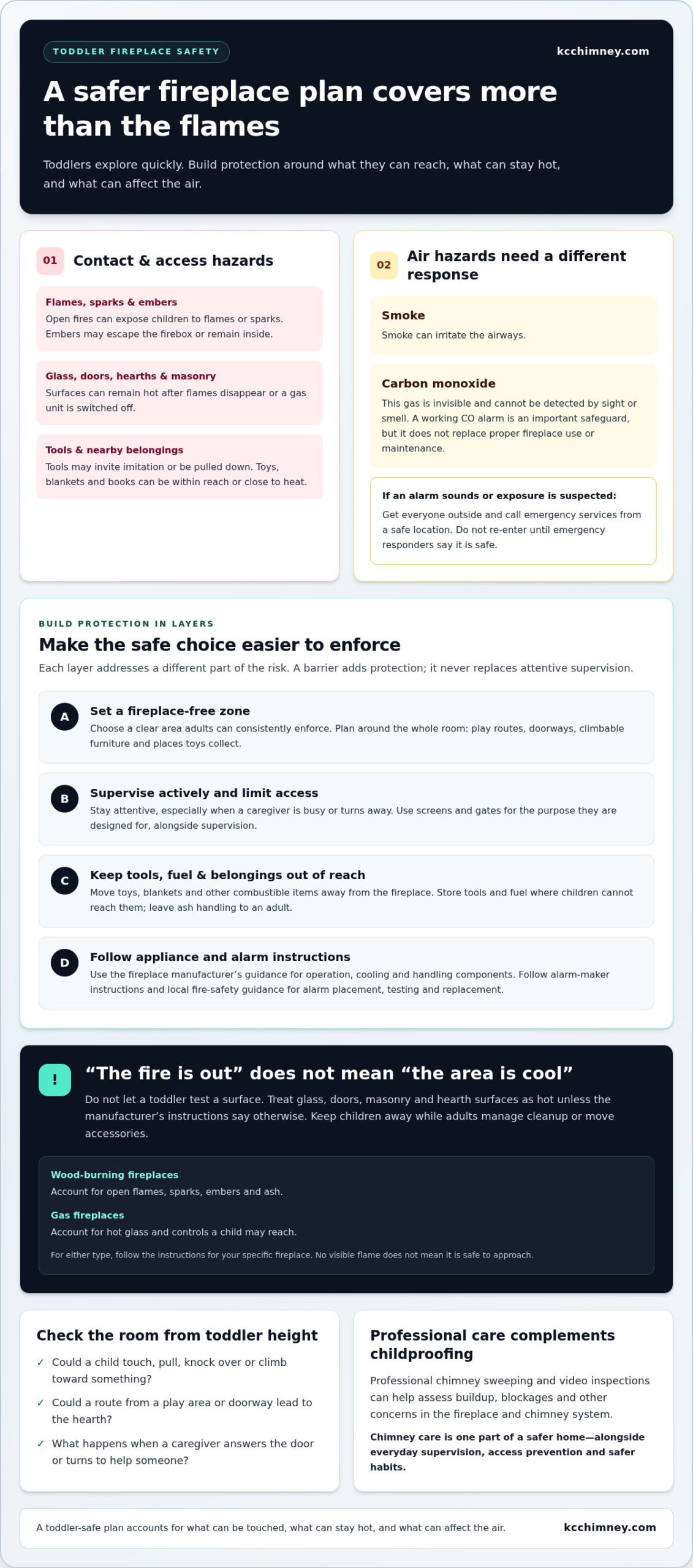
Look at the fireplace from your toddler’s perspective. Consider what they could touch, pull, knock over, or climb toward. Depending on the fireplace, risks may include:
- Flames, sparks, and embers: An open fire can expose a child to flames or sparks. Embers may escape the firebox or remain inside it.
- Hot glass, doors, and masonry: Glass fronts, metal components, hearths, and nearby surfaces can heat up during use. A gas unit that has been switched off or a fire that appears out may still leave surfaces hot.
- Tools and accessories: Poker handles, tongs, and other tools may tempt a toddler to imitate an adult or may be pulled down if left within reach.
- Nearby items: Toys, blankets, books, and other household objects can become hazards when left close to heat or where a child can reach them.
Don’t judge safety by whether the fire is still burning. Follow the fireplace manufacturer’s instructions for operating the unit and handling its components, including guidance on when they’re safe to touch. For a general overview of fireplace parts and uses, see this fireplace safety information.
Why Spring Hill caregivers should plan around the whole room
In Spring Hill, Kansas, build your plan around the room your child actually uses, not just the hearth. From toddler height, check routes between play areas and doorways, nearby chairs or tables a child could climb, and spots where toys tend to collect. Think through what happens when you carry laundry, answer the door, or turn to help someone else. The goal is to make access harder and keep your child’s usual play area away from fireplace hazards.
Apply the same room-wide approach to wood-burning and gas fireplaces, while accounting for their different risks. Wood fires involve open flames, sparks, and embers; gas units may have hot glass and controls a child can reach. Identify the hazards for your model, then make supervision and access prevention part of the plan. A safer setup doesn’t depend on a toddler remembering a rule. It helps caregivers enforce the rule consistently.
How Fireplace Heat and Combustion Create Risks for Toddlers
A fireplace can injure a toddler in several ways. A child might reach toward a flame, touch hot glass or masonry, or trip over a tool left beside the hearth. Sparks and embers can also escape a wood-burning fire. These risks don’t end when flames are no longer visible. Fireplace doors, hearths, and nearby surfaces may retain heat after a fire is out or a gas unit is switched off.
Flames, hot surfaces, embers, and tools can cause contact burns; smoke and carbon monoxide create separate risks that require alarms and a quick response. Keeping these concerns distinct helps caregivers plan for both physical access and safe operation. Fireplace safety tips for families with toddlers Spring Hill caregivers use should account for what a child can touch and hazards that can affect the air in the home.
Hot glass, embers, and surfaces remain hazards beyond the visible flame
Treat fireplace glass, doors, masonry, and hearth surfaces as hot unless the manufacturer’s instructions say otherwise. Don’t let a toddler test whether a surface has cooled. Leave ash handling to an adult, follow the appliance instructions, and keep ash and embers away from children. Store fireplace tools and fuel out of reach, and move toys, blankets, and other combustible items away from the fireplace area.
With a gas fireplace, a child may be drawn to the glass or controls. With a wood-burning fireplace, loose embers and ash add hazards around the firebox. In either case, the absence of flames doesn’t mean it’s safe to approach. Follow the manufacturer’s operating and cooling guidance for your fireplace, and keep children away while adults manage cleanup or move accessories.
Smoke and carbon monoxide require a different safety response
Smoke can irritate the airways, while carbon monoxide is an invisible gas that can’t be detected by sight or smell. A working carbon monoxide alarm is an important safeguard, but it doesn’t replace proper fireplace use or maintenance. Follow the alarm manufacturer’s current instructions and local fire-safety guidance for placement, testing, and replacement. Don’t guess at placement based on convenience alone.
If an alarm sounds or you suspect carbon monoxide exposure, get everyone outside and call emergency services from a safe location. Don’t re-enter until emergency responders say it’s safe. This differs from preventing a toddler’s contact burn: barriers limit access to hot components, while alarms alert a household to an air hazard. Both belong in a family safety plan.
For Spring Hill households, professional chimney sweeping and inspection can complement daily precautions by helping assess the fireplace and chimney. Best Chimney Services uses thorough sweeping techniques and video equipment to support internal chimney inspections. This care doesn’t replace supervision or childproofing, but it can be a practical part of a broader safety routine. Learn more about chimney sweeping and inspections as you consider your fireplace’s condition.
Do Fireplace Screens and Baby Gates Keep Toddlers Safe?
A screen or gate can make it harder for a toddler to reach the fireplace, but neither makes the area completely safe. Choose a barrier based on the job you need it to do. A screen designed to catch sparks may not be sturdy enough to stop a child, while a room-level gate only helps if it stays closed and your toddler can’t get around it.
Treat barriers as one layer of protection, not a substitute for supervision. Use each product as its manufacturer directs, check that it fits the fireplace or doorway, and make sure it stays stable if your child leans or pushes against it. Keep blankets, toys, and other combustible items clear of the fireplace and barrier.
Choose a barrier suited to the fireplace and room
First decide whether you need spark protection, restricted access to the hearth, or a way to keep your child out of the room. A fireplace screen and a child-resistant barrier aren’t interchangeable. Choose an option that’s stable and difficult for your toddler to move or climb, then follow its installation and use instructions. Recheck the setup after moving furniture or changing how the room is used.
Barrier
Intended role
Key limitation
Fireplace screen
Helps contain sparks or embers, depending on its design.
May not prevent a toddler from reaching hot surfaces or moving the screen.
Fixed hearth barrier
Creates a boundary around the fireplace area.
Can be ineffective if poorly fitted, unstable, or climbable.
Room-level gate
Restricts access to the room or its entrance.
Only works while correctly installed and kept closed.
For wood-burning fireplaces, a screen may help manage sparks, but caregivers still need to keep children away from the hearth and tools. For gas fireplaces, a barrier can limit access to the unit, but it doesn’t make hot glass safe to touch. Follow the fireplace and barrier manufacturers’ instructions, including guidance on placement and clearance.
Why supervision remains essential in Spring Hill homes
In Spring Hill homes, family routines can shift as people move between rooms or take turns caring for a child. Make handoffs explicit: tell the next adult who’s watching the toddler and whether the fireplace is operating or still warm. Don’t assume someone else is keeping watch just because they’re nearby.
A barrier can’t notice a child climbing, an open gate, or a change in the room. Keep an attentive adult present whenever the fireplace is in use, and continue supervising afterward. If you’re including fireplace-system care in your home safety plan, professional chimney sweeping and inspection can complement, not replace, family precautions.
A Toddler-Safe Fireplace Routine Before, During, and After Use
A repeatable routine helps caregivers make the same safety checks each time, even when the room is busy. Set a clear fireplace-free zone and enforce it every day, not only when a fire is burning. Explain the boundary in simple words your toddler can understand, such as “Stop here” or “Stay with me.” Those words work best when adults respond consistently and calmly.
Before lighting: prepare the room and the child
Before using the fireplace, clear toys, blankets, and other tempting or combustible items from the area. Check that the barrier is positioned according to its instructions, and decide which adult is actively supervising. Tell your toddler the rule before anyone lights the fire. These fireplace safety tips for families with toddlers Spring Hill caregivers can follow are most effective when they become part of a regular household routine.
- 1. Prepare the space. Move toys, blankets, and other loose items away from the fireplace. Store matches, lighters, tools, and fuel where your toddler can’t reach them.
- 2. Check the boundary. Make sure the barrier is in place and furniture or toys don’t create a route around it. Point out where your child should stop.
- 3. Assign supervision. Name the adult watching the toddler before lighting. If another caregiver takes over, say so clearly instead of assuming they’ve noticed.
- 4. Keep the rule simple. Use the same brief reminder each time, such as “Fireplace is for grown-ups. Stay behind the gate.” Redirect your child to an activity outside the zone.
- 5. Stay focused during use. Keep an attentive adult close by. Only an adult should tend the fire, adjust fireplace controls, or handle tools. Never leave a toddler alone near an operating fireplace, even briefly.
- 6. Maintain the boundary after use. Don’t open access simply because the visible flames are gone. Fireplace surfaces may retain heat. Follow the manufacturer’s instructions before handling the unit or allowing anyone near it.
- 7. Handle cleanup and storage. Keep the child away while an adult handles ash or embers. Return tools, matches, lighters, and fuel to secure storage after use.
During and after a fire: keep the routine consistent
Keep the routine consistent during caregiver handoffs and changes in the room. If you need to step away, ask another adult to take over directly and wait for acknowledgment. Keep the zone off-limits until the fireplace and its components are safe to approach according to the manufacturer’s guidance. For additional household maintenance practices, use this Kansas City chimney safety and maintenance guide.
A routine reduces uncertainty, but it doesn’t replace a sound fireplace system. Best Chimney Services provides professional fireplace care through chimney sweeping and inspections. Pair regular attention to fireplace condition with active supervision and a clearly enforced boundary to support a safer home.
When Spring Hill Families Should Arrange Fireplace and Chimney Service
A gate and close supervision help keep a toddler away from the fireplace, but they can’t show whether the fireplace or chimney is in good condition. Professional service addresses that separate part of the safety plan by assessing the system, removing accumulated deposits through sweeping, and looking for visible or internal concerns during an inspection.
The National Fire Protection Association recommends having chimneys and fireplaces inspected at least once a year. An inspection can be useful even when a fireplace seems to operate normally, since some concerns may not be apparent during everyday use. Arrange service if you notice a change in how the fireplace operates or have concerns about its condition. Continue your child-safety routine whether or not service is due.
What a chimney sweep and inspection can assess
Chimney sweeping addresses accumulated deposits inside the system. An inspection evaluates accessible areas and the fireplace and chimney’s condition. Best Chimney Services uses thorough sweeping techniques and video camera equipment to help technicians examine internal chimney areas. The camera supports the assessment; the system’s condition can only be determined through inspection. The Kansas City chimney inspection guide explains how an inspection fits into home fireplace care.
In Spring Hill, wood-burning and gas fireplaces have different components and use patterns, so share which type you have when arranging service. Note how often you use it and describe changes or concerns you’ve noticed, such as smoke behaving differently than usual or a visible change around the fireplace. Those observations provide useful context but don’t replace an on-site assessment. Chimney care complements toddler barriers and supervision; it doesn’t replace them.
Make the next step simple for your household
Before scheduling, note the fireplace type, how it’s typically used, and any recent concerns. Include when the system was last swept or inspected if you know. You don’t need to diagnose a problem yourself. Clear observations give the technician useful context and help make the service visit relevant to your household’s needs.
Best Chimney Services serves homeowners in Spring Hill and surrounding communities in Johnson and Miami counties, including Overland Park, Mission Hills, Stilwell, and Bucyrus. Routine sweeping and inspection offer a practical way to care for the fireplace system while your family maintains its everyday safety habits. For fireplace safety tips for families with toddlers Spring Hill households can put into practice, combine professional chimney care with active supervision and a consistently enforced fireplace-free zone.
When you’re ready to arrange routine care, schedule chimney service for your Spring Hill home. It’s a straightforward step toward understanding your fireplace’s condition and maintaining it with care.
Make Fireplace Safety Part of Your Family’s Routine
Your toddler’s curiosity will change as they grow, so revisit your fireplace plan as their reach, mobility, and favorite play spots change. Keep the boundary clear and consistent, and make supervision expectations easy for every caregiver to follow. Small, steady habits help your household feel more prepared each time you use the fireplace.
Reliable fireplace safety tips for families with toddlers Spring Hill bring together everyday prevention and attention to the fireplace itself. Childproofing helps manage access; professional chimney care offers another way to look after the system your family uses. Neither replaces the other, and both can contribute to greater peace of mind at home.
If it’s time to arrange routine chimney care, take the next step with Best Chimney Services. Schedule chimney service for your Spring Hill home and make fireplace maintenance part of your family’s ongoing safety plan. With thoughtful routines and professional care, you can help your household enjoy a more prepared, comfortable home.
Frequently Asked Questions
Can a toddler be in the same room as a lit fireplace?
Yes, but only if an attentive adult stays in the room and actively supervises. A barrier adds protection, but it doesn’t replace watching your child. If you need to cook, answer the door, or step away, move your toddler to another supervised space or have another adult take over. For fireplace safety tips for families with toddlers Spring Hill households can use, plan the handoff before lighting the fire.
Are fireplace glass doors safe for toddlers to touch?
No. Treat fireplace glass as hot during use and afterward, even if the flames have disappeared or the unit has been switched off. A toddler can’t judge surface temperature by looking, and a quick touch can cause an injury. Keep children from testing the glass, and follow the fireplace manufacturer’s instructions about operation and when components may be handled. A protective barrier can help limit access, but it doesn’t make touching the glass safe.
What should I do if my toddler touches a hot fireplace?
Move your child away from the heat source and cool the affected area under cool running water. Don’t apply ice. Seek medical advice promptly, and call emergency services if the burn appears severe or you’re concerned about your child’s immediate safety. Don’t delay getting help to assess the injury yourself. Once your child is safe, keep others away from the fireplace and consider what change to the room setup could help prevent another contact.
Is a baby gate enough to make a fireplace toddler-safe?
No single gate can make a fireplace completely toddler-safe. A gate can make access more difficult, but its effectiveness depends on choosing a barrier suited to the fireplace and installing it as directed. Check that it remains secure and your child can’t easily get around or climb it. Keep supervising, and don’t use a gate in a way the manufacturer doesn’t recommend for your room or fireplace setup.
Can a gas fireplace expose children to carbon monoxide?
Yes. A gas fireplace can pose a carbon monoxide risk if it isn’t operating or venting properly. Carbon monoxide has no smell or color, so you can’t rely on noticing it in the air. Keep working carbon monoxide alarms in the home and follow their instructions. If an alarm sounds or you suspect exposure, take everyone outside and call emergency services from a safe location. Don’t re-enter until responders say it’s safe.
How often should smoke and carbon monoxide alarms be checked?
Follow the instructions supplied with each alarm for testing, battery changes, and replacement. Use the test function as directed, and don’t ignore a low-battery warning or an alarm that fails its test. Alarm placement can differ by device and local fire-safety guidance, so check both rather than guessing. Keep instructions accessible, especially if you’ve moved an alarm or changed how a room is used.
Who can inspect a fireplace in Spring Hill, Kansas?
Best Chimney Services’ certified technicians inspect fireplaces and chimneys for homeowners in Spring Hill and nearby communities, including Overland Park, Mission Hills, Stilwell, and Bucyrus. Their video camera equipment supports internal chimney inspections and helps technicians examine areas that aren’t readily visible from the room. Sweeping and inspection address fireplace-system care, while supervision and childproofing continue to protect toddlers from direct access to hazards.