
Does chimney certification for home sale Mission Hills mean a required certificate, or clear documentation of the chimney’s condition? Before inspection findings complicate closing, it helps to know what the buyer, seller, or purchase agreement is actually asking for. “Certification” can refer to different documents, while a professional inspection report describes the inspection scope and observed conditions.
This guide explains what to request or arrange before closing, what a Level 2 inspection and video review can document, and how to interpret the findings. Don’t assume one document is required for every sale. The purchase agreement and applicable requirements determine what documentation is relevant to a particular transaction.
A thorough inspection gives buyers and sellers useful information about the chimney system’s observed condition. It cannot guarantee that every concealed area is defect-free or that the system will remain safe indefinitely. Use the report to organize questions, address concerns, and plan appropriate next steps, such as sweeping or repairs when indicated.
Key Takeaways
- Understand what “chimney certification” may mean in a real estate transaction and why the report’s scope matters.
- Choose an inspection level based on the system, concerns, and transaction request, rather than assuming every Mission Hills sale has the same requirement.
- Use the chimney certification for home sale Mission Hills checklist to organize records and inspection steps from listing through closing.
- Distinguish documented observations from assumptions about severity, repairs, or next steps.
- Use clear local inspection findings to help buyers and sellers plan practical follow-up.
Chimney Certification for a Mission Hills Home Sale: What Does It Mean?
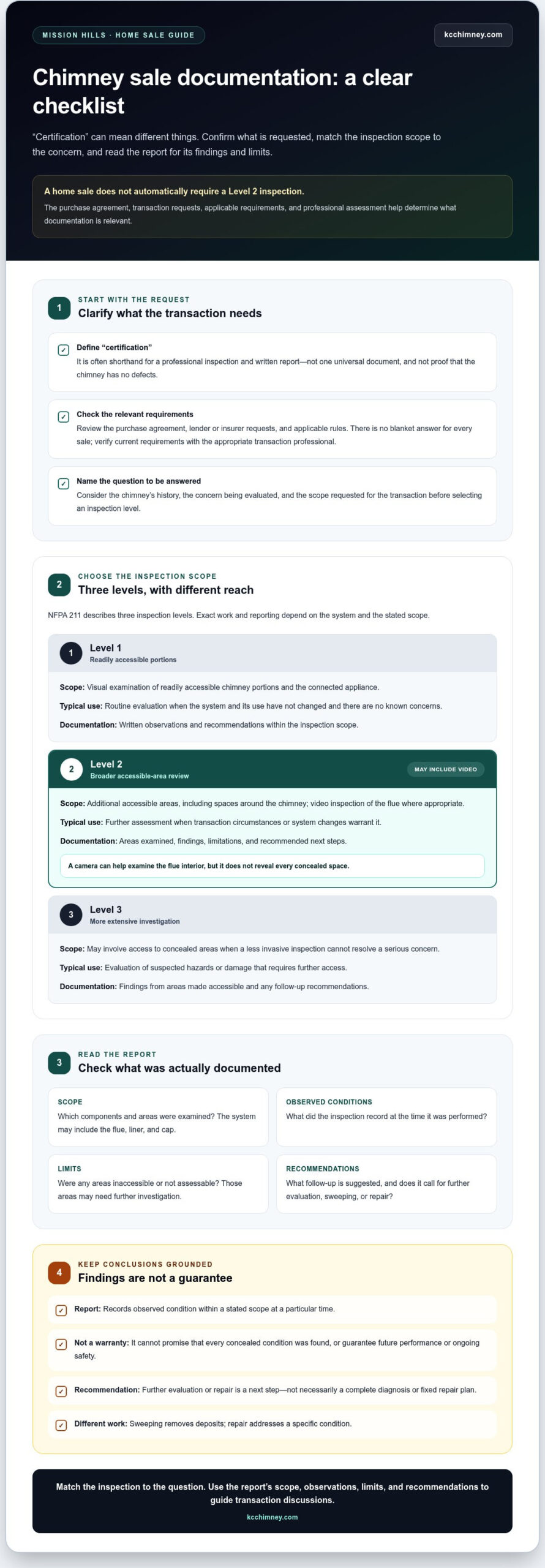
In a real estate transaction, “chimney certification” is often shorthand for a professional inspection and written report. It does not automatically mean there is one universal document or that the chimney has no defects. For chimney certification for home sale Mission Hills, focus on what inspection was completed, which areas were examined, and what the findings say.
A chimney system includes components such as the flue, liner, and cap. A basic overview of chimney components and functions can help buyers understand terminology in a report. The report should state its scope, document observed conditions, and note any limitations or recommended follow-up. An inspector’s credentials or association membership are separate from the chimney’s condition. Neither, by itself, certifies the system.
An inspection report records a chimney’s observed condition within a stated scope at a particular time. It is not a guarantee about concealed conditions, future performance, or ongoing safety. This distinction helps buyers and sellers discuss documented findings without treating the report as a warranty.
Is chimney certification required to sell a home in Mission Hills?
There is no blanket answer that applies to every sale. Documentation needs may depend on the purchase agreement, lender or insurer requests, and applicable rules. Don’t assume every Mission Hills or Kansas home sale requires the same certificate or inspection. Review the contract and relevant local requirements with your real estate or legal transaction professional, and verify current rules before relying on a general statement.
What can a chimney inspection report tell a buyer?
A report can identify the components examined, visible conditions, inspection limits, and recommendations. For example, it may document a concern and recommend further evaluation rather than determine the full extent of a concealed issue. Areas that cannot be accessed or assessed may require additional investigation. The report records findings at the time of inspection; it does not predict how the chimney will perform after the sale.
Read the scope and recommendations together. A recommendation for further evaluation or repair identifies a next step, not necessarily a complete diagnosis or fixed repair plan. Clear documentation gives both parties a sound basis for discussing the chimney and coordinating decisions during the transaction.
Which Chimney Inspection Is Appropriate for a Mission Hills Sale?
The appropriate inspection depends on the chimney’s history, the concern being evaluated, and the transaction’s requirements. The NFPA 211 standard describes three inspection levels with different scopes. A Level 2 inspection may be appropriate for a sale when the circumstances, purchase agreement, or professional assessment call for a closer review. A sale alone does not mean this level is automatically required. Confirm the requested scope and applicable criteria for the transaction.
Use this comparison to understand the differences. The exact work and report depend on the system and the inspection’s stated scope.
| Inspection level | Scope | Typical use | Documentation |
|---|---|---|---|
| Level 1 | Visual examination of readily accessible portions of the chimney and connected appliance. | Routine evaluation when the system and its use have not changed and there are no known concerns. | Written observations and any recommendations within the inspection scope. |
| Level 2 | Broader examination of accessible areas, including spaces around the chimney, with additional methods such as video inspection of the flue where appropriate. | Further assessment when transaction circumstances or changes to the system warrant it. | A report describing the areas examined, findings, limitations, and recommended next steps. |
| Level 3 | More extensive investigation that may involve access to concealed areas when less invasive inspection cannot resolve a serious concern. | Evaluation of suspected hazards or damage that requires further access. | Findings from the areas made accessible and any follow-up recommendations. |
How does a Level 2 chimney inspection differ from a basic inspection?
A Level 1 inspection focuses on readily accessible portions. Level 2 expands the review to additional accessible areas, and video equipment can help examine the flue interior. This may provide useful information about areas a visual check alone cannot show, but a camera view does not expose every concealed space. Match the inspection level to the question being answered, not simply to the fact that a home is for sale.
What does “chimney certification” not guarantee?
No inspection can promise future safety or performance, or confirm that every concealed condition has been found. Access limits matter, and later use, damage, or changes to the appliance can affect the system after inspection. A recommendation to sweep or repair is also distinct from the inspection conclusion. Sweeping removes deposits; repair work addresses a specific condition. The report documents what was observed.
Best Chimney Services provides Level 2 and Level 3 inspections in Mission Hills, including video inspections to help document findings. Review the report’s scope and recommendations to plan practical next steps. Learn more about chimney inspection services.
Mission Hills Home-Sale Chimney Checklist for Buyers and Sellers
Organizing chimney records early makes them easier to review as a sale progresses. Use this checklist to connect records and questions to the right transaction milestone. These are practical steps, not a claim that every item is legally required.
Before listing: gather what you have
- Collect existing records. Bring together chimney inspection reports, sweeping receipts, and repair records. Note dates and retain documents that identify the work completed.
- Describe known concerns accurately. Record issues you’re aware of, such as fireplace draft concerns or visible damage. Don’t describe work as completed without supporting documentation.
- Consider an inspection. An inspection before listing can help you understand the chimney’s observed condition and prepare for questions during negotiations.
After an offer is accepted: clarify the request
- Review the purchase agreement. Identify chimney-related inspection or documentation terms and any applicable timelines.
- Define the requested documentation. “Certification” can mean different things in a transaction. Clarify whether the request is for an inspection, a written report, repair records, or another specific document.
- Coordinate through the transaction team. Buyers and sellers can discuss contract interpretation and deadlines with their real estate or legal professionals. Don’t treat an optional record as a universal local requirement.
During the inspection: match scope to the question
- Check the report’s scope. Note the inspection date and level, components examined, accessible areas, and stated limitations.
- Compare it with the agreement and concerns. If the purchase agreement calls for a particular inspection, or the buyer has a specific concern, make sure the report addresses the request. A general home inspection may not answer every chimney-specific question.
- Keep records together. Pair the report with available maintenance and repair documents to help both parties understand the system’s documented history.
Before closing: track follow-up clearly
Separate observations that may need prompt attention from maintenance suggestions or longer-term repair recommendations. If the report calls for further evaluation, record who will coordinate it and how the results will be shared. Buyers should discuss how findings relate to contract decisions with their transaction professionals. Sellers should retain copies of reports and records of completed work. For broader inspection guidance, look for the article titled Expert Chimney Inspection in Kansas City.
Keeping the chimney certification for home sale Mission Hills paperwork organized helps both sides follow the inspection scope, understand what the records establish, and coordinate next steps without mistaking documentation for a guarantee.
Chimney Inspection Findings: How to Keep a Mission Hills Sale Moving
An inspection report can identify maintenance needs, visible damage, or conditions that warrant further evaluation. A finding is a starting point, not a complete repair estimate or a verdict on the sale. Before drawing conclusions about severity, read the specific observation, the area inspected, and any stated limitations.
For chimney certification for home sale Mission Hills, clear communication helps keep follow-up practical. For example, if a report notes a damaged component, it may recommend further evaluation before anyone can determine the full repair scope. A maintenance recommendation does not automatically mean the chimney has a major defect.
What happens if an inspection identifies a chimney concern?
Start with the report. Identify what was observed, where it was observed, and whether the inspector recommends clarification, further evaluation, or repair. If the wording is unclear, ask for an explanation of the documented finding rather than guessing at its cause or severity.
Possible next steps include arranging further inspection, obtaining repair guidance, or discussing the finding with the transaction professionals. Buyers and sellers decide how findings affect negotiations and contract terms. A repair may address a specific documented condition, but don’t represent it as resolving every concern or satisfying every buyer without supporting documentation.
If the report points to repair work, explore chimney repair options as a practical next step. The appropriate work depends on the observed condition and any additional evaluation needed.
How should chimney records be shared during the transaction?
Share the complete inspection report promptly with the relevant transaction parties, along with available sweeping records, repair receipts, and prior inspection documents. Keep the report intact. Its scope, limitations, photos if included, and recommendations help readers understand what the inspection did and did not establish.
A short summary can orient the reader, but it should not replace or alter the original findings. If follow-up work is completed, keep the related paperwork with the report so the record shows what was done and when. For ongoing upkeep context, the Chimney Sweep Kansas City: The 2026 Homeowner’s Safety & Maintenance Guide can help readers understand how sweeping fits into chimney maintenance.
- Clarify: Request a plain-language explanation of specific report terms.
- Evaluate: Arrange further inspection if the report recommends it or leaves an important question unresolved.
- Document: Keep reports and records of completed work together for transaction review.
Accurate records don’t decide the negotiation, but they give both sides a clearer basis for discussing the chimney and coordinating next steps.
Schedule a Mission Hills Chimney Inspection with Best Chimney Services
A sale-related chimney inspection is easier to coordinate when everyone understands the request. Start by identifying what the purchase agreement or transaction team is asking for. Arrange an inspection suited to the chimney system and circumstances, then review the written findings before deciding on follow-up. This gives buyers and sellers clear information instead of assumptions about what “certification” means.
Best Chimney Services is a locally owned Kansas City-area business serving Mission Hills. The team provides Level 2 and Level 3 chimney inspections, using video inspection equipment where applicable to examine the chimney interior. The report documents observed conditions, inspection scope, limitations, and recommended next steps. It records what was assessed, not a guaranteed outcome for the sale or future performance.
What to have ready when scheduling a sale-related inspection
These details help define the request and plan an appropriate inspection. Gather the property location, fireplace or appliance type, known chimney concerns, and transaction timing. Share any inspection request or report language from the purchase agreement so the requested scope can be considered.
- Property details: Mission Hills address and the fireplace or appliance connected to the chimney.
- Known concerns: Visible damage, past issues, or areas the buyer or seller wants evaluated.
- Transaction information: Relevant contract wording, requested documentation, and timing that may affect coordination.
The appropriate inspection scope depends on the system and circumstances. Sharing details upfront helps frame the request, while the inspection determines what can be observed and documented.
A clear next step for buyers and sellers in Mission Hills
For buyers, a professional inspection can provide a clearer picture of observed conditions and identify questions that may need follow-up. For sellers, an organized report can help communicate what was examined and which recommendations were made. The findings give transaction parties practical information to review with their real estate or legal professionals.
If you’re arranging chimney certification for home sale Mission Hills, keep the goal straightforward: clarify the request, schedule the appropriate inspection, and review the findings carefully. Contact Best Chimney Services to schedule a Mission Hills chimney inspection. A clear report supports informed next steps without promising a particular inspection result or closing outcome.
Move Forward With Clear Chimney Documentation
For a Mission Hills sale, understanding what the inspection covered and what its written findings say matters more than the word “certification.” Review the purchase agreement and any transaction-specific requests, then keep the report’s scope, limitations, and recommendations with the chimney records. An inspection documents observed conditions; it does not guarantee future performance.
Best Chimney Services is a locally owned Kansas City-area business serving Mission Hills with professional chimney inspections, including Level 2 and Level 3 evaluations. Clear findings can help buyers and sellers discuss concerns and coordinate appropriate next steps.
For chimney certification for home sale Mission Hills, start with documentation that fits your transaction. Schedule a chimney inspection with Best Chimney Services to get a clearer picture of your chimney’s observed condition. With careful preparation and a thorough inspection, you can approach the next steps with greater confidence.
Frequently Asked Questions
Is chimney certification required when selling a home in Mission Hills?
There is no universal chimney certificate requirement to assume applies to every Mission Hills sale. Documentation needs may depend on the purchase agreement, lender or insurer requests, and applicable rules. For chimney certification for home sale Mission Hills, review the contract language and verify current local requirements with your transaction professionals. A written inspection report may be requested to document observed conditions, but its name and scope should match the actual request.
What is the difference between a chimney inspection and chimney certification?
A chimney inspection is a professional evaluation of specified areas and conditions, with findings typically recorded in a report. “Chimney certification” is often used informally during a sale, but it can mean different things. Don’t assume it refers to a standard document or a guarantee. Read the report’s scope, limitations, and recommendations. The inspection records what was observed at that time; it does not promise future performance or reveal every concealed condition.
Can a home sale require a Level 2 chimney inspection?
Yes, a purchase agreement or another transaction-specific request may call for a Level 2 inspection. The need depends on the circumstances and applicable criteria, so a home sale alone does not automatically mean this level is required. A Level 2 inspection has a broader scope than a basic visual review and may use video equipment to assess the flue interior. Confirm the requested scope and applicable requirements before scheduling.
What does a chimney inspection report include for a home buyer?
A report generally describes the inspection scope, components and accessible areas examined, observed conditions, limitations, and recommendations. It may note visible damage, maintenance needs, or a condition requiring further evaluation. Buyers should compare those details with the inspection request and any chimney-related concerns. If a report recommends additional assessment, that is a next step, not necessarily a complete diagnosis or confirmed repair plan.
How long is a chimney inspection report useful during a home sale?
There is no universal expiration period that makes every chimney report valid for a set length of time. Its usefulness depends on the report’s date and scope, the transaction’s requirements, and whether the chimney or its use has changed since the inspection. A report documents conditions observed at that time. If damage, changes, or new concerns arise before closing, the parties may need updated information or further evaluation.
What happens if a chimney inspection finds damage before closing?
Review the exact observation, its location, and any stated limitation before deciding what it means. The report may recommend clarification, further inspection, maintenance, or repair. These steps can help define the issue, but the inspection alone may not establish the full repair scope. Buyers and sellers decide how findings affect negotiations and contract terms with their transaction professionals. Keep reports and records of completed work together.
Can a chimney inspection confirm that a fireplace is safe to use?
An inspection can assess and document observed conditions within its stated scope, and the findings may identify concerns or recommend follow-up. It cannot guarantee future safety or rule out every concealed issue, particularly in areas that were not accessible. If the report identifies a concern or calls for further evaluation, follow its recommendation before using the fireplace. Best Chimney Services provides chimney inspections in Mission Hills and nearby communities, including Overland Park, Stilwell, Bucyrus, and Spring Hill.
Who arranges a chimney inspection during a home sale, the buyer or seller?
Either the buyer or seller may arrange an inspection, depending on the purchase agreement, transaction timing, and who is responding to a request. Sellers may choose to obtain an inspection before listing to understand documented conditions; buyers may request one as part of their due diligence. Clarify who will schedule it, what scope is requested, and how the report will be shared so both parties can plan next steps.