
Could a chimney pass a basic visual check and still have a problem out of sight? That’s a fair concern when you’re asking, “what is a level 1 chimney inspection Bucyrus homeowners may need?” A Level 1 inspection can be appropriate when a chimney and its use haven’t changed, but it focuses on readily accessible areas. It can’t confirm that every hidden part of the system is clear.
Before scheduling, it helps to know what a technician will look at and when a closer evaluation may be warranted. This guide explains what a Level 1 inspection generally covers, where its limits are, and why a Level 2 inspection may be recommended after a home sale, a change to the chimney or appliance, or a potentially damaging event.
You’ll also find practical questions to ask a Bucyrus-area chimney professional about the inspection’s scope, whether video equipment is appropriate, and what happens if the technician spots a concern. The goal is to help you choose an inspection that fits your chimney’s history and gives you a clearer next step.
Key Takeaways
- Learn what a Level 1 inspection can tell you about accessible chimney components, and what it may not reveal.
- Understand what is a level 1 chimney inspection Bucyrus homeowners may consider when their fireplace and venting setup remain unchanged.
- Compare common reasons to discuss a Level 2 inspection with a chimney professional.
- Prepare useful details about your appliance, past repairs, leaks, or changes in use before the inspection.
- Know what to ask a local professional about inspection scope, credentials, and recommended next steps.
What Is a Level 1 Chimney Inspection in Bucyrus?
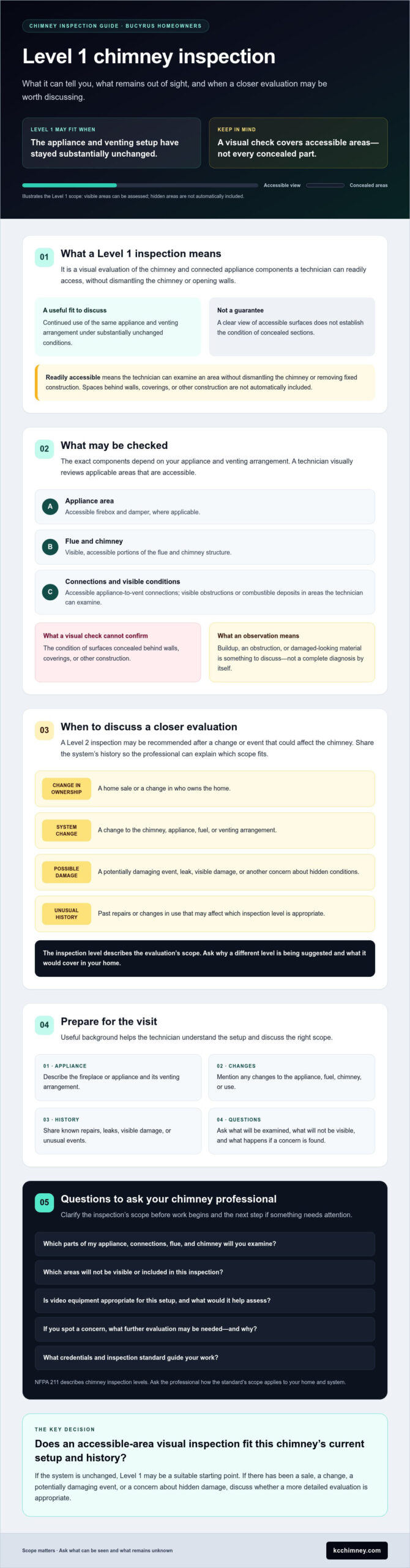
If you’re asking what is a level 1 chimney inspection Bucyrus homeowners may need, it’s a visual evaluation of the chimney and connected appliance components a technician can readily access. The inspection assesses visible conditions without opening walls or dismantling the chimney. A chimney carries smoke and combustion gases away from the home. Learn more about what a chimney is and how its construction supports that function.
A Level 1 inspection generally suits continued use of an unchanged appliance and venting arrangement, and is limited to readily accessible areas. The inspection level describes the evaluation’s scope, not a guarantee that every concealed area is free of defects. If the system has changed or a concern suggests hidden damage, ask whether a more detailed inspection is appropriate.
What does “readily accessible” mean during an inspection?
Readily accessible areas are those a technician can examine without dismantling the chimney or removing fixed construction. They may include visible components around the appliance and portions of the flue that can be viewed through existing access. Spaces behind walls, coverings, or other construction aren’t automatically included. NFPA 211 describes inspection levels; ask the chimney professional how its scope applies to your home.
This distinction sets realistic expectations. A visual check can identify conditions in areas the technician can see, but it can’t confirm the condition of concealed surfaces. If the findings or your chimney’s history raise questions, ask whether additional evaluation is warranted.
When is a Level 1 inspection generally appropriate?
A Level 1 inspection generally fits a chimney that continues to serve the same appliance and venting system under substantially unchanged operating conditions. If you’ve been using the same fireplace setup without material changes, this scope may be a suitable starting point. Still, discuss the chimney’s history before the visit.
Tell the professional about repairs, leaks, visible damage, changes in appliance or fuel, or unusual events involving the chimney. These details may affect which inspection level is appropriate. Explaining what has changed helps the technician assess the situation and describe the inspection’s limits before work begins.
For Bucyrus homeowners, the question isn’t simply whether a Level 1 inspection is “enough.” It’s whether its accessible-area scope fits the system’s current setup and history. Ask what will be examined, what won’t be visible, and what findings could lead to a recommendation for further evaluation.
What Does a Level 1 Chimney Inspection Check?
A Level 1 inspection is a visual review of accessible areas of the chimney and venting system. For Bucyrus homeowners wondering what is a level 1 chimney inspection Bucyrus, the practical answer is a check of visible conditions, not an opening-up of the whole system. The National Fire Protection Association (NFPA) 211 describes inspection levels and their scope.
Depending on the appliance and setup, a typical Level 1 inspection considers the accessible firebox, damper, visible flue, chimney structure, and connections between the appliance and chimney. The technician may also look for visible obstructions or combustible deposits in areas they can examine. The components that apply depend on whether your home has a wood-burning fireplace, a gas appliance, or another venting arrangement.
How are the flue and chimney structure evaluated?
The technician visually assesses accessible portions of the flue and visible chimney structure for conditions that may need attention. An obstruction, damaged-looking material, or buildup is an observation to discuss, not a complete diagnosis on its own. Its significance depends on the system and what the technician can see. Areas hidden behind walls or coverings remain outside a visual check unless further access is arranged.
A clear view of accessible surfaces doesn’t establish the condition of concealed sections. If the technician identifies a concern or can’t assess a relevant area, ask what further evaluation may be needed and why.
Are the fireplace and appliance connections included?
Accessible parts of the appliance and its connection to the venting system may be included in the visual review. The components examined vary by setup, so ask which parts of your fireplace or appliance the technician will check. A Level 1 inspection is an assessment, not a repair, installation, or full system teardown.
Before the visit, describe the appliance and mention any known repairs or changes. That context helps the professional clarify whether the planned inspection scope fits your system. To discuss what inspection options may apply, review local chimney inspection information and confirm the scope directly with the provider.
Level 1 vs. Level 2 Chimney Inspection: What Is the Difference?
The main difference is how much of the chimney system the inspection evaluates. A Level 1 inspection generally suits continued use of an unchanged appliance and venting arrangement. A Level 2 inspection is more detailed and may be appropriate when the system, property, or its condition has changed. Neither level is a one-size-fits-all choice. The right scope depends on the chimney’s history and the reason for the inspection.
| Inspection level | Typical purpose and scope | Common reasons to discuss it |
|---|---|---|
| Level 1 | Visual evaluation of readily accessible areas while the same appliance and venting arrangement remain in use. | Continued use without material changes or a known event that may have damaged the chimney. |
| Level 2 | A more detailed evaluation that can include accessible areas as well as additional examination, such as an internal video scan when appropriate. | Property transfer, changes to the appliance or venting system, or suspected damage. |
What changes or events can lead to a Level 2 inspection?
A home sale or purchase, a change to the appliance or venting arrangement, or possible chimney damage can be reasons to ask whether Level 2 is appropriate. These examples aren’t exhaustive, and a situation doesn’t automatically determine the inspection level. Explain what happened and ask the chimney professional to assess the suitable scope. For more background, you can also read the article on Level 2 chimney inspections in Overland Park.
Does a Level 1 inspection include a video scan?
Don’t assume every Level 1 appointment includes a camera scan. Equipment and scope depend on the inspection circumstances and applicable standard. A more detailed evaluation may involve video equipment, but the technician should confirm whether it’s included, recommended, or unnecessary for your chimney. Ask what the scan would assess and how its findings could affect next steps.
If a professional recommends moving from Level 1 to Level 2, ask why, what additional areas or conditions the inspection will evaluate, and whether video equipment is part of the proposed scope. This helps you understand the recommendation without assuming a suitable Level 1 inspection is unsafe or inadequate. For homeowners asking what is a level 1 chimney inspection Bucyrus homes may need, the key is matching the inspection scope to the chimney’s history and current use.
How Should Bucyrus Homeowners Prepare and Follow Up?
A little preparation helps the technician understand your chimney’s history and makes the visit more useful. If you’re researching what is a level 1 chimney inspection Bucyrus homeowners can arrange, use this sequence:
- Describe the appliance: Share whether it’s a wood-burning fireplace, gas appliance, or another setup, and explain how you normally use it.
- Report changes and concerns: Mention appliance or venting changes, repairs, leaks, visible damage, unusual operation, or any event that may have affected the chimney.
- Prepare access: Ask whether the technician needs a clear path to the fireplace or access to specific areas. Follow the provider’s instructions rather than moving equipment or removing coverings yourself.
- Review the findings: Ask the technician to explain observations in plain language.
- Clarify next steps: Find out whether a recommendation involves sweeping, repairs, or further inspection, and whether that work is separate.
What information should you share before the appointment?
Details that may seem minor can help establish whether the planned inspection scope fits your system. Note the fuel type, normal use, past repairs, changes to the appliance or venting, and any recent leak or damage. If the fireplace has behaved differently, describe what you noticed and when. Ask whether the technician needs specific access arrangements before arriving.
What should you ask when the inspection is complete?
Request a clear explanation of each observation and any recommended work. Ask whether the condition was directly visible, whether it involves an area the inspection couldn’t access, or whether additional evaluation is needed. If the technician recommends a next step, clarify why it matters and whether it needs further assessment before you decide how to proceed.
Inspection findings don’t automatically mean sweeping or repairs are needed. Those may be separate services, depending on what the technician observes and the condition of the system. Ask which service is being recommended, what it addresses, and whether you’ll receive a separate explanation of the work.
For broader planning, consult a Kansas City chimney inspection guide alongside these questions. If you’re in Bucyrus and want to discuss inspection options and scope, contact a local chimney professional before scheduling.
Choosing a Chimney Inspection in Bucyrus: Local Questions and Next Steps
For Bucyrus homeowners, a useful inspection starts with a clear conversation about the chimney’s history and what the appointment will cover. Best Chimney Services serves Bucyrus and communities in Miami County, but confirm directly whether the specific inspection you need is currently available. If you’re still considering what is a level 1 chimney inspection Bucyrus homes may need, focus on matching the inspection scope to your system’s condition and use, not simply choosing the simplest option. Homeowners in Overland Park, Mission Hills, Stilwell, and Spring Hill can use the same questions when discussing an inspection for their chimney.
What should Bucyrus homeowners ask a chimney professional?
Before scheduling, get specific answers about the proposed service. Clear answers help you understand what you’re booking and what may require a separate visit or evaluation.
- What areas will you inspect? Ask which accessible chimney, flue, appliance, and venting components are included, and what falls outside the inspection’s scope.
- What does the appointment include? Confirm whether sweeping, a written report, or additional testing is part of the quoted service or offered separately.
- Who will conduct the inspection? Ask about the technician’s relevant training and credentials, and which inspection standard they use.
- What might make Level 2 appropriate? Ask which findings or details in your chimney’s history could lead the technician to recommend a more detailed evaluation.
These questions are reasonable whether you live in Bucyrus or elsewhere in Miami County. A professional should be able to explain the intended scope in plain language and distinguish what the inspection can assess from what it cannot access.
When is it time to schedule a professional evaluation?
Ask for professional guidance before using the fireplace if you’re uncertain about its condition or maintenance history. Visible damage, a reported chimney event, a change in appliance or venting use, or a leak are reasons to describe the situation to a chimney professional and ask what evaluation fits. These details don’t automatically determine the inspection level, but they can affect the recommended scope.
Best Chimney Services serves Bucyrus, but confirm directly whether Level 1 inspections are currently available there. Contact the company to ask about inspection options, what each includes, and whether the circumstances you describe call for a Level 2 evaluation. A straightforward discussion can help you understand the next step.
Make an Informed Choice for Your Chimney
Knowing what is a level 1 chimney inspection Bucyrus homeowners may need comes down to understanding its accessible-area scope and whether it fits the chimney’s history and current use. Level 1 can suit an unchanged system, while changes, suspected damage, or a property transfer may be reasons to ask whether a Level 2 inspection is appropriate. Before scheduling, confirm what the inspection includes and ask the technician to explain any recommendations clearly.
Best Chimney Services offers chimney sweeping, inspections, and Level 2 and Level 3 inspections, and lists Bucyrus among its service-area communities. Contact the company to confirm which inspection options are currently available for your situation and what each covers.
Ask Best Chimney Services about chimney inspection options in Bucyrus. With clear information and an inspection scope suited to your system, you can take the next step with greater confidence.
Frequently Asked Questions
What is a Level 1 chimney inspection?
A Level 1 chimney inspection is a visual evaluation of readily accessible parts of the chimney, venting system, and connected appliance. It generally suits continued use under the same conditions, without relevant changes to the system. It doesn’t guarantee that concealed areas are defect-free. Before the visit, ask the inspector to explain what’s included for your fireplace or appliance and which parts won’t be accessible.
What does a Level 1 chimney inspection include?
A typical inspection considers accessible portions of the flue, visible chimney structure, and appliance connections. The technician may also look for visible obstructions or combustible deposits in areas they can examine. The exact scope depends on your system and applicable inspection requirements, so confirm what the appointment covers. Don’t assume the inspection includes chimney sweeping, repairs, or a video camera scan; ask whether any of those are separate or recommended.
When is a Level 1 chimney inspection enough?
A Level 1 inspection may be appropriate when you plan to keep using the same chimney and connected appliance as before, with no relevant system changes. A professional should consider the chimney’s condition and history before recommending an inspection level. If there has been damage, a change in use, or another event that may have affected the system, ask whether a more detailed evaluation is warranted before using the fireplace.
What is the difference between a Level 1 and Level 2 chimney inspection?
A Level 1 inspection generally focuses on readily accessible areas when the appliance and venting arrangement remain unchanged. A Level 2 inspection is more detailed and may be considered after a property transfer, possible damage, or a change to the appliance or venting system. The right level depends on the circumstances, not just preference. Ask the chimney professional to explain the reason for any recommendation and what additional evaluation would cover.
Does a Level 1 chimney inspection include a video scan?
Not necessarily. A Level 1 inspection focuses on readily accessible areas, and equipment use depends on the system, inspection requirements, and what the technician observes. A camera evaluation may be discussed if further examination is appropriate, but don’t assume it’s part of every basic inspection. Before scheduling, ask whether a video scan is included, recommended as a separate step, or not needed for your chimney’s circumstances.
Can I use my fireplace after a Level 1 chimney inspection?
Follow the technician’s findings and recommendations rather than relying on the inspection level alone. If the inspection identifies an obstruction, damage, combustible deposits, or a concern requiring further evaluation, ask whether you should avoid using the fireplace until the issue is addressed. Request a plain-language explanation of any limits on use and the recommended next step. If the findings are unclear, ask the technician to clarify before operating the appliance.
How do I arrange a Level 1 chimney inspection in Bucyrus, Kansas?
Contact a chimney professional serving Bucyrus and confirm whether Level 1 inspections are currently available there. Ask what the inspection covers, whether sweeping is separate, and how the technician will explain the findings. Share any system changes, chimney damage, or unusual operating history before the visit. Best Chimney Services lists Bucyrus, Overland Park, Mission Hills, Stilwell, and Spring Hill among its service communities; confirm Level 1 availability directly.