
The repair name on an estimate may tell you less than the condition of your chimney. For Bucyrus homeowners, “tuckpointing” and “repointing” can sound interchangeable, making it hard to tell whether a proposal describes a practical mortar repair or includes a decorative finish. The question behind “tuckpointing vs repointing chimney Bucyrus” is simple: what work does the masonry actually need?
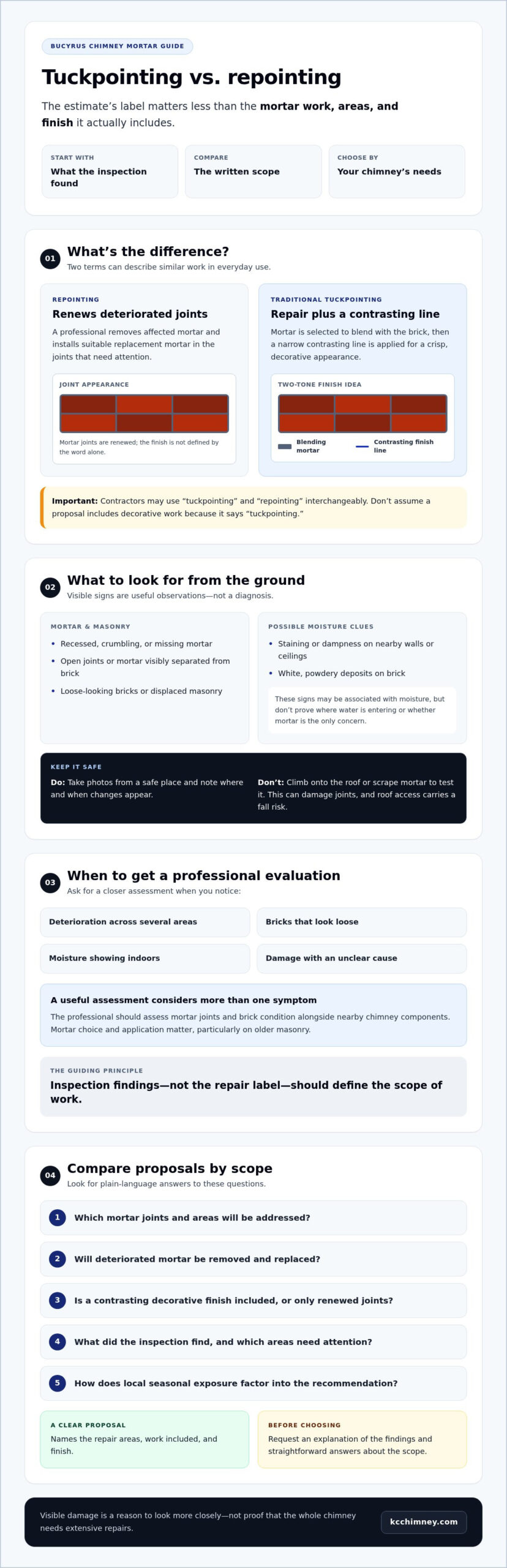
It’s reasonable to worry when mortar is cracking, crumbling, or leaving gaps. Those signs can allow water to reach the brickwork, but they don’t automatically mean the whole chimney needs extensive repairs. Repointing removes deteriorated mortar and replaces it. In its traditional sense, tuckpointing addresses failing mortar and adds contrasting mortar lines for a crisp, decorative appearance.
This guide explains the difference, what a chimney professional should inspect before recommending a repair, and what to ask when comparing proposals. Visible mortar damage, signs of moisture, and the condition of other chimney components can help clarify the right scope. The goal is to choose based on your chimney’s needs, not just the label on an estimate.
Key Takeaways
- Compare the work described in each estimate, not just the terms “tuckpointing” and “repointing,” since contractors may use them differently.
- Document missing mortar, open joints, or loose masonry from the ground, then ask a chimney professional to assess the full repair scope.
- Use the tuckpointing vs repointing chimney Bucyrus comparison to clarify what mortar work and finish an estimate includes.
- Before approving work, ask what the inspection found, which areas need attention, and how local seasonal exposure factors into the recommendation.
- Look for a clear written scope and straightforward answers. Request an explanation of the findings before choosing a repair approach.
Tuckpointing vs. repointing a chimney in Bucyrus: what is the difference?
Two chimney estimates can use “tuckpointing” and “repointing” to describe similar mortar work, even though the terms can have different technical meanings. The label is less useful than the details: which joints will be worked on, what mortar will be removed and replaced, and what finish is included.
Repointing renews deteriorated mortar joints. In the stricter traditional sense, tuckpointing adds a contrasting finish line to create a decorative effect. That distinction matters when comparing proposals for the tuckpointing vs repointing chimney Bucyrus homeowners are trying to understand.
What does repointing repair on a chimney?
Repointing addresses mortar that has deteriorated between bricks. A professional removes the affected mortar and installs suitable replacement mortar, aiming for joints that are sound, weather-resistant, and compatible with the existing masonry. The work should target joints that need attention, rather than using appearance alone to set the scope.
Cracks or worn-looking mortar may prompt an assessment, but they don’t show by themselves how much mortar should be replaced. A chimney inspection can help determine the condition of the joints and whether other parts of the chimney also need attention.
Does tuckpointing mean something different from repointing?
In traditional usage, tuckpointing can refer to a two-color finish: mortar is selected to blend with the brick, then a narrow contrasting line is applied to give the joints a neat, fine appearance. The Tuckpointing overview describes this historical technique and the terminology confusion around it. In everyday U.S. use, homeowners and contractors may also use “tuckpointing” and “repointing” interchangeably for mortar-joint repair.
Don’t assume a proposal includes decorative work just because it says “tuckpointing.” Ask the contractor to spell out the work in plain language:
- Which mortar joints will be addressed?
- Will deteriorated mortar be removed and replaced?
- Does the proposal include a contrasting decorative finish, or only renewed joints?
Clear answers make estimates easier to compare and help you understand what your chimney needs. Best Chimney Services offers chimney inspections and tuckpointing in the Kansas City metro, including Bucyrus, so homeowners can ask about the findings and proposed scope before deciding.
How to tell whether a Bucyrus chimney needs mortar repair
A few visible cracks don’t automatically tell you whether a chimney needs repointing, tuckpointing, or a different repair. They’re a reason to look more closely, not a diagnosis. For the tuckpointing vs repointing chimney Bucyrus decision, the guiding principle is simple: inspection findings, not the repair label, should define the scope of work.
Which mortar and brick warning signs should homeowners notice?
From the ground, look for mortar joints that appear recessed, crumbling, missing, or visibly separated from the brick. Note open joints, loose-looking bricks, or pieces of masonry that seem displaced. These observations can help a chimney professional understand what you’ve noticed, but they can’t confirm the cause or extent of the damage.
Also report staining or dampness on nearby walls or ceilings, and any white, powdery deposits on the brick. These signs may be associated with moisture, but they don’t prove where water is entering or whether mortar is the only concern. Take photos from a safe place and note where and when you see changes. Don’t climb onto the roof or scrape mortar to test it. Disturbing the joints can damage them, and roof access carries a fall risk.
When is a chimney inspection needed before choosing a repair?
Arrange a professional evaluation if deterioration appears across several areas, bricks look loose, moisture is showing indoors, or the cause of the damage isn’t clear. A useful assessment considers mortar joints and brick condition alongside nearby chimney components, since a visible symptom may not reveal the full source of a problem.
Mortar choice and application matter, particularly on older masonry. The National Park Service guide to repointing explains the care involved in repointing historic mortar joints. A professional can assess what’s appropriate for your chimney instead of relying on a surface-level guess.
Best Chimney Services provides chimney inspections and tuckpointing in the Kansas City metro, including Bucyrus. If you’re unsure what the signs on your chimney mean, request an assessment and a clear explanation of the recommended scope. Learn more about expert chimney inspection services before deciding what work to approve.
Tuckpointing or repointing: compare the scope before choosing
The words on an estimate can be less informative than the work it describes. Use this comparison as a guide to the scope, not a universal rule for contractor terminology. Some professionals use “tuckpointing” and “repointing” interchangeably, so ask what each term means in the proposal you received.
| Work detail | Repointing description | Tuckpointing description |
|---|---|---|
| Terminology | Usually describes renewing deteriorated mortar joints. | May mean mortar-joint repair, or may refer to a decorative finish. |
| Mortar removal | Identifies which damaged joints will be cleared of old mortar. | Should state whether and where existing mortar will be removed. |
| Replacement | Describes installing suitable mortar in the prepared joints. | Should clarify the replacement mortar and any additional finishing steps. |
| Finish | Typically describes the finished, renewed joint without specifying a contrasting line. | In the traditional sense, may include a contrasting line for a crisp decorative appearance. |
| Intended outcome | Renews deteriorated joints to address their condition. | May address joint deterioration and, when specified, add a particular visual finish. |
What should a chimney tuckpointing or repointing estimate include?
A useful proposal should identify the affected areas and explain the intended work in plain language. Ask the contractor to specify how much mortar will be removed, what replacement material is proposed, and whether the finish includes decorative treatment. Mortar selection should account for the existing brick and mortar. Ask how compatibility will be assessed instead of assuming one mix suits every chimney.
Get the scope in writing, including cleanup and any exclusions. Ask how additional work will be handled and whether it requires your approval before proceeding. Clear documentation helps you compare proposals based on the same details, even when contractors use different labels.
Which repair approach fits the condition of the chimney?
If deterioration appears limited to a small number of joints, an assessment may support a focused repair. If damage is widespread, or the concern appears deeper than the visible mortar, the proposal may need to address a broader area. Either way, the scope should explain why those locations need work and what the repair is meant to accomplish.
There’s no reliable way to select the right method from the estimate title alone. An on-site evaluation should guide the recommendation. When comparing tuckpointing vs repointing chimney Bucyrus proposals, ask the professional to connect the inspection findings to each part of the written scope before approving work.
What Bucyrus homeowners should ask before chimney mortar work
A clear repair decision starts with good information, not a guess based on the estimate’s terminology. Document what you’ve noticed, arrange an assessment, compare the written scopes, and approve work only after you understand what each proposal includes.
How should you prepare for a local chimney repair assessment?
Take photos of visible concerns from the ground and note when you first noticed them or whether they’ve changed. Share any indoor leaks or dampness, loose debris, and details of earlier chimney repairs. These observations give the professional helpful context without asking you to inspect unsafe areas yourself.
Ask whether adjacent chimney components should be evaluated before mortar work begins. Discuss the chimney’s exposure to local seasonal weather, without assuming that a particular pattern caused the damage. Weather can affect scheduling, so ask how current conditions may influence timing and whether your project has specific preparation or scheduling considerations.
How can you compare proposals without focusing only on terminology?
Put estimates side by side and compare the actual work. Check whether each one identifies the areas to be repaired, describes preparation and mortar materials, explains the finish, and accounts for cleanup. Note exclusions, too. If a contractor identifies additional work, ask what prompted the recommendation and whether you’ll be asked to approve it before it’s added.
Ask each provider to explain how the proposed scope relates to the chimney’s observed condition. The goal is to understand why the work is needed, not simply choose the proposal that uses the more familiar term. For the tuckpointing vs repointing chimney Bucyrus decision, clear explanations make it easier to compare the repair itself.
- What areas did you inspect, and what did you find?
- What work is included, and what is excluded?
- How will you communicate if conditions change or additional work is proposed?
- Which local authority should I contact to confirm whether any current permit or other requirements apply?
Don’t assume a permit rule applies without checking with the appropriate authority. Best Chimney Services serves Bucyrus and the Kansas City metro, and offers chimney repair and inspections. To discuss your concerns and request a clear explanation of the recommended work, connect with a local provider for expert chimney repair in Kansas City.
Choosing a chimney tuckpointing professional serving Bucyrus
A good provider should make the repair understandable before asking you to approve it. When weighing tuckpointing vs repointing chimney Bucyrus, look for clear findings, a specific written scope, and answers that connect the proposed work to your chimney’s condition.
What questions help you choose a chimney masonry contractor?
Ask the professional to explain what they mean by “tuckpointing” or “repointing” in your estimate. Then ask which areas need work and why. The goal is to understand the repair, not simply accept a familiar label.
- What did you find, and which mortar joints or masonry areas are included?
- How will the proposed mortar and finish suit the existing brick and mortar?
- What preparation, removal, replacement, and cleanup does the written scope cover?
- What schedule should I expect, and which credentials or qualifications can you confirm for this work?
Mortar and finish recommendations depend on the existing masonry, so ask the contractor to explain the basis for those choices. Request the scope and schedule expectations in writing, along with any exclusions and how additional work would be discussed. If a detail is unclear, ask for clarification before approving the proposal.
What is the next step if you are unsure which repair you need?
You don’t have to choose between tuckpointing and repointing before you understand the condition of the chimney. Request an assessment, then ask the professional to explain the findings and why the proposed work fits. A responsible recommendation should address the observed condition and scope, not rely on the term printed at the top of an estimate.
Best Chimney Services is a locally owned Kansas City-area business serving Bucyrus, with tuckpointing, chimney repair, and inspection services among its listed offerings. Homeowners can request an inspection and a clear explanation of the recommended work before deciding whether to proceed.
Before approving a repair, make sure you can describe what will be done, where it will be done, and why. If you’re ready to clarify the condition of your chimney, contact a local chimney professional to discuss an assessment and the next steps for your home.
Choose the Repair That Fits Your Chimney
The terms “tuckpointing” and “repointing” can describe different work depending on how a contractor uses them. Focus on what the estimate includes: which joints need attention, how the repair will be completed, and whether it includes a decorative finish. Most importantly, let inspection findings, not the label alone, guide the repair scope.
For homeowners weighing tuckpointing vs repointing chimney Bucyrus, a clear assessment and written explanation can make the next step easier. Ask questions until you understand what was found and why the recommended work suits your chimney.
Best Chimney Services has served the Kansas City metropolitan area, including Bucyrus, since 2012. Its listed services include tuckpointing, chimney repair, and inspections. Contact Best Chimney Services to discuss your chimney repair needs and request an explanation of the appropriate next steps.
With a clear scope and a trusted local resource, you can move forward with greater confidence and help protect your home.
Frequently Asked Questions
These answers can help homeowners in Bucyrus, Overland Park, Mission Hills, Stilwell, and Spring Hill compare chimney mortar proposals and understand what to ask before approving work.
What is the difference between tuckpointing and repointing a chimney?
Repointing generally means removing deteriorated mortar from masonry joints and replacing it. Tuckpointing may describe the same repair in everyday U.S. use, or a decorative finish made with contrasting mortar. For tuckpointing vs repointing chimney Bucyrus estimates, the wording alone doesn’t show how much mortar will be removed or what work is included. Ask the contractor to explain the exact scope and finish in writing.
Is tuckpointing the same as repointing?
Sometimes, yes. Homeowners and contractors in the United States may use the terms interchangeably, while more specific usage can reserve “tuckpointing” for a decorative mortar finish. Terminology varies, so don’t rely on the estimate heading alone. Ask which joints will be repaired, how existing mortar will be handled, what replacement material is proposed, and whether a contrasting finish is included.
How do I know if my chimney needs repointing?
Missing, crumbling, recessed, or separated mortar can indicate that your chimney needs professional evaluation. Loose brick, staining, or signs of moisture are also worth reporting, but they don’t confirm the cause or the right repair. Photograph concerns from a safe location and share them with a chimney professional serving Bucyrus or nearby communities. Ask for an assessment of the masonry and a clear explanation of the proposed scope before work begins.
Can damaged chimney mortar be repaired without replacing the bricks?
In some situations, a professional can repair deteriorated mortar joints while retaining bricks that remain sound. The right approach depends on the brick’s condition, the depth and extent of mortar damage, and the suitability of replacement materials for the existing masonry. If bricks are loose, cracked, or damaged, the assessment may identify additional work. Ask the contractor to identify which areas need attention and explain why each repair is recommended.
How long does chimney tuckpointing or repointing take?
Project duration depends on the amount and location of damaged mortar, access to the chimney, weather, and any related repairs found during assessment. A small, accessible repair may take less time than work across multiple chimney sides, but an exact schedule depends on project details. Ask your provider for an expected work window, any preparation needed, and how weather could affect scheduling in Bucyrus or surrounding areas.
How much does chimney tuckpointing cost in Bucyrus?
The cost depends on factors such as the extent of mortar deterioration, chimney height and access, materials, and any related repairs identified during assessment. Request a written proposal that identifies the areas and work included, then compare estimates covering the same scope. Ask what is excluded and what circumstances could change the proposal. A brief description and a broader restoration scope aren’t directly comparable just because both mention mortar work.
How do I choose between a tuckpointing and repointing estimate?
Compare the described work, not just the terms in each estimate’s heading. Check which joints are included, how existing mortar will be removed, what replacement material and finish are proposed, and what the estimate excludes. Ask each contractor to connect the scope to their findings from the chimney assessment. If anything remains unclear, request a written explanation before approving work, whether your home is in Bucyrus, Overland Park, or elsewhere nearby.