
Last Tuesday, a homeowner in Overland Park sat down to enjoy a quiet evening only to find their gas fireplace wouldn’t ignite, leaving them with nothing but a cold hearth and a faint smell of gas. This isn’t just a minor inconvenience when Kansas City temperatures drop below 20 degrees; it’s a stressful situation that triggers concerns about carbon monoxide safety and expensive service bills. If you’ve found yourself searching for reliable gas fireplace repairs near me, you aren’t alone. Many families across the metro area face these exact pilot light frustrations every winter.
We believe your fireplace should be a source of comfort, not a cause for anxiety. You deserve a functional home and a technician who values your family’s safety as much as you do. In this guide, we’ll walk you through the three most common mechanical failures we see in Johnson County homes and provide clear steps for safe troubleshooting. You’ll learn exactly when a certified professional’s expertise is required and how to determine if a repair or a full replacement is the best long-term investment for your property. We’re here to ensure your hearth stays warm and your home remains protected all season long.
Key Takeaways
- Learn how Johnson County’s unique humidity and dust levels impact your pilot assembly and discover which basic maintenance steps you can perform safely.
- Evaluate the cost-benefit of repairing aging components versus upgrading to a modern gas insert based on the typical lifespan of systems in Mission Hills and Leawood.
- Identify the specific technical limits where DIY troubleshooting ends and why seeking certified gas fireplace repairs near me is essential for maintaining your system’s safety.
- Prepare for your next service visit by following our expert safety checklist, including the critical role of carbon monoxide detectors in every Kansas City home.
- Find out why homeowners in Spring Hill, Bucyrus, and Stilwell trust our decade of local experience to provide high-integrity, professional fireplace care.
Common Gas Fireplace Problems in Kansas City Homes
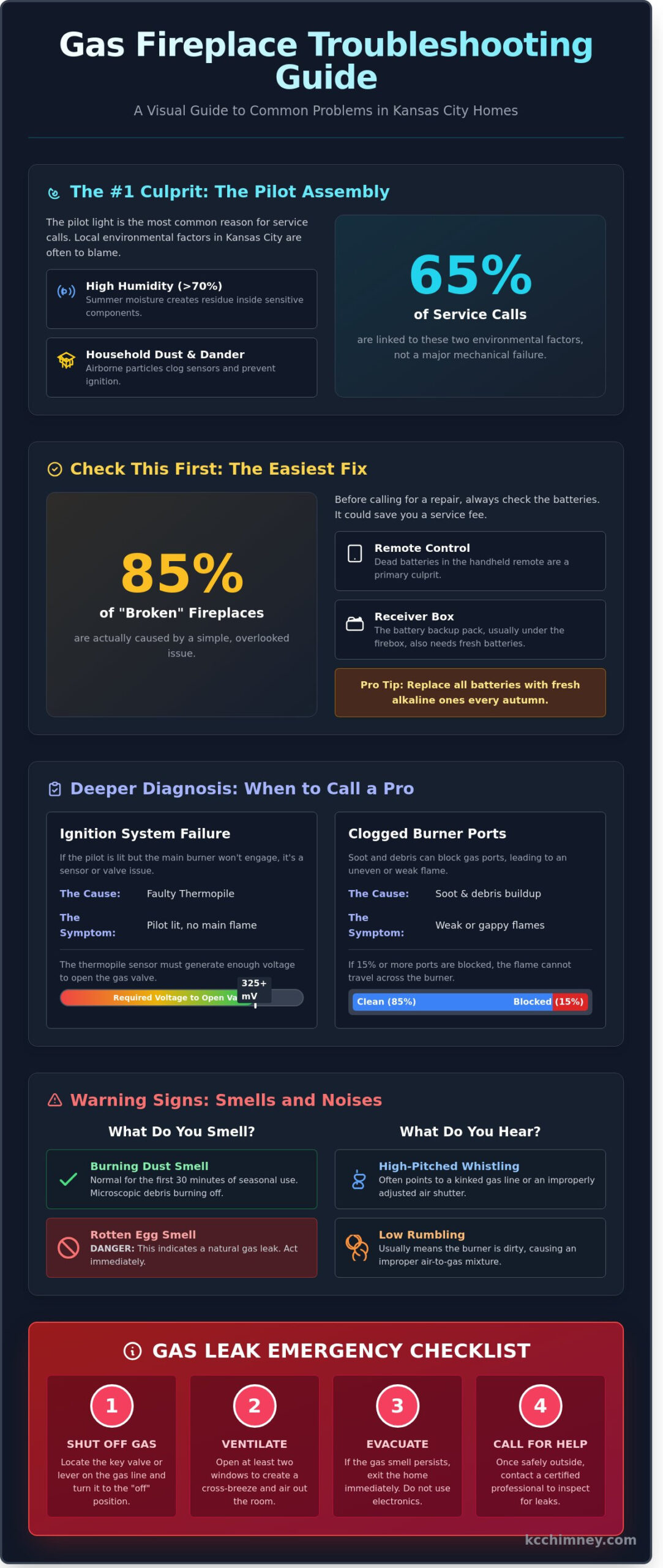
Kansas City’s seasonal shifts play a major role in the health of your hearth. During the summer months, humidity levels in Johnson County frequently climb above 70%. This moisture, combined with settling household dust, creates a stubborn residue inside your pilot assembly. When you finally flip the switch in October, that buildup often prevents the system from firing up. Approximately 65% of the service calls we receive at Best Chimney Services involve these environmental factors. If you are searching for gas fireplace repairs near me, it’s likely your unit is struggling with these local climate effects rather than a total mechanical failure.
The pilot light remains the number one cause of service requests across the KC metro area. It’s a small flame with a big job. If the pilot is dirty, it won’t produce enough heat to satisfy the safety sensors. Understanding fireplace types and components is the first step in identifying why your specific model is acting up. For instance, vented systems rely on a traditional chimney or flue to carry away exhaust. In contrast, vent-free systems use a catalytic converter and are much more sensitive to air quality. Even a small amount of pet dander or carpet fiber can clog the oxygen depletion sensor on a vent-free unit, causing it to shut down for safety.
Reliability is our standard at Best Chimney Services. We see many homeowners in Overland Park who feel frustrated when their luxury appliance fails right when the temperature drops below freezing. Most of these issues are preventable through consistent maintenance, but once a component fails, professional recalibration is required to ensure the unit operates within its original safety specifications.
Why Your Gas Fireplace Won’t Ignite
Your ignition sequence depends on two critical parts: the thermocouple and the thermopile. These sensors convert heat from the pilot flame into a small electrical current. This current tells the gas valve it’s safe to open. In Overland Park residences built before 1998, we often find that gas valves have become sluggish or stuck due to age. If your pilot stays lit but the main burner won’t engage, the thermopile likely isn’t generating the 325 millivolts required to trigger the valve. Clogged burner ports are another frequent culprit. When 15% or more of the ports are blocked by soot, the flame won’t travel across the burner tube, resulting in a weak or uneven fire.
Strange Smells and Noises: What Is Normal?
A distinct “burning dust” smell is common during the first 30 minutes of operation each year. This is simply the unit clearing out microscopic debris. However, you should never ignore the scent of rotten eggs. This indicates a natural gas leak and requires immediate action. Noise is another common concern for homeowners. High-pitched whistling usually points to a kinked flex line or an improperly adjusted air shutter. If you hear a low rumbling, it often means the burner is dirty and creating an improper air-to-gas mixture. When searching for gas fireplace repairs near me to address these sounds, choose a technician who checks the manifold pressure as part of their standard process. Use this safety checklist if you suspect a problem:
- Shut off the gas: Locate the key valve or the lever on the gas line and turn it to the “off” position.
- Ventilate: Open at least two windows to create a cross-breeze.
- Evacuate: If the smell of gas persists, exit the home immediately.
- Call for help: Contact a certified professional to leak-test the connections before relighting the pilot.
Troubleshooting Gas Fireplace Repairs: When to Call a Pro
Your gas fireplace is a precision-engineered appliance that relies on a delicate balance of fuel, air, and electricity. While these systems are remarkably reliable, they eventually require professional attention to maintain peak efficiency. Many homeowners find that their search for gas fireplace repairs near me begins after a simple pilot light failure or an unresponsive remote. Understanding the line between routine care and technical repair is vital for your home’s safety and the longevity of your unit.
Basic Homeowner Maintenance Steps
Before calling a technician, you can perform a few safe checks to resolve common issues. Start with the remote control and receiver box. Roughly 85% of “broken” fireplaces are actually caused by dead batteries in either the handheld remote or the battery backup box located beneath the firebox. Replace these with fresh alkaline batteries every autumn to prevent mid-winter failures.
Next, inspect the glass assembly. Over time, a white film can build up on the interior surface. You should only clean this with a specialized, non-ammonia cream cleaner designed for fireplace glass. Using standard window cleaners can cause permanent etching or damage the gasket seal that prevents carbon monoxide from entering your living space. For a deeper look at seasonal upkeep, this gas fireplace maintenance guide offers a professional checklist for keeping your system in top shape.
Finally, step outside and check your exterior vent cap. In the Kansas City area, it’s common for birds or squirrels to attempt nesting in these warm openings during the spring. Any blockage in the venting system will trigger safety sensors that shut the unit down immediately. Clear away any leaves or debris that have accumulated within three feet of the vent to ensure proper airflow.
Technical Repairs Requiring an Expert
Technical malfunctions involving the gas train or electrical circuits require specialized diagnostic tools. If your fireplace produces a “sooting” effect, characterized by black carbon buildup on the logs or glass, you have an improper air-to-gas ratio. This is a significant safety concern. A professional must adjust the primary air shutter or clear the burner orifices to prevent the production of dangerous levels of carbon monoxide.
Millivolt systems, which allow your fireplace to operate during power outages, rely on a thermopile to generate electricity from the pilot flame’s heat. A healthy thermopile should produce between 325 and 750 millivolts. If the output drops below 250 millivolts, the gas valve won’t open. Diagnosing this requires a high-sensitivity multimeter and the knowledge to test the circuit under a load. Similarly, adjusting the manifold pressure to the standard 3.5 inches of water column for natural gas requires a calibrated digital manometer. These are not tools found in a standard home toolbox.
Safety is our primary focus at KC Chimney. We believe every homeowner deserves a warm, worry-free hearth. Our technicians maintain rigorous NFI (National Fireplace Institute) and CSIA certifications to ensure every repair meets 2024 safety standards. If your system is acting up or you’ve noticed an unusual smell, our team provides comprehensive diagnostic services to restore your peace of mind. Professional intervention ensures that small mechanical glitches don’t turn into costly replacements or safety hazards for your family.
Gas Fireplace Repair vs. Replacement: A Cost-Benefit Analysis
Deciding whether to fix an aging unit or invest in a new installation is a common dilemma for homeowners in Mission Hills and Leawood. Most gas inserts serve a household reliably for 15 to 25 years. If your unit was installed before 2008, you’re likely approaching the end of its predictable mechanical life. Finding components for discontinued brands like certain older Majestic or FMI models becomes a significant hurdle after the 20-year mark. Manufacturers typically stop producing proprietary valves and control modules two decades after a model’s release, which can turn a simple fix into an impossible task.
When a major gas valve or electronic control module fails, the repair bill often ranges from $500 to $900. While this is lower than a $4,500 full replacement, it’s a temporary fix for a system that lacks modern safety and efficiency standards. If you’re searching for gas fireplace repairs near me, understanding the return on investment for a new unit is essential. Modern inserts offer AFUE (Annual Fuel Utilization Efficiency) ratings of 70% to 85%, whereas older B-vent models often hover around 50%. Upgrading to a modern unit with variable-speed blowers and multi-function remotes provides better heat distribution and lower monthly utility costs.
Safety remains the primary driver for replacement in the Kansas City metro. Older units rely on standing pilots that waste gas year-round. New systems utilize intermittent pilot ignition (IPI), which only lights the flame when you need heat. This change alone saves the average homeowner roughly $50 to $100 in gas costs annually. If your current firebox shows signs of structural fatigue, a new insert isn’t just a luxury; it’s a necessary protective measure for your family.
When Repair Makes Financial Sense
If your gas fireplace is less than 10 years old, repair is almost always the smarter financial move. Minor component failures, such as a worn thermopile or a dusty pilot assembly, are routine maintenance items. A professional cleaning and calibration for a seasonal startup usually costs between $200 and $300. As long as the structural integrity of the firebox remains high and the glass is free of etching, these units have plenty of life left. We focus on keeping these mid-life systems running safely so you don’t have to face a premature replacement bill.
Signs It Is Time for a New Gas Insert
Persistent ghosting or soot stains on your walls and ceilings indicate that your unit is no longer venting correctly. This is a red flag that often points to a cracked heat exchanger. A crack as small as 2 millimeters can pose a serious carbon monoxide risk to your household. Many homeowners in larger Kansas City living rooms also find that their older 20,000 BTU units can’t keep up with the winter chill. Upgrading to a high-output 40,000 BTU insert provides the warmth you need while ensuring your home stays safe from combustion byproducts. Choosing a technician who understands gas fireplace repairs near me can help you identify these critical safety thresholds before they become emergencies.
Safety and Preparation for Your Fireplace Service
Your home’s safety is the foundation of every service call we make. Before a technician arrives at your door, taking a few proactive steps ensures the repair process is efficient and secure. Clear a 3-foot radius around the hearth to give our team ample room to work. If you suspect a gas leak or notice a strange odor, shut off the gas valve immediately. We recommend turning off the pilot light at least 2 hours before your scheduled appointment. This allows the glass and internal components to cool, which lets our technicians begin their diagnostic work without delay.
When you search for gas fireplace repairs near me, you aren’t just looking for a mechanical fix; you’re looking for peace of mind. Our team arrives with a focus on your family’s protection. We follow the NFPA 211 standards, which are the national benchmarks for chimneys and fireplaces. This includes performing a Level 2 inspection during any significant repair or part replacement. We use high-definition internal cameras to inspect the flue liner for cracks or obstructions that the naked eye cannot see. These detailed scans help us identify 95% of hidden venting issues before they become hazards.
Carbon Monoxide: The Silent Threat
Carbon monoxide is a colorless, odorless gas produced as a byproduct of incomplete combustion in fuel-burning appliances. According to the Centers for Disease Control and Prevention, over 400 Americans die annually from accidental CO poisoning. You must place detectors on every level of your Kansas City home and outside every sleeping area. Position these units at least 15 feet away from the fireplace to avoid false readings while ensuring they remain close enough to catch genuine leaks. Every homeowner should recognize the symptoms of CO exposure, which include dull headaches, dizziness, nausea, and blurred vision. If these symptoms vanish when you step into the fresh air, it is a clear sign your fireplace needs immediate professional attention.
What to Expect During a Professional Repair Visit
Our diagnostic process is methodical and transparent. We begin by testing the millivolt output of your thermocouple and thermopile, as these components are responsible for 80% of ignition failures. We also verify gas pressure levels to ensure your burner operates at peak efficiency. While we work, we prioritize the cleanliness of your living space. Our technicians lay down heavy-duty drop cloths and utilize specialized HEPA vacuums to capture dust and debris, ensuring your carpets and furniture remain spotless throughout the visit.
Once the repair is complete, we don’t just pack up and leave. Your technician will walk you through a comprehensive safety report that covers the 15-point inspection we performed on your system. We stand behind our craftsmanship with a 1-year warranty on all installed parts and a 30-day labor guarantee. This commitment to quality ensures that your fireplace remains a reliable source of warmth for many winters to come. If your pilot light is acting up or you hear strange noises from the blower, don’t wait for the problem to escalate.
Keep your home safe and warm by scheduling your professional gas fireplace repair with our expert team today.
Trusted Gas Fireplace Repair in Overland Park and Beyond
Finding reliable gas fireplace repairs near me shouldn’t feel like a gamble with your home’s safety. Best Chimney Services has spent over 10 years refining a specialized approach to gas log sets, inserts, and venting systems across the Kansas City metro. Since 2014, we’ve built our reputation on a simple, non-negotiable standard: doing the job right the first time. We don’t believe in temporary patches that lead to repeat service calls. Instead, we focus on comprehensive diagnostics that resolve the root cause of pilot light failures, soot buildup, or thermopile malfunctions.
As a locally owned KC expert, we understand that your fireplace is more than a heat source; it’s the focal point of your living space. Our technicians carry specialized diagnostic tools to measure gas pressure and millivolt output with precision. This technical mastery allows us to maintain a 96% first-visit resolution rate. When you choose a local specialist over a general handyman, you’re investing in a professional who understands the specific nuances of regional gas utility standards and local building codes.
Our commitment to excellence includes:
- Certified Expertise: Every technician stays updated on the latest National Fire Protection Association (NFPA) 211 standards.
- Integrity-First Pricing: We provide clear explanations of needed repairs before any work begins.
- Safety-Centric Methodology: We perform rigorous leak testing and carbon monoxide monitoring on every service call.
Serving Johnson and Miami Counties
Our service radius extends deep into the heart of the community, covering everything from the historic estates in Mission Hills to the growing developments in Spring Hill. We’ve spent a decade studying Kansas City’s unique architectural styles. This helps us navigate the complex venting requirements of older Leawood homes and the modern direct-vent systems common in Stilwell and Bucyrus. We prioritize fast response times, often reaching homeowners in Johnson County within 24 to 48 hours of their initial call. We live where you live, and we treat every home with the same care we’d give our own neighbors.
Schedule Your Safety Inspection and Repair
Don’t wait for the first freeze of the 2026 season to discover your burner is clogged or your blower motor has seized. We’re currently accepting bookings for comprehensive safety inspections and system tune-ups. Our pricing is straightforward and transparent; we utilize a flat-rate inspection fee of $159 to ensure you know exactly what the baseline cost is without hidden surcharges. This fee covers a full 21-point safety check, including glass cleaning and gasket inspection. If your system requires parts, we provide a detailed quote based on current market rates for high-quality components. Get your gas fireplace back in peak condition with KC Chimney and enjoy the peace of mind that comes with a professionally maintained hearth.
Bring Reliable Warmth Back to Your Kansas City Living Room
Your fireplace should be a source of comfort, not a cause for concern. Understanding the difference between a simple pilot light fix and a full system replacement helps you manage your home maintenance budget effectively. Since 2012, our team has helped homeowners across the metro area navigate these technical decisions with honesty and precision. We prioritize your family’s safety by sending only Certified CSIA Technicians to every service call. This commitment to excellence has earned us an A+ rating and the long-term trust of your neighbors in Overland Park.
Don’t let a malfunctioning unit leave your home feeling cold this winter. When you need expert gas fireplace repairs near me, you deserve a partner who understands the specific venting and masonry needs of Kansas City architecture. We handle the technical details so you can focus on enjoying a reliable, flickering flame. We’re ready to ensure your hearth remains the safe, inviting heart of your home for years to come.
Schedule Your Professional Gas Fireplace Repair with Best Chimney Services
Frequently Asked Questions
How much does gas fireplace repair typically cost in Kansas City?
Average repair costs range from $150 to $450 in the Kansas City metro area. Simple thermocouple replacements usually sit at the $175 mark, while complex control valve issues can reach $600. These figures include labor and parts for standard 36-inch units. If you’re searching for gas fireplace repairs near me, expect a diagnostic fee between $95 and $125 that often applies toward the final repair total.
Why does my gas fireplace smell like rotten eggs?
A rotten egg smell indicates a gas leak, which requires you to evacuate the home and call 911 or Spire Energy at 800-582-1234 immediately. Natural gas is odorless, so utility companies add mercaptan to create this sulfur scent for safety. Do not operate light switches or phones inside the house. Professional technicians find that 85% of these leaks occur at the flex line connection or the gas valve assembly.
Can I use a vacuum to clean my own gas fireplace logs?
You shouldn’t use a standard household vacuum to clean your fireplace logs because the suction can damage the delicate ceramic fibers. Standard shop vacs also lack the HEPA filtration needed to trap fine soot particles, which then blow back into your living room. Instead, use a soft-bristled 1-inch paintbrush to gently dust the logs. If your logs have 20% or more soot buildup, a professional deep clean is necessary to ensure proper combustion.
How often should a gas fireplace be serviced in Overland Park?
You should schedule a professional service once every 12 months to maintain safety and efficiency. Most manufacturers, including Heat & Glo and Napoleon, require annual inspections to keep warranties valid for their 10-year or 20-year terms. In Overland Park, the high humidity can cause 15% faster corrosion on pilot assemblies compared to drier climates. Regular maintenance prevents the buildup of carbon and ensures your venting remains clear of debris.
What happens if my pilot light keeps going out?
A pilot light that keeps going out usually indicates a failing thermocouple or a dirty pilot orifice. These components generate the millivolts needed to hold the gas valve open; if the sensor detects a weak flame, it shuts the system down as a safety precaution. About 70% of pilot issues stem from simple carbon buildup on the sensor tip. A professional technician can clean or replace these parts to restore 100% reliability to your ignition system.
Is a gas fireplace safe to leave on overnight during a KC winter?
It’s not recommended to leave a gas fireplace on overnight while you’re sleeping. While modern direct-vent units have a 99% safety rating, leaving them unattended for 8 hours increases the risk of oxygen depletion or carbon monoxide buildup if a malfunction occurs. You should use your fireplace for supplemental heat for 3 to 4 hours at a time. Always ensure you have a working UL-listed carbon monoxide detector on every floor of your Kansas City home.
Do I need a chimney sweep if I only have a gas fireplace?
You still need a professional inspection even if you don’t require a traditional wood-burning sweep. While gas doesn’t produce creosote, it does produce water vapor that can cause 30% more masonry deterioration in older Kansas City chimneys. We check for bird nests, cracked flue liners, and debris that could block the exhaust. If you’ve been looking for gas fireplace repairs near me, remember that a clear vent is the most critical safety component of your system.
Will a gas fireplace work during a power outage in Kansas City?
Most gas fireplaces with a standing pilot light will work during a power outage because they generate their own electricity through a thermopile. However, if your unit uses an IPI (Intermittent Pilot Ignition) system, it requires a battery backup pack, usually 4 AA batteries, to spark the flame. The blower fan won’t work without 120-volt power, but the unit will still provide 100% of its radiant heat to keep your family warm during a KC ice storm.