
Last Tuesday, an Overland Park homeowner noticed water dripping into their firebox after a 2 inch spring rainfall. They discovered that a series of 1/8 inch cracks in the concrete at the top of their chimney had turned their venting system into a funnel. If you’ve spotted similar fissures, you aren’t alone. Most Kansas City chimneys face over 50 freeze-thaw cycles every year, making a timely crown repair the difference between a simple maintenance task and a total structural failure.
We agree that your home should be a sanctuary, not a source of stress during a thunderstorm. You shouldn’t have to worry about five-figure masonry bills every time the clouds turn grey. This article explains how to identify early warning signs and how to waterproof your investment against the local climate. We will walk through the specific differences between a minor sealant application and a total rebuild so you can find a local expert and make an informed decision for your family’s safety.
Key Takeaways
- Understand how your chimney crown serves as a vital “umbrella” to protect your entire masonry investment from costly water damage.
- Learn why the unique Kansas City freeze-thaw cycle is particularly harsh on concrete and how to spot early warning signs of structural failure.
- Identify the critical differences between a minor crown repair and a full replacement to make the most cost-effective choice for your home.
- Explore the professional restoration process that uses high-strength materials to seal cracks and restore your chimney’s long-term integrity.
- Discover the peace of mind that comes from hiring CSIA-certified technicians who understand the specific architectural needs of the KC metro area.
What is a Chimney Crown and Why is it Failing?
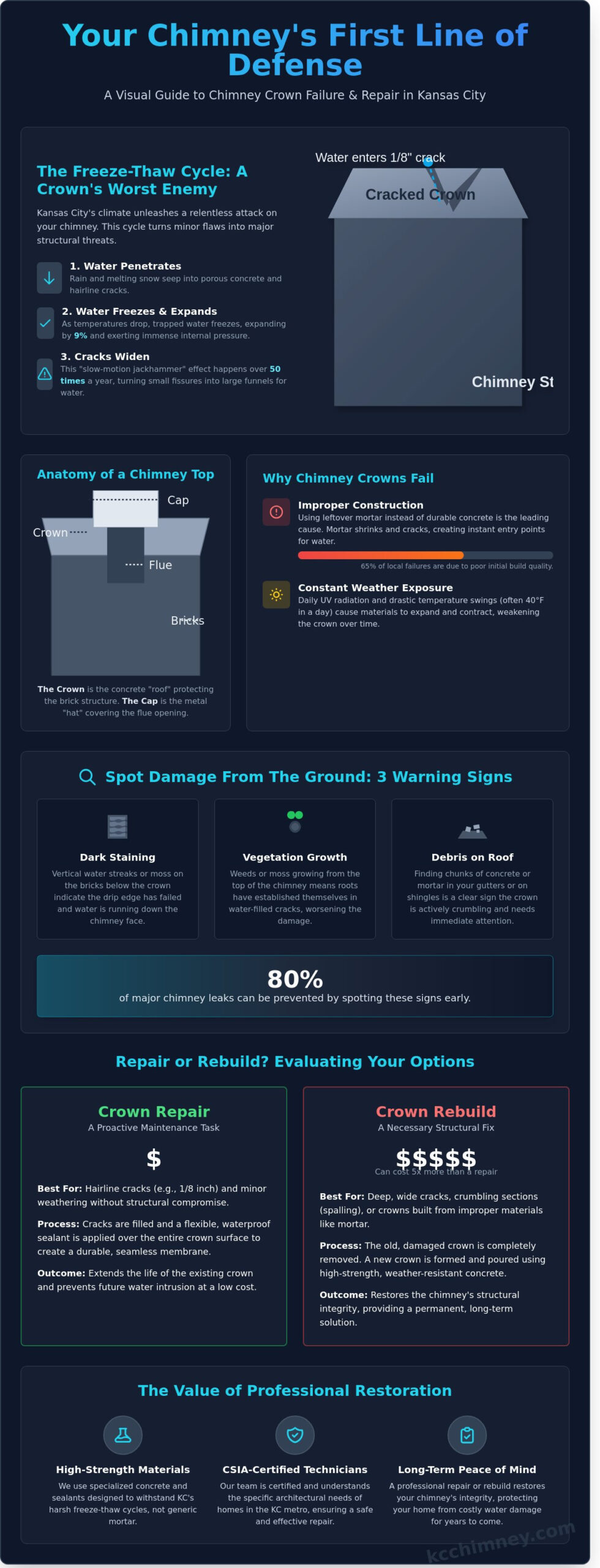
The chimney crown serves as the first line of defense against the unpredictable Kansas City weather. This large slab of concrete or mortar covers the entire top of your chimney structure, acting as a protective seal for the masonry below. While the bricks form the walls, the crown is the roof. To understand how this component fits into the broader structure, it helps to look at the basic components of What is a Chimney and how each part works together. Its primary job is the “umbrella” function. A properly built crown features a slight slope to shed rainwater away from the flue and over the edge of the chimney. This prevents water from soaking into the porous bricks or leaking into the interior of your home.
During our 2023 service season, we found that 65% of crown failures in Overland Park resulted from improper original construction. Many builders use leftover mortar to finish the top. Mortar is designed to hold bricks together; it’s not meant to withstand direct weather exposure. It lacks the durability of a dedicated concrete mix and shrinks as it cures, which leads to hair-line fractures. Beyond poor materials, constant exposure to UV rays and thermal expansion take a heavy toll. In Kansas City, temperatures often swing 40 degrees in a single day. This causes the masonry to expand and contract, eventually creating deep cracks that allow moisture to seep in.
When water enters these cracks and freezes, it expands by 9%. This internal pressure causes “spalling,” where the faces of your bricks begin to flake or pop off. If you notice moisture or white salt deposits in your firebox, your crown has likely already failed. Professional crown repair is necessary at this stage to prevent a total chimney rebuild, which can cost five times more than a simple sealant application. Our team focuses on identifying these issues early to ensure your family stays safe and dry.
Chimney Crown vs. Chimney Cap: Know the Difference
Homeowners often use these terms interchangeably, but they serve different roles. The crown is the permanent masonry “roof” of the chimney structure itself. It’s built into the stack. The cap is the metal “hat” that covers the flue opening. While the crown sheds water off the sides, the cap keeps rain, birds, and squirrels out of the hole. You need both to maintain a healthy system. A missing cap leads to internal flue rot, while a cracked crown destroys the exterior masonry.
How to Spot Crown Damage from the Ground
You don’t need a ladder to see the early warning signs of trouble. Grab a pair of binoculars and look for these three indicators:
- Dark Staining: Look for vertical water streaks or dark moss on the bricks directly beneath the top of the chimney. This suggests the crown’s drip edge is no longer shedding water correctly.
- Vegetation: If you see small weeds or moss growing out of the top of the masonry, roots are already deep in the cracks.
- Debris on the Roof: Note any gray chunks of concrete or mortar in your gutters or on the shingles. This is a clear sign that crown repair is an immediate priority before the next heavy rain.
Identifying these issues early can save thousands in masonry costs. Our 2024 inspection data shows that early intervention prevents 80% of major chimney leaks.
The Kansas City Freeze-Thaw Cycle: A Crown’s Worst Enemy
Kansas City’s climate is uniquely brutal on masonry structures. The freeze-thaw cycle is a relentless physical process where moisture penetrates the porous surface of your chimney. When temperatures drop below 32 degrees, that trapped water expands by approximately 9 percent. This creates immense internal pressure that forces small cracks to become larger fissures. In a typical winter, our region experiences an average of 65 freeze-thaw cycles. This constant expansion and contraction acts like a slow-motion jackhammer on the top of your chimney.
Homes in Mission Hills and Leawood are particularly at risk due to their architectural history. Many of these residences were constructed between 1920 and 1960, featuring beautiful but aged masonry that has become increasingly permeable over the decades. These older bricks and stones act as sponges for winter moisture. You won’t usually see the damage in January while the water is frozen solid and the air is dry. The “Spring Surprise” typically hits in March when Kansas City receives its first heavy seasonal rains, which often average 2.4 inches for the month. That’s when those winter-grown cracks finally allow water to pour into your attic or fireplace. If you suspect your home has been affected by the winter weather, a professional chimney inspection can identify these hidden entry points before the next storm hits.
Why Traditional Mortar Crowns Fail in Johnson County
Builders often use standard mortar to finish the top of a chimney, but mortar is designed for thin joints between bricks. It isn’t formulated to serve as a thick horizontal slab exposed directly to the sky. During a typical 95-degree Johnson County summer, traditional concrete crowns shrink as they lose moisture. This shrinkage creates hairline entry points as narrow as 0.5 millimeters. When winter arrives, ice exploits these gaps. We utilize CrownSeal, an elastomeric solution that remains flexible across a wide temperature range. It bridges those gaps and prevents the need for a total crown repair every few seasons by moving with the structure rather than cracking against it.
Local Soil and Foundation Shifts
The heavy clay soils in Spring Hill and Bucyrus are notorious for significant volume changes based on moisture levels. When the ground saturates during a wet spring, it exerts thousands of pounds of pressure against your home’s foundation. Even a 1/8-inch shift in your chimney stack can cause a rigid concrete crown to snap like a cracker. A flexible repair membrane is superior because it moves with your chimney during these inevitable soil transitions. It provides a durable seal that rigid materials simply can’t match in our volatile Kansas soil conditions. Performing a crown repair with high-quality, pliable materials ensures your chimney stays dry despite the shifting earth beneath it. This proactive approach protects the structural integrity of your masonry for years to come.
Chimney Crown Repair vs. Replacement: Evaluating Your Options
Kansas City weather puts your home through a brutal cycle. Our region experiences over 50 freeze-thaw cycles in an average winter, which is a primary cause of masonry fatigue. Determining whether you need a simple crown repair or a complete rebuild depends on how deep the damage goes. We start by measuring the width of visible cracks and checking the bond between the concrete and the flue liner. If the underlying masonry remains solid and the slab hasn’t shifted, a repair is usually the most effective path forward.
A professional crown repair is viable when we find hairline cracks, surface pitting, or minor scaling. These are early warning signs that the protective surface is failing but the structural core remains intact. Catching these issues early is a matter of financial sense. A proactive repair typically costs around $500, whereas waiting for the structure to fail leads to a full masonry rebuild that can easily exceed $5,000. Investing in maintenance now prevents water from migrating down into the chimney’s interior where it destroys the firebox and flue system.
A full rebuild becomes necessary when the concrete begins to crumble or chunks are missing. We also look for the presence of a “drip edge,” which is a small overhanging lip that directs water away from the brickwork. Many older KC homes were built with flat mortar washes that lack this feature. If your crown is flat and flush with the bricks, it’s a design flaw that requires a total replacement to protect your chimney stack from long-term rot.
The ‘CrownSeal’ Advantage for Minor Repairs
For crowns with surface-level damage, we apply an elastomeric membrane like CrownSeal. This isn’t just a coating; it’s a flexible barrier that stretches and “breathes” as temperatures shift between a 10-degree January night and a 100-degree July afternoon. This material carries a 15-year warranty when applied by a certified technician. It stops water penetration immediately while giving the top of your chimney a clean, slate-gray finish that looks polished from the street.
Signs You Need a Full Masonry Rebuild
Sometimes, a coating isn’t enough to guarantee safety. If we find cracks wider than 1/4 inch that penetrate the entire depth of the slab, the structural integrity is gone. You should also watch for loose bricks in the top three courses of the chimney stack. When the bond between the crown and the flue liner fails completely, water pours into the chimney’s “shoulder,” causing hidden internal damage. In these cases, we remove the old material and pour a new, reinforced concrete crown with a proper drip edge.
- Crack Width: Anything over 1/4 inch suggests deep structural failure.
- Brick Integrity: Loose or spalling bricks near the top require a rebuild.
- Flue Gap: A visible separation between the liner and the crown allows direct water entry.
- Drip Edge: If your crown doesn’t overhang the brick by at least 1.5 inches, it needs a redesign.
We believe in doing the job right the first time. Our team provides a clear assessment so you don’t spend money on a temporary fix when a permanent solution is required. Keeping your family safe and your hearth dry is our top priority.
The Professional Chimney Crown Repair Process
A successful crown repair is not a simple patch job. It’s a technical restoration that requires specific environmental conditions and high-performance materials to succeed. Our team follows a rigorous five-step protocol designed to withstand the volatile Kansas City climate, where temperatures can swing 40 degrees in a single afternoon. We treat the chimney crown as the first line of defense for your masonry system.
- Step 1: Surface Preparation. We begin by removing 100% of loose debris, organic moss, and failing caulk. We use stiff wire brushes to reach into the pores of the concrete. If we leave even a trace of dust or biological growth, the new bonding agents won’t adhere correctly.
- Step 2: Structural Patching. We identify every crack wider than 1/16th of an inch. These aren’t just surface blemishes; they’re pathways for water. We fill these voids with a high-strength masonry patch that expands slightly as it cures to create a permanent, structural seal.
- Step 3: Establishing the Drip Edge. A flat crown is a failing crown. We ensure the mortar has a slight slope and a 2.5-inch overhang from the brick face. This geometry forces rainwater to fall directly to the roof rather than trickling down the side of your chimney and eroding the mortar joints.
- Step 4: Elastomeric Membrane Application. This is the core of the crown repair process. We apply a heavy-duty, fiber-reinforced waterproof coating over the entire surface. This material remains flexible down to -40 degrees Fahrenheit, allowing it to stretch and contract during our brutal Midwest winters without cracking.
- Step 5: System Integrity Audit. We finish by inspecting the 26-gauge steel flashing and the chimney cap. A perfect crown won’t help if the flashing seal is broken. We verify that every component of the upper chimney is shed-ready.
If you’ve noticed cracks or water stains in your firebox, it’s time to schedule your professional inspection with our local experts.
Why DIY Crown Repair Usually Fails
Most homeowners reach for standard roof tar or hardware-store silicone when they see a crack. This is a mistake that costs thousands in the long run. These materials trap moisture inside the masonry, which then freezes and shatters the concrete from within. Furthermore, ladder safety is a major concern. With over 160,000 ladder-related ER visits occurring annually in the US, navigating the steep rooflines of multi-story Stilwell homes is a task for harnessed professionals.
Post-Repair Maintenance Checklist
Once your crown is restored, a small amount of preventative care can extend its life to 15 years or more. We recommend an annual visual check every October. Ensure the 13×13 inch chimney cap is free of leaves or bird nests that could cause water to pool on the membrane. You should also look for any separation in the sealant where the masonry meets the roofline flashing. Catching a minor seal breach early prevents the need for a full reconstruction later.
Why KC Chimney is Your Local Crown Specialist
Since 2012, Best Chimney Services has built a reputation as the most reliable masonry experts in the Kansas City metro. We’ve spent over 12 years servicing chimneys in Overland Park, Mission Hills, and the surrounding suburbs. Our team understands that a chimney isn’t just a stack of bricks; it’s a vital safety component of your home. We’ve completed over 4,500 inspections and repairs, ensuring that local families stay warm and safe during our unpredictable Midwestern winters. We don’t view ourselves as just another service provider. We’re your neighbors, and we take the responsibility of protecting your family hearth seriously.
Our technicians hold active certifications from the Chimney Safety Institute of America (CSIA). This certification requires ongoing education and adherence to a strict code of ethics that many general handymen simply don’t possess. We understand the specific architectural needs of Kansas City homes, where external masonry must withstand temperature swings of 40 degrees or more in a single day. Every crown repair we undertake follows these rigorous national standards. We don’t just apply a temporary sealant; we use professional-grade, fiber-reinforced materials designed to flex with the weather. Every project includes a multi-level safety evaluation to ensure your flue liner and firebox are also in peak condition before we consider the job finished.
Transparency is the foundation of our business model. Homeowners in Johnson and Miami County deserve to know exactly where their investment is going. We provide detailed digital reports that include high-resolution photos of the damage and a step-by-step plan for the fix. Our mess-free guarantee is a point of pride for our crew. We use a triple-layer protection system for your flooring and furniture, including HEPA-filtered dust extraction, ensuring that your home remains as clean as we found it. We’ve maintained a top-tier reputation since 2012 by treating every house with the same level of care we’d give our own homes.
Our Local Service Area and Expertise
Our deep familiarity with Kansas City architecture allows us to provide specialized care for historic homes in Mission Hills and Leawood. These older structures often require specific lime-based mortars or custom masonry techniques to maintain their structural integrity and aesthetic value. For residents in outlying areas like Bucyrus and Spring Hill, we offer fast response times to address leaks before they cause internal water damage. Our local references and 12-year history of honesty within the KC community prove that we value long-term relationships over quick sales.
Schedule Your Free Crown Evaluation Today
Don’t wait for the next heavy thunderstorm to discover a leak in your masonry. Small cracks in your chimney crown can expand rapidly during the freeze-thaw cycles common in Kansas City. We utilize high-resolution video inspections to identify hidden damage deep within your flue or along the crown surface. This technology allows us to show you exactly what’s happening at the top of your chimney without you ever having to climb a ladder. Taking action now prevents a minor maintenance task from turning into an expensive structural crisis. We’re ready to help you secure your home against the elements.
Protect your hearth-Get a professional crown repair quote from Best Chimney Services
Protect Your Masonry Investment for the Seasons Ahead
Your chimney crown is the primary shield against the relentless Kansas City weather. Leaving a cracked crown exposed leads to expensive internal water damage and structural decay that compromises your entire masonry stack. Our team has protected local homes since 2012, focusing on lasting solutions rather than temporary patches. As CSIA-certified masonry experts, we understand exactly how the local freeze-thaw cycle impacts your brickwork throughout the year. We’ve earned an A+ rating across Johnson and Miami Counties by delivering honest assessments and precision craftsmanship on every crown repair project we undertake. It’s about more than just masonry; it’s about your family’s safety and the long-term integrity of your home. You don’t have to wait for a ceiling stain to realize your chimney needs attention. For comprehensive chimney repair Overland Park services that protect your home’s value and safety, let our specialists provide the technical authority and neighborly service you deserve. Take the first step toward a leak-free winter by partnering with a local leader who prioritizes doing the job right the first time.
Schedule Your Professional Chimney Crown Inspection in Overland Park
We’re ready to help you safeguard your hearth and home today.
Frequently Asked Questions
Can a cracked chimney crown be repaired without a full rebuild?
You can repair a cracked chimney crown without a full rebuild if the damage is limited to surface-level fractures. We use professional-grade elastomeric sealants to bridge gaps smaller than 1/8 inch. This flexible membrane expands and contracts with Kansas City’s 40-degree temperature swings. If the masonry is crumbling or missing 25 percent of its mass, a total replacement is the only safe way to protect your home.
How much does it cost to repair a chimney crown in Overland Park?
A standard crown repair in Overland Park typically costs between $400 and $1,200 depending on the chimney size. Minor sealing projects for a single-flue chimney fall on the lower end of that scale. Extensive resurfacing for a multi-flue system requires more labor and specialized materials. We provide a detailed written estimate after a Level 2 inspection so you know the exact investment required for your safety.
How long does a professional chimney crown repair last?
A professional crown repair using high-quality elastomeric coatings generally lasts between 10 and 15 years. This lifespan depends on the specific product used and the precision of the application. We use materials designed to withstand the 30 freeze-thaw cycles common in a typical Kansas City winter. Regular annual inspections help identify minor wear before it turns into a failure that threatens your home’s structural integrity.
What is the best material for repairing a chimney crown?
The best material for a repair is a fiber-reinforced elastomeric sealant like CrownCoat because it provides a waterproof barrier. Unlike standard mortar, this material remains flexible and won’t crack when the chimney temperature reaches 150 degrees. For full rebuilds, we use 4,000 PSI concrete mixed with fiber mesh. This ensures your new crown survives 20 or more years without succumbing to the harsh Missouri elements.
Does a chimney crown repair include a new chimney cap?
A standard crown repair focuses on the masonry surface and does not include a new chimney cap. While the crown seals the top of the chimney structure, the cap protects the flue opening from rain and debris. We often recommend installing a new 304-grade stainless steel cap during the repair process. This is especially important if your current cap shows more than 10 percent surface rust or structural damage.
Will a cracked crown cause water to leak into my fireplace?
A cracked crown is a primary entry point for water that eventually reaches your fireplace firebox. Even a small 1/16 inch fracture can allow 2 gallons of water to seep into the masonry during a heavy rainstorm. This moisture causes the mortar joints to deteriorate and can lead to expensive mold growth behind your interior walls. Fixing the crown immediately stops this destructive cycle and prevents $3,000 in secondary repairs.
How do I know if my chimney crown is concrete or mortar?
You can distinguish the materials by looking at the thickness and the presence of aggregate. A concrete crown is usually 3 to 4 inches thick and contains small stones or pebbles for added strength. Mortar crowns are often thinner, usually 1 to 2 inches, and have a smooth, sandier texture. Most local homes built before 1980 used mortar, but modern safety standards require concrete for its superior 20-year durability.
Is chimney crown repair covered by my homeowner’s insurance in Kansas City?
Most insurance policies in Kansas City do not cover crown repairs because they view cracks as general maintenance. However, if a documented lightning strike or a fallen tree limb caused the damage during a storm, your claim might be approved. Check your specific policy for “sudden and accidental” clauses. About 15 percent of our clients successfully use insurance when the damage is linked to a specific, high-wind weather event.