
A hairline crack in your fireplace mortar might look like a minor cosmetic flaw, but it is actually the only thing standing between a 1,000-degree fire and your home’s combustible wooden framing. You likely value the warmth of your hearth during Kansas City’s freezing January nights, yet that peace of mind disappears the moment you spot crumbling brick or gaps in the masonry. It’s natural to feel anxious about the potential for heat transfer or the hidden costs of professional firebox repair.
We understand that your home is your greatest investment and your family’s safety is non-negotiable. This 2026 guide will show you how to accurately identify early signs of deterioration, explain why a $25 DIY mortar kit often creates a false sense of security, and provide updated pricing for expert masonry services across the Kansas City metro. We’ll examine the specific safety risks associated with cracked firebrick and help you select a local technician who puts your protection first. You’ll finish this article with a clear plan to restore your fireplace’s integrity and the confidence to enjoy your next fire without worry.
Key Takeaways
- Learn how refractory mortar and firebricks protect your home and why these materials eventually fail in the unique Kansas City climate.
- Discover the “Dime Test” and other critical visual indicators that tell you exactly when your fireplace has transitioned from safe to hazardous.
- Understand the limitations of store-bought patch kits and why professional firebox repair is essential for long-term heat containment and structural integrity.
- Get a step-by-step look at the professional restoration process, including high-definition video inspections and precision mortar grinding.
- Find out why homeowners across Johnson and Miami counties rely on our 14 years of local expertise for mess-free, safety-first masonry service.
What is a Firebox and Why is it Failing in Your Kansas City Home?
When you light a fire on a cold January night in Brookside or Lee’s Summit, the temperature inside your fireplace can quickly climb above 800 degrees Fahrenheit. This intense heat is contained within a specialized masonry chamber designed to protect your home’s framing. Understanding What is a Firebox helps clarify why this area is the most critical safety component of your hearth. It’s the interior “box” where the actual combustion happens; its walls are built to withstand thermal shock that would shatter standard house bricks.
Local homeowners often mistake aesthetic issues for structural ones. A thick layer of black soot or creosote on the walls is a maintenance task for a sweep, but it doesn’t necessarily mean you need a firebox repair. The real danger lies in gaps, missing mortar, or bricks that have begun to “spall” or flake away. If you find small piles of red sand or stone shards on your fireplace floor, your masonry is actively failing. These openings allow heat to transfer directly to the wooden studs behind the fireplace, which can lead to a house fire that starts inside your walls where you can’t see it.
The Anatomy of a Safe Hearth
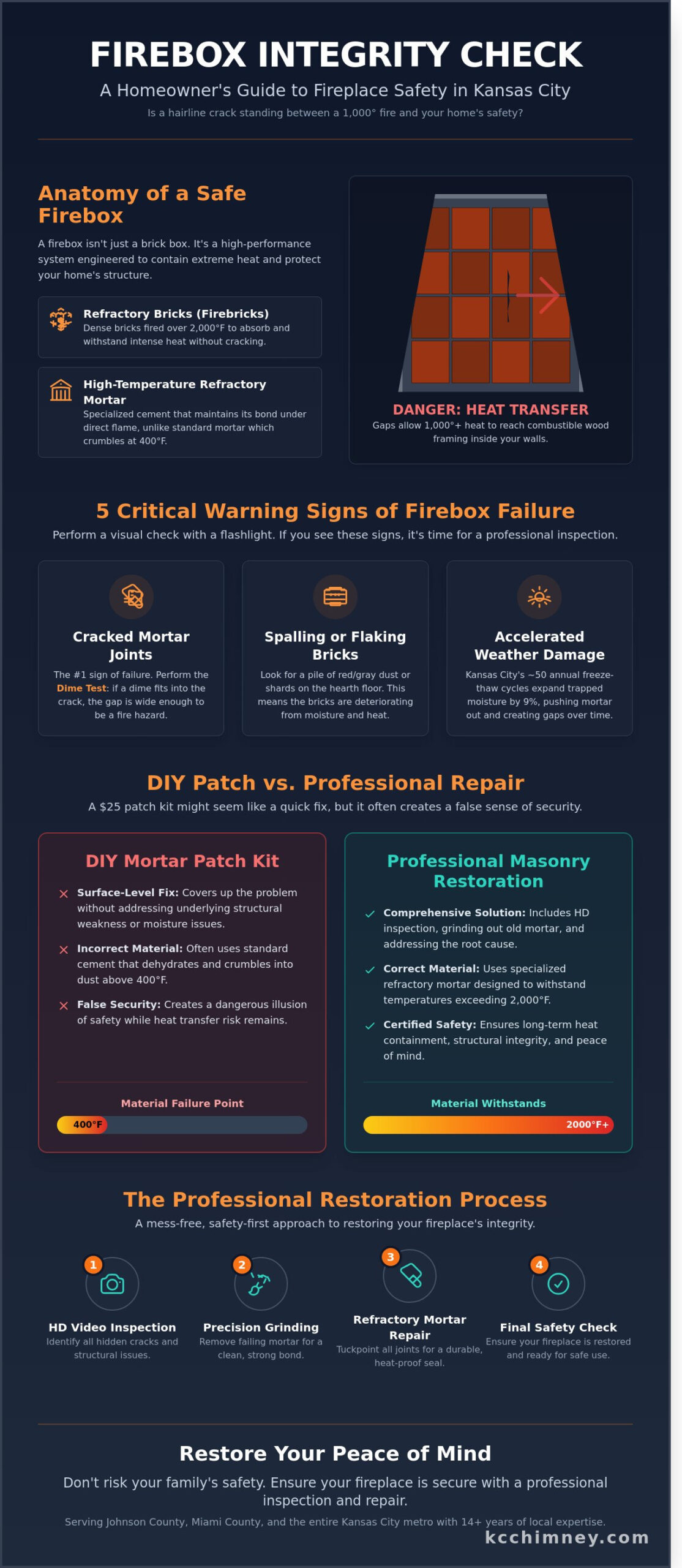
A safe firebox isn’t built with the same materials as your home’s exterior. It utilizes refractory bricks, also known as firebricks, which are fired at temperatures exceeding 2,000 degrees Fahrenheit. These bricks are dense and heavy, specifically designed to absorb heat without cracking. However, the bricks are only as strong as the joints holding them together. We use specialized refractory mortar, a high-temperature cement that maintains its bond when exposed to direct flame. Standard Portland cement mortar, often used by general contractors, will dehydrate and crumble into dust once it hits 400 degrees.
The firebox doesn’t sit in isolation. It connects upward into the smoke shelf and the chimney flue. This transition point is a common failure zone. If the seal between the firebox and the flue liner breaks, smoke and toxic gases can bypass the chimney and leak into your living room. Ensuring these connections remain airtight is a non-negotiable standard for our team during any inspection.
Why KC Weather Accelerates Firebox Damage
Kansas City’s climate is particularly brutal on masonry. Our region experiences an average of 50 freeze-thaw cycles every year. When moisture gets trapped in the mortar joints during a humid 70% humidity July day, it stays there until winter. When that water freezes, it expands by 9%, physically pushing the mortar out of the joints. This cycle repeats dozens of times per season, slowly turning solid joints into brittle gaps.
The age of your neighborhood also dictates the type of firebox repair you might eventually need. In older Mission Hills estates built between 1920 and 1945, we often see traditional clay firebricks that have finally reached the end of their 80-year lifespan. In contrast, newer homes in Overland Park or Olathe built in the 1990s frequently use pre-cast refractory panels. These panels are thinner and tend to crack after 15 to 20 years of regular use. Whether you have a historic masonry hearth or a modern factory-built system, the goal remains the same: keeping the fire contained and your family protected.
5 Warning Signs You Need Firebox Repair in Overland Park
Identifying firebox damage early protects your family and prevents expensive structural damage to your home. Homeowners in Stilwell and Bucyrus should perform a visual check every autumn using a high-lumen flashlight to inspect the interior walls of the fireplace. Look closely for “spalling,” which is when the surface of the brick begins to peel, flake, or pop off. This often happens because moisture trapped inside the masonry expanded during the 2024 winter freeze-thaw cycles, weakening the brick’s integrity. If you notice a pile of red or gray dust on the floor of the hearth, your bricks are likely deteriorating from the inside out.
A simple way to check the safety of your mortar is the “Dime Test.” A standard U.S. dime is approximately 1/16th of an inch thick. If you can slide a dime into a crack in your refractory mortar, the gap is large enough to allow heat and gases to escape. The Chimney Safety Institute of America suggests that any breach in the firebox lining requires immediate attention to meet National Fire Protection Association standards. You should also touch the wall or mantel above the fireplace while a fire is burning. If the surface feels hot to the touch rather than just warm, heat is transferring through a compromised firebox wall, creating a hidden fire hazard.
Cracks in Mortar Joints vs. Cracked Bricks
Small hairline fractures are common, but “stair-step” cracks following the mortar lines often signal that your home’s foundation is settling. This movement pulls the firebox away from the chimney, creating dangerous voids. Vertical cracks in the rear firebox wall are even more concerning. These usually result from thermal shock when the fire is too hot for the current state of the masonry. If you find any loose bricks that wiggle when touched, it’s an immediate “do not burn” situation. You’ll need a professional firebox repair evaluation to determine if the unit can be patched or requires a full rebuild.
Gaps Behind the Fireplace Insert
Many Overland Park homes feature fireplace inserts that can shift over 10 to 15 years of use. Gaps between the insert and the original masonry allow heat to reach the combustible 2×4 wood framing behind the wall. This leads to a dangerous process called “pyrolysis.” While wood typically ignites at 450 degrees Fahrenheit, repeated exposure to temperatures as low as 212 degrees over several years chemically changes the wood. This lowers its ignition point until it can catch fire at normal operating temperatures. Because these gaps are hidden from view, a Level 2 inspection using a specialized camera system is the only reliable way to confirm your home is safe from these invisible threats.
DIY Patching vs. Professional Masonry: Evaluating Your Options
Kansas City homeowners often feel the urge to grab a tube of “fireplace patch” from a local hardware store when they spot a crack. It looks like a simple Sunday afternoon project. However, these store-bought kits have strict limitations that most labels don’t clearly explain. These products are designed only for minor hairline touch-ups, specifically cracks thinner than 1/16th of an inch. If you try to fill a structural gap with a 15-dollar tube of sealant, you’re likely just masking a deeper problem that will continue to expand behind the patch.
Professional firebox repair requires more than a caulk gun and a steady hand. Our team at Best Chimney Services uses specialized tuckpointing irons and high-heat diamond saws to remove failing mortar properly before applying new material. We follow the National Fire Protection Association (NFPA) 211 standards for every job. This ensures the bond between the new refractory mortar and the existing firebrick is permanent. A simple patch kit cannot replicate the structural integrity of a professional masonry rebuild, especially when facing the 1,000-degree temperatures common in a standard wood fire.
Liability is another factor that many homeowners overlook. If you perform your own repairs and a house fire occurs, insurance adjusters will scrutinize the cause. They frequently look for professional service records to verify that the system was maintained according to code. Without that paper trail, you risk a denied claim. We prioritize your peace of mind by providing documented, certified work that stands up to both heat and inspection.
The Risks of Improper DIY Repair
Using standard masonry mortar instead of specialized high-temp refractory cement is a dangerous mistake. Regular mortar contains trapped moisture that expands rapidly when it hits 500 degrees Fahrenheit. This leads to explosive popping or spalling, which can shoot hot embers into your living room. Beyond the immediate physical danger, DIY fixes can hide deep structural rot. Data from the Chimney Safety Institute of America indicates that 15% of residential chimney fires involve heat transfer through compromised masonry. A cosmetic patch doesn’t stop this heat transfer; it only hides the evidence until it’s too late.
When to Call a CSIA Certified Mason
Safety is the baseline of everything we do. You should stop using your fireplace and call for a professional firebox repair evaluation if you notice a crack wider than 1/8 inch. This specific width indicates that the firebrick has shifted or the mortar has failed completely. You should also reach out if the firebox floor feels unstable or looks like it is sinking. Finally, if your fireplace hasn’t had a professional inspection in over 12 months, it’s time for a checkup. Our technicians ensure your hearth meets Kansas City building codes and remains a safe centerpiece for your home.
- Cracks over 1/8 inch: These are structural, not cosmetic.
- Sinking hearth: This indicates a failure of the support or foundation.
- Annual inspections: A 12-month interval is the industry standard for safety.
The Firebox Restoration Process: What to Expect in Johnson County
Firebox repair requires a methodical approach that prioritizes your family’s safety. We treat every Johnson County home with the same precision we would our own. Our process is designed to eliminate fire hazards while preserving the architectural integrity of your fireplace. Restoration isn’t just about making the hearth look new; it’s about ensuring the heat stays where it belongs.
We begin the process with a comprehensive video inspection. This isn’t a quick glance with a flashlight. Our technicians use high-resolution cameras to identify hidden voids behind the masonry. These gaps often occur when the original mortar shrinks or cracks over several decades. They create a direct path for 1,000-degree heat to reach the wooden studs behind your chimney, which is a leading cause of residential structure fires in the Kansas City metro area.
The grinding phase follows the inspection. We carefully remove old, failing mortar using specialized hand tools and diamond-tipped blades. This step requires a steady hand to avoid chipping the firebricks. We remove the debris until we reach solid, healthy material. This ensures the new mortar has a clean, porous surface to bond with, which is vital for a repair that lasts twenty years or more.
Applying new refractory mortar through professional tuckpointing follows the cleaning phase. Unlike standard masonry mortar used on exterior walls, refractory mortar is rated to withstand temperatures exceeding 2,000 degrees Fahrenheit. We pack this material tightly into the joints to create a seamless, heat-proof barrier. This professional-grade mortar won’t crack or pull away when the fireplace reaches peak operating temperatures.
The final step is the curing protocol. Refractory mortar needs time to set properly through a chemical process. We typically require a 7 to 10-day waiting period before you light a fire. After this window, we ask you to follow the “first small fire” protocol. This involves burning a few small logs for exactly 45 minutes to gently bake the mortar. This controlled heat exposure completes the bonding process without causing thermal shock to the new materials.
Common Repair Methods: Pointing vs. Rebuilding
Tuckpointing is the most frequent firebox repair we perform for local homeowners. It involves replacing the mortar joints while keeping your original firebricks in place. If 20 percent or more of your bricks are cracked, crumbling, or loose, a full rebuild is necessary to ensure structural safety. For homeowners with prefabricated metal systems, we often recommend firebox liners as a specialized alternative to replacing the entire factory-built unit.
Estimated Costs for KC Firebox Repair in 2026
Budgeting for home maintenance is easier when you have concrete numbers. In Overland Park, a minor tuckpointing project typically ranges from $300 to $700. For historic homes in Mission Hills that require a full firebox rebuild due to structural failure, costs often fall between $1,500 and $3,500. These figures reflect current local masonry labor rates, which average $115 per hour in the Kansas City metro area for 2026. Investing in these repairs now prevents the much higher costs associated with emergency chimney fires.
Don’t leave your home’s safety to chance this winter. Schedule a professional firebox inspection with our expert team today.
Why Overland Park Homeowners Trust Best Chimney Services
Since 2010, Best Chimney Services has operated as a trusted partner for homeowners across Johnson and Miami counties. We bring 14 years of hands-on experience to every job site in the region. We know that inviting a contractor into your home requires a high level of trust. That’s why we prioritize a mess-free service model that sets us apart from standard masonry crews. Our technicians use specialized floor runners and industrial-grade HEPA dust containment systems to protect your hardwood, tile, and carpets. We don’t just fix chimneys; we safeguard your entire living space. A high-quality firebox repair shouldn’t leave your home smelling like soot or covered in fine gray dust. We treat your home with the same respect we’d show our own, ensuring a clean exit every time.
Safety validation is the non-negotiable core of our business. Every one of our lead technicians is CSIA-certified, which means they’ve passed rigorous national exams on fire codes, chimney physics, and clearance requirements. This certification isn’t a one-time event; it requires ongoing education to stay current with the latest 2024 industry safety standards. When we evaluate your firebox, we aren’t just looking for visible damage. We’re checking the structural integrity of the refractory mortar and the heat-shielding capabilities of your masonry. This level of technical detail is why we’ve maintained a top-tier reputation in the Kansas City metro area for over a decade. It provides the peace of mind that your family is protected against the risks of heat transfer to combustible wall studs.
Our Local Expertise in Kansas City Masonry
Kansas City masonry varies significantly between a 1940s colonial in Leawood and a modern farmhouse build in Spring Hill. Our team understands these regional nuances perfectly. We’ve mastered the specific brickwork styles and mortar compositions common to the local landscape, from traditional red clay to regional limestone accents. We ensure every firebox repair aligns with the International Residential Code (IRC) and local Overland Park fire safety ordinances. We’ve served over 5,200 families in the KC metro, providing us with a deep understanding of how our local humidity and freeze-thaw cycles affect chimney longevity. Our neighbors trust us because we provide honest assessments without high-pressure sales tactics.
Schedule Your Safety Inspection Today
Don’t wait for the first deep freeze of the winter season to discover a structural problem. Scheduling a firebox evaluation now ensures your heating system is ready when the temperature drops below freezing. Our booking process is straightforward and designed around your busy schedule. To prepare for our arrival, please ensure the fireplace is clear of decorations and has been cold for at least 24 hours. This allows our technicians to perform a thorough tactile inspection of the masonry without safety risks. We arrive on time, provide a detailed digital report, and walk you through every finding. Take the first step toward a safer, warmer home today.
Protect Your Home With Professional Masonry Restoration
Your fireplace is the heart of your home during freezing Kansas City winters. Maintaining its structural integrity is vital for your family’s safety. Since 2012, our team has provided reliable masonry solutions across Johnson County, ensuring every hearth meets rigorous standards. We’ve earned an A+ rating by focusing on precision and long-term durability rather than quick fixes. Our CSIA Certified Technicians understand the specific architectural needs of local homes and the damage our climate causes to firebrick. Addressing minor gaps now prevents dangerous heat transfer to your home’s framing later. Choosing a professional firebox repair is the most effective way to guarantee your chimney remains a safe, functional asset for the 2026 season and beyond. We take pride in our craft and treat every chimney as if it were in our own home. You’ll feel confident knowing your fireplace is ready for the next cold snap.
When firebox issues extend beyond the interior chamber to affect the entire chimney structure, homeowners often need comprehensive chimney repair in Overland Park to address water damage, crown deterioration, and structural concerns that can compromise your home’s value and safety.
Request a Firebox Repair Quote in Overland Park
Frequently Asked Questions
Is it safe to use a fireplace with a cracked firebox?
It is not safe to operate your fireplace if the firebox has visible cracks or missing mortar. Even a hairline fracture measuring 1/16th of an inch can allow heat or sparks to reach the wooden framing of your home. According to the NFPA 211 standards, any breach in the firebox integrity poses a high risk of a house fire. We recommend a professional firebox repair to seal these gaps before your next burn.
How long does a firebox repair usually take to complete?
A standard firebox repair typically takes between 4 and 8 hours to complete depending on the level of masonry damage. If we are replacing the entire floor or back wall, our technicians usually finish the work in a single day. You should wait 24 to 48 hours for the new mortar to cure before lighting a fire. This timeline ensures the specialized materials reach their full heat-resistant strength.
What is the difference between regular mortar and refractory mortar?
Refractory mortar is specifically engineered to withstand temperatures exceeding 2,000 degrees Fahrenheit without crumbling. Regular masonry mortar begins to degrade and lose its structural bond at just 400 degrees. We use calcium aluminate cement in our refractory mixes to ensure your firebox remains stable during high-heat operation. This specialized material is the industry standard for safe, long-lasting fireplace liners and firebox walls.
Can I paint the inside of my firebox after a repair?
You can paint your firebox, but you must use specialized high-temperature paint rated for at least 1,200 degrees Fahrenheit. Standard interior latex or oil-based paints will ignite or peel when exposed to an open flame. We advise homeowners to wait 30 days after a masonry repair before applying any coating. This allows the new mortar to off-gas completely, ensuring the paint adheres properly to the brick surface.
Will my homeowners insurance cover firebox repair costs?
Homeowners insurance usually covers masonry costs if the damage resulted from a sudden, accidental event like a chimney fire or a lightning strike. Standard policies don’t cover routine maintenance or damage from 20 years of gradual wear. We provide detailed digital photo documentation for the 15% of our clients who file claims for storm-related damage. It’s best to review your specific policy’s perils covered section with your agent.
How often should I have my firebox inspected in Kansas City?
You should schedule a professional inspection once every 12 months to ensure your fireplace remains safe for the winter season. The Chimney Safety Institute of America recommends this annual interval to catch small mortar cracks before they require a full rebuild. Kansas City’s freeze-thaw cycles can cause masonry to expand and contract 30 times a year. Regular checks prevent minor issues from becoming expensive structural failures.
What causes the bricks in my fireplace to crack or crumble?
Thermal shock is the primary cause of firebox degradation, occurring when bricks face 1,000-degree temperature swings in under 30 minutes. Moisture also plays a role; if your chimney crown is cracked, water can seep into the bricks. When that trapped water freezes, it expands by 9% and shatters the masonry from the inside out. Using seasoned wood with less than 20% moisture content helps reduce the stress on your firebox walls.